


Landing at Montréal–Trudeau International Airport (YUL) for the first time can feel intense: bilingual announcements, unfamiliar transit tickets, and a long terminal that seems to stretch forever. With a bit of preparation, though, YUL is a straightforward airport and one of the easiest gateways into Canada’s most European-feeling city. This guide walks you through ground transport, the 747 airport bus, taxis and Uber, terminal zones, U.S. preclearance, car rentals, and smart first‑time tips specific to Montreal.
Get the latest updates straight to your inbox!
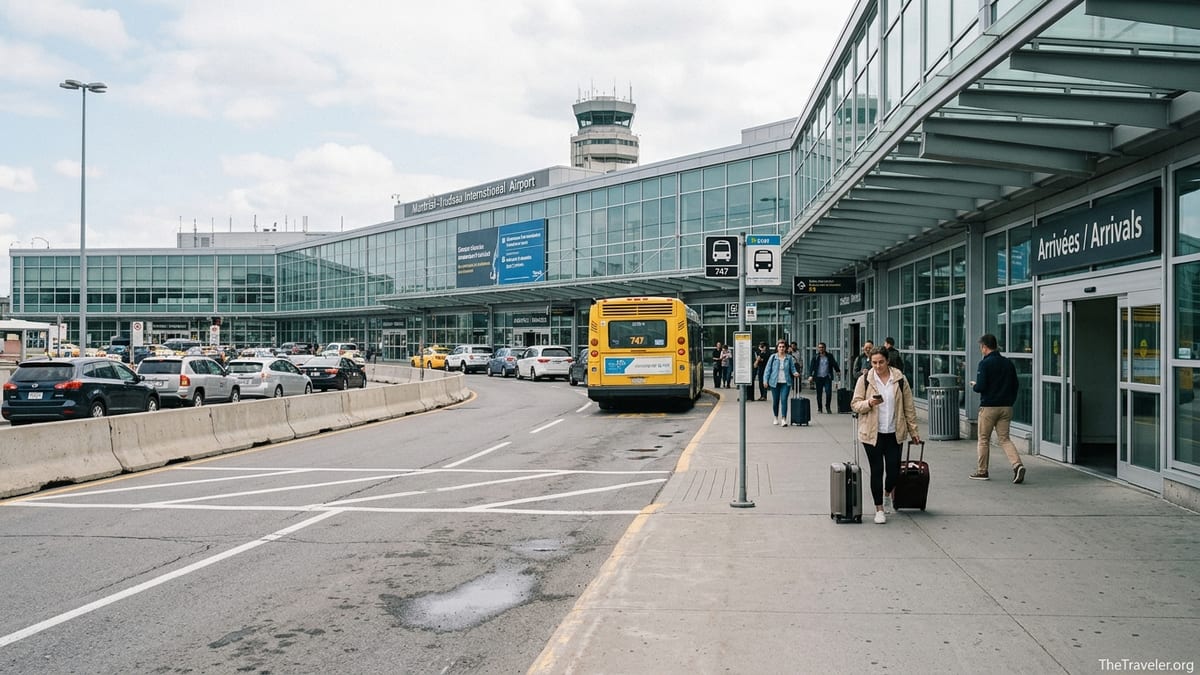
Understanding YUL: Layout, Levels, and Zones
Montréal–Trudeau has a single, long terminal with two main public levels: Arrivals on the lower level and Departures on the upper level. You will see signs in both French and English, but French comes first, so look for "Arrivées" and "Départs" in addition to the English wording. The same building serves all flights, but beyond security it splits into three airside areas: domestic (within Canada), international (non‑U.S.), and a separate transborder section for flights to the United States.
The Departures level is where airline check‑in counters line the curbside, with one side focused on flights within or outside Canada (except the U.S.) and a separate area for passengers bound for American cities. Below that, the Arrivals level houses baggage claim, customs, and the public exit to ground transportation. If someone is meeting you, they will usually wait in the Arrivals public area just beyond the sliding doors from customs.
For most passengers, the important mental map is simple: domestic and international check‑in are toward the central and western part of the terminal, while U.S. check‑in and the Marriott in‑terminal hotel sit closer to the eastern end. After security, domestic and international gates branch off one way, and U.S. transborder gates the other. Walking distances can be long but are essentially in a straight line, which makes orientation easier than in a multi‑pier airport.
Outside the terminal, curbside is split into numbered doors. Departures doors 2 to 11 are used for drop‑off, while Arrivals has zones labeled A to E for quick pick‑ups. Official airport signage and electronic boards clearly mark where to find the 747 bus, taxis, ride‑share zones, and hotel shuttles, so once you know which mode you want, simply follow the pictograms.
Getting to Downtown: 747 Bus, Local Transit, and New Options
For budget‑minded travelers, the STM 747 YUL Aéroport Montréal‑Trudeau / Centre‑ville bus is usually the best value. As of May 2026, the 747 fare is 11.25 Canadian dollars and includes unlimited travel on the entire STM bus and metro network for 24 hours after validation. That means a solo traveler can ride the 747 from the airport to downtown, then continue by metro to areas like Plateau‑Mont‑Royal or Old Montreal on the same ticket.
The 747 runs 24 hours a day. During the day and evening, frequencies are typically every 10 to 15 minutes, dropping to roughly every 30 to 45 minutes overnight. The main downtown stop has recently been relocated: from 26 January 2026 the 747 terminus is on Boulevard René‑Lévesque at the corner of Berri Street, near the Berri‑UQAM metro hub. In practical terms, that puts you within a short walk of several hotels in the Quartier Latin and an easy metro ride from central downtown stations like McGill and Bonaventure.
You can pay the 747 fare using a ticket machine at the airport (accepting cards and cash) or by using an OPUS transit card if you already have one loaded with a compatible ticket type. If you pay cash on board, the driver will not give change, so have exact coins ready. Many first‑time visitors find it easiest to buy an OPUS card and load a 24‑hour or 3‑day pass that covers Zone A; these passes work on the 747 and make it simple to hop on metro and buses without thinking about individual fares.
Beyond the 747, local buses also serve the airport, but they usually require at least one transfer and are suited more to residents familiar with the system. A new wave of services, like an Air Canada branded downtown shuttle discussed locally in 2026, may add options in future, but at the time of writing the 747 remains the official, frequent, and easy‑to‑understand public link between YUL and the city core.
Taxis, Uber, and Ride‑Shares at YUL
If you value comfort and door‑to‑door convenience, taxis from the airport are heavily regulated and straightforward. Quebec’s taxi authority sets a flat rate for trips between Montréal–Trudeau and the downtown core. As of April 2026 that flat rate is approximately 49.45 Canadian dollars during the day (5 a.m. to 11 p.m.) and about 56.70 Canadian dollars at night (11 p.m. to 5 a.m.), plus a small surcharge if you request a minivan. This fare is per taxi, not per passenger, so a family of four with luggage can often get downtown for about the same price as two individual 747 tickets.
Official taxis line up outside the Arrivals level. Follow the "Taxis" pictograms after you exit customs; you will normally step out near a covered queue where an attendant directs you to the next available cab. You should not accept rides from anyone approaching you inside the terminal or offering unofficial taxis. Pay in cash or credit card; most taxis accept major cards, but it does not hurt to ask before the trip if card payment is important to you.
Ride‑share services such as Uber operate at YUL, with pick‑up areas clearly signed. The ride‑share zone is usually a short walk from the main exit, separated from the taxi rank. Typical fares to central downtown hotels fluctuate with demand but often fall in the range of 30 to 45 Canadian dollars in moderate traffic. At busy times, such as Sunday evenings or during major festivals, surge pricing can push Uber and Lyft fares above the fixed taxi rate, making the regulated taxi a better deal.
A practical comparison: a solo backpacker arriving at midday might choose the 11.25 dollar 747 and spend about 45 to 60 minutes reaching a hostel near Berri‑UQAM. A couple with two large suitcases landing close to midnight on a winter night may prefer the simplicity of a flat‑rate taxi to a downtown hotel door, especially if sidewalks are icy and they are less comfortable navigating the metro after dark.
Arrivals, Departures, and Terminal Flow
On arrival from an international flight, you will typically step into a large arrivals corridor before reaching Canada Border Services Agency (CBSA). After passport control, you head down one level to baggage claim, then customs, then exit into the public Arrivals hall. If you are connecting onward within Canada, signs will direct you to domestic connections before you fully exit. Look for bright overhead panels indicating “Connections Canada” or similar wording.
Departing passengers should arrive at YUL well in advance, particularly at peak times such as early weekday mornings and late‑afternoon bank departures to Europe. For domestic and standard international flights, airline guidance often suggests arriving about two hours before departure; for the U.S. preclearance process, three hours is safer, especially if you are checking bags. In summer and during holidays, give yourself even more buffer to account for security and border queues.
Security screening areas are clearly separated by destination type. Once you have checked in and tagged your bags, follow signage for either Canada/International or U.S. Flights. Families with strollers and passengers with mobility issues can request assistance from airline staff; wheelchairs and priority lanes are available but should be requested as early as possible. If you hold NEXUS or similar trusted traveler status, certain lanes at security and border control may shorten your wait.
Inside the airside zone, services are roughly what you would expect of a major Canadian hub: cafes serving coffee and bagels, fast‑casual restaurants, duty‑free in the international and U.S. areas, and a mix of local and international brands. If you are catching a late‑night flight, note that some restaurants close earlier; do not assume a full range of dining is available after 10 p.m. A simple rule is to eat or buy snacks soon after you pass security rather than waiting until the last minute.
U.S. Preclearance: How It Works at YUL
One of the most distinctive features of Montréal–Trudeau is its U.S. customs and immigration preclearance facility. For flights bound to American cities, passengers complete U.S. entry formalities at YUL before boarding. Once you land in the United States, you arrive as a domestic passenger, which means no immigration inspection and often a shorter, simpler connection, even at busy airports.
The preclearance area sits in its own section of the terminal. After checking in for a U.S. flight, you first pass through regular security screening, then proceed to the U.S. border control zone operated by U.S. Customs and Border Protection. There, an officer will review your passport, visa or ESTA if required, and ask routine questions about your trip. Checked bags are usually transferred automatically, but you may see them on screens or in some cases in physical inspection areas if selected for secondary checks.
Trusted traveler programs such as NEXUS and Global Entry can speed this process. Montréal–Trudeau is one of the Canadian airports where NEXUS members can use designated kiosks or lanes for U.S. preclearance when flying to America. For example, a Canadian frequent flyer with NEXUS flying YUL to New York LaGuardia may clear the border in just a few minutes in off‑peak times, while regular lines at the same moment might stretch to 30 minutes or more.
Because missing your flight due to long preclearance lines can be difficult to fix, it is wise to treat U.S. departures as more time‑sensitive than domestic ones. Aim to reach the airport three hours before departure, and head directly to the preclearance area after check‑in rather than lingering in the public departures hall. Once you are in the U.S. departures area, you will still find shops, food, and seating, but you will be safely “through” the part that can cause delays.
Car Rentals and Driving from YUL
Major car rental brands such as Avis, Budget, Enterprise, Hertz, National, and others operate at Montréal–Trudeau, with counters in or adjacent to the terminal and vehicle pick‑up typically in nearby parking structures. If your trip includes road excursions to the Laurentians, Quebec City, or the Eastern Townships, renting at the airport can be a convenient starting point.
Driving from YUL into Montreal involves joining Autoroute 20 or Autoroute 520, depending on your direction. In light traffic, the ride from the airport to downtown hotels near Boulevard René‑Lévesque can take 20 to 30 minutes. During weekday rush hours and in summer construction season, that time can easily double. First‑time visitors sometimes underestimate Montreal traffic and roadwork; if you plan to drive, build generous time buffers into your schedule, especially when returning to the airport before a flight.
Parking in downtown Montreal is relatively expensive and can be challenging in older neighborhoods like Old Montreal and the Plateau. Many visitors choose to rent a car only for specific days when leaving the city, returning it to a downtown rental location rather than keeping it for the entire stay. For example, you might spend three car‑free days exploring by metro and bike shares, then rent a car for a weekend trip to Mont‑Tremblant picked up from a central branch.
If you are not used to winter driving, think carefully before committing to a rental car between roughly December and March. Snow, ice, and reduced visibility are common, and Montreal drivers are accustomed to conditions that may be stressful for visitors. In those months, relying on transit, taxis, and intercity trains or buses can make your trip more enjoyable.
First‑Time Tips for Montreal Visitors
Montreal is officially bilingual, but day‑to‑day life is predominantly in French. At the airport and on public transit, all essential information appears in both languages, and staff are generally comfortable switching to English. Learning a few basic phrases like “Bonjour” and “Merci” is appreciated and can make interactions, including with taxi drivers and cafe staff, feel warmer.
Weather can vary dramatically by season. In January, an arrival at YUL might involve stepping out into temperatures well below freezing with strong winds over exposed parking structures. In July, the same spot can feel hot and humid, with afternoon thunderstorms. Pack for the season and keep essential outerwear in your carry‑on in case your checked bag is delayed, particularly in winter when you do not want to be standing at the taxi rank in only a light sweater.
Payment is straightforward: credit and debit cards are widely accepted in taxis, airport shops, and downtown businesses. Contactless payments using phones and watches are common. Carrying a small amount of Canadian cash can still be handy for tipping or small purchases, but you can navigate most of your trip cash‑light. If you plan to use transit extensively, consider buying a multi‑day Zone A pass on an OPUS card at the airport or major metro stations, which covers the metro, regular buses, and the 747 service, making it easy to explore neighborhoods from Mile End to Verdun.
Finally, remember that Montreal’s festivals and events, from the International Jazz Festival to Formula 1 Grand Prix weekend, can significantly affect both airport crowds and hotel prices. If you land on a Friday afternoon in late June, do not be surprised if immigration lines, downtown traffic, and Uber fares are all higher than usual. In those cases, building extra time into your arrival or departure day is one of the simplest ways to keep the trip relaxed.
The Takeaway
For a first‑time visitor, Montréal–Trudeau is a manageable, modern airport whose complexity is more about choices than confusion. You can leave the terminal on an 11.25 dollar 747 bus and be at a downtown metro hub within about an hour, or pay a predictable flat taxi fare to be dropped at your hotel door. U.S. preclearance adds an extra step on departure but makes arrivals in the United States smoother. With a single terminal, clear bilingual signage, and a mix of transit and road options, YUL is well suited to both budget travelers and those who prioritize comfort.
Approach your arrival with a simple plan: decide in advance whether you will take the 747, a taxi, or a ride‑share; know roughly how long the ride will take and how much it will cost; and give yourself generous time for U.S. departures. Add in a few local habits, such as greeting staff in French and dressing for the season, and your first transit through Montreal’s airport can be as welcoming as the city itself.
FAQ
Q1. How long does it take to get from Montréal–Trudeau Airport to downtown by 747 bus?
In normal traffic, the 747 bus takes about 45 to 60 minutes between the airport and its downtown stop near Berri‑UQAM, though travel times can be longer during rush hour or heavy construction.
Q2. Is the 747 bus ticket really valid on the metro too?
Yes. The 11.25 Canadian dollar 747 fare currently includes unlimited travel for 24 hours on the STM bus and metro network in Zone A, so you can transfer to the metro at no extra cost within that period.
Q3. How much is a taxi from the airport to downtown Montreal?
There is a regulated flat rate for trips between YUL and the downtown zone. As of 2026 it is roughly 49.45 Canadian dollars during the day and about 56.70 dollars at night, regardless of traffic.
Q4. Where do I find Uber or Lyft at Montréal–Trudeau?
After exiting customs, follow the signs for ride‑share pick‑up areas, which are separate from the regular taxi rank. The exact location can change, but it is clearly indicated on airport signage and in the apps when you request a ride.
Q5. How early should I arrive at YUL before a U.S. flight?
Aim to be at the airport at least three hours before your scheduled departure to allow time for check‑in, security screening, and U.S. preclearance. During peak travel periods or if you are checking bags, adding extra time is wise.
Q6. Do all U.S. flights from Montreal go through preclearance?
Most regularly scheduled commercial flights from Montréal–Trudeau to the United States use the preclearance facility. In rare operational situations there may be exceptions, but you should plan on completing U.S. immigration and customs before boarding.
Q7. Can I rent a car directly at Montréal–Trudeau Airport?
Yes. Major rental companies have desks at or connected to the terminal, with vehicles parked in adjacent garages. You can prebook online and head straight to the rental counters after collecting your luggage.
Q8. Is Montreal easy to get around without a car?
For most visitors staying in central neighborhoods, yes. The metro, buses, and the 747 provide good coverage, and many areas are walkable or bike‑friendly. A car is most useful for day trips outside the city, not for everyday downtown movement.
Q9. Are English speakers comfortable using the airport and transit in Montreal?
Generally yes. Airport and STM staff are used to serving English‑speaking travelers, and all key signage is bilingual. Knowing a few basic French greetings is courteous but not required for navigation.
Q10. What is the best option if I arrive late at night with a lot of luggage?
If budget allows, a regulated flat‑rate taxi or prebooked ride‑share is usually the most comfortable and straightforward option late at night, especially with heavy bags or in winter conditions.