


If you are flying through Montreal Pierre Elliott Trudeau International Airport and find references to “Terminal 1” and “Terminal 2” on boarding passes, travel apps, or even some airport maps, it is easy to assume that YUL is a two-terminal airport like Toronto Pearson or London Heathrow. In reality, Montreal Trudeau operates as a single integrated terminal with three main airside zones: domestic, international, and transborder (U.S.) departures. Understanding this distinction can save you time, stress, and unnecessary walking on the day of your flight.
Get the latest updates straight to your inbox!
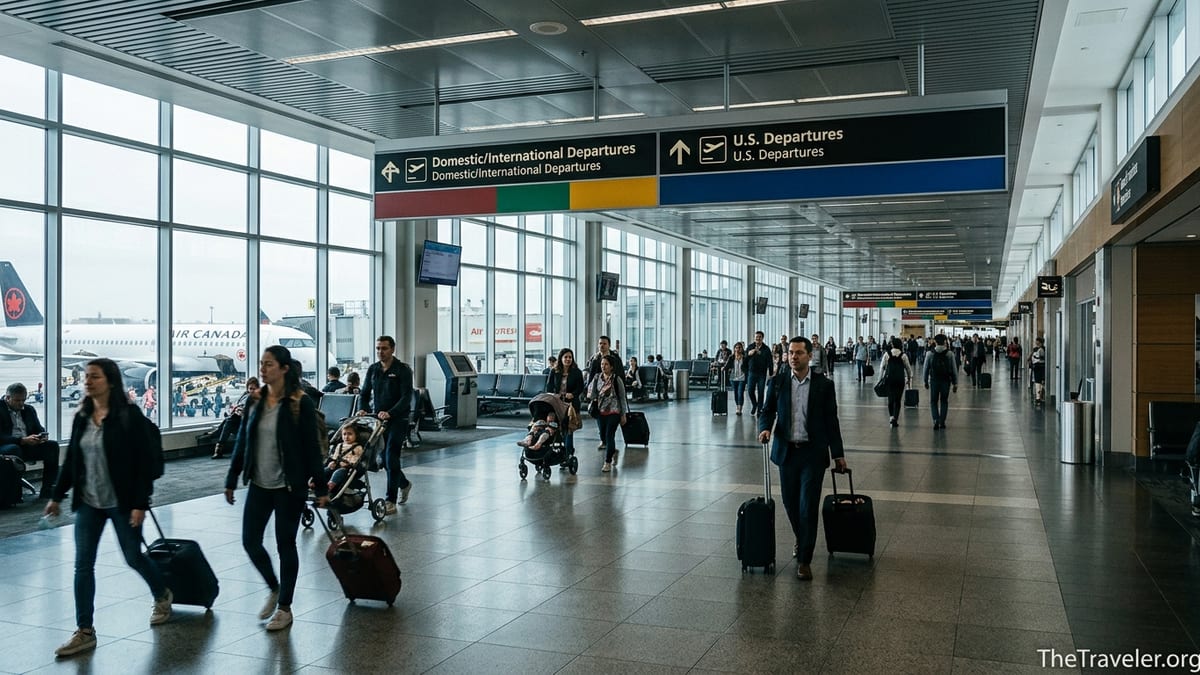
Montreal Trudeau Is Technically a One-Terminal Airport
Despite what some travel sites and printed diagrams might suggest, Montreal Pierre Elliott Trudeau International Airport is officially a single-passenger-terminal airport. Aéroports de Montréal, the airport operator, describes YUL as having one integrated terminal that is divided into domestic, international, and U.S. transborder departure areas rather than separate physical terminals. The building is laid out in a long, mostly linear shape with check-in and departures on the upper level and arrivals, baggage claim, and customs on the lower level.
The confusion often begins when travelers see outdated or third-party maps that label parts of the building as “Terminal 1” or when global airport mapping tools apply their own terminal numbering systems. For example, some downloadable PDFs and flight-tracking apps tag the entire main building as “Terminal 1” simply because their software expects every airport to have at least one numbered terminal. That does not reflect how the airport itself is organized or signposted once you arrive.
On the ground, passengers never follow signs for Terminal 1 or Terminal 2 at YUL. Instead, you will see clear overhead signage for “Domestic & International Departures,” “U.S. Departures,” “Arrivals,” and “Connections.” A traveler flying Air Canada from Montreal to Vancouver and another flying Air France to Paris will both check in within the same departures hall, but after security they will enter different gate zones based on their destination rather than on a terminal number.
In practical terms, this means that travelers connecting between flights at YUL are usually staying within the same continuous building, with airside corridors and tunnels linking the domestic, international, and U.S. areas. That setup is very different from airports where “Terminal 1 vs Terminal 2” might require a shuttle bus or train ride.
How the Three Main Zones Work: Domestic, International, and U.S. Transborder
Instead of thinking in terms of Terminal 1 and Terminal 2, it is more accurate to think of three secure zones inside a single structure: domestic Canada departures, international departures, and transborder (U.S.) departures. Each of these zones is served by its own security checkpoint, boarding gate range, and in some cases separate border controls.
Domestic departures, generally covering flights within Canada, are accessed via Security Checkpoint A and lead to gates serving routes such as Montreal to Toronto, Vancouver, or Halifax. International departures, including Europe, Latin America, and many other global destinations, use another set of gates further along the same linear concourse. Travelers heading to Paris with Air France, Casablanca with Royal Air Maroc, or London with Air Canada will all depart from this international zone.
The U.S. transborder area, which includes gates for flights to cities like New York, Chicago, or Miami, is separated from the rest of the terminal because it contains a U.S. Customs and Border Protection preclearance facility. Passengers flying on Air Canada, United, Delta, American, and other carriers to the United States clear U.S. immigration and customs in Montreal before boarding. As a result, that section of the concourse operates under U.S. border controls and is treated differently from the Canadian and international areas.
While the exact gate numbers can change over time, the pattern is consistent: domestic gates occupy one “jetty,” the international gates stretch along another, and the U.S. transborder jetty branches away into its own secure corridor. Walking from one end of the domestic section near the low-numbered gates to the far international pier can easily take 10 to 15 minutes at a normal pace, which is why understanding that this is all one long building is more useful than relying on an imagined terminal split.
Where “Terminal 1” and “Terminal 2” Labels Come From
The idea that Montreal Trudeau has both Terminal 1 and Terminal 2 usually appears in third-party maps, booking engines, and flight apps that import data from multiple airports. When a system is designed around airports with clearly numbered terminals, it may automatically label YUL’s passenger building as “Terminal 1,” and sometimes a remote or future facility is labeled as “Terminal 2,” even when no such second terminal currently serves passengers.
For instance, certain online airport map repositories and airline advisory documents have shown “Terminal 1” printed near the main concourse, even though the same diagrams clearly depict only one connected structure. Other websites that list airport lounges sometimes tag all facilities as being in a “Main Terminal” rather than naming a terminal number at all, reflecting the reality that everything is inside one shared building.
Some travelers also mistakenly borrow terminology from Toronto Pearson, which does have clearly distinct Terminal 1 and Terminal 3 buildings, and apply it to Montreal. A passenger accustomed to saying “meet me at Terminal 1” in Toronto may assume Montreal works the same way. That can cause confusion when giving directions to friends or rideshare drivers, since locals in Montreal will usually refer to “departures level” or “arrivals level” instead of a terminal number.
As a real-world example, a traveler landing at YUL on an Air Canada domestic flight from Calgary might message a friend, “I’m at Terminal 1 arrivals.” The friend, familiar with the airport, will instead look for the clearly signed general arrivals hall on the lower level, where passengers from both domestic and international flights emerge after baggage claim and customs. No one at the airport will refer to that location as Terminal 1.
Check-in, Security, and Walking Distances in a Single Building
Because Montreal Trudeau functions as one integrated terminal, check-in is centralized. Airline counters for Air Canada, Air Transat, WestJet, and major international carriers share the same departures hall. Self-service kiosks for printing bag tags are spread across this upper level, and passengers are directed to security based on their destination type. A traveler flying to Toronto on Air Canada and another flying to Newark with United might both check in at roughly the same part of the hall but then be pointed toward different security checkpoints.
Security Checkpoint A generally serves domestic and most international departures, while another checkpoint leads toward the international jetty, and a dedicated checkpoint C typically handles U.S. departures because it feeds directly into the U.S. preclearance area. Families traveling with small children benefit from priority access lanes at key checkpoints, including those used for domestic/international and U.S. flights, which can make a noticeable difference during busy morning and evening peaks.
Once inside security, walking distances matter. A passenger departing on a Canada-wide low-cost carrier flight to Halifax may find their gate only a short walk from the domestic security exit, while someone heading to Europe from a far international gate near the end of the pier should expect a 10-minute walk from the domestic lounge area. Similarly, travelers connecting from an international flight to a U.S.-bound flight may have to follow corridors through the connections area, clear U.S. preclearance, and then walk down the transborder pier to a high-numbered gate.
In practice, this layout means that “switching terminals” at YUL almost always just means moving along the same continuous concourse or cutting through a secure transfer corridor. For example, an Air Canada passenger arriving domestically from Ottawa and connecting to an international flight to Rome will typically remain within the same terminal, following “Connections” signs, passing through Canadian exit controls and possibly security again, then walking along to the international boarding area.
Connections: Domestic, International, and U.S. Flights at YUL
Many travelers only become aware of the terminal layout when they are looking at a tight connection time. Because everything is under one roof in Montreal, minimum connection times can be relatively efficient, but much depends on whether you need to clear security, immigration, or customs in between flights. The key distinction is not Terminal 1 versus Terminal 2, but which of the three main zones you are moving between.
For a domestic to domestic connection, such as Quebec City to Montreal and then Montreal to Vancouver, passengers with through-checked bags usually remain within the domestic/international zone. They follow connection signs, may pass through a brief screening or boarding-pass check, and then walk to their next gate. A 60-minute connection is usually manageable when flights are on time, though airlines often recommend at least 90 minutes to allow for delays and walking time.
For an international to domestic connection, such as Paris to Montreal and then Montreal to Toronto, the process is more involved because of Canadian customs and immigration. After landing, passengers proceed through border control and claim their checked bags before rechecking them for the domestic leg if required by the airline. Even though they end up at a domestic gate in the same building, they will have passed through the arrivals level and then back up to the departures side. Airlines typically advise allowing at least two to three hours for such connections, especially during busy periods.
Connecting to or from U.S. flights adds the extra layer of U.S. preclearance. For example, a traveler flying from Halifax to Montreal and then to Boston with Air Canada will arrive in the domestic zone, follow the signs for U.S. connections, clear U.S. immigration and customs in Montreal, pass through transborder security, and then walk down the U.S. pier to their gate. They will land in Boston as a domestic arrival. This multi-step path all happens inside one overall terminal, but it feels like moving through several self-contained zones rather than changing buildings.
Lounges, Services, and Meeting Points Without Terminal Numbers
Because there is no Terminal 1 vs Terminal 2 split, lounges and services at YUL are also organized by zone rather than by terminal name. Air Canada operates Maple Leaf Lounges in both the domestic and international areas, with the domestic lounge located near the lower-numbered domestic gates and the international lounge positioned closer to the middle of the international concourse. In the U.S. transborder area, Air Canada also offers a dedicated lounge for eligible passengers flying to U.S. destinations.
Other airlines and operators run lounges in the international zone. For example, the Air France and KLM-branded lounge is positioned near one of the mid-50s international gates and caters to SkyTeam passengers, as well as some credit card holders and pay-in customers through its operator. Because all these lounges exist inside the same physical building, a traveler with time before an international departure could, in theory, walk from the domestic Maple Leaf Lounge to the international lounge, although they would need to pass through internal boarding pass checks between the domestic and international sections.
For meeting points, Montreal Trudeau relies on level-based and door-based directions instead of terminal numbers. Rideshares, taxis, and private vehicles all access the same elevated departures roadway on the upper level and the arrivals curb on the lower level. When you arrange a pickup, it is far more useful to say “Arrivals level, outside door X” or “Departures level, near check-in for Air Canada” than to say “Terminal 1,” which will not appear on local road signs.
Shops, restaurants, and services like pharmacies and currency exchange offices are scattered throughout the pre-security public area and the three secure zones. A traveler might check in for a domestic evening flight, have a coffee at a café in the public departures hall, and then go through Security A and still find a different selection of restaurants and bars in the domestic airside area near their gate, all within the same single terminal footprint.
Ground Transport and Future Rail Links: Still One Terminal
Ground transportation reinforces the idea that YUL is a one-terminal airport. All public buses, including the popular 747 shuttle bus connecting the airport with downtown Montreal, pick up and drop off at stops adjacent to the same main terminal building. Local city buses that serve nearby suburbs also converge at this central point. Passengers do not need to choose between multiple terminal stops the way they might in large multi-terminal hubs.
Taxis and app-based rides also serve a single, well-signed pickup area. For example, a traveler arriving from New York, having cleared U.S. preclearance in Montreal before departure, will land in the same arrivals area as someone flying in from Vancouver or Paris. After baggage claim, they will walk into the shared landside arrivals hall, where all the taxi and rideshare signs lead to the same ground transportation zones just outside.
Montreal is also planning a dedicated rail connection to the airport via the REM light-rail network, with a station being built directly under the terminal complex. Even once the REM station opens, it will attach to the same unified terminal footprint rather than to separate terminal-specific stations. Travelers arriving by train will simply follow overhead signs from the station concourse into the central check-in and departures hall.
For drivers, parking facilities are arranged around the single terminal as well. Short-term and long-term lots, as well as multi-level garages, are connected by walkways or shuttle routes that all feed into the same main entrance. Signs guide passengers to levels and doors corresponding to departures or arrivals, never to Terminal 1 or Terminal 2.
The Takeaway
For travelers, the most important point is that talking about Terminal 1 versus Terminal 2 at Montreal Trudeau is misleading. YUL operates as a single integrated terminal with three main secure zones: domestic, international, and U.S. transborder. All flights, check-in counters, and baggage claim areas are contained within this continuous building, and movement between different parts of the airport is mostly a matter of walking and following clear signage rather than changing terminals.
If your itinerary, airline app, or a third-party map mentions Terminal 1, treat it as referring to the general passenger terminal at Montreal Trudeau, not as a separate building. Focus instead on which departure zone you will use, how early you need to arrive for domestic, international, or U.S. flights, and what kind of connection you are making. That framing will make it much easier to understand whether you need to clear customs, how far you might have to walk, and which lounges or services you can reasonably reach before your flight.
When arranging pickups or giving directions, refer to the departures or arrivals level, airline check-in area, or specific doors rather than to terminal numbers. Doing so will align with how the airport is actually configured and how locals, staff, and ground transport operators understand the space. With that mental map in mind, Montreal Trudeau becomes a relatively straightforward, single-building hub rather than a confusing multi-terminal maze.
FAQ
Q1. Does Montreal Trudeau Airport have Terminal 1 and Terminal 2?
Montreal Trudeau operates a single integrated passenger terminal. References to “Terminal 1” or “Terminal 2” usually come from third-party apps or generic airport maps, not from the airport itself.
Q2. Why does my boarding pass or app say Terminal 1 at YUL?
Many global booking systems automatically assign “Terminal 1” to airports with one main terminal. At YUL, this simply means the general passenger terminal building, not a distinct numbered terminal.
Q3. How is the terminal at Montreal Trudeau actually organized?
The terminal is divided into three main airside zones: domestic departures within Canada, international departures to other countries, and a U.S. transborder area with U.S. preclearance facilities.
Q4. Do I need to change terminals when connecting at YUL?
No. All regular passenger flights use the same continuous building. However, you may need to change zones, clear security again, or pass through customs or U.S. preclearance depending on your connection.
Q5. How early should I arrive for my flight at Montreal Trudeau?
Guidelines can vary by airline, but a common recommendation is around 2 hours before domestic departures and at least 3 hours before international or U.S. transborder flights.
Q6. Where do U.S.-bound flights depart from at YUL?
Flights to the United States depart from the dedicated U.S. transborder area, which includes a U.S. Customs and Border Protection preclearance facility inside the terminal.
Q7. Are arrivals separated by domestic and international terminals?
No. All passengers emerge into the same general arrivals level after baggage claim and, where applicable, customs and immigration. Ground transportation serves this shared arrivals area.
Q8. How do I tell someone where to pick me up at Montreal Trudeau?
Use “Arrivals level” or “Departures level” and, if possible, a specific door number or airline zone. Local drivers and signs do not use terminal numbers for directions.
Q9. Are airport lounges tied to Terminal 1 or Terminal 2 at YUL?
Lounges are tied to zones, not terminal numbers. For example, there are Air Canada Maple Leaf Lounges in the domestic, international, and U.S. transborder areas within the same building.
Q10. Will the future REM rail station create a second terminal at Montreal Trudeau?
No. The REM station is being built to connect directly to the existing terminal complex. Rail passengers will enter the same central check-in and departures hall used by all other travelers.