


Landing at Montréal–Trudeau (YUL) and just want a straightforward ride to your downtown hotel? Taxis remain one of the easiest options, especially if you are tired, arriving late at night, or traveling with kids and luggage. This guide walks you through how official airport taxis work, what you should expect to pay, how the downtown hotel zone is defined, and when a taxi is genuinely easier than dealing with the 747 bus or other transit options.
Get the latest updates straight to your inbox!
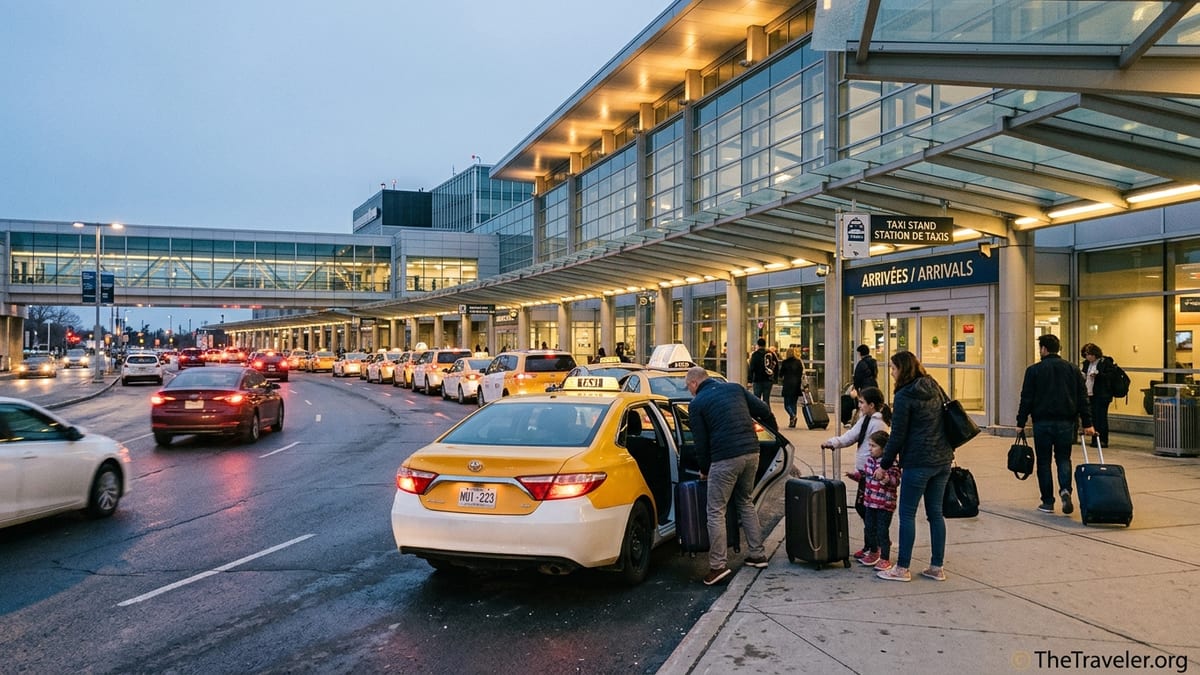
How Airport Taxis Work at Montréal–Trudeau (YUL)
Montréal–Trudeau has a clearly signed official taxi area just outside the international and domestic arrivals hall. After you pass customs and baggage claim, you follow the “Taxis” signs toward the ground transportation level. You will emerge at a designated taxi queue supervised by airport staff, with vehicles from licensed companies such as Taxi Diamond, Téo Taxi and other approved fleets. Only taxis authorized by Aéroports de Montréal are allowed to pick up at the terminal, which helps protect you from unlicensed drivers.
The setup is simple: you join the taxi line, an attendant directs you to the next available cab, and the driver already knows that most passengers are heading toward central Montréal. Unlike some cities where you must negotiate a price, Montréal uses regulated fares and a fixed rate between YUL and the downtown hotel zone. The cars are usually standard sedans or hybrids, though you will also see minivans that can take larger families and luggage.
Allow around 20 to 30 minutes to reach most downtown hotels in normal traffic. In light traffic late at night, the ride to popular addresses like the Fairmont The Queen Elizabeth, Le Centre Sheraton, or hotels around Place des Arts can be closer to 20 minutes. In heavy rush-hour congestion on Autoroute 20 and the Ville-Marie expressway, that trip can stretch to 35 minutes or more, but the taxi will still cost the same flat fee if your destination is within the fixed downtown zone.
It is important to ignore anyone inside the terminal who quietly offers you a “taxi” ride before you reach the official queue. These unofficial offers, including from drivers who claim they can take you “faster” or for “cash only,” bypass airport controls and may ignore regulated fares. For a predictable price and proper insurance coverage, always use the marked taxi stand outside the arrivals level.
Current Flat Fares from YUL to Downtown & Other Zones
At the time of writing in July 2026, Montréal–Trudeau uses a fixed price for trips between the airport and the designated downtown zone. According to the airport’s official information, the flat fare is just under 50 Canadian dollars from the airport to central downtown hotels, with two price bands depending on the time of day. In practice, you should expect to pay about 50 dollars from 5 a.m. until late evening, and a slightly higher fixed rate overnight. This fare includes the passenger, vehicle, and normal road usage, but excludes tip.
By comparison, a metered taxi to closer suburbs like Dorval or western neighborhoods outside the fixed downtown zone is based on distance and time. For example, a very short trip from YUL to a nearby Dorval hotel might show a meter total in the low 20 dollar range, while a ride out toward residential areas on the West Island can climb higher than the downtown flat fare if traffic is slow. The key distinction is that only the central zone has a fixed airport rate; everywhere else is calculated by the meter under provincial taxi regulations.
Uber and similar app-based services operate in Montréal and also serve the airport, but their fares vary with demand. On a quiet midweek afternoon, an UberX from YUL to a downtown address around Rue Sainte-Catherine may cost slightly less than a taxi flat fare. On a busy festival weekend or during a snowstorm, surge pricing can push app fares above the regulated taxi rate. Many travelers choose a taxi on arrival because they know the exact price in advance and can simply walk into the queue with no app setup or roaming data issues.
Because rates are periodically adjusted by provincial authorities, you should treat all numbers as approximate and reconfirm close to your travel date. The important takeaway is that there is a predictable flat fee to the central downtown zone, while other destinations use the meter. For budgeting, assume around 50 dollars plus tip for a standard taxi from YUL to most downtown hotels in 2026.
Understanding Downtown Hotel Zones and Sample Destinations
The downtown flat-fare zone from Montréal–Trudeau is defined by a specific area of central Montréal that includes most of the city’s major hotels and business addresses. In practical terms, it covers the cluster of high-rises around René-Lévesque Boulevard, Sainte-Catherine Street, Sherbrooke Street West and the core around Peel, Guy–Concordia and McGill metro stations. If you are staying at international chains such as the Fairmont The Queen Elizabeth (by Gare Centrale), Marriott Château Champlain, Le Centre Sheraton, the Hyatt Regency near Complexe Desjardins, or boutique hotels near Phillips Square, you will almost certainly be inside the flat-fare zone.
Old Montréal and the Old Port, with hotels like Hôtel Nelligan, Place d’Armes Hotel, and the InterContinental Montréal, also generally fall within this downtown perimeter. So do many properties in the Quartier des spectacles around Place des Arts, including small design hotels and apartment-style accommodations on Boulevard De Maisonneuve and Rue Saint-Laurent. When in doubt, you can simply tell the taxi dispatcher or driver your hotel name; they work with the airport every day and usually know instantly whether it qualifies for the fixed airport rate.
Areas that are still quite central but may fall just outside the strict zone include some parts of Plateau-Mont-Royal, Mile End, and certain addresses further east along Boulevard René-Lévesque or Sherbrooke. For instance, a trip from YUL to a guesthouse on Avenue du Mont-Royal Est could be charged by the meter rather than at the downtown flat fare. In such cases, the final amount might end up roughly similar to the downtown flat rate, but it can vary more with traffic conditions.
If you are unsure whether your specific hotel is in the flat-fare area, it is sensible to check the postal code with your hotel in advance and then confirm at the airport taxi stand. The dispatcher can tell you whether you will pay the downtown flat fare or the standard metered rate. This is especially useful if you are staying in emerging neighborhoods just beyond the usual tourist core, such as Griffintown, Saint-Henri or the Village, where classification may depend on the exact street.
Luggage, Families and Accessibility in Montréal Taxis
Standard Montréal taxis are used to handling airport runs and have trunks sized for typical traveler loads. A pair of travelers with two large checked suitcases and two carry-ons will fit comfortably into most sedans serving YUL. Larger families or groups with skis, strollers or multiple checked bags are often directed to a minivan taxi at the head of the line, which offers more space without a huge price premium. If you are traveling with young children and bulky gear, do not hesitate to mention this to the dispatcher so they can place you with a more spacious vehicle.
In Québec, it is legal for taxis to transport children without car seats, but safety recommendations still favor using one whenever possible. Some local parents bring a compact, foldable child seat for young travelers and install it themselves in the taxi. Others rely on the fact that the airport-to-hotel ride uses city speeds and highway driving for only a short period. If you want a guaranteed child seat provided by the driver, it is better to pre-book a private transfer or specialized car service, since that level of customization is not typical in the general taxi queue.
Montréal’s taxi fleet includes wheelchair-accessible vehicles, but they are not guaranteed at random in the airport line. Travelers with reduced mobility who need a ramp or lift generally benefit from reserving a dedicated accessible taxi in advance and confirming that the company is authorized to pick up at YUL. If you arrive without a booking, you can still ask the dispatcher to request an accessible cab, but you may need to wait longer than for a standard sedan.
In terms of payment, nearly all airport taxis accept both cash and major credit cards, and many now take contactless tap payments. To avoid surprises, you can confirm with the driver before loading luggage. For tipping, Montréal follows a North American norm: many locals round up the fare and add about 15 percent for polite, efficient service. For example, for a flat fare around 50 dollars to downtown, a total of 57 to 60 dollars is considered a typical tip-inclusive amount if you are satisfied with the ride.
Late-Night and Winter Arrivals: What to Expect
One of the main advantages of taking a taxi from Montréal–Trudeau is reliability during late-night arrivals. International flights commonly land at or after midnight, and the official taxi queue remains staffed 24 hours a day. While the line can be shorter than during evening peaks, you may still find a small cluster of passengers if several long-haul flights arrive close together. In most cases, you should be in a cab within 10 to 20 minutes, even after midnight.
For a typical scenario, imagine landing on a Friday at 11:45 p.m., clearing immigration and baggage by 12:30 a.m., and stepping outside into a chilly Montréal night. The 747 bus technically runs 24 hours, but after a long flight you might not want to wait outdoors with luggage for the next departure or manage ticket machines in a second language. A taxi lets you simply join the queue and be driven directly to an address like the DoubleTree by Hilton Montreal or a rental apartment near Square Victoria without hauling bags through stations at 1 a.m.
Winter changes the equation even more. Between December and March, snowstorms and sub-zero temperatures are common. At -15 degrees Celsius with blowing snow, waiting for a bus can be uncomfortable, especially with children or older travelers. Taxis still operate in winter conditions and are equipped for snow, and drivers are used to navigating the city in ice and slush. The ride might take longer as road crews clear highways, but you remain warm and dry. Even budget-conscious travelers often justify the taxi flat fare in winter as a comfort and safety upgrade.
The one drawback of late-night taxis can be occasional waits when many flights land simultaneously or when severe weather reduces the number of available vehicles. In those cases, it may take 30 minutes or more to reach the front of the queue. If you know that you are arriving at a very busy time, a pre-booked car service with a meeting point inside the terminal can be worthwhile for peace of mind, though it usually costs more than the official taxi flat fare.
Taxi vs 747 Bus vs REM: When Taxi Is the Easier Choice
Montréal’s 747 airport bus and the newer REM train provide solid lower-cost links between YUL and downtown, but they come with trade-offs. The 747 bus runs 24 hours a day and connects the airport with key downtown stops such as Lionel-Groulx, Gare Centrale, and Berri-UQAM. The fare is a special ticket that currently costs a bit more than a standard single bus ride, but it includes 24 hours of unlimited access to buses and metro within the city. This is an excellent deal if you plan to use public transit extensively in your first day.
By contrast, a taxi is point-to-point and does not give you extra transit time, but it dramatically simplifies arrival. If you are staying at a hotel like the InterContinental Montréal, a taxi pulls directly up to the entrance; with the 747, you would ride to a downtown stop and then walk several blocks with luggage, or change to the metro. On a dry summer afternoon, many travelers enjoy that short walk. At midnight in freezing rain, a direct taxi drop-off is much more appealing.
The REM airport station is designed to provide a faster rail connection between YUL and central Montréal, linking into the city’s wider network. Fares are structured based on zones, and a REM ticket can cost less than a taxi but more than a basic local bus ride. Using the REM often means an escalator ride from the terminal to the station, a quick train ride, and then either a walk or a metro transfer to your exact destination. For solo travelers with light bags, this can be efficient and good value. For a family of four with two large suitcases each, four separate REM tickets plus extra metro or bus fares can approach or even exceed the cost of a single taxi flat fare.
As a rule of thumb, taxis are easiest if you are arriving late at night, in winter, with a lot of luggage, or with small children. Public transport makes more sense if you are on a strict budget, enjoy using urban transit, or are traveling solo or as a couple with backpacks. A realistic comparison helps: imagine two adults and two teenagers arriving at 11:30 p.m. The 747 would require four tickets, each at the special airport fare, plus some walking downtown. A taxi for the same group at the fixed rate to a hotel near Place des Arts divides the cost among four passengers and delivers you door to door, often for only a modest premium per person.
Staying Safe and Avoiding Taxi Pitfalls
While Montréal’s airport taxi system is generally well regulated, it pays to follow a few practical steps to avoid misunderstandings. First, confirm with the driver before departure that you are paying the official flat fare if you are heading to a downtown hotel. You can simply ask, in English or French, “Is this the flat rate to downtown?” Most drivers will answer clearly and may even show you the rate card posted in the vehicle or on the window. There is no need to negotiate; the price is set by regulation.
Second, make sure the meter is activated correctly if you are traveling to an address outside the downtown zone. A reputable driver will start the meter as you leave the airport and it will display both distance and time. If you notice that the meter is not running a few minutes into the journey, politely ask about it. Sometimes drivers forget; occasionally, an inactive meter can lead to disputes at drop-off. It is easier to clarify early than to argue later in front of your hotel.
Third, be cautious around anyone who approaches you inside the terminal offering a faster, cheaper or “private” ride. Authorized taxi drivers wait at the official rank and do not canvas inside the arrivals hall. Unofficial drivers may not have proper permits or insurance and might not respect the fixed fare, especially if you are an obvious visitor carrying bags. If someone insists they are “taxi” but is not standing in the signed taxi line outside, decline and keep walking toward the official queue.
If you believe you have been overcharged or treated unfairly, keep your receipt and note the taxi’s permit number, which is usually visible inside the vehicle. You can then contact the appropriate local authority or the airport’s customer service to file a complaint. While serious problems are not the norm, knowing that you have this option can make you more confident when stepping into a cab after a long flight.
The Takeaway
For many visitors, taking a taxi from Montréal–Trudeau Airport to downtown is the most straightforward way to start a trip. The presence of an official taxi queue, regulated flat fares to the central hotel zone, and a fleet accustomed to handling luggage all combine to make the process surprisingly stress-free. You walk out of the terminal, join the line, confirm the fixed fare if you are staying downtown, and within minutes you are on your way to your hotel door.
Public transport options such as the 747 bus and the REM train can offer excellent value, especially for light packers who enjoy navigating a new city’s transit system. Yet when you factor in late arrivals, extreme winter weather, tired children, or awkward luggage, the convenience of a taxi often justifies the cost. Splitting a flat fare among several people can bring the per-person price close to that of transit tickets, with none of the transfers or walking.
By understanding how the downtown zone works, what the approximate fares are, and how to avoid unlicensed drivers, you can step out of YUL with confidence. Whether you are heading to a business meeting near Gare Centrale, a festival stay in the Quartier des spectacles, or a romantic weekend in Old Montréal, a licensed airport taxi remains one of the simplest and most predictable ways to connect the runway to your hotel lobby.
FAQ
Q1. How much is a taxi from Montréal–Trudeau Airport to downtown?
The fare between YUL and the designated downtown zone is a regulated flat rate that is currently just under 50 Canadian dollars, plus an optional tip.
Q2. Which downtown hotels are covered by the flat taxi fare?
Most major hotels in central Montréal are included, such as the Fairmont The Queen Elizabeth, Marriott Château Champlain, Le Centre Sheraton, and many properties in Old Montréal and the Quartier des spectacles.
Q3. How long does the taxi ride from the airport to downtown take?
In normal traffic, plan on about 20 to 30 minutes. During heavy rush-hour traffic or winter storms, it can take 35 minutes or longer.
Q4. Do Montréal airport taxis accept credit cards?
Yes. Most taxis serving YUL accept major credit cards and often contactless payments, but you can quickly confirm with the driver before leaving the airport.
Q5. Is it safe to take a taxi from Montréal–Trudeau late at night?
Yes. The official taxi queue operates 24 hours a day, and licensed drivers are authorized by the airport, making late-night rides a common and generally safe choice.
Q6. Should I tip my taxi driver, and how much?
Tipping is customary in Montréal. Many passengers add around 15 percent for good service or round up to a convenient amount above the flat fare.
Q7. Is a taxi or the 747 bus better for getting downtown?
The 747 bus is cheaper and includes 24 hours of transit access, but a taxi is faster door to door, especially late at night, in bad weather, or with heavy luggage.
Q8. Can I get a taxi with a child seat at Montréal–Trudeau?
Child seats are not standard in the taxi queue. If you need one provided, it is best to pre-book a private car service that offers appropriate seats.
Q9. How do I avoid unlicensed or unofficial taxis at the airport?
Ignore anyone offering rides inside the terminal and use only the clearly signed official taxi queue outside the arrivals level, where licensed vehicles line up.
Q10. Are accessible taxis available from Montréal–Trudeau?
Some taxis are wheelchair-accessible, but availability is limited. For guaranteed access, reserve an accessible taxi or car service in advance and confirm airport pickup.