


If you rely on glasses to see clearly, snorkeling can feel like a logistical puzzle. Rental masks are almost always plain glass, full-face masks rarely come in prescription versions, and swapping glasses under a wet strap is a non-starter. The good news: there are now multiple practical ways to match your vision needs with the underwater world, from dedicated prescription snorkel masks to clever lens inserts and safe contact lens routines. This guide walks through the real options, real prices, and real limitations so you can choose what works for your eyes, your trip and your budget.
Get the latest updates straight to your inbox!
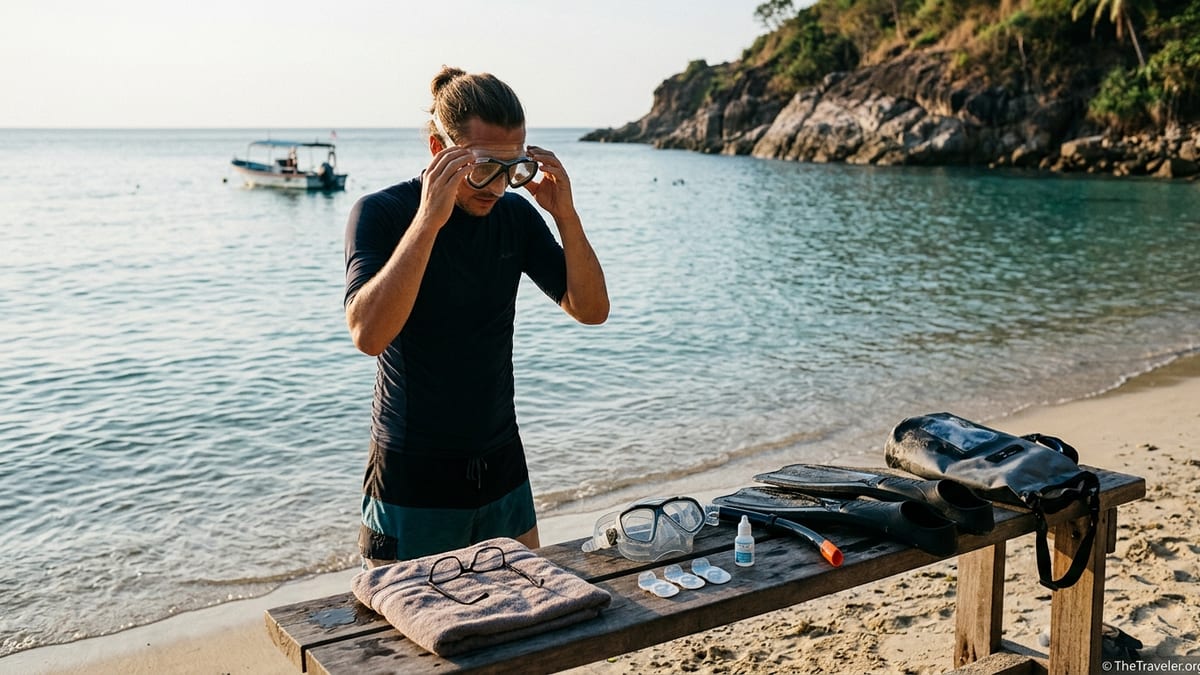
Understanding Your Vision Needs Before You Buy
Before you start shopping for snorkel gear, it helps to translate your everyday glasses prescription into what actually matters in the water. For most recreational snorkelers who are nearsighted or farsighted without major astigmatism, an approximate spherical prescription is often enough. That is why many premade prescription masks are sold in half-step diopters such as −2.0, −3.5 or −5.0 rather than your exact complex prescription with cylinder and axis values. Water itself slightly magnifies objects, roughly 25 percent compared with air, so mild blur on land can feel less severe once your face is in the sea. Many travelers with a prescription around −1.0 to −1.5 report they are happy with a standard mask, especially if they mostly care about colorful fish close to the reef rather than reading tiny numbers on a dive computer.
If your prescription is stronger, or if you have significant astigmatism or need multifocal correction, you will likely benefit from a more tailored option. A traveler who is −6.0 in both eyes and has noticeable astigmatism will see a dramatic difference between a generic rental mask and a custom insert cut to their full prescription. The tradeoff is cost and preparation time. Custom prescription masks or inserts usually must be ordered weeks before your trip, sometimes through a local dive shop working with an optical lab. This is rarely a last-minute airport purchase, so build it into your trip planning the same way you would arrange travel insurance or vaccinations.
For anyone under active care for eye conditions, recent surgery such as LASIK, or a history of eye infections, your first step should be a conversation with your eye care professional. They can advise whether a prescription mask, properly managed contact lenses, or simply staying in shallow water with your regular glasses on shore is safest for you right now. It may feel like overkill, but your eyes are not as easily replaced as a lost fin.
Types of Prescription Snorkel Masks and Lenses
The classic solution for glasses wearers is a dedicated prescription snorkel or dive mask. Many brands, from mainstream snorkel companies stocked in Caribbean resorts to optical specialists found online, sell masks where the clear tempered-glass lenses can be swapped for prescription versions. A typical premade option might cost around 60 to 120 US dollars for the mask plus prescription lenses in common powers, with each side ordered separately if your eyes differ. A dive shop in Puerto Rico, for example, recently quoted a customer about 270 dollars to replace standard lenses in a favored mask with custom-cut prescription glass matching a complex prescription in both eyes, showing how price climbs with customization.
Premade prescription lenses are usually available in set diopter steps and correct only nearsightedness or farsightedness, not astigmatism. This works well for many snorkelers who simply want coral heads, turtles and reef fish to pop back into focus. A traveler with −3.75 and −4.0 prescriptions might choose a mask with −4.0 lenses on both sides, accepting a slight mismatch in one eye in exchange for affordability and fast delivery. For those who need more precision, optical inserts offer another level of correction. Products such as spectacle-style frames that clip or sit inside a mask, or proprietary inserts from specialist retailers, can be glazed with your full single-vision or even bifocal prescription by an optician. One popular insert sold through large retailers fits into many single-lens masks and can be fitted with custom lenses so a snorkeler can read their watch or camera settings clearly.
Full-face snorkel masks are widely available in tourist shops from Hawaii to Thailand, but true prescription-ready versions remain rare. A few brands market stick-on reader segments that can adhere to the inside of a full-face lens for people who only need help with close-up tasks such as checking a camera housing. However, if you are significantly myopic or need detailed distance correction, a traditional mask with prescription lenses or an insert is usually the more reliable choice. Remember that any add-on inside the mask must sit securely and not create extra leak paths or fogging surfaces.
Stick-On Readers and Budget Lens Hacks
For travelers who mainly struggle with near vision, such as reading a watch, camera controls or settings on a rental underwater scooter, stick-on reader lenses can be a surprisingly effective budget solution. These thin, semi-flexible lenses adhere to the lower inside portion of your mask lens using water tension or a small amount of removable adhesive. They are sold in reading strengths similar to drugstore readers, such as +1.75 or +2.5, and typically cost around 20 to 40 dollars. Optical retailers and some dive shops keep them in stock precisely because they are easy to trim and install just before a trip.
A realistic example: a 55-year-old traveler who sees distance well after LASIK but now needs +2.0 readers on land wants to snorkel in Belize. Their distance vision underwater is fine with a standard good-fitting mask, but they cannot make out the buttons on their camera or the depth display on a rental dive computer. By applying a pair of +2.0 stick-on readers to the bottom corners of their mask, they effectively create a bifocal mask. Looking straight ahead, the reef is clear; glancing downward, the near segment sharpens the small text. Because these lenses are removable, they can be peeled off and reused for future trips if stored carefully.
These stick-on options have limitations. They do nothing for distance blur, so they are not appropriate for a traveler who is −5.0 and cannot see the boat ladder ten meters away. They can also contribute to fogging or detach if not applied correctly. Following the manufacturer’s instructions, cleaning the mask glass thoroughly before application, and checking the adhesion in a sink or bathtub at home can prevent surprises on your first ocean swim. For occasional snorkelers who mainly need help with reading, however, they are often the simplest compromise between cost, convenience and visibility.
Snorkeling With Contact Lenses: Pros, Cons and Safety
Many glasses wearers automatically reach for contact lenses when they think about water sports, assuming this is the most flexible solution. Soft contact lenses can work for snorkeling if they are used with care and combined with a properly fitting mask that keeps water out. Organizations that study dive safety note that soft lenses are generally more comfortable than rigid gas-permeable lenses under a mask, because they adapt better to small pressure changes and are less likely to dislodge. However, health authorities such as the Centers for Disease Control and Prevention and the National Eye Institute consistently warn that contact lenses and water are a risky combination because water can harbor germs and change how the lens sits on the eye.
If you choose to snorkel in soft lenses, treat them as single-use for that session. Many eye care professionals advise discarding daily disposable lenses after swimming, even if they feel fine, rather than cleaning and reusing them. A cautious routine might look like this: insert a fresh pair of daily lenses in your hotel room, snorkel for the morning with a tight, well-fitting mask that you have tested for leaks, avoid deliberately flooding your mask or removing it in the water, then discard the lenses as soon as you return to shore and rinse your eyes with sterile saline if recommended by your doctor. Pack extra daily lenses, lubricating drops approved for contact lens wear and a backup pair of glasses in your beach bag in case a lens irritates your eye or washes out.
Travelers with a history of eye infections, dry eye, corneal surgery or complex prescriptions should talk with their eye doctor before relying on contacts in the ocean. Water exposure increases the risk of rare but serious infections such as acanthamoeba keratitis that can be difficult to treat. Eye health agencies advise against swimming or showering in contact lenses at all, and view occasional water sports as exceptions that require strict hygiene. If your doctor is uneasy about contacts in the sea, a prescription mask or insert may be the safer route. At minimum, never wear lenses overnight after a day of snorkeling, never rinse them in tap or bottled water, and never use saliva or pool water to wet a lens.
Getting the Right Mask Fit When You Wear Glasses or Contacts
Even the best prescription lenses will not help if the mask leaks or pinches. Glasses wearers often run into fit problems because the habit of resting weight on the nose bridge and ears does not translate well to a silicone-skirted mask that must seal against bare skin. When trying masks at a dive shop or sports store, remove your glasses completely. Place the mask gently on your face without using the strap, inhale slightly through your nose and see whether the mask holds with light suction for several seconds. If it falls away immediately or presses painfully on the bridge of your nose, try a different shape or size. A well-fitting mask should seal comfortably around the soft parts of your face without needing to be cinched tight with the strap.
Travelers who plan to snorkel in contact lenses should be particularly picky about fit. Every small leak brings water into contact with the lens, which can cause irritation or wash a lens out. A mask that feels acceptable in a dry shop may behave differently with hair, sunscreen and waves involved. If possible, test your mask in a pool or bath before flying to the Maldives or Maui. Adjust the strap so it sits high on the back of your head, not directly on the ears, and check that you can equalize pressure comfortably by exhaling a tiny bit of air through your nose. A mask that constantly fogs or floods will tempt you to take it off in the water, which is when contact lenses are most likely to be exposed to seawater.
Facial hair can complicate the seal, especially for men with mustaches. Some snorkelers with strong prescriptions choose masks with slightly smaller skirts that sit above the lip line to minimize leaks, while others use a small amount of silicone-safe grease or conditioner on the mustache area to help the skirt seal. If you are ordering a custom prescription mask online and know you have a wide face or high nose bridge, look for models marketed as "Asian fit" or "wide fit" and read user reviews that describe real-world face shapes rather than stock photos. For children who wear glasses, plan for growth and consider adjustable junior masks with the option of low-cost premade lenses that can be swapped out as their prescription changes between trips.
Buying Online vs Local Dive Shops and What Rentals Can (and Cannot) Do
Most large coastal destinations and cruise excursions provide basic snorkel sets that include a plain tempered-glass mask, snorkel and fins. Prices vary by location, but a common pattern is around 15 US dollars for a day rental of mask, snorkel and fins at a California beach operator, or a similar price bundled into a boat tour fee in places such as Mexico or Indonesia. These rental masks almost never include prescription correction, and staff may politely confirm that they do not keep prescription masks in stock for hygiene and cost reasons. A rental shop near San Diego, for example, makes clear in its pricing notes that it does not provide prescription snorkel masks alongside its standard gear.
A handful of specialist operators in high-volume snorkel destinations such as Maui or the Cayman Islands do stock a limited range of prescription masks for rent, typically in common nearsighted powers between about −1.5 and −6.0. Travelers report day rental prices that can approach or even exceed what a basic new prescription mask would cost online, especially if insurance does not cover rentals. Availability is inconsistent: you might be able to rent a −3.0 mask in one Caribbean port but find nothing beyond plain glass on the next island. Relying on prescription rentals is therefore a gamble, most suitable for travelers who forgot their own gear and are willing to compromise on perfect correction for a single day in the water.
Buying your own gear allows you to control fit and vision, and the price difference compared with repeated rentals quickly narrows. Entry-level prescription masks sold through major online retailers often start around 40 to 80 dollars for premade nearsighted lenses, while locally sourced custom masks and inserts can range from about 150 dollars at a modest dive shop to 300 dollars or more for complex prescriptions with bifocal segments. Online optical specialists that focus on sports eyewear frequently offer free or low-cost adjustments if the first lens choice is slightly off, and some accept returns before you travel if the mask does not seal well. In-person dive shops add value with expert fitting and the chance to try different skirt shapes on your face, which can matter more than saving 20 dollars by ordering blind online.
From a travel perspective, a personal mask and snorkel take up surprisingly little space in a carry-on bag and can pay off over multiple trips. Many frequent snorkelers pack just their own mask and snorkel, then rent fins locally to reduce luggage weight. For a glasses wearer, knowing that your prescription mask is in your backpack when a last-minute whale shark excursion appears on the hotel noticeboard can turn a hard decision into an easy yes.
What Glasses Wearers Should Know Before Their First Snorkel Trip
Travelers who rely heavily on glasses in daily life often underestimate how disorienting it can feel to be in open water with poor vision. Currents, boat traffic and fellow swimmers can all become harder to judge when everything is soft-edged. If you normally cannot clearly read a street sign at the length of a city bus without glasses, plan for some form of correction in the water. That might mean a simple premade prescription mask, daily disposable contact lenses under a well-fitting plain mask, or a more elaborate custom insert. What matters is that you have tested the setup before stepping off a boat in another country.
For short, casual resort trips, run a small experiment at home. Stand across a room from a television or clock with your glasses off, then hold a basic snorkel mask to your face without straps and look through it. Many people are surprised that the refraction of the flat glass and the way the eye focuses in water behind it already sharpens things slightly. If you can comfortably read large text across the room, you may only need mild correction or none at all for a quick guided snorkel near shore. If you cannot recognize faces about three meters away, that is a warning that renting a generic mask on site will not be enough.
People who cannot wear contacts because of dry eye or medical advice should not assume snorkeling is off the table. Prescription masks and inserts exist precisely for this group, and many optometrists can help you order one based on your existing glasses prescription. One snorkeler with −6 and −7 prescriptions and significant astigmatism recently described choosing between a premade mask that ignored their astigmatism and a more expensive insert that matched their full prescription but slightly reduced field of view. They opted for the insert and reported that, for them, the clarity of fish and coral outweighed the narrower frame edges. Your tradeoffs may be different, but you will only know by considering your priorities in advance.
The Takeaway
For travelers who depend on glasses, enjoying the underwater world no longer has to mean half-seeing shadows of fish and guessing which way the boat lies. A spectrum of solutions now exists, from affordable premade prescription masks and stick-on readers to fully customized optical inserts and carefully managed contact lens routines. The best choice depends on how strong and complex your prescription is, how often you plan to snorkel, and how much preparation time and budget you can allocate before your trip.
As a rule of thumb, occasional snorkelers with mild blur can often get by with a standard well-fitting mask or a low-cost premade prescription model. Those with stronger or more complex prescriptions usually benefit from investing in a custom mask or insert they can use for years across different destinations. Contact lenses can be part of the toolkit if handled with strict hygiene and a focus on minimizing water exposure, but they are never a shortcut around eye health. Whatever route you choose, testing your gear in a pool or bathtub at home before packing your suitcase will pay dividends in comfort and confidence when you finally roll off the boat into warm, clear water.
FAQ
Q1. Do I really need a prescription snorkel mask if I am only mildly nearsighted?
If your prescription is around −1.0 to −1.5 and you mainly plan casual snorkeling in clear water, you may be comfortable with a standard mask, especially because water slightly magnifies objects. If you struggle to recognize faces a few meters away without glasses, a basic premade prescription mask is likely worth the modest extra cost.
Q2. Can I wear my regular contact lenses while snorkeling?
Soft contact lenses can be worn under a snug, well-sealed mask, but health authorities caution against exposing contacts to water because of infection risk. If you choose this option, many eye care professionals recommend using daily disposables, avoiding intentionally flooding your mask, discarding lenses immediately afterward and bringing a backup pair of glasses.
Q3. Are stick-on reader lenses in masks reliable?
Stick-on readers work well for many travelers who only need help with close-up tasks like reading a watch or camera settings. They must be applied to a clean, dry mask lens and tested in water before your trip. They will not fix distance blur and can sometimes fog more easily if not positioned carefully.
Q4. How far in advance should I order a custom prescription snorkel mask?
Custom masks and inserts often require one to several weeks for fabrication and shipping, especially if your prescription is complex or includes astigmatism or bifocal segments. Ordering at least a month before departure provides a buffer to check fit and make adjustments or exchanges if needed.
Q5. Can I rent a prescription snorkel mask at my destination instead of buying one?
Some high-volume snorkel destinations have shops that rent prescription masks in common nearsighted powers, but availability, fit and power range are inconsistent. Many operators do not stock prescription masks at all. If clear vision is important to you, especially with stronger prescriptions, bringing your own mask is usually more reliable and often more economical over multiple trips.
Q6. What should I tell my eye doctor if I plan to snorkel?
Let your eye doctor know you plan water activities and whether you prefer a prescription mask, contacts or both. They can confirm whether contacts are safe for you, suggest appropriate lens types, and may adjust your prescription slightly for premade mask options. They can also flag any eye conditions that make water exposure riskier.
Q7. Are full-face snorkel masks a good choice for people who wear glasses?
Full-face masks rarely offer full prescription correction. Some allow stick-on reader segments for near vision, but if you are significantly nearsighted or need precise distance correction, a traditional mask with prescription lenses or a custom insert usually provides better clarity and flexibility.
Q8. How do I choose the right diopter strength in a premade prescription mask?
Premade masks are sold in half-step diopters. Many snorkelers choose the closest slightly weaker value compared with their glasses prescription to account for water magnification. For instance, someone with −3.75 might pick −3.5 or −4.0 lenses. When in doubt, consult with an optician or dive shop familiar with prescription masks.
Q9. What if I have strong astigmatism or need progressives?
In these cases, a simple premade prescription mask will not fully match your needs. Custom optical inserts or masks glazed by an optical lab can incorporate astigmatism and, in some cases, bifocal or progressive-style segments. These options cost more and may slightly reduce field of view but can dramatically improve clarity and comfort.
Q10. Is it worth bringing my own mask on a short resort vacation?
If you depend on glasses for everyday activities, bringing your own well-fitted mask, especially a prescription one, is usually worth the luggage space even for a few days. It ensures consistent vision, better hygiene than shared rentals, and immediate readiness if a spontaneous snorkeling opportunity arises.