


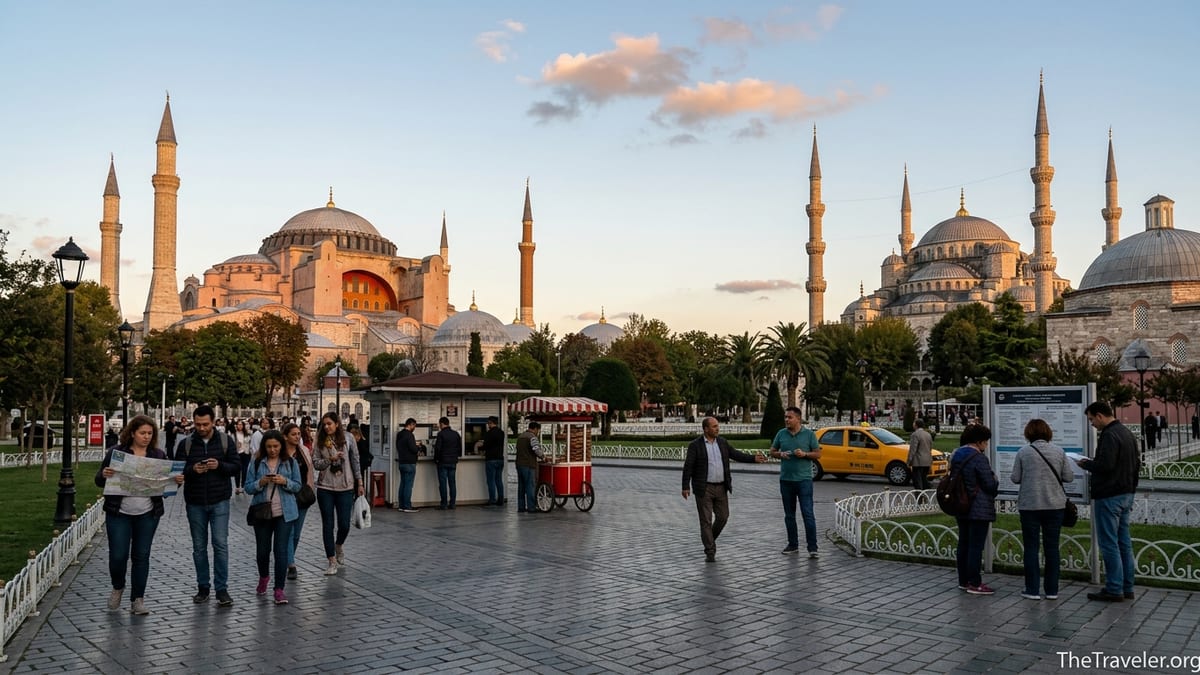
Sultanahmet is the postcard image of Istanbul: Hagia Sophia, the Blue Mosque, Topkapi Palace and the old Hippodrome all clustered around a single square. It is also where many first-time visitors burn through their budget, patience and energy in a single day. Between confusing ticket systems, aggressive touts and sky-high tourist prices, it is easy to walk away disappointed from one of the most remarkable historic districts in the world. With a little practical knowledge, however, you can enjoy Sultanahmet’s highlights without feeling rushed or ripped off.
Get the latest updates straight to your inbox!
Arriving At the Wrong Time and Expecting to See Everything in One Day
Many visitors underestimate how intense Sultanahmet can feel, especially in peak season from late spring to early autumn. They step off the tram at Sultanahmet station at 10:00 in the morning, stare up at Hagia Sophia on one side and the Blue Mosque on the other, and assume they can “do” the old city before dinner. In reality, lines can snake across the square, security checks are slow, and prayer times or restoration work can close major areas of mosques and museums with little warning.
An all-too-common mistake is scheduling Hagia Sophia and the Blue Mosque back-to-back around midday on a Friday, only to discover that Hagia Sophia is closed to tourists for the main congregational prayers. Travelers then spend the best hours of the day standing in the sun, shuffling between queues. A more realistic plan is to pick two major paid sights for one day, such as Hagia Sophia’s upper galleries and Topkapi Palace, and leave the rest of the time for wandering the Hippodrome, the park and quieter mosques like Sokollu Mehmed Pasha nearby.
Timing also matters for the overall mood. In the early morning, around 8:00, Sultanahmet Square is still waking up; you can photograph Hagia Sophia and the Blue Mosque with minimal crowds and then have breakfast at a side-street simit bakery before heading into your first museum when it opens. Late afternoon and evening are better for strolling, tea in the park and catching the golden light on the domes, rather than trying to race through ticketed interiors that are about to close.
Another planning error is not checking seasonal hours and assuming everything stays open late. In winter months, many ticketed sites on the historic peninsula start closing entry in the late afternoon. Visitors who arrive at Topkapi Palace at 15:30 on a short winter day often find themselves rushed through its courtyards, barely glancing at the Harem or treasury. Building your plan around opening times and prayer schedules, instead of trying to cram everything into a single, generic “old city day,” makes Sultanahmet far more rewarding.
Getting Caught in Ticket Confusion and Overpriced “Packages”
The single biggest practical complaint you will hear about Sultanahmet today involves tickets. Hagia Sophia is again an active mosque, but access for non-worshippers is organized through paid visitor routes, usually to the upper galleries, with separate fees for add-ons like the Hagia Sophia History Museum. Nearby, Topkapi Palace, the Istanbul Archaeology Museums and other sights operate on their own ticket systems. On top of this, Istanbul-wide products such as the Istanbul Museum Pass and various private “tourist passes” are heavily marketed around the square.
Visitors regularly report being steered at Hagia Sophia’s official-looking counters toward more expensive combinations when they only asked for simple mosque access. Couples have walked away paying the equivalent of 70 to 80 British pounds for two tickets after being told that the cheaper option “is only for the balcony” or “does not include the real experience,” when in fact that balcony is where ordinary tourists are allowed to be in the first place. Others purchase an additional ticket for the separate Hagia Sophia History Museum in a different building around the square without realizing they could have skipped it if they only wanted to see the mosque interior.
Similar confusion appears around city passes. The official Istanbul Museum Pass costs roughly the price of three or four major museum tickets and is usually good value if you plan to visit Topkapi Palace, the Istanbul Archaeology Museums and several other state-run sites within five days. Many private “all-inclusive” cards, however, bundle in boat tours, airport transfers and basic walking tours at inflated prices that you might not use. Travelers staying in Sultanahmet for only one or two days often spend more on such passes than they would have paid buying individual tickets on the official Müze mobile app or at the regular counters.
The simplest way to avoid these pitfalls is to decide, before you reach the square, which experiences you actually want: for example, “Hagia Sophia upper galleries plus Topkapi and the Archaeology Museums” versus “only Hagia Sophia with a quality guided tour.” Take a note of the standard ticket prices listed on the official museum information pages and compare them mentally with what is shown on the screen at the counter. If a seller starts pushing bundles you did not ask for, politely insist on the basic ticket or step aside and take a moment to think. In Sultanahmet, hesitation at the counter is cheaper than buyer’s remorse later.
Underestimating Scams, Touts and Sky-High Tourist Prices
Sultanahmet has a dense layer of low-level tourism hustles that rarely make the news but collectively sour many visits. Around the Blue Mosque and Hagia Sophia, friendly men approach with the classic line, “Where are you from?” and offer unsolicited guiding services, carpet shop visits or help with mosque rules. Some pose as “official mosque guides” and try to charge entry or mandatory tour fees for places that are free to enter. Others lead visitors to bars or cafes where a simple round of drinks turns into a four-figure bill in local currency.
Within the square itself, prices can jump dramatically compared with less touristy neighborhoods. Freshly squeezed pomegranate juice that costs a modest amount in a residential district may suddenly appear at 200 or 250 lira per cup at a kiosk overlooking Hagia Sophia. Small souvenir stands sell basic Nazar amulets or fridge magnets for several times the price charged in local markets on the Asian side. Some visitors have found that even supposedly official kiosks around the monuments quietly add “service fees” or ring up higher amounts on card terminals than the posted ticket prices.
There are also specific scams that repeat so often they are almost predictable. Near the square and the Grand Bazaar, the dropped-shoeshine-brush trick, where a man “accidentally” drops his brush, starts polishing your shoes and then demands payment, is still reported. Taxis lingering on side streets around Sultanahmet quote flat fares to Taksim or the airport that can be double the normal meter price, sometimes accompanied by a rigged meter or a swapped banknote when you pay in cash. First-time visitors who arrive at Istanbul Airport and accept the very first unmetered taxi offer straight to their Sultanahmet hotel frequently report fares at the extreme top end of what is reasonable for the route.
The best defenses are straightforward. Decline unsolicited help with a firm but polite “no thank you” and keep walking. Only enter bars, cafes and carpet shops that you have chosen yourself, not places where someone shepherded you in off the street. For taxis, either use the official airport ranks and insist on the meter, or pre-book a reputable transfer through your hotel. Within the city, the T1 tram and the Marmaray commuter rail are safer and dramatically cheaper ways to move between Sultanahmet, Eminönü, Karaköy and the modern center.
Ignoring Public Transport and Overpaying for Taxis
From a map, Sultanahmet looks like a self-contained historic island, and many visitors assume that taxis are the natural way to reach it and move around. In practice, Istanbul’s public transport network makes reaching the old city straightforward, and ignoring it is an expensive mistake, especially with rising fuel prices and taxi complaints. The modern T1 tram line runs from Bağcılar in the west through Aksaray and Beyazıt to Sultanahmet, then down to the ferry hubs at Eminönü and Karaköy and on to Kabataş. For most hotel clusters in the historic peninsula and along the Bosphorus, one or two rides on this line are enough to connect with almost anywhere else you want to go.
The Istanbulkart, a rechargeable contactless card, is the key to using this network efficiently. You tap it on the yellow readers at tram turnstiles, metro gates and ferry piers, and each ride costs a fraction of a taxi fare, with discounted transfers if you switch lines within a couple of hours. Cards are sold at major transport hubs and machines for a small nonrefundable deposit, then topped up in cash or by card. Yet many short-stay visitors who base themselves in Sultanahmet never buy one, instead hopping into taxis for short journeys to Spice Bazaar, Karaköy or even Galata that would have cost a tiny amount by tram.
Overreliance on taxis is especially painful on the airport route. A metered yellow taxi from Istanbul Airport to Sultanahmet in 2026 might legitimately cost the equivalent of 20 to 30 US dollars depending on traffic and surcharges. Unsuspecting travelers, however, routinely accept fixed-fee offers significantly higher, or find that the driver takes a slow, scenic route along the seafront walls that adds half an hour to the journey. Meanwhile, the Havaist airport bus delivers passengers to central hubs such as Beyazıt or Sultanahmet’s edges for a fraction of that price, and combined with a short tram ride can be almost as convenient.
Choosing public transport also changes how you experience the city. Standing on the T1 tram as it rattles past the Grand Bazaar, glimpsing the city walls and emerging into Sultanahmet Square alongside local commuters, gives a better sense of Istanbul than sitting in taxi traffic. For central journeys, aim to default to tram, metro and ferries and treat taxis as a backup option at night or when carrying heavy luggage. That one habit shift can easily save a family hundreds of lira over a long weekend.
Dressing and Behaving Inappropriately at Mosques
Hagia Sophia and the Blue Mosque are working places of worship, not just architectural wonders. A surprisingly common mistake is arriving dressed for a beach-city stroll and being shocked at the dress code. Women with bare shoulders or short skirts, and men in vests or very short shorts, are often stopped at mosque entrances. Scarves and wraparound skirts can sometimes be borrowed, but stocks are limited and a fee or “donation” may be requested. In busy periods, this creates a secondary bottleneck at the door, where unprepared tourists scramble to cover up under the eyes of security officers and worshippers.
Inside, the etiquette of a mosque is different from that of a museum, and many visitors inadvertently behave in ways that locals find disruptive. Visitors step onto the main prayer carpets with their shoes still half on, pose for selfies during the call to prayer, or try to cross restricted lines to photograph the mihrab. At Hagia Sophia, where the ground floor is largely reserved for worshippers, some tourists repeatedly attempt to argue with guards about crossing into taped-off sections, insisting that their ticket should grant them access anywhere.
Planning your clothing makes everyone’s life easier. For both men and women, covered shoulders, covered knees and reasonably modest tops are a safe baseline for mosque visits. Women who normally travel without headscarves can bring a lightweight scarf in their bag specifically for Sultanahmet; it takes almost no space and avoids having to queue for communal coverings. Slip-on shoes or sandals are helpful, as you will remove them repeatedly at mosque doors and carry them in plastic bags inside.
Equally important is adjusting your expectations. When you enter a mosque, you are stepping into someone else’s sacred space. Flash photography, loud conversations and filming people at prayer should be avoided. If parts of Hagia Sophia are closed for a prayer interval or restoration work, treat the access you are given as a privilege, not a commercial transaction. That mindset not only reduces conflict at the doors, it also helps you experience these buildings as more than just Instagram backdrops.
Overpaying for Food, Views and Souvenirs in the Tourist Core
Sultanahmet has some charming tea gardens, pastry shops and restaurants. It also has an enormous number of places whose main business model is extracting as much money as possible from a captive audience that will never return. Travelers make the mistake of assuming that any café with a terrace facing Hagia Sophia must, by definition, be “the place to eat,” then are shocked when a simple kebab, salad and beer add up to a bill equivalent to what a local family might spend on a full dinner in a less touristy neighborhood.
Roof terraces with impressive views of the domes and the Sea of Marmara are especially prone to this. Hosts stand outside with multilingual menus and promises of “best view in Istanbul.” Prices for grilled fish, meze and shisha on these rooftops can run to three or four times what you would pay in Kadıköy or Beşiktaş. Service charges and “music fees” sometimes appear at the bottom of the bill without clear prior warning. Visitors who do not check the menu carefully, or who leave ordering to the waiter’s suggestions, can easily find themselves paying a premium for fairly ordinary food.
Souvenir shopping tells a similar story. The small streets between Sultanahmet Square and the Grand Bazaar are lined with carpet shops, ceramic boutiques and spice stalls stacked with eye-catching displays. Not all of them are dishonest. Many, however, use pressure tactics: complimentary apple tea followed by a long sales pitch, insistence that a particular kilim is a “museum piece” when it was made in a factory last year, or exaggerated claims about silver and gold content. Tourists who buy jewelry or antiques in a rush, on their first day in Istanbul, often later discover similar items for far less in more local-oriented bazaars.
There are two practical ways to approach this. First, treat Sultanahmet as a place to browse and shortlist rather than to make big-ticket purchases. Note the designs you like and approximate prices, then comparison shop in other districts like Karaköy, the Asian-side neighborhoods or the Arasta Bazaar behind the Blue Mosque, which tends to be calmer. Second, assume that anything with an iconic view attached comes with a surcharge. If you want one memorable rooftop drink looking over the mosques at sunset, budget for it and enjoy it consciously. For daily meals and coffees, step a few blocks away from the square into streets where menus are written mostly in Turkish and where you see local office workers eating. The atmosphere may be less theatrical, but the food is often better and the bill much kinder.
Spending All Your Time in Sultanahmet and Missing the Rest of Istanbul
Sultanahmet is the historic heart of Istanbul, but it is not the whole city. A frequent mistake, especially on short trips, is to book a hotel in the middle of the old town and then never leave its narrow radius. Visitors spend three or four days circling between Hagia Sophia, the Blue Mosque, the Hippodrome, the Basilica Cistern and the Grand Bazaar, coming away with beautiful photos but little sense of how modern Istanbul lives and works.
This concentration also amplifies the sense of fatigue. After your third loop past the same carpet shops and tour touts, the magic wears thin. Some travelers begin to believe that all of Istanbul is an elaborate tourist stage set. In reality, just a 15-minute tram ride over the Golden Horn to Karaköy, followed by a short walk up to Galata or a ferry ride to Kadıköy, reveals cafés, bookstores, street art and ordinary neighborhoods where the ratio of locals to visitors flips completely.
Even within walking distance of Sultanahmet, there are quieter corners that many people skip. The backstreets sloping down toward the Sea of Marmara, the Little Hagia Sophia mosque, and the remnants of the ancient city walls offer glimpses of daily life: children playing football in narrow lanes, elderly residents chatting outside grocery shops, laundry lines strung between wooden houses. These areas are not as manicured as the central square, but they give context to the monuments on the hill.
A balanced itinerary might devote one full day to the must-see icons of Sultanahmet, a second to the Grand Bazaar, Spice Bazaar and a Bosphorus ferry from Eminönü, and at least one more to modern neighborhoods on either the European or Asian side. Treat Sultanahmet as your base layer of understanding, not as the entire story, and your memories of Istanbul will feel far richer.
The Takeaway
Sultanahmet’s beauty is undeniable. The silhouettes of Hagia Sophia and the Blue Mosque at dusk, the echo of footsteps in Topkapi’s courtyards, and the call to prayer rolling across the square are among the great urban experiences of the world. Yet the district’s popularity has also produced its own ecosystem of confusion, inflated prices and tourist-only experiences that can leave visitors feeling shortchanged.
Avoiding the biggest mistakes is less about secret insider tricks and more about a handful of grounded habits. Plan around realistic timeframes and prayer schedules. Decide in advance which tickets you actually need and be skeptical of upsells. Use the tram, metro and ferries instead of defaulting to taxis. Dress with mosque etiquette in mind. Eat and shop a few streets away from the main square. And above all, remember that Sultanahmet is one neighborhood in a vast, layered metropolis. Approach it with curiosity rather than urgency, and it will reward you as the beginning of your Istanbul story, not the whole of it.
FAQ
Q1. Do I have to pay to enter Hagia Sophia as a visitor?
Non-Muslim visitors who want to follow the designated sightseeing route, usually through the upper galleries, pay a ticketed entrance fee, while worshippers using the mosque for prayer enter through separate access without that tourism charge. Always check the posted prices at the official counter before paying and be cautious of unofficial “packages” that include extra add-ons you may not need.
Q2. Is there an entrance fee for the Blue Mosque?
The Blue Mosque remains free to enter as a place of worship, but visiting hours for tourists are restricted around prayer times and sections may close during major services or restoration. Anyone asking for a ticket fee outside its gates is not part of the mosque administration, although you may choose to tip a legitimate guide if you request their services.
Q3. When is the best time of day to visit Sultanahmet’s main sights?
Early morning right after opening or late afternoon a couple of hours before closing are usually the least crowded times for Hagia Sophia and Topkapi Palace. Midday, especially on weekends and Fridays, tends to bring long queues and stronger sun in the open courtyards, so plan your indoor visits accordingly and use the hottest hours for shaded walks or lunch breaks.
Q4. Is the Istanbul Museum Pass worth it if I am staying mostly in Sultanahmet?
The official Museum Pass can be good value if you intend to visit several major state-run sites such as Topkapi Palace and the Istanbul Archaeology Museums within its validity period. If you only plan to see one paid museum plus mosque interiors, or if your schedule is loose, it may be cheaper to buy individual tickets. Be wary of similarly named private “tourist passes” that bundle in services you might not use.
Q5. How can I avoid scams and aggressive touts around the square?
The simplest rule is to refuse unsolicited offers politely but firmly, whether for guiding, carpet shopping, drinks or taxi rides. Do not follow strangers to bars or shops you did not choose, and ignore anyone who insists that a mosque requires an entry ticket. If something feels off at a ticket window or a bar, step back and either ask a tourism police officer for clarification or choose a different provider.
Q6. What should I wear to visit Hagia Sophia and the Blue Mosque?
Dress as you would for any conservative place of worship: shoulders and knees covered for everyone, with women bringing a light scarf to cover their hair. Avoid very tight or transparent clothing and choose shoes that are easy to slip on and off, since you will remove them at mosque entrances and carry them inside.
Q7. Is it safe to use public transport to and from Sultanahmet?
Yes, the T1 tram line, metro and ferries are widely used by locals and tourists and are generally safe, especially during the day and evening. Crowded vehicles can attract pickpockets, so keep bags zipped and valuables in front of you, but for most journeys between Sultanahmet, Eminönü, Karaköy and other central districts, public transport is both cheaper and less stressful than negotiating taxi fares.
Q8. How much should I expect to pay for a meal in Sultanahmet?
Prices vary sharply. Restaurants with direct views of Hagia Sophia or rooftop terraces often charge a significant premium, where a simple grilled dish and drink can cost several times the neighborhood average. If you walk a few blocks away from the main square into side streets where menus are mostly in Turkish and filled with local office workers at lunchtime, you can usually find filling, home-style meals at much more reasonable prices.
Q9. Can I visit Sultanahmet as a day trip and still see the highlights?
You can certainly see the square, walk past Hagia Sophia and the Blue Mosque, and perhaps tour one major site like Topkapi Palace in a single day. However, trying to fully visit Hagia Sophia, Topkapi, the Basilica Cistern and the Grand Bazaar in one rushed itinerary usually leads to long queues and superficial impressions. If possible, plan at least two days so you can slow down and explore quieter corners without sacrificing the big sights.
Q10. Where should I stay if I want to explore beyond Sultanahmet as well?
Staying in or near Sultanahmet is convenient for first-time visitors focused on the classic monuments, but areas like Sirkeci, Karaköy, Galata or the Asian-side districts along the ferry routes offer easier access to both the old town and modern neighborhoods. Look for accommodation within walking distance of the T1 tram or major ferry piers so you can reach Sultanahmet in minutes while still experiencing a broader slice of the city.