


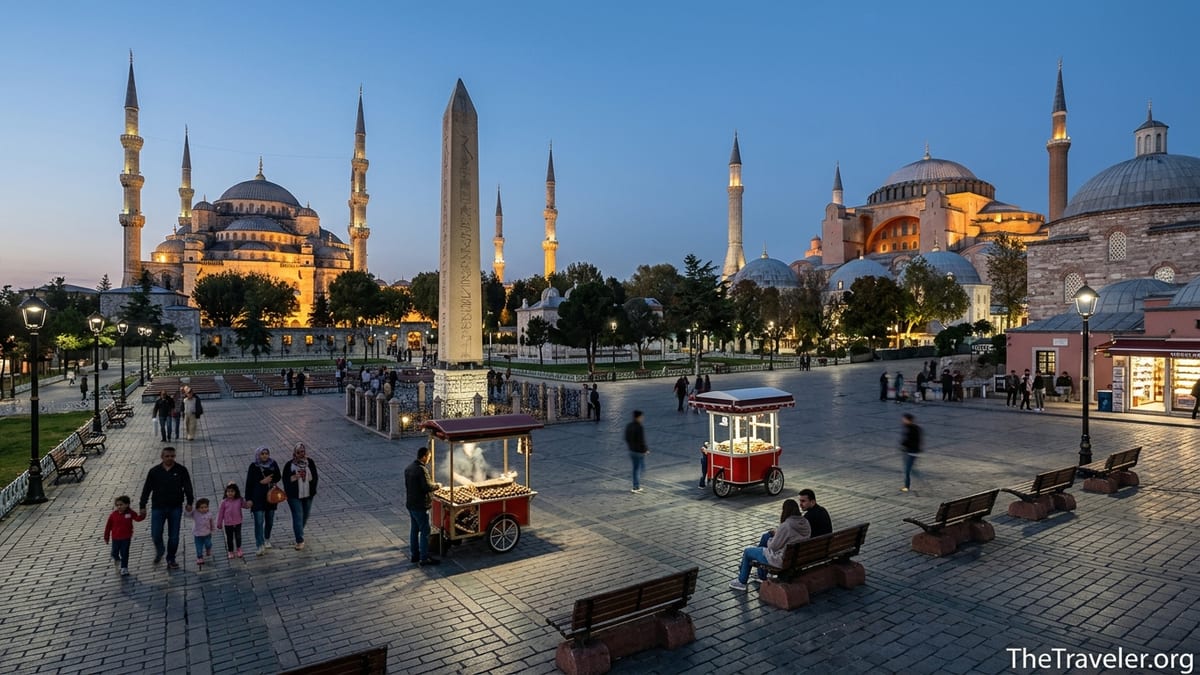
By the time the last call to prayer floated over Sultanahmet, the tour groups were already filing back toward their buses. I left my hotel near the tram line without a map, drawn instead by the glow around the Blue Mosque and Hagia Sophia. Over a single evening walk, the neighborhood that many travelers rush through in daylight shifted in my mind from checklist of monuments to a living, breathing quarter of Istanbul. The transformation happened slowly, corner by corner, as the city changed gears for the night.
Get the latest updates straight to your inbox!
From Tram Rattle to Twilight Quiet
I started at Sultanahmet tram stop just after sunset, when the M2 line still rattles regularly between Bağcılar and Kabataş but the commuter rush is thinning. On the platform, a mix of day-trippers with selfie sticks and office workers with loosened ties stepped off together, then quickly peeled in different directions. Within a few minutes of walking up the gentle slope toward the square, the background noise shifted from metal on tracks to footsteps on old paving stones.
Street vendors who had spent the day hawking tours to Bosphorus cruises were packing away their signs advertising boat trips and “skip-the-line” tickets to Topkapı Palace. A man at a small cart near the German Fountain closed the lid on his simit, keeping a few sesame-covered rings aside for late customers. The tour buses that line the Hippodrome during the day were mostly gone, replaced by taxis dropping off couples and families for a calmer, more local kind of evening.
The first real change I felt was in my own pace. In the morning, I had crossed this same square in a hurry to make a timed entry slot at the Basilica Cistern. Now, without any reservation looming, my steps slowed naturally. The benches that were packed at noon had emptied out. I sat for a while facing the Blue Mosque, noticing details I had ignored earlier: the way one minaret leans ever so slightly when you look from the side, the uneven wear on the stone steps where centuries of shoes have passed.
Hagia Sophia and the Blue Mosque After the Crowds
During the day, Hagia Sophia and the Blue Mosque are logistical puzzles. You worry about ticket queues, prayer times when visitors are not allowed inside, and the knot of guides near the entrances offering “very special price” tours. In the evening, especially between the last light of day and the late prayer, the tension around these icons of Istanbul relaxes.
Hagia Sophia’s courtyard was still busy, but the line that had stretched across the square that afternoon had melted into a loose cluster of visitors. Since its reconversion into a mosque, entry is free, though there are now separate flows for worshippers and tourists. I watched a family from Konya walk purposefully toward the main door, while a pair of backpackers hesitated over whether to remove their shoes at the same threshold. A volunteer in a navy vest waved them forward, explaining gently that they could step inside briefly as long as they kept to the roped-off visitor area.
Across the square, the Blue Mosque glowed in cooler light, its grey domes turning almost silver once the floodlights snapped on. The earlier renovation work that had wrapped parts of the mosque in scaffolding in recent years is much reduced now, and from most angles the view feels whole again. I passed through the side entrance off the Hippodrome, where a modest sign reminds visitors of dress codes. A basket of light blue scarves sat by the door for anyone who needed to cover bare shoulders or hair; a security guard reminded an older man to slip his shorts below the knee before stepping onto the carpet.
Inside, a small group of local teenagers sat in the back corner, their whispered conversation bouncing lightly off tiled walls and stained glass. A guide pointed out the famous İznik tiles to a couple from Spain, quietly explaining why this mosque is called “blue” when the dominant tones after dark are closer to emerald and soft grey. Standing there, I realized I had spent years talking about these buildings as “must-sees,” but only now was I watching them being used, not just visited.
Sultanahmet Square: The Hippodrome in Soft Focus
Back in the open air of Sultanahmet Square, the former Hippodrome of Constantinople, the mood had changed again. The Obelisk of Theodosius, which looks almost harsh at noon with the sun bouncing off its pink granite, seemed gentler in the lamplight. Couples leaned against its low fence, more interested in each other than in the Latin inscription that tour guides recite by heart.
A few steps away, a man in a knit cap roasted chestnuts and corn over a small charcoal grill. Prices here are never the cheapest in Istanbul, but they are still modest by international standards. For the equivalent of a couple of euros, I left with a paper cone of chestnuts warm enough to warm my fingers. Further along the square, a mobile cart selling fresh-squeezed pomegranate and orange juice did brisk business with local families who had brought their children out for an after-dinner walk.
Without the mid-day pressure to absorb historical facts, I started to notice how locals used this space. A grandfather practiced slow laps with his grandson, teaching him to ride a small bicycle between the Serpent Column and the remains of the German Fountain. Two women, likely hotel workers on a break, shared a plastic-wrapped gözleme while scrolling through messages on their phones. A police car idled near the tram tracks, its presence barely acknowledged, a reminder of why many locals describe Sultanahmet as one of the safest areas in the city even late at night.
Standing near the center of the former chariot track, I tried to imagine the racing crowds that once filled these stands. But the image that stuck instead was of the present-day square as a neighborhood park. It is easy to think of Sultanahmet only in terms of emperors and sultans. An evening walk interrupts that narrative and replaces it with smaller stories: everyday routines, small gestures, and the kind of casual interactions that rarely make it into guidebooks.
Side Streets, Small Mosques, and the Everyday City
Leaving the main square, I let myself be pulled down a narrow street toward the Arasta Bazaar. By day, this lane behind the Blue Mosque is lined with textile shops selling kilims, ceramic plates, and patterned towels. At night, most terraces were dark, but a few shopkeepers sat on low stools at their thresholds, chatting quietly and sipping tea from tulip-shaped glasses. Instead of calling out for my attention, they nodded hello and went back to their conversations.
On Kucuk Ayasofya Caddesi, where many mid-range hotels cluster, I passed a small neighborhood mosque whose minaret is almost entirely overshadowed by a modern apartment block. It was time for the last prayer of the evening. Inside, maybe a dozen men had gathered, their shoes neatly lined up along the entrance. There was nothing monumental or spectacular about this building, especially compared with the structures just a ten-minute walk away. Yet the simplicity of the scene was what finally made Istanbul feel real to me. Faith here was not only in domes and mosaics but also in fluorescent-lit rooms off side streets.
In one doorway, a woman in a house dress leaned on the railing of her small balcony, watching the flow of people below like television. At a corner grocery, the owner restocked crates of tomatoes and cucumbers, ready for the next morning’s breakfast rush in nearby hotels. A pair of young Australian travelers studied the label on a bottle of ayran, wondering aloud whether it was yogurt or milk. The grocer answered in two words of English and three of Turkish, and somehow they all understood one another.
Tasting Sultanahmet After Dark
My previous meals in the area had been hurried affairs squeezed between museum visits: a quick döner from a stand facing the tram line, a sit-down lunch at a restaurant with an English-language menu in big glossy photos. That night, unhurried, I followed the smell of grilled fish down to a simple lokanta on a back street where the plastic chairs still felt warm from the day’s sun.
The menu here was handwritten and short: grilled sea bream, meatballs, lentil soup, a few meze. Prices were lower than the restaurants directly on the square, though still higher than what you might find in Kadıköy or Fatih. I ordered a plate of köfte with rice and a side of shepherd’s salad. The owner, an older man with deep lines at the corners of his eyes, brought a basket of bread and gently corrected my pronunciation of “teşekkürler” when I thanked him. The total bill came to a modest amount that would barely cover a starter in many European capitals.
After dinner, I stopped at a café near the tram tracks for Turkish coffee. Inside, most of the customers were local: two hotel receptionists in neat shirts discussing shift schedules, a taxi driver catching up on football scores, a young couple sharing a single slice of cake. The waiter set my coffee down with a small glass of water and, unasked, a square of lokum. Looking out the window, I could see a lit-up souvenir shop still open for last-minute shoppers, but the atmosphere inside the café had nothing to do with tourism. It felt like a neighborhood living room that happened to sit amid some of the world’s most famous monuments.
Safety, Solitude, and the Late-Night Return
One of the questions many travelers quietly ask themselves is whether it is safe to wander Sultanahmet after dark, especially alone. What I found on my walk echoed what many local residents say: the area feels remarkably secure compared with many historic centers elsewhere. There is a consistent police presence, the main streets are well lit, and even close to midnight there were still enough people around that I never felt isolated.
That does not mean the area is free of annoyance. I did encounter a few persistent carpet sellers and restaurant hosts who tried to draw me into conversation, assuming I was new in town. The script was familiar: “My friend, where are you from?” followed by offers of tea or special menus. A firm but friendly “No thank you” in any language usually did the job. Compared with the daytime barrage of offers, though, the evening version felt less intense, especially once I moved just a block or two away from the main square.
Walking back toward the tram stop, I noticed how the lighting along Divan Yolu subtly guided travelers toward their hotels and public transport. The last trams were still running, their interiors bright against the dark street. A digital sign flashed the minutes until the next departure. Even if you prefer to take a taxi late at night, it is easy to find one near the main junctions, especially around the edges of the square and by the busier hotel clusters.
By the time I reached my hotel, the call to the final prayer of the day had faded. The city felt quieter but not asleep. Somewhere down the hill toward the Marmara Sea, I could just make out the honk of a ferry. For the first time since arriving, I felt less like a visitor passing through a giant open-air museum, and more like a temporary neighbor who had been allowed a glimpse of Istanbul’s private evening rituals.
The Takeaway
Before that walk, I thought of Sultanahmet primarily in terms of logistics. I knew the opening hours for Topkapı Palace, the approximate cost of the Istanbul Museum Pass, and how long lines at Hagia Sophia might be in peak season. What I did not understand was how different the neighborhood feels once the tour groups leave. The monuments remain, perhaps even more impressive when lit against a deep blue sky, but the emphasis shifts from seeing to observing.
If you plan to visit Istanbul, leave at least one evening free of reservations and fixed times. Start near the tram stop, circle the square, step briefly into whichever mosque is open, and then let your feet decide which side street to explore. Sit on a bench and watch the families, the workers, the students, and the elderly couples for whom this is simply the local park. Eat where the menus are handwritten rather than laminated. Order coffee where no one is trying to sell you a tour.
An evening walk in Sultanahmet will not replace the need to queue for tickets or navigate modern travel logistics. Those practicalities remain. What it can do, however, is rebalance your sense of what Istanbul is. The city stops being just a list of epoch-defining monuments and becomes a web of small, human-scale moments: a shared bench, a corrected word of Turkish, a borrowed scarf at a mosque doorway. That shift, at least for me, changed everything.
FAQ
Q1. Is it safe to walk around Sultanahmet in the evening?
Yes, Sultanahmet is generally considered one of Istanbul’s safest and most heavily policed areas, and main streets stay lively and well lit into the late evening.
Q2. What is the best time to start an evening walk in Sultanahmet?
Begin around sunset so you can see the square in daylight, then watch as the floodlights on Hagia Sophia and the Blue Mosque come on and the atmosphere softens.
Q3. Can I visit Hagia Sophia and the Blue Mosque at night?
You can usually enter briefly during evening prayer breaks, but hours for tourists change, so check locally and always respect prayer times and mosque etiquette.
Q4. How should I dress for visiting mosques in the evening?
Wear modest clothing that covers shoulders and knees; women should bring a scarf for hair. Both men and women remove shoes before stepping onto mosque carpets.
Q5. Are restaurants and cafés in Sultanahmet open late?
Many tourist-focused restaurants close by around 22:00 to 23:00, but smaller lokantas, dessert shops, and cafés on side streets often stay open a bit later.
Q6. Is an evening walk suitable for solo travelers?
Yes, solo travelers regularly walk Sultanahmet in the evening. As in any big city, stay aware of your surroundings and stick to well lit, busier streets.
Q7. How much cash should I bring for an evening out in Sultanahmet?
Carrying the equivalent of 20 to 40 euros in Turkish lira is usually enough for street snacks, a simple dinner, and coffee or tea, with cards accepted in most places.
Q8. Do I need a guide for an evening walk through Sultanahmet?
No guide is necessary. Many travelers prefer to wander independently in the evening, though a daytime walking tour can provide helpful context for what you later see at night.
Q9. Are the trams and public transport convenient for returning from Sultanahmet at night?
Trams run into the late evening and stops are close to major sights, but if you are out very late or tired, taxis are easy to find on main roads nearby.
Q10. What is one thing I should not miss during an evening walk in Sultanahmet?
Do not miss pausing in the middle of Sultanahmet Square between Hagia Sophia and the Blue Mosque to listen to the layered calls to prayer and watch the lights come on.