


On my first full day in San Francisco, I walked less than three miles and felt like I had visited four different cities. The fog rolled in and vanished, the languages around me shifted, the food changed, and even the pace of the street seemed to reset every few blocks. I had expected hills and a famous bridge. What I had not expected was how dramatically different each neighborhood would feel in such a compact, walkable place.
Get the latest updates straight to your inbox!
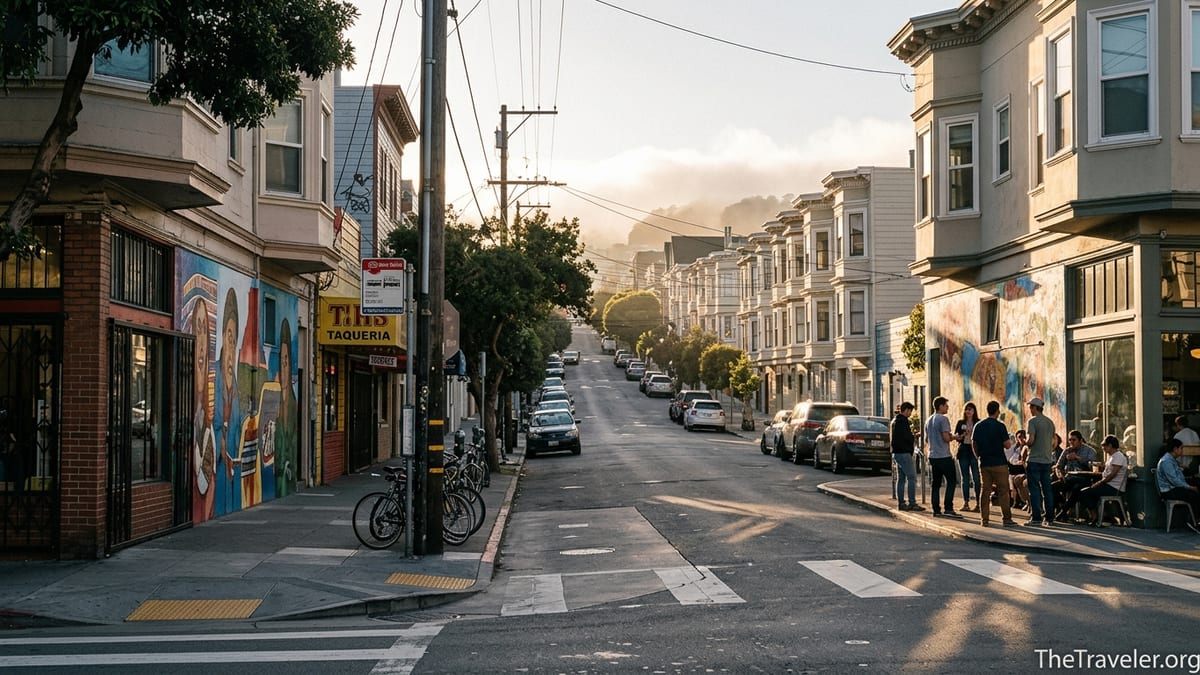
Crossing Invisible Borders in a Compact City
San Francisco is only about seven by seven miles, yet it feels vast because the character of its neighborhoods shifts so quickly. You can start your morning with a Mexican pastry in the Mission District, sip an espresso in Little Italy at North Beach before lunch, ride a cable car up to the grand hotels of Nob Hill in the afternoon, and finish with dim sum in Chinatown, all without ever taking a rideshare. The city’s transit system and walkable street grid make these transitions feel like stepping over invisible borders.
Even the weather participates in the illusion. Local planners and newspapers regularly talk about San Francisco’s patchwork of microclimates, and you feel that the moment you leave the mild, sunny Mission for the windier, fog-prone northern hills. On a July afternoon, you might be in a T-shirt on Valencia Street, then need a fleece twenty minutes later near Nob Hill or Fisherman’s Wharf. Locals are used to carrying a light jacket in their tote, but for visitors it can be disorienting how quickly the sky, temperature, and wind change from neighborhood to neighborhood.
Public transit helps make these contrasts feel accessible. With a one-day Muni pass, which typically costs a little under six dollars for buses and light rail without the cable car, you can hop on and off all day without thinking about individual fares. Visitors who want the full postcard experience can buy a higher priced day pass that includes cable cars, which are treated more like a moving attraction than standard transit. The result is that you are free to treat the city like a tasting menu of neighborhoods rather than committing to just one area.
The Mission District: Murals, Microclimate, and Late-Night Energy
For me, the Mission District was the first neighborhood that shattered my expectations. Technically one of the city’s oldest areas, it feels youthful and restless, packed with independent restaurants, bars, and taquerias. Walk down 24th Street or Valencia Street and you are surrounded by murals that spill across alleyways, roll-up doors, and even utility boxes. Clarion Alley, just off Valencia, is a constantly changing outdoor gallery where artists repaint entire walls when the mood or the politics shift.
The Mission is also where the weather feels noticeably different. Local coverage often compares it to a pocket of Southern California because it is sunnier and warmer than many other parts of San Francisco. On one late August visit, I watched the temperature jump almost ten degrees between the cool wind of Market Street and the still, dry heat of 24th and Mission. Sidewalk tables at cafes like Ritual Coffee or the many smaller, no-name panaderías fill with people lingering over iced coffee or horchata long after the downtown lunch crowd has gone back to work.
Food is the clearest way to understand the Mission’s personality. Burritos here are a point of local pride: a classic “Mission-style” burrito from a well-known taqueria such as La Taqueria or El Farolito might cost around 10 to 14 dollars, and you will see a line of regulars, tech workers, and tourists all waiting for the same foil-wrapped staple. On weekends, the sidewalks on Valencia swell with brunch lines for spots serving chilaquiles, breakfast tacos, or inventive California takes on eggs and toast. At night, the neighborhood’s bars, from low-lit cocktail spots to casual dive bars with jukeboxes, stay busy well past midnight, especially on Fridays and Saturdays.
Yet walk only fifteen minutes west, and the Mission’s dense, mural-covered streets quickly shift into a quieter, more residential feel in the adjacent Noe Valley, underscoring how sharply the city’s atmosphere changes over short distances.
North Beach: Little Italy, Bookstores, and Late-Night Cafés
If the Mission feels like a sun-warmed street party, North Beach feels like a European village grafted onto a San Francisco hill. Official city and tourism materials still describe it as Little Italy, and you see that heritage in the neon signs for trattorias, the Italian flags in windows, and the smell of garlic and espresso afloat along Columbus Avenue. The pace here is more languid; café tables spill onto the sidewalks, and it is common to see people lingering over a glass of wine on a weekday afternoon.
One of the most striking things in North Beach is how much of everyday life happens at street level. Vintage corner bars sit next to family-owned bakeries and pasta restaurants that have been around for decades. You might wander into a place like Stella Pastry for a cannoli and espresso for under ten dollars, then drift next door into a narrow wine bar where locals stand shoulder-to-shoulder at high tables. Around the corner from the triangular, flat-iron shape of the Sentinel Building, the smell of fresh focaccia from tiny bakeries still competes with the coffee roasting inside independent cafes.
North Beach is also where San Francisco’s literary and bohemian history feels most alive. City Lights, the legendary bookstore founded in the 1950s, still anchors the neighborhood. Inside, poetry sections and radical politics shelves sit just steps from postcards and tourists buying tote bags. But the sidewalk outside belongs as much to locals as it does to visitors, with musicians busking nearby and street artists selling prints. In the evening, jazz and rock drift out from small music venues on Grant Avenue and Green Street, blending with the multilingual conversations flowing from restaurant patios.
What surprised me most was how late North Beach stays awake compared with some other parts of the city. On weeknights, restaurants are often busy past 10 p.m., and small cafes still serve espresso to people heading out to comedy shows or live music. Move just a few blocks uphill into the quieter, residential parts of Russian Hill and the energy softens dramatically, confirming again how tightly packed but distinct these urban pockets are.
Nob Hill and Chinatown: Old-World Grandeur Meets Everyday Hustle
Just uphill from the Financial District, Nob Hill feels like stepping onto the set of a period film, only everything is real and still in use. The crest of the hill is crowned with historic hotels, a cathedral, and apartment buildings that look out over the bay. Tourism boards and neighborhood guides regularly describe Nob Hill as one of San Francisco’s most affluent areas, and you feel that in the grand lobbies, polished brass, and doormen who have been greeting guests for years. The clang of the cable car as it stops just outside the big hotels on California or Powell adds to the sense of old-world glamour.
A drink in one of Nob Hill’s hotel bars can quickly cost 18 to 25 dollars, and a sit-down dinner in one of the area’s white-tablecloth restaurants might feel similar to dining in a European capital. Yet the neighborhood is not only for well-heeled travelers. Many residents live in apartments tucked between these landmarks, and you will find small corner markets, laundromats, and modest cafes on the side streets. This mix keeps Nob Hill from feeling like a museum piece, even as its public face projects history and wealth.
Walk down the hill to the east, and within minutes you are in Chinatown, a completely different world of markets, herbal shops, bakeries, and family-owned restaurants. San Francisco’s Chinatown is often described by tourism organizations as the oldest and one of the largest in North America, and its scale is immediately obvious. Grant Avenue, with its decorative gate and lanterns, is the main postcard view, but it is Stockton Street where daily life plays out. Here, you see delivery trucks unloading boxes of produce, fish markets trimming fillets on ice, and long lines at modest dim sum counters where you can pick up a steamed barbecue pork bun for around 2 to 3 dollars.
The contrast between Nob Hill and Chinatown is one of the city’s sharpest. On one side of the hill, guests in suits are stepping out of ride-hail cars in front of a hotel doorman. On the other side, home cooks pull wheeled carts past sidewalk vegetable stands while children in school uniforms weave through the crowd. Yet these worlds are separated by nothing more than a gravity-testing sidewalk or a short cable car ride. For a visitor, it is a powerful reminder that San Francisco contains multitudes within walking distance.
The Castro and the Haight: Identity, Counterculture, and Everyday Life
Another set of neighborhoods that feel dramatically different from the rest of the city are the Castro and the Haight. The Castro, centered around Castro and Market Streets, is often described as one of the world’s most historically significant LGBTQ+ neighborhoods. Rainbow crosswalks, flags, and murals celebrate that heritage openly, and even the local hardware store and bank branch might be decked out in Pride colors year-round. At the same time, the Castro is a very practical, lived-in neighborhood with grocery stores, pharmacies, and a busy Muni station funneling commuters in and out.
On a typical evening, you might see a mix of locals grabbing groceries, friends meeting for a drink at a neighborhood bar with a sidewalk patio, and visitors pausing to take photos of the marquee of the Castro Theatre, the historic cinema that dominates the main intersection. Many bars here have weekday happy hours where a beer or house wine might cost around 6 to 8 dollars, and you will hear conversations in multiple languages mingling with the rumble of the streetcars. It is festive without being exclusively for tourists, which gives the area an authenticity that surprises first-time visitors expecting a purely nightlife-focused district.
A 20-minute walk or a short bus ride away, the Haight has a very different energy rooted in its 1960s counterculture legacy. Upper Haight Street has the feel of a vintage bazaar: secondhand clothing stores, record shops, tie-dye boutiques, and independent bookstores cluster together, often with classic rock spilling from their speakers. Prices vary wildly; you might find a used jacket for 30 dollars in one shop and a rare band T-shirt for ten times that three doors down. Tour buses still pause here, but the side streets lined with Victorian houses and kids walking dogs remind you that this is also a residential neighborhood.
Golden Gate Park borders the Haight, and that proximity shapes daily life. It is common to see residents in running gear headed downhill toward the park’s wooded trails in the morning, or groups carrying picnic supplies in the afternoon. Walk a few blocks into the trees and the noise of Haight Street vanishes into birdsong and distant drum circles. Once again, the sense is of stepping across an unseen boundary into a different city altogether, even though you are still well within San Francisco’s limits.
Waterfront Contrasts: Fisherman’s Wharf, The Embarcadero, and Mission Bay
San Francisco’s waterfront adds another layer of neighborhood contrast. Fisherman’s Wharf, at the northern edge of the city, is unapologetically tourist-focused: souvenir shops selling hoodies and keychains, stands offering bowls of clam chowder in sourdough bread bowls for around 12 to 18 dollars, and crowds queued for harbor cruises to see Alcatraz or the Golden Gate Bridge. Street performers juggle or play music near Pier 39, where sea lions haul themselves onto floating docks, delighting visitors with their barking and indifference to the crowd.
Walk southeast along the Embarcadero and the atmosphere shifts. The wide promenade fills with joggers, cyclists, and commuters walking to offices in the Financial District. The Ferry Building, a historic terminal converted into a marketplace, is full of local food vendors. Here you might wander between stalls selling artisan cheese, oysters shucked to order, and pour-over coffee from specialty roasters. A basic drip coffee can easily approach 4 to 5 dollars at some kiosks, reflecting the city’s broader trend of rising cafe prices, but people line up regardless, laptops and reusable cups in hand.
Continue down the waterfront or hop on a light rail train, and you reach Mission Bay, which feels like another world again. Once an industrial area, it has been transformed over the last two decades into a sleek district of research hospitals, tech offices, and new apartments. Glass-fronted buildings belonging to a major university medical campus face landscaped plazas and a ballpark where fans in team jerseys gather on game days. Bike lanes, wide sidewalks, and new parks along the water give Mission Bay a planned, contemporary look that contrasts sharply with the Victorian facades in older neighborhoods.
What ties these waterfront areas together is access. The same transit pass that takes you to the murals of the Mission will also carry you along the Embarcadero’s streetcar line and down into Mission Bay’s modern grid. Yet the experiences they offer could not be more different, from souvenir shopping and street performers to polished corporate campuses and clinical research centers that rarely appear on postcards.
How to Experience the Neighborhood Patchwork in a Short Visit
For travelers with limited time, the variety of San Francisco’s neighborhoods can feel overwhelming. It helps to think in loops instead of long commutes. One popular daylong walking route, for instance, might start downtown, climb into Nob Hill by cable car, drop into Chinatown for a dim sum lunch, continue to North Beach for coffee and cannoli, and then cut over to the waterfront before ending with a sunset ride back on a streetcar along the Embarcadero. With reasonable fitness and a willingness to tackle hills, you can cover all of this in a day without feeling rushed.
Transit passes are worth considering if you want to sample multiple neighborhoods. A standard Muni single ride on buses and light rail costs under 3 dollars with a contactless card, while a one-day Muni-only pass is usually priced under 6 dollars and offers unlimited rides for the day, excluding cable cars. Separate cable car tickets are more expensive, close to the price of a casual sit-down meal per ride, so it can be more economical to choose a day pass that includes cable cars if riding them is a priority. Because fares have changed several times in recent years, it is wise to double-check current prices when you arrive, but you can plan broadly around these ranges.
Another practical trick is to plan your day around microclimates. Morning can be cool and foggy along the waterfront and in hilltop neighborhoods, while the Mission and parts of the eastern side often warm up by midday. If you are sensitive to cold, you might start in the Mission for brunch and murals when the sun is strongest, then move toward the Embarcadero, North Beach, or Nob Hill later in the afternoon when the fog and wind pick up. Always carry a light jacket or sweater; it is not uncommon to need it in the middle of what weather apps report as a “warm” summer day.
Finally, budget a little extra time for each neighborhood, even if you are only planning a quick pass-through. The most memorable moments often involve unplanned stops: a street performance in Union Square, an alleyway mural you spot from a bus window, an impromptu coffee in a tiny cafe where you end up sitting beside a local reading the paper. These are the experiences that make the city’s patchwork of neighborhoods feel less like a checklist and more like a living, overlapping set of communities.
The Takeaway
Before I visited San Francisco, I thought of it as a single, iconic place: the city of the Golden Gate Bridge, cable cars, and fog. Walking its streets, I discovered something far more interesting. Within a short radius, the city holds a sunny, mural-covered Mission District where taquerias stay open late, a North Beach that feels like a corner of Italy, a Nob Hill of grand hotels and cable car bells, a Chinatown that hums with daily market life, and waterfront districts that swing from souvenir stands to sleek research campuses.
What surprised me most was not just the visual differences but the way each neighborhood shapes how people live their everyday lives: what they eat, how they commute, when they stay out, and even what they wear to adapt to the microclimates. For travelers, that means San Francisco rewards curiosity over checklists. Instead of racing from landmark to landmark, slow down and let the neighborhoods reveal themselves. Sit in a cafe and watch people come and go, follow a side street just to see where it leads, or ride the bus to the end of the line and walk back.
In a world of increasingly standardized city centers, San Francisco’s neighborhoods remain impressively distinct. The city may be small on a map, but if you pay attention to its shifting street life, it can feel like visiting several different cities in the span of a single day.
FAQ
Q1. How many neighborhoods should I try to see on a first visit to San Francisco?
On a short trip of three to four days, focusing on three to five neighborhoods is usually enough to get a real sense of variety without feeling rushed.
Q2. Which neighborhoods are best for a first-time visitor without a car?
Downtown, Chinatown, North Beach, Nob Hill, the Mission District, and the Castro are all well served by transit and walkable, making them ideal for car-free visitors.
Q3. Is the Mission District safe to visit at night for dinner and drinks?
The Mission is a lively nightlife area, and many visitors go out there after dark. As in any city, stay aware of your surroundings and stick to well-lit main streets.
Q4. What neighborhood is best if I love coffee and independent cafes?
The Mission, North Beach, and the Inner Richmond have dense clusters of independent coffee shops where a basic drink usually runs around 4 to 6 dollars.
Q5. How much should I budget for a meal in different neighborhoods?
Casual meals in most neighborhoods range from about 12 to 20 dollars per person before tax and tip, though upscale restaurants in Nob Hill or downtown can cost significantly more.
Q6. Do I need different clothing for different parts of the city?
You do not need different outfits, but layering is essential. Neighborhood microclimates mean you might be comfortable in a T-shirt in the Mission and need a jacket near the waterfront the same afternoon.
Q7. Is it worth buying a transit pass just to explore neighborhoods?
If you plan to take four or more bus or light rail rides in a day, a one-day Muni pass, usually priced under 6 dollars for non-cable-car service, is typically good value.
Q8. Which neighborhood is best for families with kids?
Areas near Golden Gate Park, like the Inner Sunset and the Haight, work well for families thanks to easier park access, playgrounds, and a more relaxed pace.
Q9. Are there free or low-cost ways to experience different neighborhoods?
Absolutely. Walking self-guided routes, browsing markets, watching street performers, visiting free viewpoints, and exploring murals or public art are all low-cost ways to experience the city.
Q10. How much time should I plan to spend in each neighborhood?
Plan at least two to three hours per neighborhood, more if you want to sit down for a meal or visit specific attractions like museums, bookstores, or parks.