


For most of my life, “New York” meant one thing: the island of Manhattan framed by movie skylines and yellow cabs. I knew, in a vague way, that the state stretched far past the outer boroughs, but in my imagination anything beyond the last subway stop was a snowy blur of small towns and highway rest areas. That illusion finally shattered on my first real trip through New York State, a weeklong loop from New York City up the Hudson Valley, across the Finger Lakes, and west to Niagara Falls. By the time I rolled back into the city, everything I assumed about New York had changed.
Get the latest updates straight to your inbox!
Letting Go of the “New York City Is New York” Myth
The trip started, predictably, in Midtown. I had booked a basic hotel room in Manhattan, the kind of place that would have felt like a splurge anywhere else. Recent city data puts average nightly rates north of 300 dollars, and in peak season it is common to see standard rooms around Times Square or near Penn Station listed in the 250 to 400 dollar range. The hotel clerk asked how long I was staying in New York, and when I said, “I’m actually leaving the city tomorrow to see the rest of the state,” he raised an eyebrow. “Upstate, huh?” he said. “You’ll think you crossed a border.”
His reaction was a preview of the mental leap I was about to make. I had always viewed places like Albany, Syracuse, and Buffalo as satellite outposts orbiting the real New York. Planning this trip forced me to look at a map and confront just how big the state is. Driving from New York City to Buffalo covers roughly 380 miles and typically takes more than six hours on the highway, a distance that feels closer to a European cross-country road trip than a jaunt within a single U.S. state.
The second realization came when I priced transportation. A one-way Amtrak ticket on the Empire Service from New York’s Moynihan Train Hall to Albany usually starts around 30 to 50 dollars in coach if you book ahead for off-peak times, which is often less than a rideshare from Manhattan to JFK at rush hour. That number alone reframed things. It suddenly felt absurd that I had taken transatlantic flights before I had ever ridden a train two and a half hours up the Hudson River in my own state.
So I bought a flexible rail ticket, reserved a rental car for later in the week in Albany, and decided to treat the route itself as part of the destination rather than just a way to leave the city. Leaving New York behind, as it turned out, meant redefining what New York actually is.
The Hudson Valley: Where the State First Surprised Me
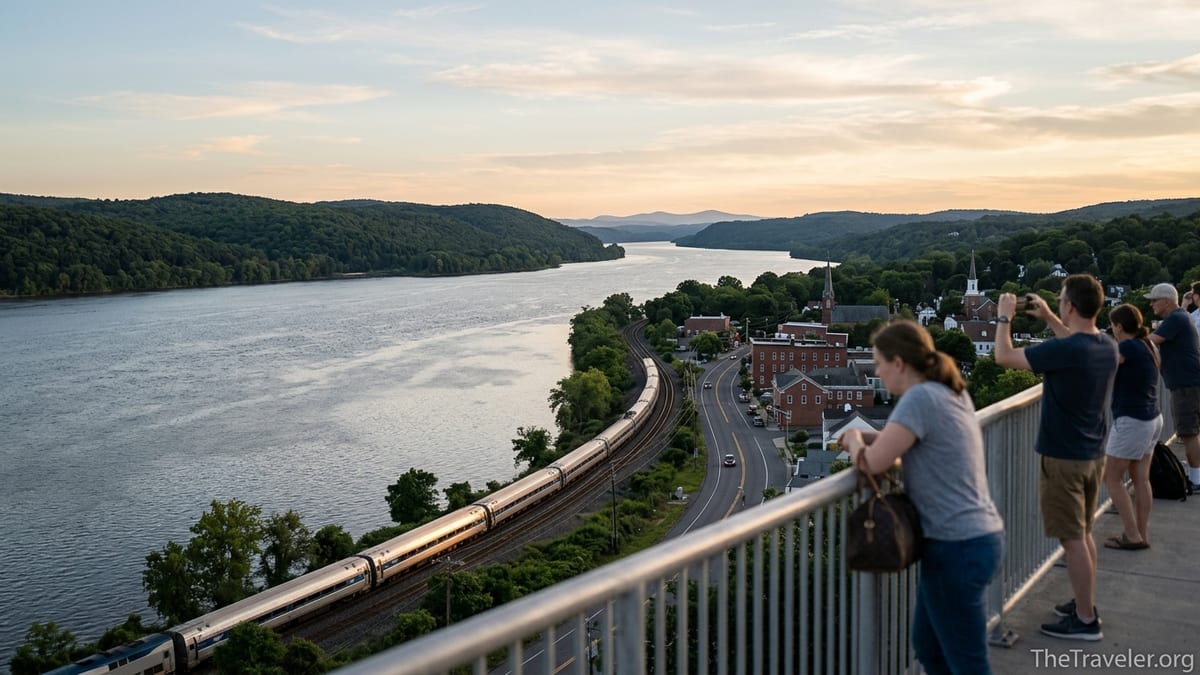
The Empire Service train slid out of Manhattan in the morning, tunneled briefly through the city’s underbelly, then emerged onto river views that felt almost theatrical in their contrast. On the left, commuter towns and industrial remnants; on the right, the Hudson River widening into mirror-like stretches, with low mountains layering into the distance. It is a journey local transit advocates frequently praise as one of the country’s most scenic short train rides, and it took less than half an hour of watching the skyline recede for me to understand why.
Places I had once skimmed past as station names on a timetable suddenly snapped into focus. In Poughkeepsie, the elevated Walkway Over the Hudson arches more than 200 feet above the river, a converted railroad bridge that now forms part of a popular multi-use trail. Day-trippers step off the train, walk straight uphill from the station, and find themselves staring down at the same river the train had just followed, framed by forested hills and the outlines of old estates on both banks. The decks of the walkway buzzed with a mix of Lycra-clad cyclists, families pushing strollers, and photographers setting up tripods for long shots of freight trains snaking along the shore.
Further north, the Hudson Valley’s small river cities offered a lifestyle that felt almost like a rebuke to the intensity of New York City. In Kingston, I wandered cobblestone blocks in the Stockade District where 18th-century stone houses now held bakeries, wine bars, and design shops. Locals lined up at a neighborhood bakery for loaves made with heritage grains and seasonal pastries; a sandwich and coffee came in around 15 dollars, about what you would pay in Brooklyn but in a room that felt more like a living room than a production line. A ten-minute drive brought me down to the Rondout Creek waterfront, where people lingered on benches looking out at marinas and low hills, with none of the performative rushing you see on a Manhattan sidewalk.
What struck me more than the scenery was the language people used. In cafes and on sidewalks I heard New Yorkers refer to “going down to the city” the way someone in a small town in France might mention a trip to Paris. New York, in their vocabulary, clearly did not mean the entire state. The Hudson Valley was its own world, with its own rhythms and reference points. Hiking plans revolved around the Catskill and Shawangunk ranges. Restaurant conversations centered on which farm was supplying tomatoes that week. At some point between Yonkers and Albany, the mental map I had carried for years began to redraw itself.
Albany: A Capital That Feels More Like a College Town
Roughly two and a half hours after leaving Manhattan, the train pulled into Albany-Rensselaer, the main rail hub for New York’s capital region. The station sits across the river from downtown, and a quick rideshare across the bridge cost about 10 to 15 dollars at midday, far less than what I’d expect to pay for a similar distance in Manhattan. For under 70 dollars door to door, I had traveled from Midtown to the steps of the State Capitol, something that would have sounded implausible to my earlier self who thought long-distance American rail was a luxury product.
Albany surprised me with its density of history packed into just a few walkable blocks. The New York State Capitol building itself is an ornate stone puzzle of staircases and turrets that feels transplanted from Europe, perched on a hill that looks out over the city. Behind it, the towers and plazas of the Empire State Plaza create an almost surreal modernist counterpoint. Office workers eat lunch in the sun on wide concrete steps, and teenagers on skateboards practice tricks under the watchful gaze of government buildings. Only a few streets away, Lark Street and Center Square have the compact, artsy feel of a college neighborhood, with coffee shops, vintage stores, and casual restaurants doing brisk business with a mix of students and civil servants.
Practically speaking, Albany was the point where the cost of travel seemed to reset. I checked into a small independent hotel just off Washington Park for roughly half of what I had paid in Manhattan, and the room was bigger, with leafy views over Victorian brownstones. Dinner at a mid-range bistro, including a glass of local Riesling from the Finger Lakes and a main course built around seasonal produce, came in just under 40 dollars before tip. For anyone used to city prices, that kind of bill recalibrates what a night out can feel like.
More than anything, the capital region showed me that New York’s political heartland is not the metropolis on the Hudson that dominates the headlines. Lawmakers debate budgets in chambers that sit closer to Adirondack trailheads than to Broadway theaters. Policies that affect New Yorkers from Queens to the Canadian border are hammered out in a city where most restaurants close by 10 p.m. and where a short drive puts you on quiet back roads skirting horse paddocks and cornfields. The state’s center of gravity, in other words, is literally and figuratively elsewhere.
The Finger Lakes: Discovering Wine Country in “Snow Country”
From Albany I picked up a compact rental car, the kind you can often find for around 50 to 80 dollars per day before taxes and fees if you book ahead outside of holiday periods. The drive west toward the Finger Lakes followed the New York State Thruway past rest areas, wind farms, and rolling fields. It is about two and a half to three hours to major Finger Lakes towns like Ithaca or Geneva, but it feels longer simply because the scenery slowly shifts from low, gentle hills to deeper green valleys and, eventually, the long narrow lakes that give the region its name.
I based myself near Seneca Lake, one of the largest of the chain, where vineyards tumble almost directly down to the water’s edge. Before this trip, I associated American wine regions with California and perhaps Oregon. Standing on a deck at a family-run winery outside Geneva, watching a tour group swirl glasses of dry Riesling while a local winemaker pointed to the glacial slopes behind us, I realized how completely I had missed New York’s reputation as a serious wine state. Tasting flights commonly run around 10 to 20 dollars, and many wineries waive that fee if you purchase a bottle. It is an approachable, come-as-you-are kind of wine country, where visitors arrive in hiking boots and hoodies instead of linen suits.
Beyond the vineyards, the Finger Lakes revealed New York as a state defined by water in more ways than the Hudson or East River headlines suggest. At Watkins Glen State Park, the gorge trail climbs beside a stream that has carved 19 waterfalls into layers of shale and limestone, each bend revealing another curtain of water spilling into misty pools. The park’s entry fee is modest, and on a weekday morning I found myself sharing stone staircases and arched bridges with families speaking multiple languages, as well as local retirees who clearly walked the gorge as part of their regular routine. It was as far as you could get, spiritually, from a packed subway platform.
In Ithaca, the college town on Cayuga Lake fringed by Cornell University and Ithaca College, the stereotype of “snow country” softened even further. Restaurants downtown served menus built around local farms and dairies, often at prices just below what you might pay for similar dishes in New York City. A casual lunch of a seasonal salad, soup, and coffee set me back just over 20 dollars including tax and tip. The city’s slogan, “Ithaca is Gorges,” printed on T-shirts and café mugs, is more than a pun. A short walk from downtown brought me to the edge of Cascadilla Gorge, where stone stairs climb past waterfalls powerful enough to generate their own fine spray of rain on a sunny day.
Western New York and Niagara Falls: A Borderland State of Mind
From the central lakes, I continued west toward Buffalo and Niagara Falls, a drive that adds roughly another three hours depending on your route and traffic. The open farmland gradually gave way to a patchwork of small towns, industrial corridors, and, eventually, the grain elevators and brick warehouses that mark the approach to Buffalo’s waterfront. Until I arrived, Buffalo had existed in my mind as a punch line about snowstorms and football heartbreak. On the ground, it felt like a lake city in the middle of a long, determined reinvention.
Down at Canalside, a redeveloped stretch where the Erie Canal once met Lake Erie, families rented kayaks, teens zipped by on rented scooters, and couples lined up for soft-serve ice cream from food trucks. It was a summer evening, and live music drifted from a public stage while the glassy facade of a nearby hotel reflected pastel clouds. Hotel rates in Buffalo and nearby Niagara Falls can vary wildly by season, but midweek stays outside the height of summer or major holidays often come in significantly lower than New York City prices, making this part of the state an attractive base for budget-conscious travelers who still want big-water drama.
That drama came into full view at Niagara Falls, which I reached on a short drive north from Buffalo. On the U.S. side, Niagara Falls State Park is free to enter, and while attractions like boat tours and observation decks charge separate fees, it is entirely possible to spend a day wandering the paths that thread along the cliffs with little more than parking and snack money. Standing at the lip of Horseshoe Falls, the roar drowns out conversation and a constant plume of mist rises into the air, catching whatever sunlight filters through. It is a reminder that New York’s western border is defined not just by a line on a map, but by a natural spectacle that the world flies in to see.
What struck me here was how psychologically far Niagara felt from New York City. Many visitors I chatted with at the railings had arrived from Ohio, Pennsylvania, or Ontario and had never been to Manhattan at all. For them, New York meant upstate outlets, campgrounds, and border crossings, not Broadway or Wall Street. The state I had always viewed through a city-centric lens revealed itself as a borderland, as oriented toward the Great Lakes and Canada as it is toward the Atlantic and New Jersey.
Meeting the Many New Yorks Through the People Who Live There
As landscapes shifted, so did my picture of who a New Yorker is. On the train north out of Manhattan, I sat across from a state employee commuting back to Albany after a weekend in the city. His definition of home included lunch breaks on the Empire State Plaza, weekend hikes in the Adirondacks, and the comforting knowledge that he could be in Manhattan in a few hours if he wanted a big-city night. “We go down once a month,” he said. “It’s nice to visit. But I like that my kids can ride their bikes on our street.”
In the Hudson Valley, small business owners talked about the delicate balance between being close enough to New York City to attract weekenders and distant enough to maintain a sense of community. A café owner in Kingston told me that half her Saturday customers seemed to arrive in cars with city parking stickers, while weekdays were dominated by locals on first-name terms. Her rent, she said, was a fraction of what it would be in Brooklyn, but staffing was a challenge because younger workers often left for bigger cities after college. The push and pull of opportunity versus affordability played out in nearly every conversation.
Out in the Finger Lakes, “New Yorker” meant something else again. Vineyard employees and winemakers spoke with quiet pride about seeing bottles from Seneca, Keuka, and Cayuga lakes appear on wine lists in Manhattan and beyond, yet many had little interest in moving downstate themselves. Their year was structured more around harvests, frost warnings, and summer tourism than around subway schedules. At one winery, a young assistant winemaker with family in Queens described his life as “city by phone, country by choice,” flying down for weddings and holidays but always returning north as quickly as possible.
By the time I reached Buffalo and Niagara Falls, the state’s identity had splintered further in the best possible way. Here, the word “New York” frequently appeared alongside “Great Lakes,” “Rust Belt,” and “border town” in local news coverage and casual conversation. Buffalo residents spoke as easily about weekend trips to Toronto or Cleveland as they did about journeys to Manhattan. The idea of New York as a single, coherent mental picture had dissolved into a mosaic of overlapping regional identities, each anchored in specific landscapes, industries, and histories.
The Takeaway
My first real trip through New York State taught me that the version of New York most outsiders know is, at best, a single chapter in a much larger story. In one week, I watched the state transform from global city to river valley, from small capital to quiet wine country, and finally to a windswept Great Lakes frontier. Each region came with its own price points, priorities, and pace of life, challenging the assumption that New York is synonymous with density, noise, and relentless ambition.
Practically, the journey showed how accessible much of this diversity is. A mid-range traveler can pair a couple of high-cost nights in Manhattan with more affordable stays in Albany, the Finger Lakes, and Western New York, balancing out the budget while dramatically expanding their idea of what a New York vacation can be. Trains cover key corridors along the Hudson and across the state, while well-maintained highways connect the rest, making it entirely feasible to stitch together a city, countryside, and borderland itinerary without elaborate planning.
More subtly, the trip shifted the way I think about labels. Saying you have “been to New York” after a long weekend in Manhattan now feels a bit like claiming you know Italy because you once spent 48 hours in Rome. The state contains multitudes: small towns where everyone waves from porches, college cities built around gorges and waterfalls, capitals where politics unfold far from television studios, and frontier cities facing lakes that behave like inland seas. The next time someone tells me they want to see New York, I will ask what they mean. Do they want neon or mist, skyscrapers or vineyards, subway rumble or train whistles on river curves?
My own answer, after that first real trip, is simple. New York is all of these things at once, and understanding the state means stepping onto a train or highway and letting the city recede in the rearview mirror. Only then do the other New Yorks come into view.
FAQ
Q1. Is it realistic to explore New York beyond the city on a one-week trip?
Yes. In about seven days you can comfortably combine New York City with the Hudson Valley, Albany, part of the Finger Lakes, and either Buffalo or Niagara Falls, especially if you use the train for the Hudson corridor and a rental car for the central and western parts of the state.
Q2. How expensive is it to travel through New York State compared with staying only in New York City?
Outside New York City, average hotel and restaurant prices tend to drop noticeably. While Manhattan rooms commonly run well above 250 dollars per night, you can often find comfortable mid-range hotels in places like Albany, Ithaca, or Buffalo for roughly half to two-thirds of that, which helps balance out the higher costs of a few city nights.
Q3. Do I need a car to see the Hudson Valley and Albany?
You can reach many Hudson Valley towns and Albany by train from New York City, and local rideshares or taxis can cover short hops from stations to hotels or attractions. A car becomes more useful if you want to explore smaller trailheads, country roads, or multiple towns in one day, but it is not strictly essential for a first visit focused on major stops along the Hudson.
Q4. What is the best way to reach the Finger Lakes from New York City?
The most flexible option is to take a train from New York City to Albany or Syracuse, pick up a rental car there, and drive the remaining distance to lakes such as Seneca, Cayuga, or Keuka. Direct long-distance buses also serve some towns, but a car gives you much more freedom to visit wineries, state parks, and smaller villages scattered around the lakes.
Q5. When is the best time of year for a first trip through upstate New York?
Late spring through early fall offers the most reliable weather for hiking, winery visits, and lake activities, with October being especially popular for fall foliage in the Hudson Valley and the Finger Lakes. Winter visits can be rewarding for snow sports in the Adirondacks and Catskills, but driving conditions and shorter daylight hours require more planning and flexibility.
Q6. Are train tickets within New York State affordable for budget travelers?
On key routes like New York City to Albany, advance-purchase coach fares can start in the 30 to 50 dollar range for one-way trips, which is competitive with the combined cost of gas, tolls, and parking. Prices rise around holidays and busy weekends, so booking early and being flexible with departure times is the best way to keep costs down.
Q7. Is it safe to travel alone through the Hudson Valley, Finger Lakes, and Western New York?
Most visitors find these regions welcoming and straightforward for solo travel, with well-used trails, busy small towns, and established tourist infrastructure around places like Niagara Falls. As in any destination, it is wise to follow standard precautions, such as staying aware of your surroundings, checking trail conditions, and choosing reputable accommodations.
Q8. How long does it take to drive from New York City to Niagara Falls?
The drive from New York City to Niagara Falls is roughly 380 miles and usually takes between six and seven hours in normal traffic using major highways. Many travelers break the trip with overnight stops in cities such as Syracuse, Rochester, or Buffalo, which turns a long drive into a more relaxed road trip with time to explore along the way.
Q9. Can I visit wineries in the Finger Lakes without deep knowledge of wine?
Absolutely. Most tasting rooms in the Finger Lakes welcome beginners, offering simple flights that cost around 10 to 20 dollars and staff who are happy to explain styles and grape varieties. Casual clothing is standard, and many wineries have outdoor seating with lake views, making the experience as much about the landscape as the wine itself.
Q10. How should I split my time between New York City and the rest of the state on a first visit?
A balanced first itinerary might allocate two or three nights to New York City for core sights, then four or five nights divided between the Hudson Valley, one Finger Lake, and either Buffalo or Niagara Falls. This pacing lets you experience both the iconic city highlights and at least two very different upstate landscapes without feeling rushed.