


It started as a simple plan: swap one high-speed TGV ride for a slower regional TER train and see what everyday rail travel in France actually feels like. A few hours, a couple of missed announcements, and one impromptu lakeside stop later, I finally understood why locals talk about "prendre le TER" the way some people talk about their neighborhood café. TER trains are not glamorous, but they are woven into the daily fabric of French life in a way no glossy brochure can capture.
Get the latest updates straight to your inbox!
Discovering What TER Really Is
Like many visitors to France, my mental image of French trains began and ended with the sleek nose of the TGV. It was only when I started planning a side trip from Lyon to Annecy that the booking app kept suggesting something else entirely: TER. These Transport Express Régional services form the dense regional network that links more than a thousand stations across the country, from vineyard villages in Bourgogne-Franche-Comté to Atlantic surf towns in Nouvelle-Aquitaine. While TGVs race between major hubs, TER trains cover the smaller distances that actually shape day-to-day life.
On screen, a TER looks unremarkable: no obligatory seat reservations, a second-class fare that, on my Lyon–Annecy run, hovered around 25 to 30 euros one way depending on the time, and a travel time about an hour slower than the TGV options via Geneva. What the timetable did not show was the rhythm of commuters getting on with their lives: students with season tickets clipped to backpacks, nurses scrolling through duty rosters, office workers answering emails between countryside stations with names most tourists never pronounce.
My first surprise came when I realized how flexible the ticket was. For many routes, a TER ticket bought for a specific date is valid on any TER that day on the same stretch, within a certain time window set by the region. That meant if my morning coffee in Lyon’s Croix-Rousse neighborhood ran long, I could simply take the next service rather than panic about a missed reservation. For locals who juggle overtime, delayed school pick-ups, and traffic on the périphérique, that flexibility is not a bonus; it is the main reason they default to TER.
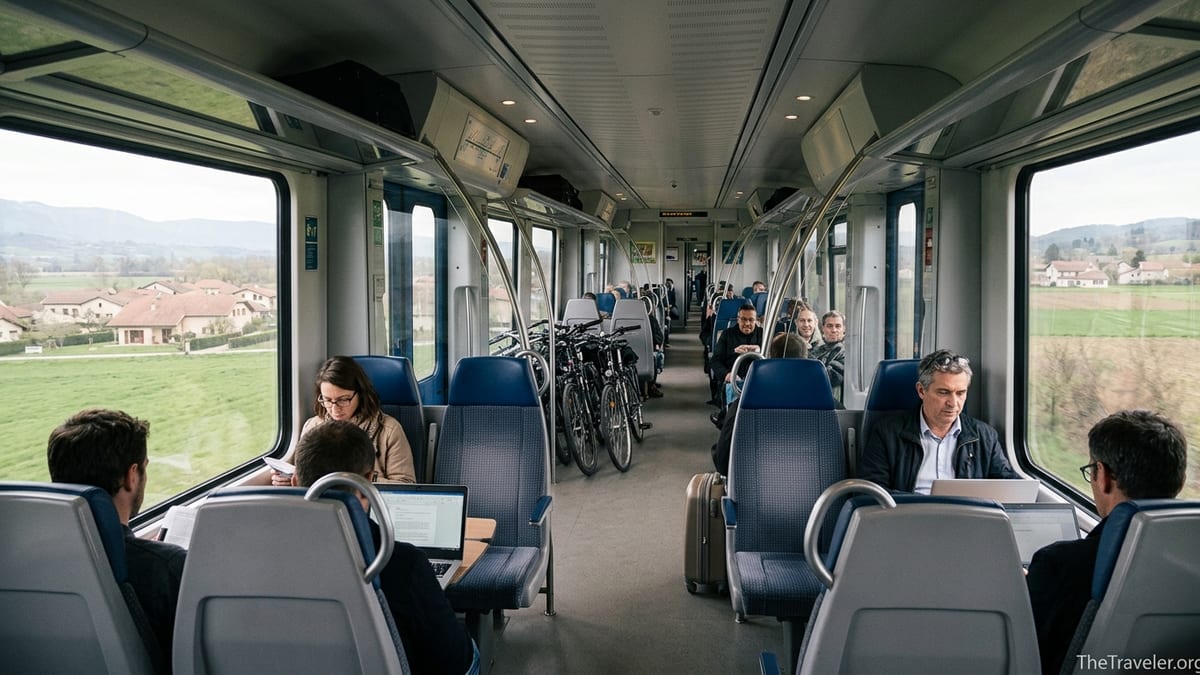
Stepping aboard in Lyon Part-Dieu on a weekday mid-morning, I immediately understood I was not on a tourist train. The carriage was clean but lived-in: fabric seats, overhead racks scuffed by decades of rolling luggage, and big picture windows that invited you to look out rather than at your phone. In the four-seat bays with tables, small groups quietly revised for exams or spread out regional newspapers. Everything felt resolutely ordinary, and oddly reassuring.
Why Locals Choose TER Over the Car Keys
Talking to fellow passengers on that first journey, I kept hearing the same refrain: "It’s simply cheaper and easier than driving." In regions where parking in city centers like Rennes, Bordeaux, or Strasbourg is both scarce and expensive, a monthly TER pass often beats the combined cost of fuel, tolls, and parking fees. Regional authorities have leaned into this with aggressive subscription offers and youth discounts, turning the TER into a backbone for commuters rather than a fallback.
On my Lyon–Annecy train, a university student from Chambéry pulled out his regional season ticket, which effectively capped what he paid for daily travel. He explained that his classmates who lived in outlying towns like Aix-les-Bains or Culoz used similar passes to commute into campus. In Nouvelle-Aquitaine, residents traveling between Bordeaux and smaller Atlantic towns benefit from regional tariffs that routinely undercut driving, especially when you factor in autoroute tolls. For families, children under four often travel free on TER when sharing a seat with an adult, and primary-school-aged kids generally get sharply reduced fares, making a Saturday trip to the coast financially realistic.
The value equation becomes clear on specific, popular routes. Between Paris and Normandy, for example, TER and regional Intercités services have long been the lifeline for commuters who live in Rouen or Dieppe but work in the capital. A single peak-hour run can be filled with people who have calculated that a regional rail subscription beats both the stress and the cost of sitting in traffic on the A13 every day. In the southeast, lines fanning out from Marseille and Nice along the Riviera move a similar crowd of workers and students who view the train as a utility rather than a travel experience.
There is also the question of reliability in capricious weather or traffic. On my own trip, a spring storm rolled over the Rhône valley, turning the autoroute into a red ribbon of delays on traffic apps. Our TER slowed slightly through heavy rain but kept moving, and the carriage stayed quiet except for the occasional hiss of doors and the soft thud of umbrellas in luggage racks. For people who must be at work in Grenoble by 8:30, or who finish late shifts at hospitals in Dijon or Lille, that predictability is worth more than shaving 20 minutes off the journey by car.
The Slow Reveal of Regional France From a TER Window
What TER lacks in drama, it makes up for in perspective. As we left the industrial edges of Lyon, the view from my window shifted to vineyards clinging to hillsides near Villefranche-sur-Saône, then to flat pastureland speckled with stone farmhouses. Regional lines, like those in Auvergne-Rhône-Alpes or Grand Est, often follow older conventional tracks that predate the high-speed network, threading right through the middle of ordinary towns. Platforms in places like Ambérieu-en-Bugey or Bourg-en-Bresse sit practically level with main squares, meaning you step off the train into the middle of daily life rather than into an out-of-town station connected by airport-style shuttles.
Other routes provide an unexpected form of sightseeing without the need for a tour. On the line from Bordeaux toward Arcachon, afternoon TER trains fill with a mix of commuters and surfers heading for the Atlantic sand. The carriage slowly empties at stations like Facture-Biganos and La Teste-de-Buch, where pine forests, campsites, and bike rentals begin just beyond the station car park. In the northeast, TER services along the Moselle and Rhine offer glimpses of terraced vineyards and riverside castles that would fit easily into a glossy brochure, yet they are simply the backdrop to someone’s Wednesday commute to Metz or Strasbourg.
My own highlight came just before we arrived in Annecy. The train hugged the north shore of the lake, and for ten minutes the windows became picture frames filled with turquoise water, small sailing boats, and paragliders drifting above alpine slopes. Many locals barely looked up from their screens. For them, the view is Tuesday. That, more than anything, revealed how TER quietly redefines what a "normal" commute can look like in France.
Crucially, TER stations anchor these landscapes in a practical way. The small station in Annecy is a gateway not just to the old town’s cobbles and canals but to a web of local buses and bike paths around the lake. You can arrive on a regional train from Lyon or Grenoble, walk straight to the bus bays outside, and be in lakeside villages like Talloires or Menthon-Saint-Bernard with a single combined ticket. It is this seamless stitching of regional rail to local transport that keeps locals returning to TER services day after day.
The Everyday Rituals of Riding TER
My induction into TER travel began before I even stepped onto the platform: at the validation machines. While many tickets and passes are now digital through the SNCF Connect app or regional equivalents, paper tickets often still need to be validated just before boarding. In larger stations such as Lyon Part-Dieu, yellow or orange composting machines sit at the entrance to the platforms. I watched as locals, barely breaking stride, slipped tickets into the slot for a quick stamp. A student noticed my hesitation and gently pointed at the machine, saving me from what could have been an awkward encounter with a ticket inspector later on.
Once aboard, the etiquette is quiet, low-key, and surprisingly consistent across regions. People answer phone calls in low voices, headphones are the norm, and feet stay off the seats. On morning runs from commuter belts into cities like Toulouse or Nantes, regulars often gravitate to the same doors or favorite sections of the carriage, nodding in recognition when they spot familiar faces. It felt a world away from the more anonymous atmosphere of long-distance trains, partly because people repeat the same journey every day at the same time.
I also learned how much TER riders depend on the little amenities sprinkled throughout the network. Some trains offer limited power outlets, especially in newer rolling stock favored on busy lines such as those linking Montpellier with Nîmes and Avignon. Bicycle spaces, free and unreserved on most TER routes, are another local essential: on a Saturday TER to Annecy, an entire section of the carriage was given over to bikes, with weekend cyclists heading toward mountain passes. In Brittany and along the Loire à Vélo, it is perfectly normal to see commuters sharing space with touring cyclists, everyone shuffling gear to make room as more bikes join at intermediate stops.
Announcements, meanwhile, drift in and out of the background like a calm radio host. At each stop, the conductor names the station and any important connections, occasionally adding a reminder about being in the correct section of a train that will later divide. Locals barely react. They have already memorized where to stand and which carriage to choose if they are changing at Clermont-Ferrand or Dijon. For a first-timer, the lesson is simple: follow the flow of regulars; they are rarely wrong.
Tickets, Flexibility, and the Fine Print Visitors Miss
Nothing taught me more about how locals use TER than buying the wrong ticket. Or more accurately, almost buying the wrong ticket. On the SNCF Connect app, I first searched Lyon to Annecy and saw a mix of options, including TGV and TER, with wide price variations across the day. A midday TER was cheaper than the early morning one, and when I clicked through, I noticed the note that my ticket would be valid for any TER on that route on the selected date, as long as I traveled within the indicated validity window. Locals instinctively look for these more flexible fare types on regional routes where they know delays or last-minute schedule changes are common.
Then there are regional discount cards and passes. Every French region has its own ecosystem: in Auvergne-Rhône-Alpes, a young traveler might hold a card that gives around 30 to 50 percent reductions on TER fares in exchange for an annual fee; in Nouvelle-Aquitaine or Occitanie, similar cards target commuters, seniors, or frequent weekend riders. Season tickets valid between two stations, like Rouen and Paris or Reims and Épernay, effectively turn TER trains into moving extensions of the metropolitan transport network. It is telling that for many city workers who live just beyond suburban rail zones, the monthly TER debit from their bank accounts sits in the same mental category as electricity or mobile phone bills.
One subtle trap for visitors is assuming that any train in a region is automatically a TER. In reality, France’s rail ecosystem includes high-speed services, long-distance Intercités, low-cost brands, and regional TER trains, each with its own rules. A ticket valid on a TER between Bordeaux and Angoulême, for instance, does not automatically allow you to board a TGV on the same line. Locals have absorbed these distinctions over years of practice, but for a first-timer it pays to double-check that the train labeled on the departure board matches the type printed on your ticket or shown in your app.
On my first journey, I also saw how locals protect themselves against disruptions. Regular riders in areas prone to strikes or engineering works keep an eye on regional transport alerts through apps or station boards, and they are quick to adjust: boarding an earlier TER, rerouting through a different hub like Valence instead of Grenoble, or temporarily switching to a bus replacement service when track work closes a line. The comfort with such changes comes from knowing that the network is dense and the fares, while not cheap in absolute terms, remain competitive enough that rebooking a TER connection is rarely ruinous.
Comfort, Crowds, and What to Expect On Board
From a comfort perspective, TER sits somewhere between a commuter train and a long-distance service. Cars are usually single-class, though older rolling stock sometimes retains a first-class section that locals mostly ignore. Seats are generally arranged in a mix of two-by-two rows and facing bays of four, with large windows that make even a grey day over the Massif Central feel expansive. On my mid-morning departure from Lyon, I easily found a pair of seats to myself; by the time we reached Chambéry, the train had filled with school groups and office workers, turning the carriage into a polite, buzzing corridor of regional life.
During peak commuter hours on routes into big job markets like Lyon, Lille, or Bordeaux, expect to stand, especially near the doors. Locals know exactly which departures are habitually busy and sometimes travel one train earlier to avoid the crush. They also board with an efficiency honed by repetition: tickets ready, backpacks off shoulders to fit overhead, and a practiced glance to locate spare seats. In some regions, especially where new bi-level TER trains operate, upper-deck seats offer quieter rides and better views, a trick locals quietly pass on to friends and family.
A notable absence on many TER services is a café bar. On my first run, I made the novice mistake of boarding without water or snacks, assuming there would be a trolley service as on some long-distance trains. Instead, the only sustenance came from a vending machine on the platform at Lyon and a small kiosk near the exit in Annecy. Regular riders plan ahead, walking onto the train with baguette sandwiches, thermos coffee, or a quick takeaway espresso from the station concourse. Watching them settle in with neatly wrapped lunches, I realized that part of the TER ritual is making the train an extension of your kitchen and living room.
Noise levels and atmosphere vary by time of day. Early-morning and late-evening trains can be almost library quiet, with half-dimmed carriage lights and passengers dozing against the windows. Mid-afternoon departures, especially in school term, sometimes fill with teenagers heading home, adding a burst of conversation and music leaking from earbuds. Even then, there is a shared understanding about volume. Over several trips across different regions, I never once saw a conductor ask someone to quiet down; the group dynamic polices itself.
How My First TER Journey Changed the Way I Plan Trips
By the time I stepped off the train in Annecy, my view of French rail travel had shifted. TER was no longer a line item in the booking app but a tool I could actively use to shape itineraries. On a later trip, I planned a weekend in Alsace using only regional trains: a TER from Strasbourg to Colmar, then another on to Mulhouse, with a stop in a smaller town to wander between half-timbered houses and vineyards. Because the tickets were flexible within the day, I did not stress about catching a specific departure. If a tarte flambée lunch in Colmar ran long, I simply took the next train south.
I also began using TER to unlock places that high-speed lines bypass. In the Loire Valley, for example, regional trains link Orléans, Blois, Amboise, and Tours, allowing you to hop between châteaux without ever renting a car. In Provence, TER lines between Marseille, Aix-en-Provence, and Arles create an easy triangle for art, Roman ruins, and sea views. Locals have long used these same trains to commute, shop at city markets, or visit family on weekends. Seeing the network through their eyes gave me a different kind of map: not one of tourist highlights, but of lived connections.
Perhaps the most lasting change was psychological. Before that first journey, I treated train reservations like flights: fixed times, non-negotiable plans, and anxiety if anything slipped. Riding TER showed me a more forgiving model. As long as I chose the right type of ticket and kept an eye on regional schedules, I could move more spontaneously, following weather, mood, or local advice. When a guesthouse owner near Annecy suggested a market in a nearby town accessible by a short TER hop, I could say yes without worrying about changing a high-speed booking.
Looking around the carriage on my subsequent trips, I realized that this flexibility is exactly why locals default to TER for so many parts of their lives. The trains are not spectacular, but they are there, running frequent services on workday mornings, shoulder-peak afternoons, and sleepy Sunday evenings. They connect jobs to homes, campuses to villages, and coastal towns to inland cities, all at a price point and reliability level that keep people choosing them over the highway.
The Takeaway
My first TER journey began as an experiment in saving money on a side trip. It ended as an education in how France really moves. By trading a little speed and glamour for a lot of flexibility and local reach, TER trains have become the quiet backbone of daily life for millions of passengers. Watching students revise, workers answer emails, and grandparents shepherd grandchildren off at tiny stations, I saw how deeply these unassuming blue-and-white trains are threaded into the country’s routines.
For travelers, the lesson is clear. If you plan your trip around TGV schedules alone, you will see the big-ticket destinations, but you may miss the web of smaller places that give France its texture. Embracing TER means accepting occasional crowds and the need to read local fine print on tickets, but it also opens up lake towns, vineyard valleys, and working cities at a human scale. It invites you into the same carriages locals use, at the same times of day, for the same everyday reasons.
On that first ride from Lyon to Annecy, the train slowed for a signal outside a small village, giving me an unscripted minute to watch kids biking home from school along a country road. No guidebook had mentioned the place; no itinerary had planned the pause. Yet in that quiet moment, framed by a TER window, I found exactly what I had been looking for: a glimpse of how people really live, move, and travel here. For that alone, I now understand why, when in doubt, French locals reach for the same simple answer: "On prend le TER."
FAQ
Q1. Do I need to reserve a seat on TER trains in France?
In most regions you do not need or even have the option to reserve a seat on TER trains; you simply buy a ticket and sit in any available seat in the correct class.
Q2. How far in advance should I buy a TER ticket?
You can usually buy TER tickets on the day of travel at station machines or via apps, but buying slightly in advance can help you understand schedules and any regional promotions.
Q3. Are TER tickets flexible if I miss my planned departure?
On many routes a TER ticket for a specific date is valid on any TER that day on the same route within a defined time window, but you should always check the conditions shown when you buy.
Q4. What is the main difference between TER and TGV trains?
TGV trains are high-speed services with mandatory reservations and higher fares on long routes, while TER trains are regional, slower, usually cheaper, and focused on shorter distances and local stops.
Q5. Can I take my bike on a TER train?
On many TER routes standard bicycles are accepted without reservation in designated spaces, although capacity is limited at busy times and staff may refuse bikes if the train is too crowded.
Q6. Is there food service on board TER trains?
Most TER trains do not have a café bar or trolley service, so locals typically bring their own water and snacks purchased at station kiosks, supermarkets, or bakeries before boarding.
Q7. Are TER trains reliable for commuting to work or study?
While delays can happen, many residents rely on TER for daily commutes to jobs and universities, and frequent services on key routes make it a practical alternative to driving.
Q8. How comfortable are TER trains for longer journeys?
TER trains have basic but generally comfortable seating with large windows, and they are perfectly manageable for journeys of a few hours, though amenities are more limited than on long-distance trains.
Q9. Do children get discounts on TER tickets?
Children under a certain age often travel free or at reduced fares, and many regions offer specific family or youth discounts, so it is worth checking the regional fare information before you buy.
Q10. Is the TER a good option for tourists exploring smaller French towns?
Yes, TER trains are ideal for reaching smaller towns and rural areas that high-speed services bypass, allowing visitors to explore lakes, vineyards, and historic centers alongside local residents.