


On my last few trips across Europe, from café-hopping in Paris to late-night taxis in Lisbon, the Halifax Clarity credit card was my main spending tool. It has a loyal following among UK travellers, but I wanted to see how it performed in the real world, across different countries, payment terminals and ATMs. This is my candid account of what the card does brilliantly, where it can catch you out, and how to use it smartly if you are planning your own European adventure.
Get the latest updates straight to your inbox!
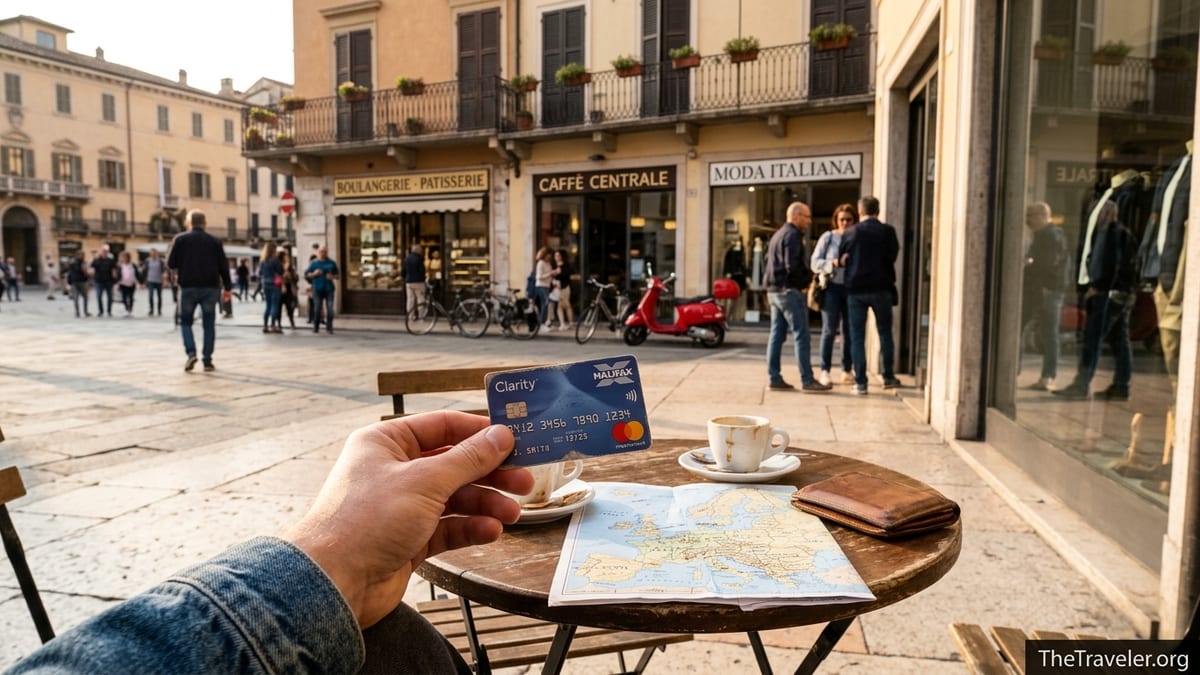
Why I Chose the Halifax Clarity for Europe
I applied for the Halifax Clarity card specifically for travel, not everyday spending at home. The headline attraction was that it does not charge a non-sterling transaction fee on card purchases abroad, and it does not add a separate fee for withdrawing foreign currency from ATMs, which is still unusual among UK credit cards. In practice, that meant I could pay in euros or other European currencies without the typical 2 to 3 percent loading that many standard cards still apply.
The second big draw was that the card uses the Mastercard exchange rate on foreign transactions. In my trips through France, Spain, Portugal and Italy, I consistently found this rate to be close to what you would see if you searched the mid-market rate on a currency converter at the same time. While exact differences move daily, restaurant and hotel charges converted back into pounds were always reassuringly close to what I had expected before I tapped the card.
Finally, I liked the simplicity. There is no annual fee, the card is widely accepted across Europe wherever Mastercard is taken, and the key rules are straightforward once you understand one important catch around cash withdrawals. I went into the trip knowing that purchases and ATM usage would be treated differently, and that knowledge made all the difference to how much I ultimately paid.
Day-to-Day Spending: Contactless, Chip & PIN and Offline Moments
For everyday spending in Europe, the Halifax Clarity card worked almost flawlessly. In central Paris, I used it contactlessly for metro tickets at the turnstiles, for coffees and pastries in Saint-Germain, and for mid-range restaurant bills around 40 to 70 euros. In Madrid and Barcelona, it paid for tapas, museum tickets and intercity train reservations. In Lisbon, I used it at small family-run restaurants where the terminal still asked for chip & PIN rather than tapping.
One thing I noticed is that the Clarity card handled small transactions just as cleanly as larger ones. A 2.50 euro espresso in Rome, a 6 euro ice cream in Florence or a 1.50 euro bakery purchase in Porto all went through without any foreign usage fee added on top. When I checked my Halifax app, the pounds equivalent was simply the Mastercard rate for that day, rounded to the nearest penny. Over a week, these tiny purchases would have quietly cost several extra pounds on a typical card with a 2.99 percent foreign loading.
Acceptance was very strong. In all the major European cities I visited, anywhere that took cards took the Halifax Clarity without batting an eyelid. In smaller towns in central Portugal and rural Italy, I occasionally had to revert to cash at tiny local cafés, but that was down to the merchant not taking cards at all rather than any issue with Halifax or Mastercard. Contactless limits were the same as for local cards, so tapping for 10 to 50 euro purchases felt completely normal for the staff processing them.
The Exchange Rate in Practice: Real Bills From the Road
To see how good the rate really was, I tracked a few specific transactions on the road. One morning in Paris, I paid a 48 euro restaurant bill for brunch on the Left Bank with the Halifax Clarity. When I checked later, the charge had appeared in my app as a pound amount that, when divided back, implied an exchange of roughly the live mid-market rate for that day, with only a tiny difference that you would expect from a card scheme rate. There was no separate line showing a foreign usage fee.
In Barcelona, I booked a last-minute hotel room costing 130 euros for the night. Again, paying with Clarity at the desk and choosing to be charged in euros rather than pounds produced an amount that came out very close to what online currency trackers were showing. If I had allowed the hotel terminal to charge me in pounds via its own conversion, the rate offered at the machine would have cost roughly several extra pounds on that single stay. Saying no to that option and letting Mastercard handle conversion with no Halifax fee was one of the simplest ways I saved money.
Similar patterns held in Lisbon and Rome. A 22 euro taxi from Lisbon airport into the city printed on the driver’s card reader with an option to “Pay in GBP” at a visibly worse rate or “Pay in EUR” at a rate I knew would be passed to Halifax and converted by Mastercard. By always choosing the local currency, every taxi, hotel and restaurant bill quietly benefited from the same principle. Over a two-week trip, that difference between the local bank’s dynamic conversion and the underlying Mastercard rate on a no-fee card can easily reach the cost of a good dinner for two.
Withdrawing Cash in Europe: The Big Catch Explained
Cash withdrawals are where the Halifax Clarity is different from a typical UK credit card, but also where it can trip you up. The strong advantage is that Halifax does not add a separate cash withdrawal fee when you take money out of a foreign ATM in euros or other local currencies. That is in contrast with many standard cards that charge you a fixed fee plus interest. On my trips, I withdrew 200 euros at a bank ATM in Paris and another 150 euros from a machine attached to a supermarket in Madrid, and in both cases the statement showed the converted pound amount with no Halifax cash fee.
The important trade-off is that interest on cash begins to accrue from the day the withdrawal is processed, not from your next statement date. That means that, even if you always pay off your full balance each month, you will still be charged some interest on those cash withdrawals for the days between taking out the money and clearing it. In my case, withdrawing 200 euros early in the trip and then paying it off through online banking a couple of days later cost me only a small amount of interest, but it was still there.
Local ATM operators can add their own charges on top, and that has nothing to do with Halifax. In central Rome, a tourist-focused ATM that was not attached to a mainstream bank tried to levy a fixed fee for withdrawing 50 euros and pushed me towards being charged in pounds at a very poor conversion rate. I cancelled the transaction, walked to a bank-branded machine a few streets away and withdrew cash there instead, avoiding the local fee and relying on the Halifax card’s no-fee structure and the Mastercard rate.
How I Managed Interest on ATM Withdrawals
To keep interest on cash withdrawals as low as possible, I treated the Halifax Clarity almost like a debit card for ATM use, even though it is a credit card. After each cash withdrawal, I opened my Halifax app that same day once the transaction had appeared as pending, and I made a manual payment from my current account to the credit card for roughly the pound value of the withdrawal. By clearing most of the balance quickly, I reduced the number of days on which interest could pile up.
On a week-long trip to Portugal, I withdrew 100 euros in Porto on the first day and 120 euros in Lisbon three days later, both using bank ATMs. As soon as I had Wi-Fi back at the hotel, I checked the card and sent a payment for just over the estimated total in pounds. When the next statement arrived, the interest on those withdrawals was only a small, clearly itemised amount, far less than what a typical card with a foreign cash fee would have charged me for the same access to cash.
Some frequent travellers go one step further and deliberately load the account into a small positive balance before travelling, so that when they withdraw cash on the Halifax Clarity, the interest effect is softened because the card is effectively drawing down that positive amount. Halifax does not market the card as a prepaid solution, and you need to be careful to stay within your credit limit and not rely on this too heavily, but in practice keeping the balance near zero or slightly in credit between withdrawals did make the overall cost of cash closer to fee-free for me.
Common Pitfalls I Faced and How to Avoid Them
The most common trap is accepting dynamic currency conversion when paying by card or using an ATM. Many terminals in Europe will ask whether you want to pay in pounds instead of the local currency, sometimes presenting this as the safer or clearer choice for British travellers. In reality, on every occasion I compared, the pound amount offered on the terminal included a weaker rate and extra margin for the local bank or payment provider. With the Halifax Clarity, the whole point is to let Mastercard do the conversion with no added Halifax fee, so I always selected the local currency: euros in France, Spain, Portugal and Italy, or other currencies elsewhere in Europe.
Another pitfall is assuming cash withdrawals are “free” just because Halifax does not charge a separate cash fee. On an early trip using the card, I made the mistake of withdrawing 300 euros in one go at the start of a city break and then waiting until my statement date to pay it off. The interest charged for that period was noticeable, and it wiped out some of the savings I had made on foreign transaction fees. After that, I made a rule for myself that any cash withdrawal had to be matched with a payment from my current account within a couple of days.
Lastly, I found it important not to mix big cash withdrawals with existing promotional balances on the same card. If you have a long-term balance transfer or other promotional rate running on your Halifax Clarity, ATM withdrawals can complicate how your payments are allocated and lead to more interest than you expect. On one occasion, I used a different card entirely for a balance transfer and kept the Clarity purely for travel spending, which made it far simpler to track and manage.
How the Card Stacked Up Against Alternatives on My Trips
On the road, I compared my Halifax Clarity experience with travelling companions who used debit cards from challenger banks and more traditional high street options. Friends with standard UK debit cards tied to big-name banks often faced a foreign transaction fee on every euro card purchase plus a separate fee for using overseas ATMs, on top of the less favourable exchange rate that some providers applied. When we split restaurant bills, their final pound cost for the same meal or bar tab was consistently higher than mine by a few percent.
By contrast, friends carrying newer app-based bank cards sometimes enjoyed similarly competitive exchange rates and low or zero foreign transaction fees on purchases. However, many of those products imposed a monthly cap on fee-free cash withdrawals abroad or charged weekend markups, particularly in very touristy periods. On a long trip where I needed to take out cash several times, that made Halifax Clarity’s no foreign ATM fee and solid Mastercard rate feel like a more robust choice, so long as I stayed on top of the daily interest by paying down withdrawals quickly.
For big-ticket expenses such as car hire deposits in Milan or hotel guarantees in Paris, having a credit card rather than just a debit card was also valuable. Several car rental desks were clearly more comfortable holding a deposit on the Halifax Clarity than on a debit card, and one hotel in Barcelona insisted that a credit card be provided for incidentals. In those cases, the Clarity acted not only as a cheap way to spend abroad but also as the key that unlocked certain bookings and services.
The Takeaway
After multiple trips across Europe using the Halifax Clarity card as my main payment method, my view is that it genuinely earns its reputation as a strong travel credit card if you use it with a bit of awareness. For everyday purchases, from metro tickets and museum entries to dinners and hotel bills, the combination of no foreign transaction fee and the Mastercard rate translated directly into savings compared with typical UK credit cards that still add a percentage charge on each non-sterling transaction.
The trade-offs are concentrated around cash. The card is unusual in letting you withdraw euros and other foreign currencies without a separate Halifax ATM fee, but you pay for that privilege through interest that starts piling up from the day of withdrawal. If you are willing to open your banking app on the road, make prompt payments back to the card, and avoid unnecessary or very large cash withdrawals, that cost can be kept modest. Ignore it, and the interest can erode the benefits of the card surprisingly quickly.
For me, the sweet spot has been to use Halifax Clarity for almost all card-based spending, always pay in the local currency instead of pounds at the terminal, and only withdraw cash when necessary, followed by a quick top-up payment. Treated that way, it has become a reliable, low-fuss companion for European travel, simplifying my spending and keeping those quiet, hard-to-see foreign card fees firmly under control.
FAQ
Q1. Does the Halifax Clarity credit card charge foreign transaction fees in Europe?
Halifax Clarity does not charge a separate non-sterling transaction fee on purchases in Europe, so card payments in euros or other local currencies are not hit with the usual percentage loading many standard cards add.
Q2. Is it really free to withdraw cash from ATMs abroad with Halifax Clarity?
Halifax does not add its own cash withdrawal fee for taking out foreign currency, but interest starts accruing from the day of the withdrawal, and some ATM operators may also charge their own fee.
Q3. How can I minimise interest on cash withdrawals when travelling?
The most effective way is to make a manual payment to your Halifax Clarity card as soon as possible after withdrawing cash, so that the balance relating to that withdrawal is cleared quickly and interest only applies for a few days.
Q4. What exchange rate does Halifax Clarity use for overseas spending?
Halifax Clarity uses the Mastercard exchange rate for foreign transactions, which is typically close to the live market rate and, importantly, does not have an extra Halifax foreign usage fee added on top for purchases.
Q5. Should I choose to pay in pounds or the local currency when using the card abroad?
With Halifax Clarity, it is generally better to pay in the local currency, such as euros, and let Mastercard handle the conversion, rather than accepting the terminal’s offer to charge you in pounds at its own, usually worse, rate.
Q6. Is the Halifax Clarity card widely accepted across Europe?
Yes, in my experience it was accepted anywhere that took Mastercard, including hotels, restaurants, train stations and most shops in major European cities and many smaller towns.
Q7. Can using the card for cash withdrawals affect my credit file?
Cash withdrawals on credit cards can be recorded as cash advances, which some lenders may view less favourably than ordinary purchases, so it is sensible to use this feature sparingly and mainly for genuine travel needs.
Q8. Is Halifax Clarity better than using a regular UK debit card abroad?
For many travellers it can be cheaper, because it avoids typical foreign transaction fees on purchases and does not add a Halifax cash fee at ATMs, although you still need to manage interest and be aware of any charges from the ATM owner.
Q9. Can I rely on Halifax Clarity as my only payment method when travelling?
While Halifax Clarity worked reliably for me, it is still wise to carry a backup card or some spare cash in case of network outages, damaged cards or merchants that only accept certain payment types.
Q10. How should I set up my Halifax Clarity card before a European trip?
Before you travel, make sure the card is activated, check your credit limit, enable the mobile app, confirm that Halifax has up-to-date contact details for you, and consider setting up online banking so you can make fast payments while you are away.