


More news on this day
Rail passengers and freight customers on several major corridors are watching recovery efforts closely after recent derailments left tangled wreckage beside key lines and raised renewed questions about how quickly railways can restore safe, reliable service.
Get the latest news straight to your inbox!
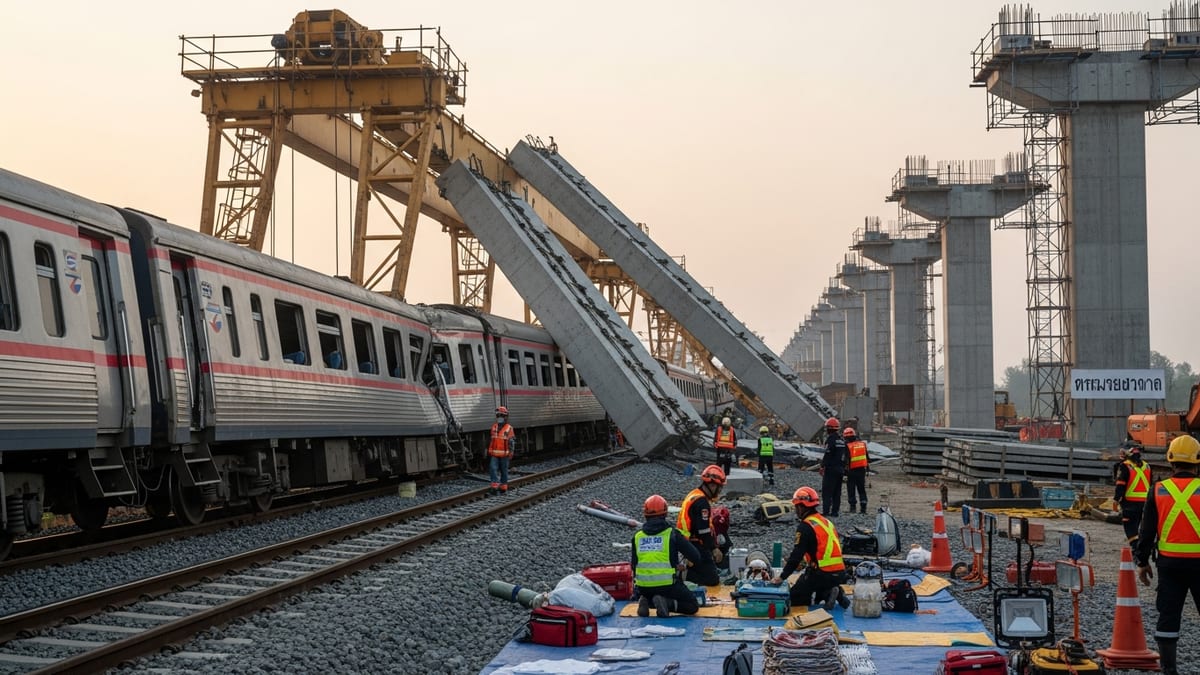
Wreckage removal shapes recovery timelines
Recent derailments in North America and abroad illustrate how long wreckage can remain in place while investigators document evidence and railway teams plan complex lifting operations. In some incidents, locomotives and freight cars have stayed visible beside reopened tracks for weeks as technical crews work around active rail traffic.
Publicly available information from rail safety boards and regional rail operators shows that the most challenging sites tend to be locations where derailed equipment has jackknifed or stacked, requiring heavy cranes, temporary access roads, and carefully sequenced lifts. These logistical demands can prolong the presence of wreckage long after trains begin running again on adjacent tracks.
Updates from rail investigators emphasize that debris cannot be moved until key components are documented, including wheels, couplers, and damaged rail. Once that phase is complete, teams focus on cutting and lifting car bodies, removing spilled cargo, and stabilizing embankments. For communities that live alongside the right of way, this means that the visual reminder of a derailment can persist even as schedules start to normalize.
In some recent cases, reports indicate that the scene transitioned from emergency response to controlled engineering work over several days, with wreckage gradually cleared to storage yards for further examination. That staged approach has allowed operators to resume limited services while still preserving evidence and managing safety risks for track workers.
Official findings highlight infrastructure and speed issues
Investigation updates on derailments over the past year point to a range of contributing factors, from infrastructure failures to operating practices. One Canadian investigation into a main-track freight derailment concluded that a combination of track conditions and train handling played a role, prompting calls for closer monitoring of high-tonnage routes.
In another high-profile case involving a passenger service, a national prosecutorial review in Latin America determined that overspeed through a restrictive curve was a central factor in the wreck. The event recorder recovered from the train helped reconstruct the train’s speed profile, and the final report recommended stricter enforcement of speed limits at known risk points.
Separately, a review of a hazardous materials derailment in the United States underscored the effect of aging tank car designs. Rail safety officials noted that while a collapsed culvert and broken rail triggered the crash, older, less robust tank cars contributed to the severity of the resulting fire and spill, reinforcing long-running efforts to phase in stronger standards.
Taken together, these findings demonstrate that even when wreckage removal appears to be a purely mechanical task, it is deeply connected to how rail networks are inspected, how trains are operated, and how rolling stock is engineered. Each new report feeds into a broader, multi-year process of upgrading infrastructure and revising operating rules that ultimately shape passenger and freight travel.
Travel disruption and route management for passengers
From a traveler’s perspective, derailments and their aftermath are most visible through cancellations, diversions, and substitute bus services. Recent coverage of freight derailments in the Midwest and South has described instances where long-distance passenger routes were halted or detoured around damaged sections of track, sometimes turning overnight journeys into extended multi-day trips.
Passenger rail operators in North America frequently rely on freight-owned tracks, meaning that a freight derailment hundreds of kilometers away can delay or re-route scheduled passenger services. Public travel advisories indicate that operators may suspend certain trains, bus passengers over affected segments, or consolidate multiple departures into a single combined service once a line partially reopens.
In Europe, where dense passenger networks share lines with freight in key corridors, post-derailment disruptions have taken the form of hourly gaps in service and mandatory transfers. Real-time journey planners compiled by rail information platforms show that rail agencies typically prioritize restoring limited, all-stop services before gradually reintroducing high-speed and express trains as capacity returns.
For travelers, this pattern translates into a strong incentive to check day-of-travel updates rather than relying solely on timetables booked weeks in advance. While many derailment sites are cleared within days, some corridor bottlenecks can persist longer if bridge structures, signaling equipment, or overhead lines require extensive repairs following the removal of wreckage.
Environmental and community impacts around wreck sites
Where derailments involve hazardous materials or fuel, the wreckage phase is closely tied to environmental monitoring and cleanup. Published reports on high-profile incidents over the past several years detail large-scale efforts to remove contaminated soil, pump tainted water, and track air quality readings in the vicinity of crash sites.
In such cases, tank car shells, damaged valves, and burned debris may remain staged near the right of way while specialists sample surrounding land and waterways. These remnants can be gradually dismantled and shipped to specialized facilities, but the process often extends well beyond the initial reopening of the rail line, reinforcing a sense of disruption for nearby residents.
Communities have also raised concerns about noise, heavy truck traffic, and temporary access roads needed to move wreckage and construction materials. Municipal notices and local media coverage document instances where detours, night work, and construction staging areas affected everyday travel patterns, including school runs and access to local businesses.
Even after heavy machinery leaves the scene, some residents continue to monitor long-term remediation plans and land restoration commitments. Public meetings and environmental filings associated with derailment sites show how the wreckage phase can evolve into a multi-year conversation about land use, drainage, and vegetation management along busy rail corridors.
Safety reforms focus on preventing future wreckage fields
Official updates on derailment wreckage are increasingly linked to broader safety reforms aimed at preventing similar crash scenes in the future. In the United States, federal rulemaking following hazardous materials incidents has emphasized real-time train consist information, stronger tank car standards, and improved emergency response planning for communities along major freight routes.
Rail safety agencies in Canada and Europe have, in parallel, highlighted the importance of continuous track monitoring, better drainage design around culverts, and the use of wayside detectors to identify mechanical issues before they escalate into full derailments. Some recent policy discussions have also focused on vegetation management, particularly where fallen trees have contributed to past incidents.
For travelers, these reforms are largely invisible but directly tied to whether a routine rail journey encounters an unexpected closure or detour. As new rules phase in and older rolling stock is retired, the goal is to reduce both the likelihood of derailments and the scale of wreckage when accidents do occur.
While each new incident prompts fresh scrutiny, the pattern across recent derailments suggests that wreckage operations are not only about clearing twisted steel from the right of way. They are also a visible measure of how seriously rail systems worldwide are reexamining the infrastructure, equipment, and procedures that underpin modern rail travel.