


Landing at Nice Côte d’Azur Airport often feels like descending straight onto the Mediterranean. The sea is on one side, the city and the hills on the other, and the good news is that the airport sits only about 6 kilometers from downtown Nice. That short distance means you have several easy ways to reach the city and wider Riviera, from ultra cheap trams and buses to comfortable taxis, ride hailing cars, and private shuttles. The challenge is choosing the option that suits both your budget and your comfort level, especially if you are jet lagged, carrying luggage, or traveling with children. This guide breaks down each transfer choice with realistic prices, concrete examples, and clear advice so you can step out of the terminal and head to your hotel with confidence.
Get the latest updates straight to your inbox!
Understanding Nice Airport and Where You Are Going
Nice Côte d’Azur Airport has two main terminals, T1 and T2, sitting right on the Promenade des Anglais at the western edge of the city. Both terminals are connected to the city by tram line 2, and there is a free shuttle between terminals if your arrival and departure points differ. The distance from the airport to the central Jean Médecin tram stop, which is the main commercial spine of Nice, is only about 6 kilometers, so journey times are short in almost every mode.
Before choosing your transfer, be clear on your final destination. A couple staying at a hotel around Place Masséna or the Old Town will have different needs from a family heading to a rental apartment in the hills of Cimiez, or business travelers continuing onward to Cannes or Monaco. For example, a solo backpacker with one carry on going from Terminal 2 to a hostel near Avenue Jean Médecin will usually be best off taking the tram all the way into town. By contrast, a family of four landing at 23:00 and going to a villa in Villefranche sur Mer may prefer a prebooked transfer that drops them directly at the door.
It also helps to understand local pricing. Public transport in the Nice urban network is among the cheapest on the Riviera, with a standard city ticket costing around 1.70 euros when bought via the Lignes d’Azur app and slightly less when loaded on certain passes. Urban taxis, by contrast, are regulated but significantly more expensive, with airport to city center rides often around the mid 30s to 40s of euros depending on traffic and time of day. Ride hailing, shared shuttles, and trains sit between those two extremes in both price and comfort.
Finally, consider your arrival time and your tolerance for navigation. The tram and bus network is excellent in the daytime and early evening, but late night arrivals may find frequencies lower and signage more confusing when tired. Elderly travelers, those with heavy luggage, or anyone with reduced mobility might sensibly trade a few extra euros for a door to door transfer instead of wrestling with stairs and cobblestones in the Old Town.
Tram Line 2: The Cheapest and Easiest Route to Central Nice
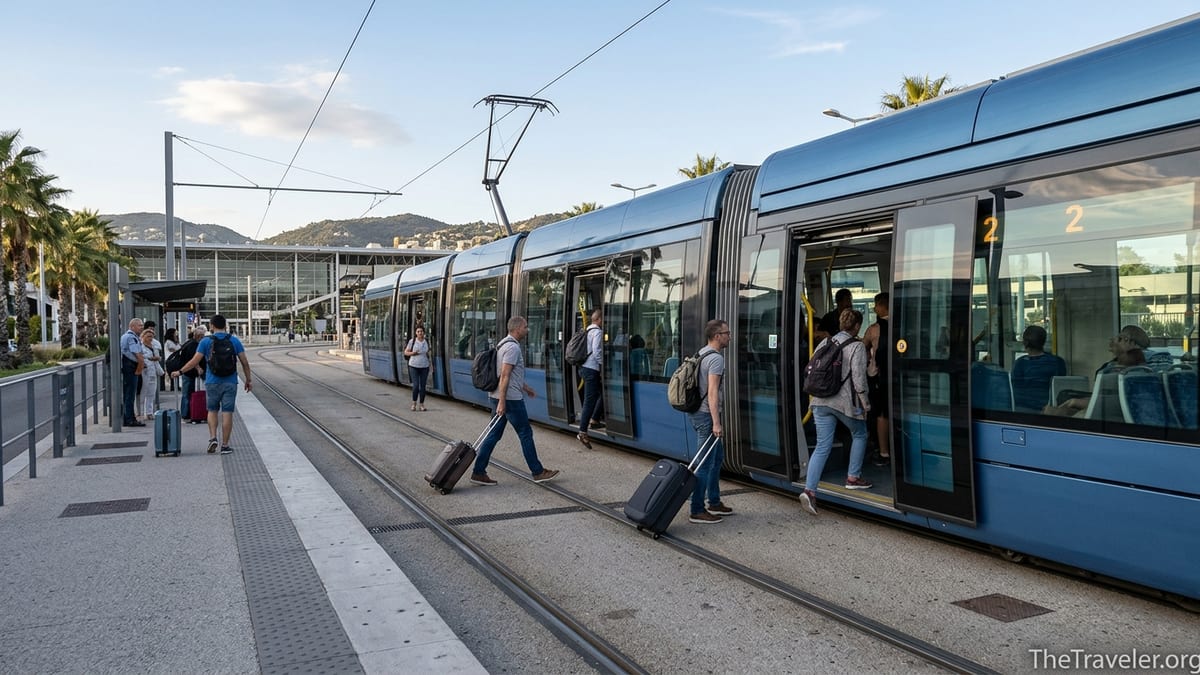
For most budget conscious travelers heading into the city center, tram line 2 is the standout option. The blue and silver trams run directly from both Terminal 1 and Terminal 2 to key stops such as Grand Arénas, Alsace Lorraine, and Jean Médecin in roughly 25 to 35 minutes, depending on where you get off. The trams are modern, air conditioned, and designed for people with luggage, with low floors and wide doors that make boarding simple even with a suitcase.
The standard single fare on the urban network is around 1.70 euros when purchased via the Lignes d’Azur smartphone app, and it is valid across trams and city buses, including journeys from the airport into town. If you buy from machines at the station, you may see more expensive “airport” products or return tickets marketed to visitors, but regular single tickets and passes also cover the trip. In practice, many travelers load a few single rides on a contactless card or in the app and then simply validate once they board the tram.
To give a real example, imagine you land at Terminal 2 around 14:00 and your hotel is on Avenue Jean Médecin. After collecting your luggage, you follow the clear “Tram” signs to the platform just outside arrivals. You purchase a 1.70 euro ticket in the app, board the next tram 2 toward Port Lympia, and validate your ticket using the onboard readers. Around 25 minutes later you step off at Jean Médecin, from where most central hotels are within a 5 to 10 minute walk. The only extra walking is from your tram stop to your accommodation, which is manageable for most travelers with a wheeled suitcase.
The tram is particularly good value for solo travelers and couples. Even if there are temporary crowds during peak hours, the ride is short and frequent. The main downsides are the lack of guaranteed seating at busy times and the fact that you will still need to navigate from your stop to your hotel. If you are staying in the steep lanes above the Old Town or far up the hills, this last leg can be tiring, especially at night.
Local Buses: An Ultra Budget Alternative With Scenic Views
Alongside the tram, local buses offer another very cheap way into town and along the coast. Lines operated under the Lignes d’Azur brand connect the airport area with destinations like Saint Laurent du Var, Cagnes sur Mer, and central Nice. One of the most useful routes for visitors is the 12 or 12+ bus, which runs along the Promenade des Anglais, serving landmarks such as the seaside hotels around Magnan and the shopping streets near Place Masséna.
The fare structure is essentially the same as the tram, with single rides around 1.70 euros when purchased through official channels. An example itinerary might be a traveler staying at a budget hotel near Magnan or Gambetta who wants a cheap yet scenic arrival. They could board the 12+ bus from the airport area and ride east along the seafront, watching the Baie des Anges unfold through the windows. The bus makes frequent stops right behind many waterfront hotels, so in some cases it can deliver you closer to your door than the tram does.
However, buses are more affected by traffic. On a summer afternoon when the Promenade is busy with beachgoers and local commuters, a bus trip from near the airport into the Masséna area can stretch to 40 minutes or more, while the tram continues unaffected on its dedicated tracks. Buses may also be more crowded at rush hour and can be awkward with bulky luggage, since dedicated luggage racks are not always available.
Buses work especially well if you are staying in the suburbs to the west or north of the city, or if you want maximum savings and do not mind a slower, more local journey. They can also be a backup option if there are disruptions on the tram line, though such disruptions are not common. As with the tram, always remember to validate your ticket when you board and keep an eye on your belongings in busy periods.
Regional Trains: Best for Budget Trips Beyond Nice
If your first stop on the Riviera is not Nice itself but a coastal town like Antibes, Cannes, or Villefranche sur Mer, the combination of tram or free airport shuttle plus regional train can be both cheap and reasonably comfortable. Just a short ride from the terminals is Nice Saint Augustin station, where frequent TER regional trains run west to Antibes and Cannes and east toward Nice Ville and Monaco.
A common budget itinerary looks like this. Two friends fly into Terminal 2 in the late morning and are staying in Antibes. From arrivals, they either use the free airport shuttle or hop on tram line 2 one stop to Grand Arénas or Saint Augustin. From there it is a short, clearly signposted walk to Nice Saint Augustin rail station. They buy TER tickets to Antibes from the station machines and board a regional train, which covers the coastal journey in around 20 to 25 minutes. The total cost is typically under 10 euros per person when combining the short tram leg with the TER ticket, far less than a direct taxi or private transfer from the airport.
The same principle applies for those continuing to Cannes or Monaco. For Cannes, the train from Nice Saint Augustin takes around 30 to 40 minutes depending on the stopping pattern, with approximate fares in the low teens of euros per person. For Monaco, passengers usually take a tram 2 ride east from the airport to Jean Médecin, then transfer to Nice Ville station for a TER heading toward Ventimiglia. Even with these transfers, public transport tends to be cheaper than direct road transfers, especially for solo travelers or couples.
The main trade off is convenience. Trains require you to change modes and manage luggage through at least one station, which can be stressful with young children or very heavy bags. Platforms can be crowded in summer, and there may be some stairs or short ramps to navigate. That said, the views along the coastline are excellent, and for travelers who are comfortable with European rail systems, this approach balances cost and comfort effectively.
Taxis: Door to Door Comfort at a Price
For travelers who prioritize comfort, speed, and simplicity over strict budget savings, official taxis from Nice Airport offer a straightforward door to door service. Taxi ranks are signposted just outside the arrivals areas of both terminals, and vehicles are required to display their licensing details and current fares. In 2026, realistic prices for an airport to central Nice ride commonly fall in a range roughly between 30 and 45 euros, depending on your exact address, traffic conditions, time of day, and supplements for luggage or night service.
As a real world example, a couple arriving from New York with two large suitcases and a carry on each, staying at a hotel near Place Rossetti in the Old Town, might expect to pay somewhere in the mid 30s of euros on a weekday afternoon. The driver will usually take the Promenade des Anglais into town and then thread into the narrow streets near the Old Town drop off point. At night or on weekends, the same route can creep closer to the upper 40s of euros as night and Sunday tariffs apply and traffic patterns change.
Taxis are particularly attractive for late arrivals after the tram and bus frequencies have dropped or if you are traveling in a small group where splitting the fare makes it more economical. For instance, four friends arriving at 23:30 and heading to an apartment near the Port might find that a taxi costing around 40 euros is only about 10 euros per person, competitive with each person buying separate public transport tickets and then walking with luggage through the streets in the dark.
To avoid unpleasant surprises, do not accept unsolicited offers of rides inside the terminal or from individuals approaching you away from the official taxi ranks. Insist on using a marked taxi with a meter and ask the driver before departure whether the fare will be fixed or metered and what supplements might apply. While outright scams are not the norm, some visitors have reported drivers claiming that the meter is broken or attempting to charge flat rates far above typical levels. If you feel uncomfortable, it is acceptable to step out of the vehicle before departure and choose another taxi from the rank.
Ride Hailing and Prebooked Transfers: Balancing Cost and Predictability
Ride hailing services and prebooked private transfers occupy a middle ground between public transport and traditional taxis. In and around Nice, app based services such as Uber and Bolt are active, and several local chauffeur companies offer fixed price prebooked rides from the airport. For many visitors, these options offer an appealing balance of comfort, cost control, and predictability.
For a standard app based ride, real world estimates in 2026 suggest an Uber style journey from the airport to central Nice might often fall anywhere from the high teens to the mid 20s of euros in normal conditions for an economy class car, though prices can rise significantly with surge pricing or heavy demand. In quieter times, a solo traveler might secure a ride to a hotel near Jean Médecin for just under 20 euros. At busy times such as major events, peak holiday weekends, or during heavy rain, that same ride can climb closer to or even above taxi levels.
Prebooked private transfers, on the other hand, typically advertise fixed rates that do not vary with traffic. A couple could, for example, secure a prearranged sedan transfer from Terminal 2 to a hotel near the Port for a set price in the mid 30s to low 40s of euros, including meet and greet in the arrivals hall. Larger groups might reserve a minivan for a fixed amount that becomes very economical when split among six or eight passengers, particularly for longer journeys to locations like Cannes, Saint Paul de Vence, or Monaco.
These options are often the best compromise for families, small groups, or anyone arriving late at night or very early in the morning. If your flight is scheduled to land at 06:00 and you are anxious about working out ticket machines and platforms before coffee, tapping an app on your phone or seeing your name on a sign in arrivals can dramatically reduce stress. Just remember that app based services may have designated pick up areas outside the terminal where you will need to meet your driver, so check the instructions within the app as soon as you land.
Choosing the Right Option for Your Budget and Comfort
There is no single “best” transfer from Nice Airport. Instead, think of your choice as a balance between how much you are willing to spend, how far you need to travel, and how much hassle you are prepared to accept, especially with luggage or children. For a solo traveler on a tight budget staying near a tram stop in central Nice, the tram will almost always win: spending around 1.70 euros for a reliable, under 30 minute ride into town simply makes sense.
For couples, the choice becomes more nuanced. If you are light packers and comfortable reading maps, two tram or bus tickets still cost a fraction of even a discounted ride hailing fare. But if you are carrying heavy suitcases or arriving late in the evening, paying a bit more for a door to door ride can feel like money well spent, turning a potentially stressful arrival into a short, air conditioned drive directly to your front door.
Families and groups should always do the simple math of dividing door to door fares by the number of travelers. A 40 euro taxi or prebooked car can work out at 10 euros per person for four people, which is suddenly not much more than tram tickets, especially if someone in your group has mobility issues or if your hotel is in a hilly district far from a tram stop. For groups of six or more heading to coastal destinations beyond Nice, prebooked vans can be surprisingly cost effective, offering both savings and the comfort of everyone staying together.
Finally, factor in your onward plans. If you are catching a train from Nice Ville to Italy later that day, it may be smarter to travel from the airport by tram 2 and then walk or transfer to the station on a single ticket, rather than making multiple separate taxi or ride hailing journeys. On the other hand, if your timetable is tight and missing a connection would be costly, a prebooked transfer that commits to getting you to the station or port on time can provide valuable peace of mind.
The Takeaway
Nice Côte d’Azur Airport is one of the easiest European gateways to navigate when it comes to ground transport. With a tram station directly at each terminal, a dense network of buses, nearby regional trains, and plentiful taxis, ride hailing cars, and private shuttles, you are never more than about half an hour from the heart of the city or the main coastal resorts in normal conditions. The real question is not whether you can get into town easily, but how you want that journey to feel.
If your top priority is saving money, take the tram or local bus and embrace a short, everyday slice of Niçois life as you roll past palm trees and apartment blocks toward Jean Médecin or Promenade des Anglais. If comfort and simplicity matter more, especially after a long flight or with children in tow, lean toward a taxi, ride hailing car, or prebooked transfer that drops you directly at your front door. And if your first stop is another Riviera town entirely, combine the tram with regional trains for a coastal journey that is both efficient and scenic.
Ultimately, the best transfer is the one that matches your budget, your luggage, and your energy level on the day you land. With a bit of planning before you fly and a clear idea of what you value most, you can step out of Nice Airport confident that the next stage of your trip will be as smooth as the Mediterranean below your airplane window.
FAQ
Q1. What is the cheapest way to get from Nice Airport to the city center?
The cheapest option is usually tram line 2 from either terminal to central stops like Jean Médecin, using a standard city ticket that costs around 1.70 euros when purchased through official channels.
Q2. How long does the tram from Nice Airport to downtown take?
In normal conditions, the tram ride from the airport to Jean Médecin in central Nice typically takes around 25 to 30 minutes, slightly more if you continue to stops closer to the port.
Q3. Is the tram ticket from the airport included in regular public transport passes?
Yes, standard single tickets and many Lignes d’Azur passes are valid on tram line 2 between the airport and the city, so you do not necessarily need a special airport ticket if you are using the official network.
Q4. How much does a taxi from Nice Airport to the city center usually cost?
Realistic taxi fares from the airport to central Nice commonly fall in a range roughly between 30 and 45 euros, depending on your exact address, traffic, time of day, and any night or luggage supplements.
Q5. Are Uber and other ride hailing services available at Nice Airport?
Yes, app based services such as Uber and similar platforms operate around Nice Airport, with typical economy rides to the city often costing somewhere from the high teens to the mid 20s of euros in normal conditions, though surge pricing can increase this.
Q6. What is the best option if my hotel is not near a tram stop?
If your hotel is far from a tram or bus stop or up a steep hill, a taxi, ride hailing car, or prebooked private transfer usually offers better comfort, since it will drop you at the door and save you from a long walk with luggage.
Q7. How do I reach other Riviera towns like Antibes or Cannes on a budget?
A common budget strategy is to take a short tram or shuttle ride from the airport to Nice Saint Augustin station, then board a regional TER train to towns such as Antibes or Cannes, which is usually cheaper than a direct taxi.
Q8. Is public transport safe for solo travelers arriving during the day?
During daytime and early evening, the tram and local buses are generally considered safe and widely used by locals and visitors; as in any city, keep an eye on your belongings and avoid displaying valuables.
Q9. What should I watch out for when taking a taxi from the airport?
Use only official taxis from the marked ranks, make sure the meter is running or that a clear fixed price is agreed before departure, and be cautious if anyone approaches you inside the terminal offering unofficial rides.
Q10. Which transfer option is best for families with young children?
For families with small children and several bags, a prebooked private transfer or taxi is often the most comfortable choice, since it minimizes walking, avoids crowded vehicles, and lets everyone travel together door to door without transfers.