


I thought I knew what to expect from Villa d’Este. I had seen the photos, read that it was a Renaissance masterpiece, memorized that it sat just outside Rome in the hill town of Tivoli. Yet the reality of stepping through its cool stone corridors and emerging into a hillside of tumbling water, cypress silhouettes, and echoing birdsong felt far more magical than I was prepared for. Villa d’Este is not just another pretty garden; it is a place where engineering, myth, and the rhythm of water reshape how you experience a single day in Italy.
Get the latest updates straight to your inbox!
Arriving in Tivoli With Modest Expectations
I based myself in Rome and treated Tivoli as a simple day trip. An early metro ride on Line B to Ponte Mammolo and a Cotral bus from there to Tivoli sounded purely practical when I was planning it, but the journey ended up setting the tone for the day. After about 45 minutes of leaving Rome’s apartment blocks behind, the road began to curl uphill, and suddenly the Lazio countryside opened up: olive groves, low stone farmhouses, and hazy views back toward the city. It felt like slipping out of Rome’s intensity and into a different century.
The bus dropped me near Piazza Garibaldi, just a few minutes’ walk from Villa d’Este’s entrance. On a spring weekday the square was busy but not overwhelming: school groups collecting around guides, a few day-trippers comparing tickets, and locals cutting through the piazza with grocery bags. I grabbed an espresso at a bar on the corner for about 1.50 euros and watched the scene for a moment. Villa d’Este sits right in the historic center, but the atmosphere is more small-town casual than museum queue chaos.
Tickets for Villa d’Este are straightforward. A standard adult ticket is around 12 euros, with reduced prices for EU visitors aged 18 to 25 and free entry for those under 18. At busy times, especially when there is a temporary exhibition in the villa, tickets can be combined or slightly higher, but the base price is still in that range. I bought mine at the on-site ticket office, though many visitors now prebook online to save a bit of waiting and to combine Villa d’Este with Hadrian’s Villa or nearby Villa Gregoriana on the same day.
What surprised me most in these first minutes was how deceptively modest the entrance feels. From the outside, Villa d’Este could be just another grand palazzo. It is only once you step inside, walk through a sequence of frescoed rooms, and then face the garden that the real scale of the place reveals itself.
First Glimpse of the Gardens: A Living Water Theater
Villa d’Este was created in the 16th century by Cardinal Ippolito II d’Este, who wanted a residence and garden that would outshine the ancient Roman villas scattered across Tivoli’s hills. The result is an Italian Renaissance garden on a steep slope, where terraces, stairways, and carved balustrades guide you past a cascade of fountains that feel almost impossibly abundant for a hillside that gets its water from a diverted river.
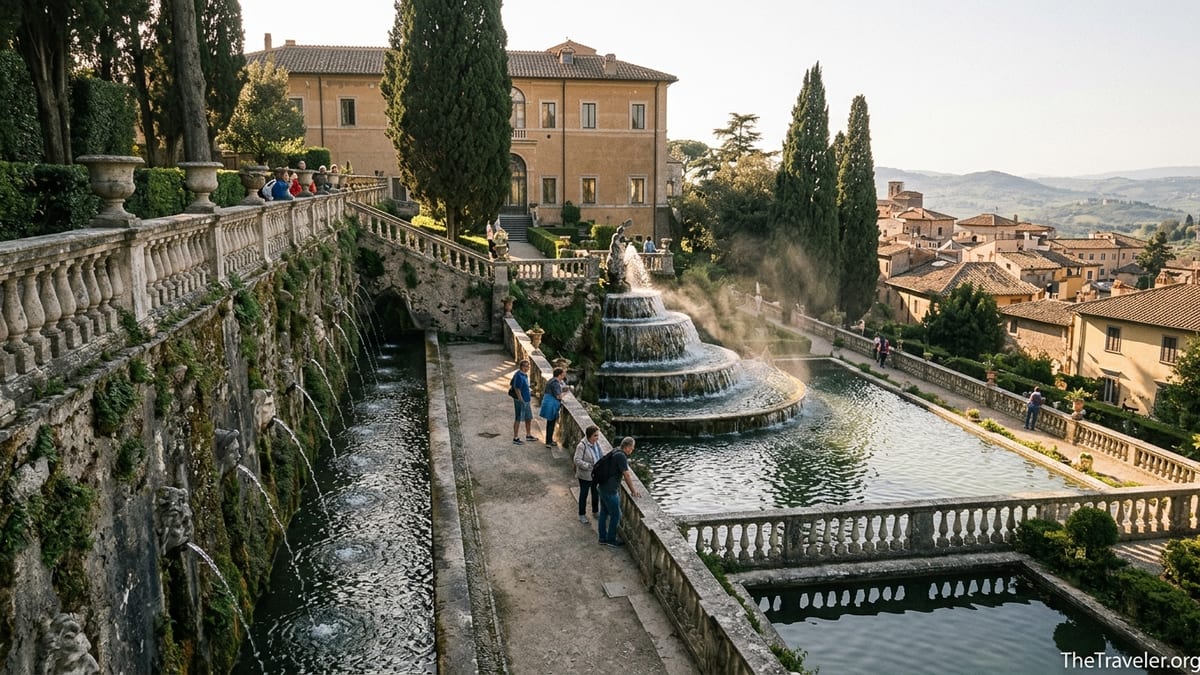
My first view of the garden came from a loggia window, where the entire hillside seems to fall away beneath you. Stone staircases zigzag down among tall cypress and umbrella pines, and everywhere there is the shimmer and sound of water. Even if you have seen photos, actually hearing the layered noise of it all is striking: a low constant roar from the larger cascades, lighter splashes where smaller fountains spray into basins, and the occasional echo of water hitting ancient stone.
Stepping outside onto the upper terrace, I followed a path toward the famous Hundred Fountains. This long, slightly downhill alley runs parallel to the main axis of the garden, and it is where the villa’s playful spirit really comes alive. Out of a mossy stone wall, dozens of small spouts launch water in graceful arcs into a narrow channel; above them are sculpted emblems and masks, their details softened by centuries of water and lichen. In the morning light, each tiny jet caught the sun, and it felt like walking beside a horizontal curtain of sparkling glass.
The practical side of this was comforting. Even on a warm day, mist from the fountains cools the air along this path, and stone benches give you a place to sit, listen, and people-watch. I saw families letting children run their hands through the water, couples taking slow photos, and solo visitors simply leaning back against the stone, letting the hillside breeze and spray soak into their travel fatigue.
The Fountain of the Organ and the Villa’s Quiet Engineering Genius
One of the moments that changed my understanding of Villa d’Este came at the Fountain of the Organ. From a distance, it looks like an ornate Baroque stage set: a central niche, sculpted figures, a wide basin below, and cascades of water framing it all. But hidden behind the façade is a Renaissance-era hydraulic organ, originally designed to play music powered entirely by the pressure of water.
Today the organ has been restored to perform at intervals, typically starting late in the morning and recurring every couple of hours. I timed my visit so that I arrived by the fountain just before one of these performances. A small crowd had gathered: a tour group fanning themselves with brochures, a few older Italian couples, and a cluster of teenagers clearly dragged here by their parents. As the time approached, the general fountain noise seemed to swell, then suddenly the water’s flow shifted and a series of haunting notes emerged, thin but clear, echoing off stone and trees.
The melody is not loud in the modern sense, and if you expect a concert-hall experience you might be underwhelmed. But when you remember that this is a 16th-century organ driven purely by water, without electricity, the effect is mesmerizing. It feels like the garden itself has found a voice. Standing there, you sense the intellectual ambition of the villa, where art, music, and engineering were all woven together to impress and delight visitors centuries ago.
This is where Villa d’Este’s “magic” showed a practical side. The entire garden is essentially a hydraulic system, fed by water diverted from the Aniene River through a series of underground channels and pressure differentials. You do not see the pipes, but you feel the constant movement of water under your feet, behind walls, and beneath terraces. At a time when many fountains around Europe are turned off to save water or limit crowds, Villa d’Este’s continued operation feels almost miraculous. Yet the magic is grounded in real, centuries-old technology still quietly doing its job.
Following the Water Down to Neptune and Back Up Again
The most dramatic view in the garden came as I descended further to the Fountain of Neptune. This great cascade occupies the heart of the lower terraces, with wide stone basins, shooting jets, and a roar that drowns out the chatter of visitors. From below, looking up, the hillside becomes a curtain of green and stone, topped by the façade of the villa itself. It is the kind of view that appears in guidebooks and travel posters, yet standing there, the sheer verticality of it all is more impressive than any image can convey.
From this vantage point, the garden can feel almost like a natural amphitheater. To one side, a narrow path branches off toward shaded corners and small grottoes. To the other, a balustrade offers views out over the Tiburtine landscape: red-tiled roofs of Tivoli, the dome of a church, and beyond that, a rolling patchwork of hills that on a clear day stretch all the way toward Rome’s distant outline. I watched as a small group of hikers, clearly fresh from Villa Gregoriana’s trails, leaned against the rail to compare canyons and waterfalls, turning their day in Tivoli into a kind of informal water pilgrimage.
Climbing back up through the garden is its own experience. The stairs are often shallow but numerous, and the temptation to stop at each landing is strong. At one mid-level terrace, I found a quiet corner where only a trickle of water from a small fountain broke the silence. A solo traveler nearby pulled out a guidebook and traced the line of ancient aqueducts on a small map, while another studied a paper ticket for the combined pass that includes Hadrian’s Villa, calculating whether there was still time to catch the local bus out there before closing.
Practically speaking, the garden paths are stone and can be a bit uneven in places, so comfortable shoes matter. There are a few railings, but you will be walking up and down a fair number of steps if you want to see the main fountains from multiple vantage points. I spent close to three hours just in Villa d’Este, and never once felt I had exhausted its small viewpoints and side paths. For many visitors, especially in the hotter months, it makes sense to plan Villa d’Este as either a morning or late-afternoon visit, with a long lunch or a siesta in between, rather than a rushed stop on a checklist of sites.
When the Light Turns Golden: Evening and Night Openings
One of the unexpected highlights of Villa d’Este is how different it feels as the day progresses. On my visit, the villa followed its standard schedule: opening around 8:45 in the morning, with closing times shifting seasonally, often around 7:45 in late spring and summer, with last entry about an hour earlier. However, on select dates in warmer months there are special evening openings, when the gardens stay open into the night and the fountains are illuminated.
I was lucky enough to catch one of these later openings. After a break in town for an early dinner on a side street just off the main square, where a plate of fresh pasta and a glass of local white wine cost under 20 euros, I re-entered the villa as the sun was sinking. The crowds had thinned, replaced mostly by couples, small groups of friends, and a few families lingering with sleepy children.
As twilight deepened, the terraces and fountains shifted character. The harsh midday glare gave way to soft pools of light highlighting statues and water jets. The Hundred Fountains path, bright and almost playful earlier, became more mysterious: the moss-dark wall glistening, the arcs of water catching only occasional glints. Down at the Fountain of Neptune, spotlights turned the primary cascade into a white, shimmering veil. The sound of water, louder now that the talking had faded, seemed to erase the boundary between garden and night sky.
These evening visits often come with a slightly different ticket, sometimes around 10 euros for a night entrance, separate from the daytime ticket. Availability and pricing can change from season to season, so it is wise to check locally or with your accommodation in Rome before planning your trip around it. But if your dates line up with one of these openings, the experience is unforgettable. Villa d’Este at night feels intimate and almost private, even if you are sharing the pathways with other visitors.
Balancing Villa d’Este With Hadrian’s Villa and Villa Gregoriana
Many travelers try to fit three major sights into a single Tivoli day: Villa d’Este, Hadrian’s Villa (Villa Adriana), and Villa Gregoriana. It is possible, especially in long summer daylight, but it requires early starts and good planning. From a personal perspective, I found that giving Villa d’Este several unhurried hours was worth sacrificing a third site.
On my own visit, I paired Villa d’Este with Hadrian’s Villa, using a local bus from Tivoli to reach the vast archaeological area in the valley. Hadrian’s Villa is spread out and sun-exposed, with ruins of palaces, pools, and libraries that once formed the emperor’s retreat from Rome. A combined “Villae” pass, which costs noticeably less than separate tickets, covers both sites and can be useful if you plan to spread your visits across two days or complete them in one long, ambitious excursion.
Other visitors I met in the garden had chosen a different combination. One couple skipped Hadrian’s Villa altogether in order to have a leisurely morning at Villa Gregoriana’s dramatic ravines and waterfalls, followed by a slow afternoon in Villa d’Este. They pointed out that the contrast between Gregoriana’s wild, almost raw landscape and the geometric, controlled water of Villa d’Este made for a particularly satisfying day. Whichever way you do it, Tivoli rewards those who are realistic about their energy levels and travel pace.
The important logistical detail is return transport. Buses back to Rome from Tivoli run regularly, but late-evening options can be less frequent, and standing at the bus stop with dozens of tired day-trippers is not unusual in peak season. Regional trains from Tivoli’s station to Rome’s Tiburtina or Termini stations are another alternative, taking around an hour and costing just a few euros, but the walk from Villa d’Este to the train station is longer and downhill on the way out, uphill on the way back. If you are planning to stay in Tivoli overnight at a local guesthouse or B&B, this becomes less of a stress factor and gives you more flexibility to enjoy the villa during quieter hours.
Small Human Moments That Made the Villa Feel Alive
Part of what made Villa d’Este feel more magical than I expected were the small, unscripted moments that had nothing to do with guidebooks. At one point, as I sat on a shady bench near a minor fountain, a local woman with a small dog took the seat beside me. She explained, in a mix of Italian and English, that residents can visit frequently with reduced or annual passes, and that she often walks here in the late afternoon to escape the summer heat. For her, the gardens were not a “sight” but a familiar park layered with childhood memories.
Later, near the upper terrace, I overheard a guide explaining to a group of architecture students how the garden’s design influenced later European formal gardens, from France’s Versailles to stately homes in England. One student compared the experience to standing in front of a blueprint made of stone and water, where each fountain expressed power, myth, or a particular technical feat. It reminded me that behind the charm of the place lies a complex ideological program, yet as a casual visitor you can enjoy it all without needing to decode every allegory.
Then there were the children, completely uninterested in symbolism and thoroughly absorbed in the immediate joy of water. At the Hundred Fountains, a small boy stretched his hands under each spout in turn, shrieking with delight when he found one particularly strong jet. His parents hovered nearby, reminding him not to soak his shoes, and nearby an elderly couple smiled, clearly remembering a similar game from decades ago. Moments like these make clear that Villa d’Este is still a living space, not a fossilized monument.
Even the practical hiccups added texture. When I stopped at the small café just outside the villa for a late-morning snack, the line was longer than expected, and the service unhurried in that distinctly Italian way. A slice of simple pizza al taglio and a cold drink came to about 8 euros, and as I waited I ended up chatting with another solo traveler who had nearly missed the hydraulic organ performance. Swapping real-time tips about bus frequency, best viewpoints, and approximate ticket prices to other Tivoli sites made the day feel communal rather than purely solitary.
The Takeaway
My visit to Villa d’Este started as a practical choice: a UNESCO-listed site close to Rome, easy to reach on public transport, surrounded by other notable attractions. It ended as one of the most atmospheric days of my time in Italy, precisely because the villa balances spectacle with intimacy. You come for the famous fountain vistas and Renaissance prestige, but you remember the cool arcs of water on your skin, the sound of the hydraulic organ echoing against stone, and the way the light shifts across terraces from morning clarity to golden evening softness.
On a purely logistical level, Villa d’Este is an accessible day trip: budget around 12 euros for a standard ticket, plus the modest cost of bus or train fares from Rome, and plan at least two to three hours on-site, more if you want to linger or pair it with Hadrian’s Villa or Villa Gregoriana. Aim for a morning or late-afternoon visit if you are sensitive to heat, and keep an eye out for occasional evening openings, which transform the garden into something almost otherworldly.
Emotionally, though, the villa works on a subtler level. It slows you down. It encourages you to sit on a stone bench and simply listen. It asks you to notice how centuries-old engineering still moves water with grace across an Italian hillside. That blend of technical ingenuity, layered history, and everyday human use is what made Villa d’Este feel more magical to me than any photo could suggest.
If you are debating whether to carve out a day from Rome for Tivoli, my advice is simple: go, but give yourself enough time not to rush. Let the journey be part of the experience, arrive with reasonable expectations, and then allow the fountains, terraces, and small human dramas playing out under the cypress trees to quietly exceed them.
FAQ
Q1. How much does it cost to visit Villa d’Este?
The standard adult ticket for Villa d’Este is typically around 12 euros, with reduced prices for EU visitors aged 18 to 25 and free entry for under-18s.
Q2. What are the usual opening hours for Villa d’Este?
The villa generally opens at 8:45 a.m., with closing times varying seasonally, often around late afternoon in winter and about 7:45 p.m. in late spring and summer.
Q3. How do I get to Villa d’Este from central Rome by public transport?
Most visitors take Metro Line B to Ponte Mammolo, then a Cotral bus to Tivoli, which takes around 45 minutes; regional trains from Rome to Tivoli station are another option.
Q4. How long should I plan to spend at Villa d’Este?
Plan at least two to three hours to explore both the villa interiors and the gardens, longer if you enjoy photography, sketching, or simply sitting and taking in the fountains.
Q5. Can I combine Villa d’Este with Hadrian’s Villa or Villa Gregoriana in one day?
Yes, many travelers pair Villa d’Este with either Hadrian’s Villa or Villa Gregoriana, but seeing all three in one day can feel rushed unless you start early and pace yourself.
Q6. Is Villa d’Este suitable for visitors with limited mobility?
The main villa interiors are relatively accessible, but the gardens involve many steps and uneven stone paths, which can be challenging for those with limited mobility.
Q7. When does the Fountain of the Organ play music?
The hydraulic organ is typically activated daily starting late in the morning and then roughly every couple of hours, though exact times can vary slightly by season and maintenance.
Q8. Are there special evening or night openings at Villa d’Este?
On selected dates, especially in warmer months, the gardens open in the evening with illuminated fountains, usually with a separate night ticket and slightly different pricing.
Q9. Do I need to book tickets for Villa d’Este in advance?
Advance booking is not always essential, but in busier periods it can reduce waiting times and is useful if you want combined tickets or guided tours including other Tivoli sites.
Q10. What should I wear and bring for a visit to Villa d’Este?
Comfortable walking shoes, water, sun protection in warmer months, and a light layer for evening visits are recommended, along with enough storage on your phone or camera for photos.