


Just 30 kilometers east of Rome, Villa d’Este in Tivoli promises terraces of cypress trees, Renaissance fountains and sweeping valley views that look straight out of an Italian movie. The question many Rome visitors face is simple: is it really worth giving up a full day in the city for a trip out here? The answer depends on how much you value gardens, historic villas and slower, small-town Lazio over another spin through Rome’s museums and piazzas. This guide weighs the pros and cons, with concrete details on time, cost and what you actually experience on the ground, to help you decide if Villa d’Este deserves a day in your itinerary.
Get the latest updates straight to your inbox!
What Makes Villa d’Este Special Enough for a Day Trip?
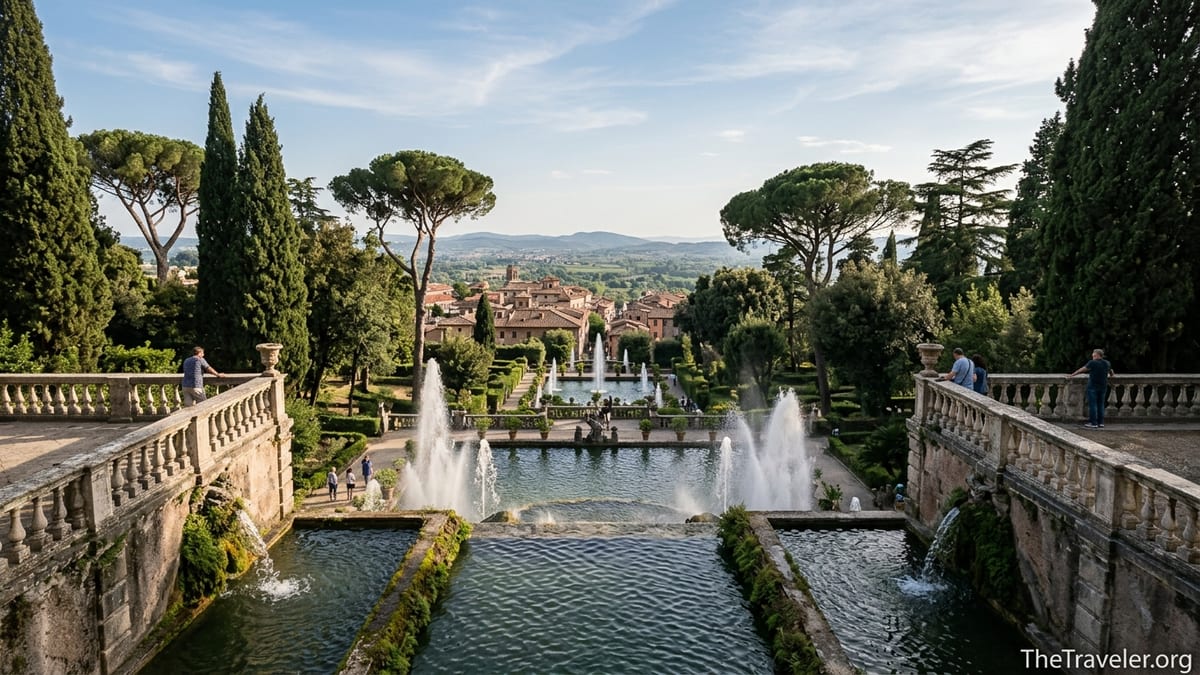
Villa d’Este is not just another pretty garden outside Rome. It is a 16th century Renaissance villa built for Cardinal Ippolito II d’Este and listed today as a UNESCO World Heritage site. The complex is famous for its hillside gardens packed with fountains, grottoes and water features that use gravity, not pumps, to keep everything flowing. Visitors walk down stone staircases to terraces framed by cypress and umbrella pines, with constant views across the Aniene Valley and Tivoli’s tiled rooftops.
What makes it stand out, even if you have already visited the Vatican Museums or the Borghese Gallery, is the concentration of water and the sheer theatricality of the design. Modern guides often quote figures of roughly 500 fountains, dozens of waterfalls and hundreds of jets spread over a relatively compact garden. You do not have to be an architecture expert to feel the impact: from the moment you step onto the main terrace overlooking the gardens, it feels like stepping into a three dimensional stage set where every angle has been carefully planned.
For many travelers, the appeal is also emotional. The interior rooms, some still covered in faded frescoes, give a glimpse of elite life during the late Renaissance, while the shaded paths below offer space to breathe after the crowds of central Rome. Travelers who have done the day trip often mention that Villa d’Este was a highlight of their time in Italy, especially if they love gardens, photography or just want a quieter environment than central Rome can provide in peak season.
On the other hand, Villa d’Este is not a must for everyone. If your main interests are ancient ruins, food or nightlife, and you only have two or three days in Rome, you may feel that the time and effort of a day trip competes with major landmarks like the Colosseum, Palatine Hill or Trastevere. Understanding exactly what the visit involves and how it fits into a Rome itinerary is key to deciding if it is worth it for you.
Travel Time and Logistics From Rome
Reaching Villa d’Este from central Rome is straightforward, but it is not a quick metro ride. The villa sits inside the historic center of Tivoli, a small hill town east of the capital. Most independent travelers use either the regional train from Roma Tiburtina station or a Cotral bus from the Ponte Mammolo metro stop. In both cases, you should allow at least one hour each way from the moment you leave central Rome.
By train, typical regional services between Rome and Tivoli take around 50 minutes, although some can be as fast as about 35 minutes depending on the specific departure. From Tivoli station it is then roughly a 15 minute uphill walk through town to Piazza Trento, where the entrance to Villa d’Este is located, or a short local bus ride that drops you near Piazza Garibaldi. Buses, by contrast, depart from the bus terminal near Ponte Mammolo on Rome’s Metro B line and usually take between 45 minutes and an hour to reach Tivoli, depending on traffic on the motorway.
Once in Tivoli, Villa d’Este is centrally placed. From the train station many visitors simply follow Google Maps or local signs on foot, grabbing a coffee in one of the bars along Via del Trevio. From the main bus stop at Piazza Garibaldi, the villa is only a few minutes’ walk. The town is compact but hilly, so comfortable shoes are important, especially in summer when daytime temperatures can easily reach or exceed 30 degrees Celsius.
Organized day tours from Rome remove the need to manage trains and buses. Several companies offer half day or full day excursions that include coach transport from central Rome, a guide, and skip the line tickets. These usually last around seven hours door to door and sometimes combine Villa d’Este with Hadrian’s Villa, another UNESCO World Heritage site on the outskirts of Tivoli. Tours cost more than going independently, but for first time visitors or those wary of Italian public transport, they can make the day trip far less stressful.
Time on Site: How Long Do You Really Need?
The amount of time you should plan inside Villa d’Este itself is essential in deciding if the trip is worth it. Most visitors spend between two and three hours exploring the villa and gardens at a relaxed pace. That includes about 30 to 45 minutes in the frescoed rooms and loggias at the top level, and another 90 minutes wandering gradually down through the terraces, pausing at major fountains like the Fountain of Neptune, the Hundred Fountains and the Oval Fountain.
If you are a photographer, garden lover or simply someone who likes to sit and soak in views, you can easily stretch this to four hours by lingering on benches, watching the play of light on water jets and exploring smaller paths. The changing soundscape is part of the experience; you constantly move between roaring cascades, quiet pools and trickling channels. Many travelers find that a late morning or mid afternoon visit provides the most pleasant combination of light and temperature, but summer afternoons can be very hot in the lower garden levels.
Adding time for transport, you should expect a Villa d’Este day trip to absorb almost a full day from Rome even if you only visit this single site in Tivoli. A realistic schedule might be leaving your Rome accommodation around 9:00, catching a 9:30 train or bus, arriving in Tivoli around 10:30 to 11:00, and entering the villa soon after. With two to three hours inside, plus a break for coffee or gelato in town, you may not be back in central Rome before late afternoon or early evening.
If you plan to combine Villa d’Este with Hadrian’s Villa or Villa Gregoriana, you will need even more time and careful planning. While it is possible to see two sites in one long summer day, three is ambitious without a private driver or organized tour. For many travelers, especially those on short trips, focusing on Villa d’Este alone makes the day less rushed and leaves room to enjoy Tivoli’s streets and viewpoints.
Tickets, Costs and Practical Details
Ticket prices for Villa d’Este change periodically, but in recent seasons standard adult entry has usually been in the low to mid teens in euro for a full price ticket, with reduced rates for European Union citizens under a certain age and free admission on specific national culture days. Because pricing can change year to year, it is best to think in approximate terms: expect to pay around the cost of a modest restaurant main course in Rome for entry. Audio guides are typically available for a small extra fee, and many visitors find them worthwhile for understanding the symbolism of the fountains and the history of the cardinal who commissioned the villa.
For those planning to visit more than one attraction in Tivoli, there is a combined “Villae” pass that covers Villa d’Este, Hadrian’s Villa and sometimes Villa Gregoriana. Recent traveler reports and official information suggest that this combined ticket costs roughly twice the price of a single site ticket, but offers significant savings compared with paying separately at each entrance. It can be purchased at any of the participating sites, making it easy to decide on the day if you want to expand your visit beyond Villa d’Este.
Opening hours also matter for planning the day trip. According to the official Villae site, Villa d’Este generally opens daily in the morning, with Monday afternoons sometimes starting later to allow for maintenance. Closing times shift seasonally, with last entry typically in the late afternoon. In winter months the gardens may close while there is still daylight, whereas in spring and summer you have longer to enjoy the light on the fountains. Because of periodic changes for holidays, evening events or conservation work, always check official information close to your visit and avoid relying solely on old guidebooks.
Transportation costs are relatively modest. A one way ticket on a regional train from Rome to Tivoli usually costs only a few euros, and Cotral bus tickets are comparable. For a couple traveling independently, the total outlay for transport and entry for Villa d’Este alone often ends up around the price of a midrange dinner in Rome. Organized tours, in contrast, can range significantly higher per person, reflecting the inclusion of transport, guiding and in some cases a restaurant lunch in Tivoli. When assessing value, compare the total cost of the day trip to what else you might have done with those hours and that budget in Rome itself.
Highlights of the Visit: What You Actually See
The villa begins indoors. After passing through the ticket area, you enter a sequence of rooms decorated with frescoes of mythological scenes, landscapes and allegories. Not all of the paintwork survives intact, but enough remains that you can imagine the impression it made on noble guests in the 16th century. From the windows, you look out over cypress trees and the shimmering spray of fountains below, a preview of the gardens you are about to enter.
Outside, the main terrace is usually where visitors pause first. It runs almost the entire width of the villa, with stone balustrades and a long view over the town and valley. From here you can see the Oval Fountain to one side, framed by a semicircle of stone niches and greenery, and the grand Fountain of Neptune directly below, where sheets of water spill into a large basin. On a sunny day, light plays across the water and the spray cools the air, making it one of the most photographed spots in Tivoli.
As you descend the garden, you encounter the Hundred Fountains, a long, linear water feature where countless small jets pour into a narrow channel lined with moss and sculpted reliefs. Walkers often stop several times along its length to capture photos or simply listen to the rhythmic splash. Further down, quieter corners invite exploration, like smaller grottoes with statues, shaded staircases and side paths that lead to less crowded viewpoints. The mix of monumental display and intimate spaces is a big part of Villa d’Este’s charm.
Even on busier days, visitors frequently report that the gardens rarely feel as packed as central Roman attractions. People spread out across terraces and pathways, and because of the constant sound of water, the atmosphere often feels more like a park than a museum. This relative calm, combined with the visual drama of the fountains, is what usually convinces travelers that the time and effort of leaving Rome for the day was worthwhile.
Combining Villa d’Este With Hadrian’s Villa or Tivoli Town
Part of the value question is whether Villa d’Este should be visited on its own or as part of a larger Tivoli day. Many travelers choose to combine it with Hadrian’s Villa, a sprawling archaeological site a short drive outside town that preserves the remains of the country retreat built by the emperor Hadrian in the 2nd century. The contrast is striking: where Villa d’Este is compact, vertical and lush, Hadrian’s Villa is wide open, ruinous and grounded in ancient Roman history.
Reaching Hadrian’s Villa from Tivoli requires a local bus, taxi or organized tour. Cotral buses linking Rome and Tivoli stop near the entrance on the main road, and local CAT buses connect Tivoli town with the archaeological area. The journey usually takes around 15 to 20 minutes. Because Hadrian’s Villa covers a large area of grounds and ruins, visitors typically allow at least two hours there, with more time if they like to read information panels or explore less visited corners.
If you try to fit both Villa d’Este and Hadrian’s Villa into a single day using public transport, the schedule becomes tight but still realistic, especially in longer summer days. One common tactic is to visit Hadrian’s Villa first while it is cooler, then return to Tivoli for lunch and an afternoon visit to Villa d’Este. Others reverse the order and finish at Hadrian’s Villa, returning to Rome from the roadside bus stop. In either case, you should be comfortable reading bus timetables and allow margin for delays.
Some visitors prefer to make Villa d’Este the main focus and leave time for Tivoli itself. The town center around Piazza Garibaldi and Piazza Rivarola has small boutiques, bars and restaurants where you can linger over a plate of pasta all’amatriciana or a simple panino. A walk to viewpoints along the edge of town reveals deep gorges and the ruins of ancient aqueducts. If you are someone who enjoys strolling and people watching in Italian hill towns, this extra time might tip the balance in favor of the day trip even if you choose to skip Hadrian’s Villa.
Who Will Find the Trip Most Worthwhile?
Villa d’Este tends to delight a particular kind of traveler. Garden lovers, design enthusiasts and photographers almost always come away satisfied. If you pore over books on Renaissance architecture, have the Boboli Gardens in Florence on your wish list, or spend a lot of time framing shots of fountains and reflections, Villa d’Este is likely to be one of your favorite outings from Rome. Couples looking for a romantic backdrop also find the shaded terraces and views especially appealing.
The day trip is also a strong choice for repeat visitors to Rome who have already covered the headline sites and want something different. After seeing the Colosseum, the Vatican, the Forum and perhaps Ostia Antica on earlier trips, many returning travelers appreciate a change of pace in Tivoli. Villa d’Este offers history without the heavy crowds and gives a sense of the wider Lazio region beyond the capital.
Families with children can also enjoy the villa, but it is worth considering the number of stairs and uneven paths. Younger kids often love the fountains and the freedom to run along the terraces, but strollers can be challenging on the steep slopes. For travelers with limited mobility, the vertical layout of the gardens and the climb from Tivoli station up to the villa may make the visit more demanding than flat sites in Rome. Before committing, it is wise to check official accessibility information and consider whether everyone in your group is comfortable with hills and stairs.
On the other hand, if your time in Rome is very short, or if you find that large formal gardens do not interest you, Villa d’Este may not justify the lost hours in the city. Food focused travelers who would rather spend the day exploring Testaccio markets or taking a cooking class, and nightlife fans who prefer to save energy for evenings in Trastevere or Monti, might feel that a Tivoli day trip dilutes their main priorities.
The Takeaway
Is Villa d’Este worth visiting on a day trip from Rome? For many travelers the answer is yes, provided they have at least four full days in the city or a strong interest in gardens, design and quieter historic towns. The villa delivers a distinctive experience that you will not find in central Rome: an intricate Renaissance water garden, cooler air, and long views over the Lazio countryside. The cost of entry and transport is moderate by Italian sightseeing standards, and the logistics are manageable for most independent visitors or easily handled via organized tours.
However, the day trip does require a meaningful investment of time. By the time you factor in trains or buses, walking in Tivoli, and a two to three hour visit, most of the day is gone. Travelers on very tight schedules, or those whose interests lie elsewhere, may reasonably decide that their hours are better spent inside Rome’s museums, churches and neighborhoods.
If you can picture yourself happily wandering among fountains and cypress trees for several hours, pausing to photograph cascades and cooling off in the shade, Villa d’Este will almost certainly feel worth it. If that image leaves you indifferent, you might keep Tivoli on the list for a future trip and focus instead on what Rome itself does best. Either way, knowing the practical details and what to expect on site makes it easier to choose the version of Italy that fits you.
FAQ
Q1. How long does it take to get from Rome to Villa d’Este?
Travel from central Rome to Tivoli typically takes around one hour each way, using either a regional train from Roma Tiburtina or a Cotral bus from Ponte Mammolo, plus a short walk or local bus ride in Tivoli.
Q2. How much time should I plan to spend inside Villa d’Este?
Most visitors spend two to three hours exploring the villa and gardens at a relaxed pace, with extra time if you enjoy photography, sketching or long breaks on the terraces.
Q3. Do I need to book tickets for Villa d’Este in advance?
Advance booking is not always mandatory, but it is wise in busy periods such as spring and early autumn to avoid queues and potential time slot limitations, especially if visiting on a weekend or holiday.
Q4. Is Villa d’Este suitable for children and strollers?
Children often enjoy the fountains and open spaces, but the gardens involve many stairs and sloping paths, which can be difficult with strollers. Lightweight foldable strollers and close supervision are recommended.
Q5. Can I visit both Villa d’Este and Hadrian’s Villa in one day?
Yes, it is possible to visit both in a single day if you start early and move efficiently, although you should expect a long, full day and allow extra time for local buses between Tivoli and Hadrian’s Villa.
Q6. Are there places to eat near Villa d’Este?
Yes, Tivoli’s historic center around Piazza Trento and Piazza Garibaldi has cafes, gelaterias and trattorias where you can find everything from quick panini to sit down lunches before or after your visit.
Q7. Is Villa d’Este accessible for visitors with limited mobility?
The villa’s interior rooms are on upper floors accessible by stairs, and the gardens are terraced and steep in places, so visitors with limited mobility may find some areas challenging and should consult official accessibility information in advance.
Q8. What is the best time of year to visit Villa d’Este?
Spring and early autumn are generally the most comfortable, with mild temperatures and active fountains, while summer can be hot in the lower gardens and winter days are shorter and cooler.
Q9. Do the fountains always run, or can they be switched off?
The main fountains usually operate during opening hours, but there can be occasional interruptions for maintenance, water management or special events, so it is possible that some features may be temporarily off.
Q10. Is Villa d’Este worth it if I only have three days in Rome?
If you are passionate about gardens or already know you will return to Rome, it can still be worthwhile, but many first time visitors with just three days prefer to focus on major city sites and save Tivoli for a future trip.