


More news on this day
A concept for a nearly mile-long, nuclear-powered “floating city” carrying up to 80,000 people has surged back into public view, sparking fascination, skepticism, and debate about whether such a vessel could ever move from digital renderings to the real ocean.
Get the latest news straight to your inbox!
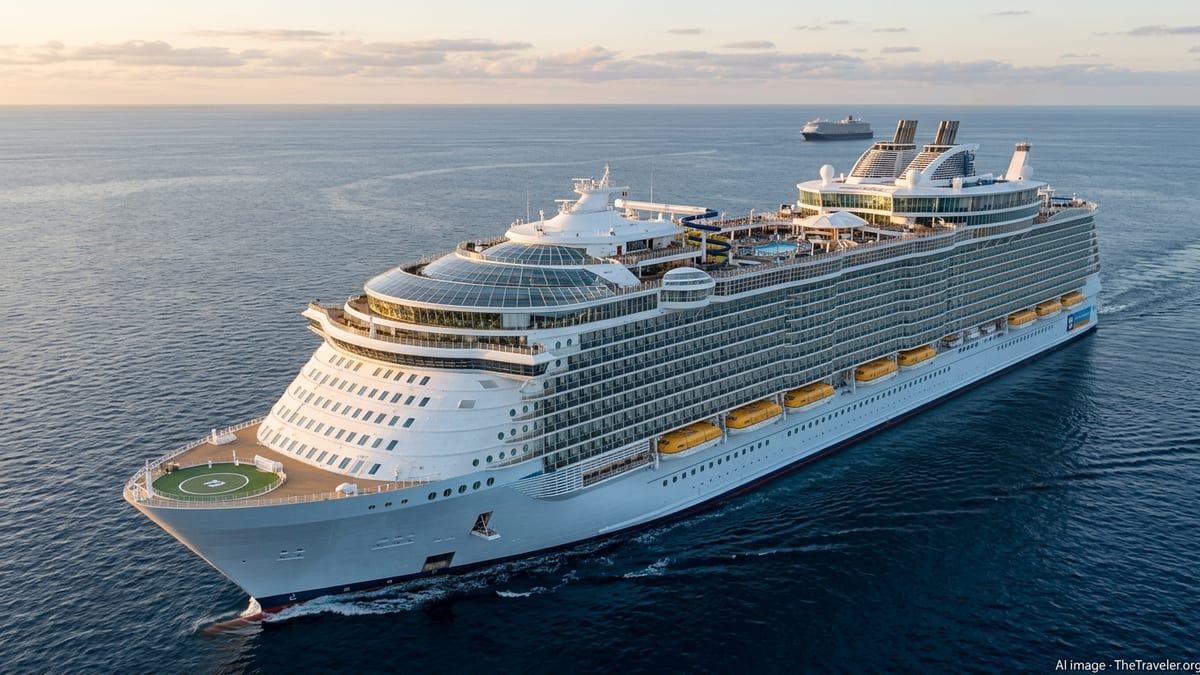
From Viral Headline to Decades-Old Megaproject
The latest wave of attention centers on an updated vision for the Freedom Ship, a privately promoted project that has circulated in various forms since the 1990s. Recent coverage describes an immense vessel stretching close to a mile in length, roughly 4,500 feet, with around 30 decks rising above the waterline and a footprint far beyond any cruise ship currently at sea.
Publicly available project descriptions depict a self-contained city at sea rather than a traditional cruise ship. Plans outline capacity for about 80,000 people in total, including an estimated 50,000 long-term residents, plus thousands of crew and day visitors. Housing units, schools, offices, retail districts, parks, and medical facilities are all part of the proposed layout, together with leisure amenities more commonly associated with large resorts than ocean liners.
The ship would not follow standard round-trip itineraries. Instead, its promoters describe a slow, continuous circumnavigation of the globe at modest speeds, remaining offshore and using ferries, helicopters, and small aircraft to connect with coastal cities. In effect, the design positions Freedom Ship as a mobile coastal metropolis, one that is intended to keep moving rather than ever fully dock.
Despite renewed interest, the project remains conceptual. There is no evidence of a finalized shipyard contract, detailed public engineering package, or full financing. The “nearly a mile long” headline reflects what designers say they want to build, not a ship that currently exists in steel.
What the Nuclear Mega-Ship Would Actually Contain
Design materials circulated by the project and by maritime-focused outlets sketch a vessel more akin to a compact city than a single ship. Renderings indicate mixed-use residential districts running along the length of the hull, with apartments and larger homes arranged around interior streets and courtyards. Higher-end units are pictured with balconies and ocean views, while central zones are reserved for commercial and public spaces.
Plans also reference a 15,000-seat sports arena, a large shopping and entertainment complex, a hospital with research capability, and a dedicated education system for children living on board. Rooftop decks would host parks, swimming pools, and a small runway intended for light aircraft operations, further emphasizing the “floating city” framing rather than standard cruise amenities.
Population figures associated with the proposal typically allocate about 50,000 places for permanent residents, 10,000 for visitors, and around 20,000 for crew and support staff. Even at partial occupancy, that would dwarf the world’s largest cruise ships, which currently top out under 10,000 passengers and crew combined. The scale of onboard services, utilities, and logistics required to support such a population, from food supply to waste management, would be comparable to those of a medium-sized city.
To sustain that level of activity, the concept leans on a mix of conventional and advanced marine technologies. The most attention-grabbing element is the suggestion of nuclear propulsion or nuclear-assisted power generation, paired with extensive onboard renewable systems and energy storage. Proponents argue that such a setup could keep the vessel underway for long stretches while reducing dependence on fossil fuels, although those claims remain untested for a structure of this size.
Engineering and Safety Hurdles on an Unprecedented Scale
Naval architects and maritime analysts who have commented publicly on the Freedom Ship concept highlight a series of formidable engineering challenges. At almost 1.6 kilometers in length, the hull would exceed the dimensions of any existing cruise ship or aircraft carrier by a wide margin, entering structural territory more commonly associated with offshore platforms and modular floating structures.
Wave loading, hull flex, and fatigue are among the primary concerns. Even today’s largest container ships and bulk carriers must be carefully designed to withstand bending forces in heavy seas, and those vessels are considerably shorter than the proposed mega-ship. Scaling up to nearly a mile long would likely require unconventional hull forms, modular construction, or segmented structures connected by articulated joints, all of which add complexity and cost.
Stability and maneuverability also pose questions. A vessel this wide and tall, with dense superstructures stacked many stories above the waterline, would need extensive design work to ensure safe behavior in storms, crosswinds, and swells. Routine operations, from anchoring offshore to conducting safe transfers of passengers and supplies, would need to be rethought at a scale where standard harbor tugs and terminals are no longer viable.
Layered on top are the implications of placing a nuclear power plant on board. Historical experience with nuclear-powered civilian ships is limited, and international rules governing nuclear fuel transport, port access, and environmental protection are strict. Any such vessel would likely face a complex patchwork of regulatory barriers and public concerns that extend far beyond typical cruise-ship certification issues.
Financing, Regulation, and the Question of Feasibility
Cost estimates cited by project promoters vary, but recent figures place the price tag in the tens of billions of dollars. That level of investment would be comparable to major national infrastructure programs, concentrated in a single movable asset whose long-term commercial performance is uncertain. Securing such financing without firm commitments from governments, institutional investors, or major industrial partners would be an extraordinary undertaking.
Regulatory frameworks present another layer of uncertainty. A nuclear-powered city at sea would need to navigate maritime safety rules, nuclear safeguards, environmental law, and coastal-state jurisdiction, all of which differ from country to country. Access to ports, even by shuttle craft, could be shaped by national policies on nuclear technology and by local attitudes toward very large cruise and residential ships.
Publicly available information does not show that these regulatory questions have been fully resolved. Instead, the project continues to be presented largely as a vision supported by renderings, promotional materials, and periodic media coverage. Specialists in seasteading and floating infrastructure note that similarly ambitious ocean-city concepts have been announced over past decades but have struggled to advance beyond early design studies.
The Freedom Ship idea, in its nuclear mega-ship variant, sits within that broader pattern. While the concept stimulates discussion about alternative ways of living and traveling at sea, there is currently no clear pathway demonstrating how such a vessel would secure approvals, funding, and technical validation at the scale envisioned.
Why the Mega-Ship Captures the Imagination Anyway
Even so, the near-mile-long nuclear mega-ship continues to resonate online and in popular culture. Recent coverage has circulated widely across social platforms and travel forums, where users debate everything from the ship’s environmental footprint to the daily experience of sharing a confined space with tens of thousands of neighbors.
The idea also taps into longer-running trends in tourism and urban development. Cruise ships have steadily grown larger over recent decades, with successive “world’s biggest” vessels adding more decks, neighborhoods, and amenities to attract passengers seeking resort-style experiences at sea. At the same time, architects and technologists have periodically proposed floating cities, seasteads, and offshore hubs as responses to coastal crowding, rising sea levels, and housing pressures.
In that context, Freedom Ship functions as a kind of thought experiment that combines cruise tourism, real-estate development, and nuclear energy into a single dramatic image. Its scale underscores the gap between what is technically conceivable on paper and what global regulations, capital markets, and public opinion are currently prepared to support.
For now, the 80,000-passenger nuclear mega-ship remains firmly in the realm of ambitious renderings and speculative engineering. Travelers curious about the future of cruising may find it more useful as a lens on emerging ideas in ship design and energy use than as a blueprint for an imminent vacation at sea.