


More news on this day
Australia’s Cocos (Keeling) Islands are set to become markedly easier to reach, as new direct services from Perth trim flying time to about four hours and position the remote Indian Ocean territory as a more accessible holiday destination.
Get the latest news straight to your inbox!
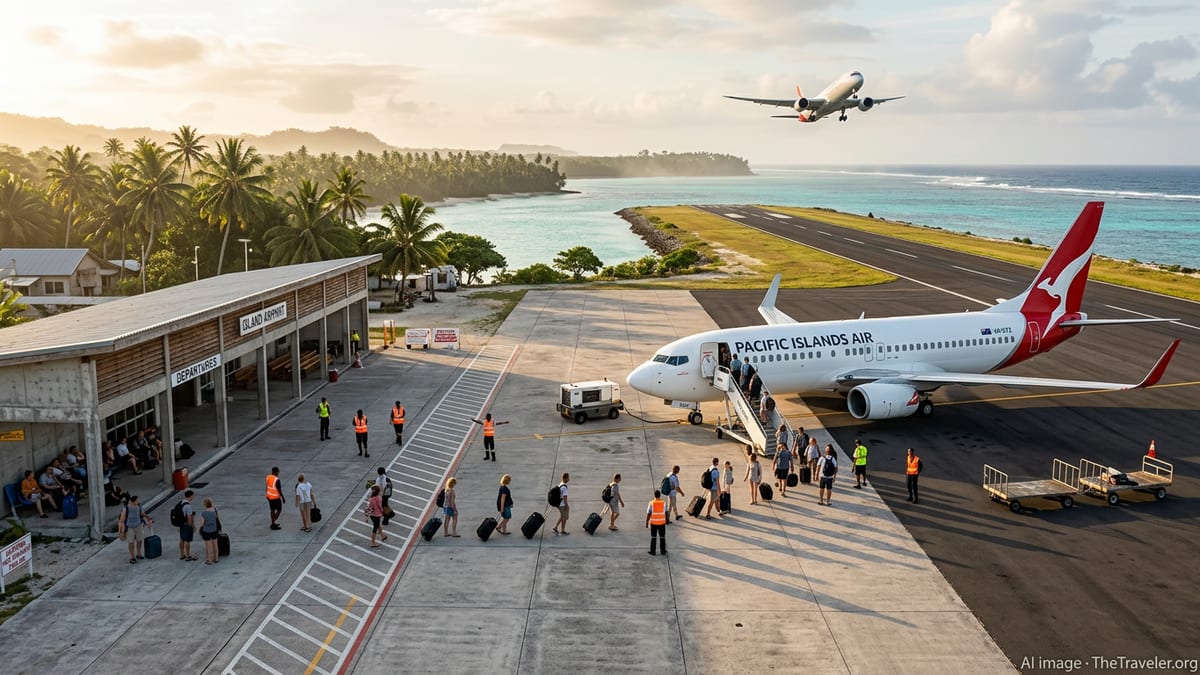
Four Hour Link Replaces Multi Stop Journeys
Until recently, reaching the Cocos (Keeling) Islands typically involved a multi leg itinerary via Christmas Island or other regional hops, stretching total travel time well beyond six hours and adding schedule uncertainty. Publicly available schedules now show non stop services between Perth and Cocos Islands Airport operating in around four hours and 20 to 30 minutes, depending on direction, cutting as much as two hours from previous routings.
Data from route tracking platforms indicates that the Perth to Cocos sector covers roughly 1,837 miles, with typical timetables listing a block time of about four hours and 25 minutes in each direction. The simplified routing removes the need for an intermediate stop for most leisure travelers, a change that industry observers describe as a significant upgrade for one of Australia’s most remote destinations.
Tourism information published for the territory highlights that direct flights from Perth are already scheduled on certain days of the week, while other services still route via Christmas Island and take more than six hours. As the new non stop pattern beds in, visitors are expected to plan more confidently around the shorter, single hop option.
New Capacity From Australian Carriers
Route analysis tools and airline fare displays attribute the renewed non stop link primarily to Australian carriers expanding their regional and leisure networks from Perth. Flight data compiled in recent months lists Virgin Australia on the Perth Cocos route on some schedules, while other published coverage points to Qantas and its regional brand QantasLink marketing fresh services into both Christmas Island and the Cocos (Keeling) Islands.
Travel industry reporting notes that these additions form part of a broader push by Australian airlines to deploy narrow body aircraft from Perth to underserved leisure markets, taking advantage of strong demand for domestic and quasi domestic escapes. For the Cocos Islands, with their limited accommodation base and small local population, even a modest increase in seat capacity represents a substantial change in potential visitor numbers.
Timetables visible on independent flight information sites show the route operated by single aisle jets such as Airbus A320 or Boeing 737 variants, aligning with the relatively short sector length and the need to balance cost efficiency with range. The use of these aircraft supports year round, scheduled connectivity that can be marketed both to Australian holidaymakers and to niche international travelers combining Perth with an Indian Ocean island experience.
Remote Paradise Positioned For Tourism Growth
The Cocos (Keeling) Islands, an Australian external territory in the middle of the Indian Ocean, have long been characterized in official tourism material as one of the country’s most remote beach destinations. With a population of only a few hundred residents spread across low lying coral atolls, the archipelago offers lagoon swimming, world class kitesurfing and diving, and a slow paced island culture far removed from mainland cities.
Holiday planners produced for the destination emphasize its appeal as a low impact, nature based getaway, with strict local controls on visitor numbers and development. The improved air access does not change the territory’s physical isolation, but it does make long weekend stays and shorter trips more realistic for travelers who previously needed to commit to longer itineraries to justify the journey.
Tourism operators have flagged in publicly available marketing materials that easier air links support the viability of guided activities such as reef excursions, birdwatching tours and cultural visits between West Island and Home Island. At the same time, community messaging continues to stress responsible travel, with visitors encouraged to conserve water, protect fragile reef systems and respect the islands’ Cocos Malay heritage.
Economic Benefits And Capacity Constraints
Economic analyses of small island destinations generally point to direct air access as a critical driver of visitor spending, job creation and supply chain resilience. For the Cocos Islands, authorities have historically relied on a combination of government support, freight services and a small but steady stream of tourists to sustain local businesses. The introduction of regular four hour non stop flights from Perth is expected, according to tourism commentary, to lift arrivals and extend the season for operators offering accommodation, dining and tours.
However, planning documents and tourism guidance for the territory also highlight clear capacity limits. With only a handful of guesthouses, small resorts and rental homes across the main islands, there is little scope for a rapid surge in visitor numbers without additional investment. Travel information sites already advise would be visitors to secure flights and lodging well in advance, particularly during school holidays and peak kitesurfing months.
Infrastructure on the islands remains modest, from roads and utilities to health and emergency services, which means that aviation growth must align with community preparedness and environmental safeguards. Industry observers note that the current scale of the new direct flights appears calibrated to match existing capacity rather than transform the territory into a mass tourism hub.
What Travelers Can Expect On The New Route
Published schedules show that most non stop Perth Cocos services operate only on selected days, effectively anchoring weekly travel patterns for both locals and visitors. Travelers can expect an international style departure experience at Perth Airport, as flights to the Cocos Islands typically use international facilities because the territory is outside mainland customs and quarantine zones, despite being Australian soil.
On board, the four hour sector length places the route in the medium haul category, where passengers generally receive a basic meal or buy on board catering, in line with the operating airline’s standard practice for similar flights. Seating configurations on the single aisle aircraft are comparable to other domestic services, with no dedicated premium cabins on many of the published rotations.
Once on the islands, tourism guidance underscores their quiet, low key atmosphere. There are no large resorts, nightlife strips or shopping malls; instead, visitors move between beaches, reef flats and village settlements by bicycle, hire car or community bus. The new direct flights therefore serve less as a gateway to a conventional resort destination and more as an easier bridge to a rare, sparsely populated tropical environment that still feels far from the main tourist circuits, despite now being only about four hours from Perth.