


More news on this day
Europe’s shift to biometric border controls is rapidly reshaping travel for British holidaymakers, with the European Union’s new Entry/Exit System already linked to long queues, missed flights and warnings to arrive hours earlier at key airports.
Get the latest news straight to your inbox!
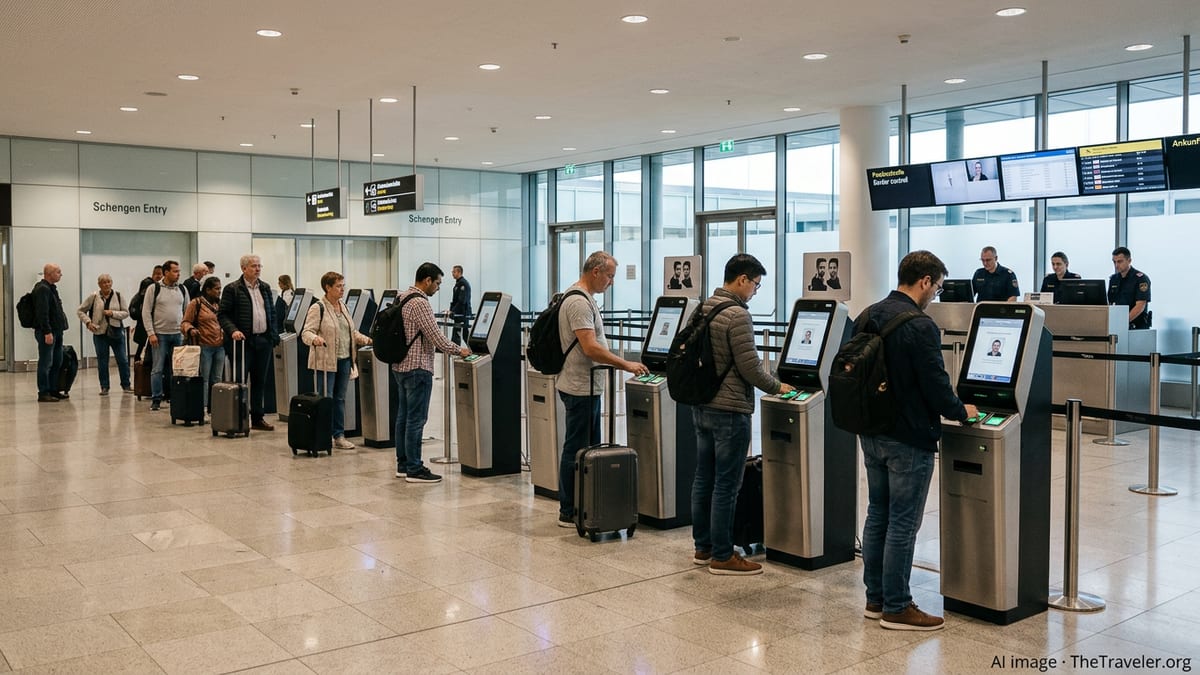
A Digital Border Revolution Arrives in Europe
The European Union’s Entry/Exit System, a bloc-wide digital border database, is moving from years of technical planning into day-to-day reality at airports, ports and land crossings across the Schengen area. The scheme replaces manual passport stamping for most non-EU visitors, including British nationals, with biometric enrolment and automated recording of every entry and exit.
Publicly available EU documentation describes the system as a major security upgrade that logs fingerprints, facial images, passport details and travel histories for short-stay visitors in a central database managed by the EU’s border technology agency. The aim is to detect overstays, reduce identity fraud and create a more consistent record of movements at external borders.
For travellers, the most visible change is at the first Schengen border they hit. Instead of a quick inspection and a stamp, first-time visitors under the new rules are guided to kiosks or manual counters where they scan their passport, provide biometric data and confirm basic itinerary information. Subsequent trips should be faster, but the initial registration step is adding precious minutes to each passenger’s processing time as the system beds in.
Industry analysis suggests that even modest added checks can ripple through crowded terminals. European aviation groups have previously warned that border control processing times at some airports have risen sharply during trial phases, and that peak-time queues may lengthen further as summer holiday traffic collides with full-scale implementation.
Queues, Missed Flights and Patchy Rollout
The impact is being felt first and most sharply by British leisure travellers heading to popular Mediterranean gateways. Recent coverage from travel outlets and consumer groups highlights reports of multi-hour queues at certain Schengen airports where large numbers of non-EU arrivals are all being enrolled into the new system for the first time.
Budget airlines have begun updating their guidance, urging passengers on routes between the United Kingdom and European Union to arrive significantly earlier than they would have before the change. In some cases, carriers now recommend arriving at least three hours before departure from EU airports to allow for both outbound biometric formalities and standard security checks.
Travel news reports describe stranded passengers who reached the departure gate too late after encountering bottlenecks at border control, particularly when several large aircraft landed within a short window. Social media posts and local media coverage from Italy, Spain and Greece point to heavily congested arrival halls on busy days as travellers navigate unfamiliar machines and staff troubleshoot early technical issues.
The picture across Europe remains uneven, however. Some airports have invested heavily in additional kiosks, staff training and queuing systems, reporting smoother operations and shorter waits. Others have installed equipment that is not yet fully operational or remain in transition, leading to a patchwork experience in which two flights landing minutes apart in different cities can face very different delays.
Channel Crossings and National Workarounds
For British holidaymakers, the situation is complicated further by the mix of air, rail and ferry routes used to reach the continent. At Channel ports and Eurotunnel terminals, new biometric infrastructure has been slower to appear, with reports indicating that equipment constraints and space limitations have delayed full deployment for many cross-Channel passengers.
Travel-focused coverage from France and the United Kingdom notes that, for now, many travellers using Eurostar, ferries or the Channel Tunnel are not yet facing the same level of biometric checks as those arriving by air into mainland European hubs. National authorities and operators have focused on incremental upgrades and pilot kiosks in an effort to avoid severe disruption at already congested border queues in Dover, Folkestone and London St Pancras.
Elsewhere in Europe, several Schengen countries have temporarily relaxed or suspended aspects of the new biometric process, particularly for British and other visa-exempt tourists, citing long lines and limited capacity at certain airports. Reports indicate that Greece and Switzerland have both adjusted implementation at popular holiday gateways, with discussions continuing in other southern European destinations about how to balance security rules with peak-season visitor flows.
This patchwork of exemptions and delays means that British travellers can face very different experiences depending on where they first enter the Schengen zone. A family flying to a Greek island may encounter lighter-touch procedures at the outset, while another arriving via a busy hub such as Paris or Amsterdam could find themselves in a slow-moving queue as full biometric enrolment is carried out.
Why the System Matters So Much to Britons
For citizens of EU member states, the Entry/Exit System operates largely out of sight, with routine checks at e-gates and manual booths continuing much as before. For British nationals, who are now treated as third-country visitors following Brexit, the new rules mark a structural change in how European holidays begin and end.
Because each entry and exit is logged electronically, the system enforces the long-standing 90-days-in-180 rule that limits how long non-EU nationals can spend in the Schengen area without a visa. Travel advice sites and legal commentators note that the margin for error is shrinking, as computerised records replace the sometimes inconsistent stamping practices that previously governed stays.
Consumer travel organisations in the United Kingdom are warning that confusion over days counted in multiple short trips could now trigger more refusals at the border, particularly for frequent visitors who juggle work and leisure stays. The fear is that a missed exit scan or a data mismatch could lead to disputes at check-in or arrival, adding to the stress already created by longer queues.
Insurance providers and travel planners are adjusting to this new environment, highlighting the importance of keeping proof of exit journeys, monitoring total days spent in the Schengen zone and double-checking passport validity before departure. For many British holidaymakers, what was once a relatively frictionless weekend break to Europe is evolving into a process that requires more preparation, documentation and time.
Next Up: ETIAS and a New Normal at Europe’s Borders
The biometric overhaul is not the final step. Alongside the Entry/Exit System, the European Union is preparing to phase in a separate digital travel authorisation, known as ETIAS, for visa-exempt nationals including those from the United Kingdom. Under current plans, travellers will need to complete an online application, pay a modest fee and receive electronic clearance before setting off.
According to recent statements and policy papers from EU institutions, ETIAS is designed to pre-screen security and migration risks in advance, while the Entry/Exit System handles identity and overstay checks at the physical border. Combined, they represent a shift towards the type of layered controls already used in destinations like the United States and Canada.
Analysts suggest that, once fully established and supported by enough staff and equipment, the new systems could eventually streamline routine crossings for compliant travellers. Early difficulties are widely attributed to the initial enrolment load, patchy infrastructure and unfamiliarity among both passengers and frontline staff.
For summer 2026, however, the immediate reality is more prosaic. Travel advisories across Europe stress the same message for British visitors: check the latest entry rules for your specific destination, build in extra time at airports, ports and stations, and do not assume that pre-2020 experiences at European borders still apply. The continent’s new digital frontier is here, and for UK holidaymakers it is quickly becoming an unavoidable part of every trip to the sun.