


More news on this day
Airports across Europe are grappling with hours-long queues and rising passenger frustration as the European Union’s new Entry/Exit System of biometric border checks beds in ahead of the peak summer travel season.
Get the latest news straight to your inbox!
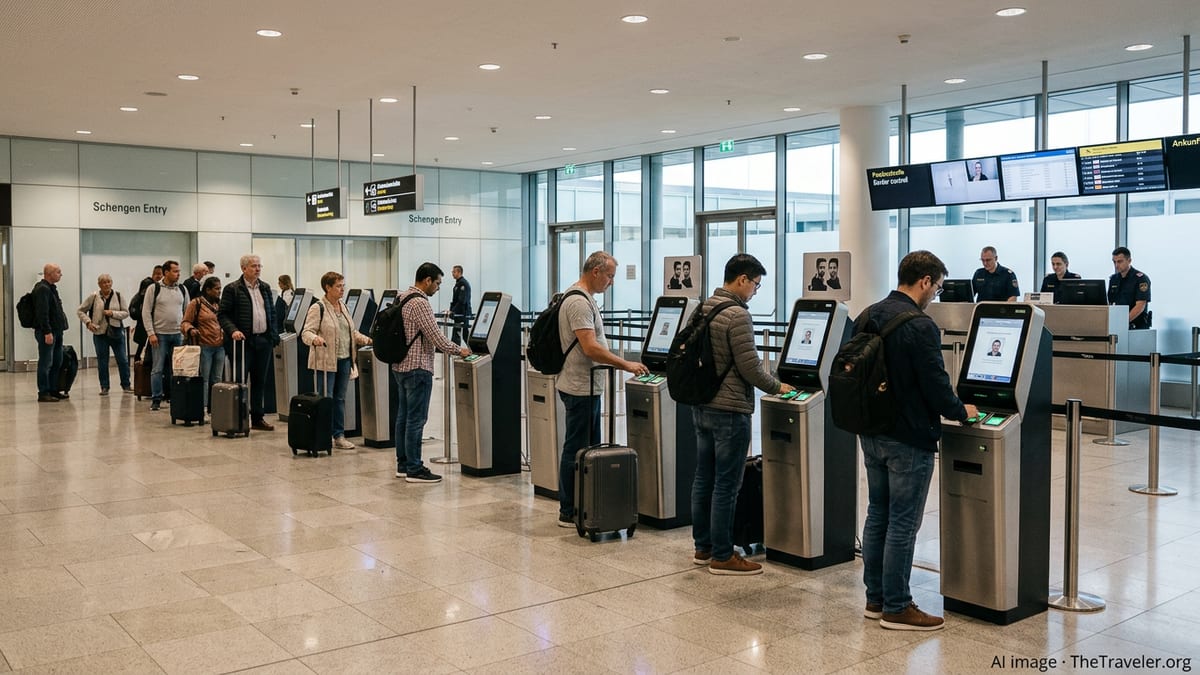
Biometric border overhaul hits breaking point
The Entry/Exit System, fully applicable at Schengen external borders since April 10, 2026, replaces passport stamping for most non-EU travelers with a mandatory digital registration of fingerprints and facial images. The overhaul is designed to tighten security, track overstays and streamline border formalities over time.
In practice, the first full summer of operation is exposing serious growing pains. Reports from aviation outlets and European media describe bottlenecks at automated kiosks, repeated system restarts and passengers being redirected back to manual booths when machines fail to capture biometric data. The added steps for first-time enrollment are extending processing times well beyond pre-EES levels.
According to publicly available data from airport and airline associations, border checks that previously took under a minute can now stretch to several minutes per traveler, particularly for those unfamiliar with the system or traveling in family groups. With thousands of non-EU passengers funneled into the same lanes during peak departure and arrival banks, the compounding delays are turning into multi-hour queues.
Several major airports and industry groups have warned that the rollout is nearing a “critical point,” arguing that current infrastructure and staffing are not sufficient to absorb summer traffic while also registering millions of travelers in the new database for the first time.
Queues, missed flights and suspended checks
From Berlin and Brussels to Rome and popular Mediterranean gateways, reports indicate that the new procedures are already disrupting journeys. Coverage in European travel and aviation media has highlighted queues of up to three hours at some hubs, with passengers missing onward connections and, in extreme cases, entire planeloads departing with dozens of empty seats because travelers were still stuck at border control.
At Brussels Airport, local reporting and internal figures cited in specialist outlets describe days when more than 600 passengers collectively missed flights over a four-day period as EES enrollment slowed departures. Arriving non-EU travelers have faced waits of more than three hours in congested corridors, with some airlines forced to delay pushback or rebook disrupted passengers.
In Italy, Rome’s Fiumicino and Ciampino airports have publicly warned of a potential “summer disaster” if EES procedures are not adjusted during peak months. Italian coverage and traveler accounts indicate that on particularly crowded days, operators temporarily suspended the biometric process and reverted to traditional passport booths in order to clear backed-up lines.
Other airports, including in Greece and Spain, have experimented with partial waivers or more flexible application of the new checks at busy times, focusing biometric registration on new arrivals while allowing previously enrolled travelers to move through faster channels. These ad hoc measures underscore how far implementation still is from the system’s original promise of seamless automated borders.
Industry demands urgent review of the rollout
Airport operators and airlines are increasingly vocal about the strain. In a joint open letter published in February, leading trade bodies representing European airports and carriers warned that EES-related delays were already “significant” and risked spiraling into large-scale travel disruption as summer demand builds. The organizations called for an immediate review of procedures, greater operational flexibility and more realistic expectations around processing times during the first full year of the system.
Since then, the tone has hardened. Recent statements referenced in international news coverage say waiting times of up to two hours have become routine at certain airports during busy periods, with evidence that the extra burden on border police is slowing both biometric and manual lanes. Airport chiefs argue that the system, rather than freeing staff, is adding extra screens and checks for officers who must supervise kiosks, resolve failed enrollments and manually override glitches.
Low-cost and leisure-focused airlines, heavily exposed to non-EU traffic from the United Kingdom and other visa-exempt countries, have issued customer advisories urging travelers to arrive much earlier than usual for flights to the Schengen Area. Some carriers warn of “queue chaos” at key hubs if governments and EU institutions do not further ease transitional rules or allocate additional resources.
Despite this pressure, European institutions have so far framed the disruption as a temporary consequence of a complex digital migration. Publicly available briefings from Brussels emphasize that EES is a long-term investment in secure, efficient borders, and that member states are responsible for ensuring smooth on-the-ground operations during the adjustment period.
Why the new system is struggling
Several structural factors appear to be feeding the current travel chaos. First-time EES registration for a non-EU traveler typically involves multiple steps at self-service kiosks, including biometric capture and verification, before a final inspection by a border officer. Any error, hesitation or technical fault multiplies across long queues of passengers, especially when families or tour groups try to enroll together.
Airports and industry experts cited in specialized reports say terminal layouts and staffing models were often optimized for a faster, stamp-based process. Many installations lack the physical space for large clusters of kiosks and waiting areas, forcing queuing passengers into already crowded immigration halls. When systems slow down or freeze, there is limited room to create additional lanes or segregate first-time enrollees from returning travelers.
Technical growing pains are also significant. Public accounts from airport representatives and travelers describe malfunctioning fingerprint readers, repeated failures of facial recognition, and instances where travelers apparently had to complete the full enrollment procedure again on subsequent trips because prior data could not be retrieved quickly at the border. Each of these issues lengthens processing times and undermines traveler confidence in the system.
Compounding the operational challenges is the broader recovery of global air travel. Passenger volumes on many intra-European and transcontinental routes are approaching or surpassing pre-pandemic levels, leaving little slack in terminal capacity. Any added friction at border checkpoints is therefore magnified, particularly at holiday gateways serving beach destinations and cruise ports.
What travelers should expect this summer
For passengers planning trips to the Schengen Area in the coming months, the main impact will be at the first point of entry, whether in a continental hub or at a smaller leisure airport. Non-EU travelers who have not yet been enrolled in EES should expect to provide fingerprints and a facial image and to spend more time at border control than they did before April 2026.
Travel advisories from airlines, tourism boards and consumer groups consistently recommend allowing additional time at departure airports, particularly for morning and evening peaks when long-haul flights arrive or depart in clusters. Families, large groups and travelers requiring extra assistance are especially likely to experience slower processing during the initial enrollment stage.
Once registered, subsequent trips should in theory be quicker, as EES data remains valid for several years. However, mixed reports from early adopters suggest that repeat delays cannot be ruled out, especially while systems are still being fine-tuned and staff adapt to new workflows. Experienced travelers are therefore building in generous buffers for connections that involve a Schengen border crossing.
Behind the scenes, EU institutions, national governments and airport operators are under growing pressure to stabilize the system before the busiest weeks of July and August. Whether incremental fixes and temporary workarounds will be sufficient to prevent further scenes of travel chaos remains an open question for Europe’s new digital border regime.