


More news on this day
A collision between two East Midlands Railway passenger trains near Bedford, north of London, has left one train driver dead and nine people in critical condition, with dozens more injured, according to reports from British media and rail agencies on Saturday.
Get the latest news straight to your inbox!
Evening rush-hour journey turns to chaos
The crash occurred late on Friday afternoon near Kempston, just south of Bedford, on a key stretch of the Midland Main Line linking northern England with London St Pancras. According to published coverage, both trains were heading toward the capital when one service struck the rear of another on the same southbound route.
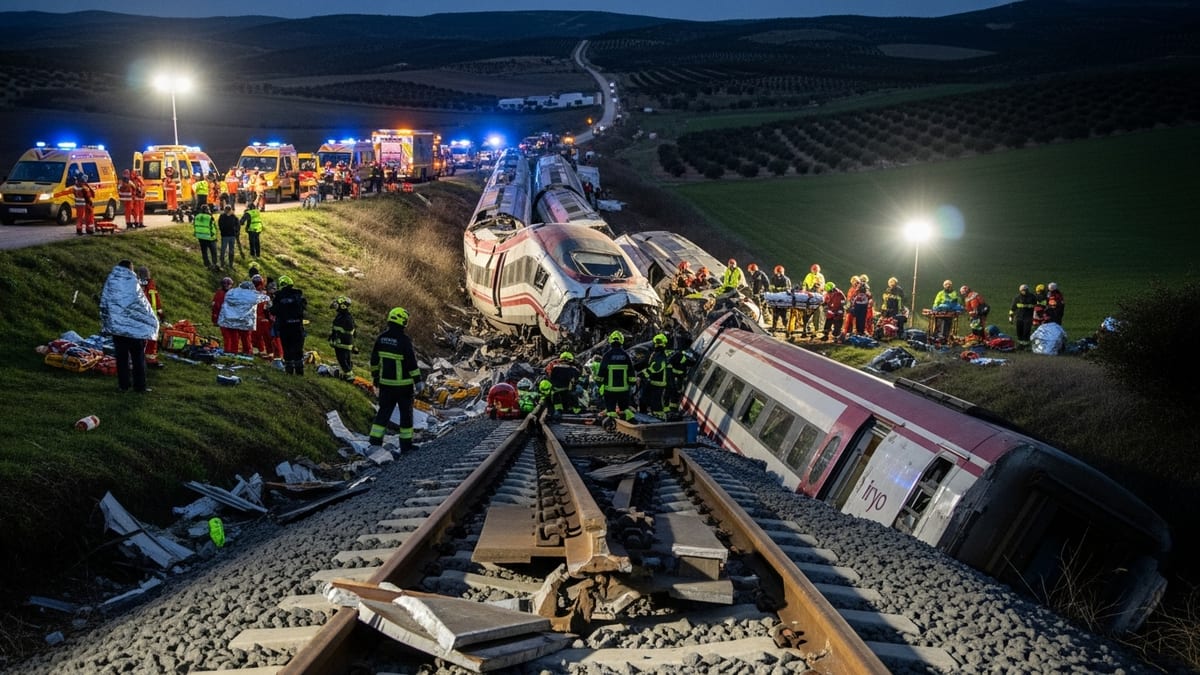
Initial accounts indicate the collision happened shortly after 5 p.m. local time, at the height of the commuter rush. Images from the scene show carriages tilted at angles, with visible damage to the leading units of the rear train and shattered windows along several coaches. Emergency lighting and floodlights illuminated the tracks as responders worked into the night.
Reports from British Transport Police and regional health services indicate that approximately 80 to 90 people required medical attention. Around 28 remained in hospital on Saturday, with nine in critical condition and others classified as having very serious or serious injuries.
Rail union representatives quoted in national media stated that the person who died was the driver of one of the trains. Publicly available information from the operator confirms that services on the affected section of line were suspended while rescue and recovery work continued.
Major emergency response along Midland Main Line
Public information from local authorities describes a large-scale emergency operation involving multiple ambulance crews, fire services and police units. A major incident was declared, allowing hospitals across the region to activate surge capacity and prepare for a high number of casualties.
Ambulance services deployed rapid response teams, road ambulances and air support to transfer the most seriously injured to trauma centres in Bedford and other nearby cities. Witness accounts reported in national broadcasters describe passengers being triaged on a roadside parallel to the tracks before being moved to waiting vehicles.
Some passengers described being thrown forward by the force of the impact and then helping others who were unable to walk or speak clearly. Photographs published by regional and national outlets show injured travellers being treated on stretchers, while others, apparently less seriously hurt, were wrapped in blankets and directed away from the scene.
Network Rail and East Midlands Railway issued public statements expressing sympathy to those affected and advising passengers to avoid travel on the route while investigations and track repairs take place. Other operators on the north-south corridor reported knock-on disruption, with delays and cancellations extending into Saturday.
Investigators focus on stopped train and safety systems
Attention is now turning to how two modern passenger services came to collide on one of the country’s busiest main lines. According to coverage in British and international outlets, early indications suggest that the front train had come to a standstill, possibly due to an issue with an onboard safety or signalling system, before the following service struck it from behind.
The Rail Accident Investigation Branch has opened a formal inquiry to examine the sequence of events, including train data recorders, signalling logs and driver actions in the minutes before the collision. Technical specialists are expected to analyse whether any failure involving automatic protection systems, braking performance or communication between trains and control centres played a role.
Published analysis of recent UK rail safety reports notes that rear-end collisions between passenger trains have been rare in recent decades, reflecting the widespread adoption of modern signalling and automatic protection technology. The circumstances near Bedford are therefore likely to be scrutinised closely for any systemic vulnerabilities.
Investigators are also expected to consider track conditions, visibility, train speed and the positioning of maintenance work or other restrictions in the area. Findings from the inquiry typically lead to recommendations aimed at preventing similar incidents, which may involve changes to procedures, equipment or driver training.
Record of strong rail safety shaken by latest crash
Britain’s rail network is frequently cited in international comparisons as having one of the strongest safety records in the world, particularly in terms of passenger fatalities on mainline services. Prior to this incident, fatal collisions between multiple passenger trains had become increasingly uncommon, interrupted mainly by isolated derailments or incidents linked to extreme weather and infrastructure challenges.
Nonetheless, the Bedford collision follows several high-profile rail and tram accidents over the past two decades, each prompting improvements to rail technology and operational standards. Transport commentators in UK media are already drawing parallels and calling for the latest investigation to translate quickly into practical safety enhancements.
For regular travellers on the Midland Main Line, the crash is also a stark reminder of the risks that remain, even on routes generally perceived as routine and reliable. Passenger testimony captured in early coverage speaks of confusion, fear and sudden injury within seconds, in a situation where most assumed they were on a standard commuter journey.
Rail-user groups have emphasized, in public statements and interviews, the importance of transparent updates on the condition of the injured and on the progress of the investigation. There is also renewed discussion about how information is shared with passengers on trains caught up in major incidents and how quickly families can be notified when loved ones are involved.
Travel disruption and what passengers need to know
For travellers, the immediate impact of the collision has been severe disruption along the route between the East Midlands and London. According to timetables and operator updates available on Saturday, services through the affected section near Bedford have been curtailed or diverted, and replacement road transport is being used on some legs of the journey.
Passengers planning to travel between London St Pancras and destinations such as Corby, Nottingham and other East Midlands towns are being advised through public announcements and online updates to check their journeys carefully, expect extended travel times and consider alternative routes where possible.
Industry analysts note that the Midland Main Line is a critical artery for both daily commuters and leisure travellers heading to and from the capital. Any extended closure for investigation and repairs is likely to place additional pressure on parallel north-south routes, as operators attempt to reroute services and reallocate rolling stock.
As the investigation progresses and more details emerge about what led to the collision, the focus for passengers and communities along the line remains on the recovery of those injured, the restoration of normal services and the question of how the lessons from Bedford will reshape safety practices on one of the United Kingdom’s most important rail corridors.