


More news on this day
Severe thunderstorms around Denver International Airport led to the diversion of 22 flights into Colorado Springs Airport, briefly transforming the regional facility into a relief hub for stranded passengers and rerouted aircraft.
Get the latest news straight to your inbox!
Storms Disrupt Operations at Major Western Hub
According to published coverage and flight-tracking data, intense thunderstorms in the Denver area prompted air traffic controllers to sharply restrict arrivals at Denver International Airport. The storms built quickly along the Front Range, creating unsafe conditions for aircraft attempting to land and forcing a series of last-minute diversions.
Publicly available information indicates that at least 22 flights originally destined for Denver were redirected to Colorado Springs Airport during the height of the disruption. The diversions affected a mix of domestic routes from multiple airlines, with aircraft arriving from cities across the United States as the storm system passed over the metro area.
Denver International is one of the country’s busiest connecting hubs, and even short periods of severe weather can have an outsized impact on schedules. With arrivals slowed or halted, flights already airborne and nearing Denver often have limited options, leading dispatchers and pilots to seek nearby airports such as Colorado Springs that can safely accommodate mid-size and larger jets.
Reports from travelers and aviation observers describe a crowded airspace and a rapidly changing sequence of holding patterns, go-arounds, and diversions as the thunderstorm cells intensified near Denver’s runways. The decision to reroute flights south to Colorado Springs helped reduce congestion in the skies above the Denver area while the worst of the weather moved through.
Colorado Springs Airport Becomes Temporary Overflow Hub
Colorado Springs Airport, a smaller commercial facility compared with Denver International, experienced an abrupt surge in traffic as the diverted aircraft began arriving. Publicly available data on flight movements show an unusually high number of inbound flights clustering within a relatively short window, with gates, ramps, and taxiways handling volumes that far exceed a typical afternoon.
The airport’s layout and runway infrastructure allow it to receive a range of mainline jets, but it is not normally tasked with serving as a large-scale diversion point for a major hub. As the 22 flights arrived, ground operations were stretched by the need to park aircraft, manage refueling, and coordinate onward travel once conditions improved north along the Front Range.
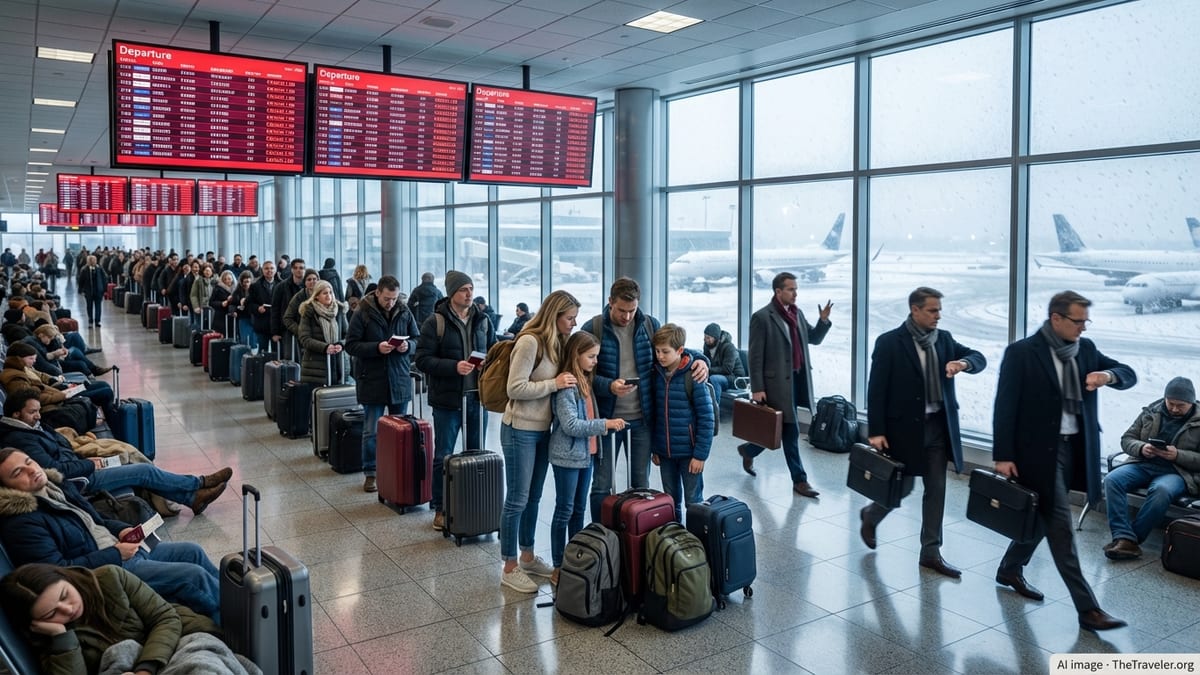
Passenger accounts shared through social media and local coverage describe crowded hold rooms, long lines at service desks, and uncertainty over whether aircraft would continue on to Denver later in the day or discharge travelers in Colorado Springs to complete their journeys by ground. Some flights reportedly remained on the tarmac for extended periods while crews awaited updated routing decisions.
Despite the rapid influx of traffic, publicly available information indicates that Colorado Springs Airport maintained safe operations, with ground crews, airlines, and air traffic control adjusting to the sudden spike in volume. For many travelers, however, the experience translated into multi-hour delays and missed connections as the ripple effects spread through airline networks.
Passenger Itineraries Upended Across Airline Networks
The diversions from Denver had cascading consequences for passengers throughout the country. Aircraft that were intended to turn around quickly at Denver and operate onward flights were temporarily stranded in Colorado Springs, while crews bumped up against duty-time limits and aircraft needed additional fuel and servicing before any onward leg could depart.
Travelers reported missed connections at Denver and at downstream hubs as the schedule disruptions reverberated. In some cases, publicly available accounts suggest passengers were offered ground transportation from Colorado Springs to the Denver area after it became clear that a timely repositioning flight would not be possible.
Airline operations centers routinely plan for thunderstorms at Rocky Mountain airports, but the concentration of 22 diversions into a single regional facility underlines how quickly a local weather event can strain even well-rehearsed contingency plans. Once aircraft are spread among alternate airports, restoring the normal pattern of departures and arrivals often requires schedule reshuffling that can extend delays into the next day.
For travelers, the episode serves as a reminder of how weather-sensitive hub operations can be, particularly in the late afternoon and evening hours when convective storms are most common in Colorado during the summer months. Even if an origin city is experiencing clear skies, conditions at a distant hub can dictate whether a flight arrives on time, diverts to an alternate field, or remains on the ground awaiting a new departure slot.
Front Range Weather Patterns Create Recurring Aviation Challenges
Climatological assessments of Colorado’s Front Range note that severe thunderstorms, high winds, hail, and rapid temperature changes are regular warm-season hazards. When these conditions line up over major aviation infrastructure, both Denver International and Colorado Springs Airport can face quick operational shifts, ranging from ground stops to runway changes and diversions.
Technical case studies prepared by meteorological and aviation agencies describe how thunderstorms can form rapidly along the foothills before propagating eastward over the plains. When storm cells develop near an airport, they can reduce visibility, introduce strong wind shear, and generate lightning, all of which complicate approaches and departures and may temporarily shut down key arrival and departure corridors.
In this latest episode, the decision to direct 22 Denver-bound flights to Colorado Springs reflects established safety practices that prioritize stable approach paths and adequate spacing around active storm cells. While diversions are disruptive for passengers and airlines, they are a core safety tool in regions where convective weather can intensify faster than scheduled traffic can be rerouted.
Longer term, transportation planners and airport managers continue to evaluate how infrastructure, staffing, and contingency agreements between airports can mitigate the impact of such events. The sudden role of Colorado Springs as an overflow hub during Denver’s storm disruption offers a fresh case study in the resilience and limits of regional air networks across Colorado’s weather-prone corridor.