


Plaça de Catalunya is the busy heart of Barcelona, a large open square where the elegant Eixample district meets the historic Ciutat Vella. For first-time visitors, it is both an orientation point and a practical hub that links the airport, metro, buses, shopping avenues and some of the city’s most famous sights. Understanding how to use this square as your “home base” will make your first days in Barcelona smoother, cheaper and a lot less confusing.
Get the latest updates straight to your inbox!
Why Plaça de Catalunya Matters for First-Time Visitors
Plaça de Catalunya is the main central square of Barcelona and one of the easiest places to recognize on a map. It sits exactly where the wide grid of Eixample streets meets the older medieval core of the city. On one side you have Passeig de Gràcia and Rambla de Catalunya, lined with upscale shops and Modernista buildings. On the other, La Rambla drops towards the sea, passing the Gothic Quarter and the Boqueria market. For a first-time visitor, this means you can reach many major sights on foot in 10 to 20 minutes from the square.
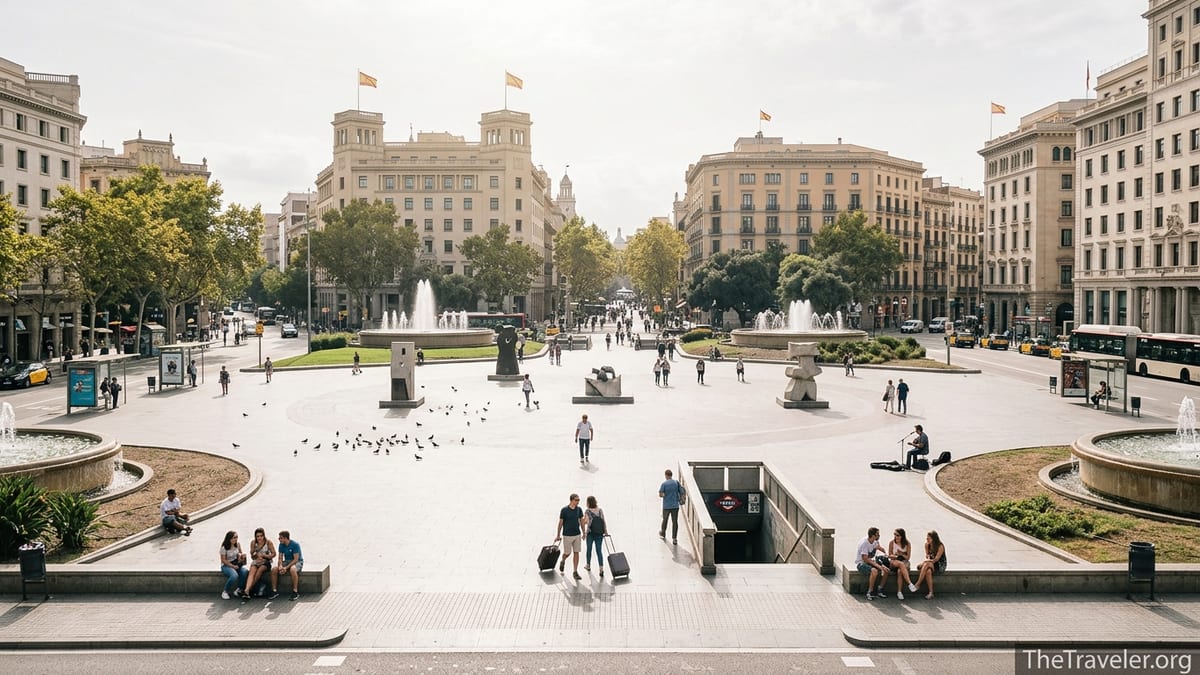
The square itself is large, with paved open areas, fountains and sculptures, and a ring of busy roads and bus stops around the edge. It is a genuine everyday space, used by office workers cutting across on their commute, teenagers meeting friends and tourists orienting themselves with paper maps and phones. Events, demonstrations and football celebrations often gather here, so do not be surprised if you arrive to find music, flags or television cameras.
Practically, Plaça de Catalunya functions as one of the city’s most important transport interchanges. The Aerobús from the airport stops here, as do several airport and night buses, local TMB buses, regional buses and tour buses. Under your feet you have multiple metro lines and suburban trains. For a first-time visitor staying nearby, this can mean a direct ride from the airport, an easy metro to Sagrada Família and affordable access to neighborhoods like Gràcia, Poblenou or Montjuïc without changing at lots of unfamiliar stations.
Because it connects so much of the city, many visitors choose hotels within a short walk of Plaça de Catalunya. This makes early-morning airport departures, late-night arrivals and day trips by train more convenient. Even if you stay elsewhere, planning your first hours in Barcelona as if Plaça de Catalunya were your central “hub” is a useful strategy.
Getting to Plaça de Catalunya from Barcelona Airport
The most straightforward way for most first-time visitors to reach Plaça de Catalunya from Barcelona–El Prat Airport is the Aerobús express coach. Separate lines operate from Terminal 1 and Terminal 2 and both run to the city center with a final stop at or next to Plaça de Catalunya. Buses are frequent, usually every few minutes during the day, and the ride typically takes around 35 minutes depending on traffic. You buy tickets from machines at the stop or pay contactless when boarding; expect to pay a bit more than a standard city bus since it is an express airport service.
If you prefer to minimize costs and do not mind a slightly longer journey, the standard public bus network and the airport metro line are alternatives. The orange L9 Sud metro line connects both airport terminals to the city’s metro system. To reach Plaça de Catalunya, you ride L9 Sud to a connection point such as Zona Universitària and then transfer to the green L3 line towards the center, getting off at Catalunya. The airport metro requires a special ticket that is more expensive than a normal single ride, but if you plan to use metro and bus heavily during your stay, a multi-day pass that includes airport access can work out cheaper overall.
Another option is the R2 Nord commuter train from the airport to central Barcelona, though it does not stop directly at Plaça de Catalunya. Instead you get off at Passeig de Gràcia station and either walk about 10 to 15 minutes slightly downhill to the square or connect onto the metro. This can be a good compromise if you are traveling light and your hotel is on Passeig de Gràcia or near Plaça de Catalunya itself.
Taxis and app-based ride services are widely available at both terminals, with official taxis clearly marked and using regulated meters. In normal daytime traffic, the drive to Plaça de Catalunya takes around 25 to 35 minutes. Many visitors with heavy luggage or arriving late at night choose a taxi directly to their hotel near the square. It costs more than public transport but removes the stress of figuring out ticket machines and connections after a long flight.
Using Plaça de Catalunya as Your Transport Hub
Once you have arrived, it helps to think of Plaça de Catalunya as your personal transport hub. Under the square is Catalunya station, a major interchange where the red L1 and green L3 metro lines meet, along with some FGC suburban train lines that locals use to commute to nearby towns. For a first-time visitor, L1 and L3 are the ones you will likely use most. L1 takes you along Gran Via to areas like Arc de Triomf, while L3 runs through central sights including Passeig de Gràcia and down La Rambla towards the port.
Down in the metro, the station can feel like a maze at first, with long corridors and multiple exits labeled after nearby streets and landmarks. If you are heading to La Rambla, follow the signs for that street or for the “Rambla” exits. If you want the Eixample side of the square, follow signs that mention Ronda Universitat or Passeig de Gràcia. Paying attention to the colored line markings on floors and walls (red for L1, green for L3) helps you stay oriented as you move between platforms.
On the surface, several city bus lines start or pass through Plaça de Catalunya. These include routes that cross the Eixample and head toward areas like Montjuïc, Barceloneta and the beach. If you plan to rely mainly on buses, pick up or download a current network map so you can see at a glance which side of the square your bus leaves from. The same bus line often has stops on opposite sides of the square depending on direction, so check the small digital signs on the front of the bus to confirm it is heading where you expect.
Regional and tourist-oriented buses also cluster around the square. Intercity coaches towards Costa Brava or some Catalan towns may pick up within a short walk, and hop-on hop-off sightseeing buses include Plaça de Catalunya as a starting point. For a jet-lagged first evening, many visitors simply use the square as the boarding point for a loop on a sightseeing bus to get an overview of the city, then decide which neighborhoods they want to explore in more depth the following days.
Orientation: What You See Around the Square
Standing in the center of Plaça de Catalunya, you can quickly get your bearings using a few fixed landmarks. Looking south, you see La Rambla starting its gentle slope towards the waterfront. This tree-lined promenade is where you will find the Boqueria market, side streets into the Gothic Quarter and plenty of cafes, some touristy and some more local. Looking north, wide avenues stretch into the Eixample grid. Passeig de Gràcia, one block to the northwest, leads to famous Modernista buildings such as Casa Batlló and La Pedrera.
On one side of the square stands the large El Corte Inglés department store building. It is an obvious reference point, useful when giving directions or finding a meeting spot, and inside you will find everything from a supermarket in the basement to electronics, fashion and travel accessories. Visitors who forget an adapter, need an umbrella during a sudden shower or want a quick snack from the supermarket often head here because it is easy to find and stays open later than many small shops.
The square itself is dotted with sculptures and fountains, and flocks of pigeons often gather on the open pavement. In good weather, families let children chase the birds while others sit on the edges of raised planters to rest their feet. The atmosphere shifts with the time of day. In the early morning it feels relatively calm, with commuters cutting across; by late morning tour groups begin to assemble, and by afternoon there may be live musicians on nearby corners. At night, the lighting on the fountains and surrounding façades makes the scene feel more theatrical, though traffic noise never really disappears.
Because several major roads meet here, the ring of traffic lights around the square can be confusing to cross. Use designated crosswalks and respect signals, especially if you are dragging luggage or traveling with children. From the central pavement areas, underground crossings lead to some exits of the metro station and to different edges of the square, which can be a useful way to avoid waiting at lights if you are already headed downstairs to catch a train.
Food, Views and Shopping Around Plaça de Catalunya
The immediate surroundings of Plaça de Catalunya mix international chains with local institutions. Inside El Corte Inglés, the higher floors include a rooftop food hall and cafeteria area where you can eat with sweeping views of the city. One popular option is a panoramic space offering different food counters, from sandwiches in the morning to sushi, woks and pastries later in the day. Prices are a bit higher than a basic bar in a side street, but many first-time visitors find it worthwhile for the combination of air conditioning, clean bathrooms and a skyline view that stretches across Eixample and towards Tibidabo.
Around the square itself and just off it, you will see familiar international coffee and fast-food brands, which some travelers like for predictability, especially with kids. At the same time, you do not need to walk far to find more local places. For example, stepping a block into the Eixample grid you will encounter traditional bars serving coffee and simple breakfasts to office workers, bakeries selling ensaïmadas and croissants, and small tapas spots that offer reasonably priced menus at lunchtime. Heading into the Gothic Quarter, narrow streets hide wine bars and small restaurants with fixed-price daily menus.
For fashion, Plaça de Catalunya marks the start of two major shopping axes. On one side, Portal de l’Àngel descends towards the cathedral with a dense line of mid-range international clothing and shoe brands. On the other, Passeig de Gràcia rises towards Gràcia with a mix of luxury labels, Spanish designer boutiques and flagship stores of popular European brands. Visitors who want to shop but have limited time often start at Plaça de Catalunya, walk one direction for an hour or two, then return to the square to decide what to do next.
If you are looking for practical travel items rather than clothing, the department store and nearby electronics chains usually have what you need. Examples include SIM cards, portable chargers, basic cameras, carry-on suitcases or replacement headphones. This can be especially useful if your luggage is delayed and you need essentials without learning your way around the whole city on day one.
Safety, Scams and Practical Tips in the Square
Plaça de Catalunya is generally safe, busy at almost all hours and heavily monitored, but like any major urban hub, it has petty crime. The main risk is pickpocketing, especially around the metro entrances, bus stops and when crowds gather for street performances or spontaneous events such as football celebrations. Keep valuables in a zipped bag carried in front, avoid leaving phones on outdoor café tables and be cautious if strangers try to distract you with petitions, friendship bracelets or sudden offers of help with tickets.
At night, the square remains active, with late-running buses, taxis and people returning from bars or performances. You will usually see uniformed police vehicles around, particularly on weekends or when large crowds are expected. While violent incidents are rare, you should still apply basic big-city common sense: stick to well-lit routes, avoid obvious public intoxication and be careful with ATMs. Many visitors feel comfortable walking from Plaça de Catalunya to surrounding hotels after midnight, but if you are carrying luggage or feel unsure, taxis are plentiful on the edges of the square.
Ticket buying can be another point where visitors feel overwhelmed. The metro and FGC machines in Catalunya station offer English and other language options. If you plan to use public transport several times a day, consider a multi-trip card rather than single tickets. You can usually purchase these with bank cards. When returning to the airport, remember that most standard metro cards do not include the airport supplement, so you may need a specific airport ticket if you choose the metro over the Aerobús.
The square is also a common place for sales of unofficial souvenirs and drinks. People might approach with cans of beer or bottles of water pulled from bags or small coolers. Hygiene and quality are not guaranteed, and local authorities periodically crack down on this informal trade. It is safer to buy drinks and snacks from convenience stores, bakeries or café bars around the edges of the square, where prices are clearly displayed and products are properly stored.
Easy Walks and Nearby Sights from Plaça de Catalunya
From Plaça de Catalunya, many of Barcelona’s classic first-time sights are within comfortable walking distance. Heading down La Rambla, you reach the famous Boqueria market in under 10 minutes. This is a lively spot to see colorful fruit stands, cured meats, seafood counters and juice stalls. Keep in mind that some stands cater mainly to tourists with ready-to-eat cones of ham or fruit cups at higher prices, while others serve local residents. If you go in the morning and buy from the more traditional counters, you can still have an authentic and not overly expensive snack.
Turning slightly southeast from the square, side streets lead into the Gothic Quarter, a dense web of alleyways, small plazas and medieval buildings. Within 15 minutes on foot you can reach Barcelona Cathedral, Plaça del Rei or Plaça Sant Jaume, where the city and regional government buildings face each other. This area is ideal for wandering, with small artisan shops, historic cafés and occasional street musicians. Using Plaça de Catalunya as your reference point makes it easier not to get completely lost in the maze; when in doubt, ask for directions back to the square or follow signs that say “Plaça Catalunya.”
In the opposite direction, if you walk north along Passeig de Gràcia you pass Modernista landmarks like Casa Batlló and Casa Milà (La Pedrera). Both are among the city’s most visited sites, with timed-ticket entries that often sell out, particularly in high season. Strolling there from Plaça de Catalunya takes roughly 10 to 20 minutes depending on your pace and stops to look in shop windows. Many visitors schedule an early-morning or late-evening visit to these buildings, using the walk back along Passeig de Gràcia to pick up food or sit for a drink before returning to their hotel.
For a quieter change of scene, you can head into the Eixample side streets just off the square. Within a few blocks you will find everyday residential streets with local bakeries, small groceries and neighborhood bars, far less crowded than La Rambla. Spending an hour exploring this area on your first day helps you see how locals live, buy groceries and socialize, and it can provide you with a more authentic place to return for dinners later in your stay.
The Takeaway
For first-time visitors to Barcelona, Plaça de Catalunya is much more than a pretty central square. It is a practical anchor point that connects the airport to your hotel, the metro and buses to major attractions, and the city’s historic and modern faces. Once you understand where the metro entrances are, how to reach the Aerobús stop and which streets lead to La Rambla, the Gothic Quarter and Passeig de Gràcia, navigating Barcelona becomes far less intimidating.
Using Plaça de Catalunya as your starting reference, you can structure each day around simple movements: out in the morning to a museum or architectural landmark, back via metro or on foot in the afternoon, then out again for dinner in nearby neighborhoods. With basic precautions against pickpockets, clear awareness of your route and a willingness to explore just beyond the most obvious tourist stretches, the area around the square can feel like a comfortable home base rather than a chaotic transit point.
Ultimately, whether you ride in on the Aerobús, step out of the metro or arrive by taxi, your first view of Plaça de Catalunya will likely be your introduction to Barcelona as a functioning modern city. Understanding how to use it, and not just pass through it, will help you make the most of your time in the Catalan capital.
FAQ
Q1. Is Plaça de Catalunya a good area to stay in for first-time visitors?
Yes. It offers direct airport connections, several metro lines, many bus routes and an easy walk to La Rambla, the Gothic Quarter and Passeig de Gràcia.
Q2. How long does it take to get from Barcelona airport to Plaça de Catalunya?
By Aerobús it usually takes around 35 minutes, depending on traffic. A taxi or ride service takes roughly 25 to 35 minutes in normal conditions.
Q3. Is it safe around Plaça de Catalunya at night?
The area is busy and generally safe, with regular police presence. The main risk is pickpocketing, so keep valuables secure and stay aware in crowds.
Q4. Which metro lines serve the Plaça de Catalunya station?
Catalunya station is served by metro lines L1 (red) and L3 (green), along with some suburban FGC lines that connect to nearby towns and residential areas.
Q5. Can I walk from Plaça de Catalunya to the Gothic Quarter?
Yes. You can reach the Gothic Quarter in about 10 to 15 minutes on foot by heading towards La Rambla or Portal de l’Àngel and then turning into the side streets.
Q6. Are there good food options near Plaça de Catalunya?
There are plenty, from rooftop food halls and international chains to local bakeries, tapas bars and cafés in the surrounding Eixample and Gothic Quarter streets.
Q7. Where can I buy transport tickets near Plaça de Catalunya?
You can buy metro and FGC tickets at machines inside Catalunya station, and bus tickets on board or from specific machines at some stops, including the Aerobús stop.
Q8. Is Plaça de Catalunya pedestrian-friendly?
The central part of the square is pedestrian, but roads around it are busy. Use marked crosswalks and underground passages connected to the metro to move safely.
Q9. How far is Plaça de Catalunya from Sagrada Família?
By metro, it is a short ride with one change or a direct ride from nearby stations. Walking takes around 30 to 40 minutes, so most visitors prefer public transport.
Q10. Can I use Plaça de Catalunya as a meeting point in Barcelona?
Yes. It is a common meeting spot. People often choose clear landmarks like the front of El Corte Inglés or a specific fountain to avoid confusion.