


More news on this day
U.S. travelers heading into the busy Thanksgiving period are not facing a new Federal Aviation Administration rule that will automatically disrupt flights nationwide on November 24. Federal notices, agency statements and airline communications reviewed as of November 24, 2026, show no fresh systemwide regulation taking effect on that date. Instead, current constraints in the U.S. air travel network are tied to an earlier nationwide ground stop on November 13, ongoing temporary capacity limits at a group of busy airports and typical holiday weather and congestion risks.
Get the latest news straight to your inbox!
What Regulators Have Actually Ordered So Far
The most disruptive recent regulatory action remains the nationwide ground stop that the FAA imposed on Friday, November 13, 2026, after instability in its telecommunications network affected multiple air traffic control centers. According to the FAA’s published explanation and subsequent briefings by the U.S. Department of Transportation, a newly installed router on the agency’s contractor-operated network triggered abnormal data flows that interfered with communications and radar feeds at several facilities. Out of what officials described as an abundance of caution, the FAA halted most departures across the country for roughly four and a half hours while it verified that controllers retained safe surveillance and communications coverage for aircraft already in the air.
Federal summaries of the event indicate that the ground stop itself and the cascading schedule recovery effort led to tens of thousands of delays and cancellations spread over several days as airlines repositioned aircraft and crews. Congressional researchers and emergency management bulletins note that thousands of flights were canceled on November 14 and November 15 as carriers worked through disrupted rosters and stranded passengers. The FAA, the Department of Transportation and Congress are now examining the incident as part of broader debates over funding and accelerating the modernization of the national airspace system’s communications backbone.
In the days since, the FAA has not converted that one-time nationwide ground stop into a standing rule that automatically triggers new systemwide halts. Instead, the agency has focused on technical mitigation measures. Public statements indicate that network service provider L3Harris and router manufacturer Juniper are working with federal investigators to understand why the new equipment interacted poorly with older infrastructure, and the FAA has paused further installations of the affected routers while the root cause analysis continues. Regulators have emphasized that any permanent procedural changes will follow established safety and rulemaking channels rather than appearing without formal notice on a single future date.
Airport-Specific Capacity Cuts, Not A Blanket Shutdown
Separate from the telecommunications failure, the FAA has imposed and adjusted temporary operating limits at a group of large hub airports over the past year to relieve pressure on congested airspace and facilities. Federal aviation analyses and congressional material describe a phased reduction in flights at 40 so-called high-impact airports, including many of the country’s busiest hubs. These measures, which began in November 2025 and have since been refined, restrict certain types of operations during peak hours and require airlines to keep scheduled movements below a defined share of previous levels.
Key features of those caps include tighter limits on general aviation activity at some major hubs, restrictions on visual-flight-rules traffic when staffing or workload do not support full services, and constraints on commercial and charter operations at specific times of day. Some early versions of the order contemplated a 6 percent reduction in scheduled commercial flights at affected airports compared with baseline levels; subsequent FAA communications and industry filings indicate that the effective cut for many carriers has been closer to 3 percent after adjustments and slot trading. Importantly for passengers, these restrictions apply only at designated high-impact airports during defined periods and are not scheduled to expand automatically to every airport nationwide on November 24.
For travelers, the visible impact of these localized caps is most noticeable at large connecting hubs such as the New York metropolitan airports, Washington, D.C., facilities and other crowded gateways. Airlines have retimed banks of flights, consolidated some frequencies and, in a few cases, shifted services to secondary airports to stay within the limits. Load factors on remaining flights can be higher, and some time-of-day options may disappear compared with previous schedules. However, these are targeted safety and capacity tools tailored to specific airports and hours. There is no evidence in current FAA rulemaking dockets or advisories of a new regulation taking effect on November 24 that would suddenly impose comparable caps on every U.S. airport at once.
How Thanksgiving Demand, Weather And Technology Glitches Interact
The timing of the November 13 ground stop, coming just days before the peak Thanksgiving travel window, has heightened traveler anxiety and fueled inaccurate claims of a looming rule-based disruption on November 24. FAA holiday traffic forecasts published on November 24 project that U.S. skies will be busier than at any point in the last 16 years over the nine-day period from November 23 to December 1, with more than 417,000 flights expected. Trade group and travel association outlooks point to tens of millions of passengers taking to the air, with demand remaining near or above recent records even after adjusting for economic conditions.
At the same time, meteorologists are flagging the potential for storms across several regions during the holiday week, including low-pressure systems and frontal boundaries that could bring strong winds, heavy rain or snow to parts of the East Coast, Midwest and Pacific Northwest. Forecasts as of November 24 highlight periods of rain and gusty conditions in some coastal cities on Thanksgiving Day itself. These patterns are typical of late November and can quickly trigger airport-specific ground delay programs, arrival metering and, in some cases, localized ground stops when crosswinds, visibility or lightning reach operational thresholds.
On top of weather and traffic volume, airlines have experienced their own technology problems in the run-up to Thanksgiving. Federal briefings and media reports recount an internal system outage at Delta Air Lines that temporarily affected weight-and-balance calculations earlier in the week, causing delays and a ground stop focused on flights into its Atlanta hub. Other carriers and service providers have reported separate IT glitches, unrelated to the FAA telecommunications incident, that temporarily disrupted check-in, dispatch or reservation functions. While these issues compounded traveler frustration and contributed to rolling delays at specific hubs, they were resolved within hours and did not involve new regulatory restrictions on the entire U.S. airspace system.
Separating Viral Rumors From Verifiable Flight Constraints
Much of the current online speculation about a supposed November 24 rule appears to conflate several different realities: the earlier nationwide ground stop, the preexisting caps at certain high-impact airports and the routine existence of day-of-operations traffic management programs. In practice, the FAA’s toolkit for managing congestion and safety on any given day includes ground delay programs, airspace flow programs, reroutes and temporary ground stops targeted at individual airports or regions when conditions warrant. These are time-limited responses that can start or end with little notice, but they are not codified as a permanent nationwide rule scheduled to activate on a specific calendar date.
Travel-focused delay trackers and FAA public dashboards on November 24 show a familiar patchwork of constraints rather than a blanket stoppage: some airports subject to minor delays due to volume or weather, others operating normally and occasional localized ground stops when thunderstorms, low ceilings or equipment maintenance create short-term bottlenecks. These status indicators fluctuate throughout the day and tend to be more pronounced during holiday peaks, but they are driven by real-time conditions in specific places, not by the implementation of a new across-the-board FAA regulation.
Regulatory records provide further confirmation that nothing of the kind is scheduled for November 24. The Federal Register continues to publish the FAA’s normal stream of technical amendments to instrument approach procedures, airspace classifications and airport design criteria, with effective dates scattered throughout late 2024 and 2025. These actions generally carry findings of minimal economic impact and target discrete locations or technical standards. Neither recent dockets nor press releases mention any rule that would, on its own, require all U.S. airports to curtail operations simultaneously beginning on November 24, 2026.
What Travelers Should Do Around November 24 And Beyond
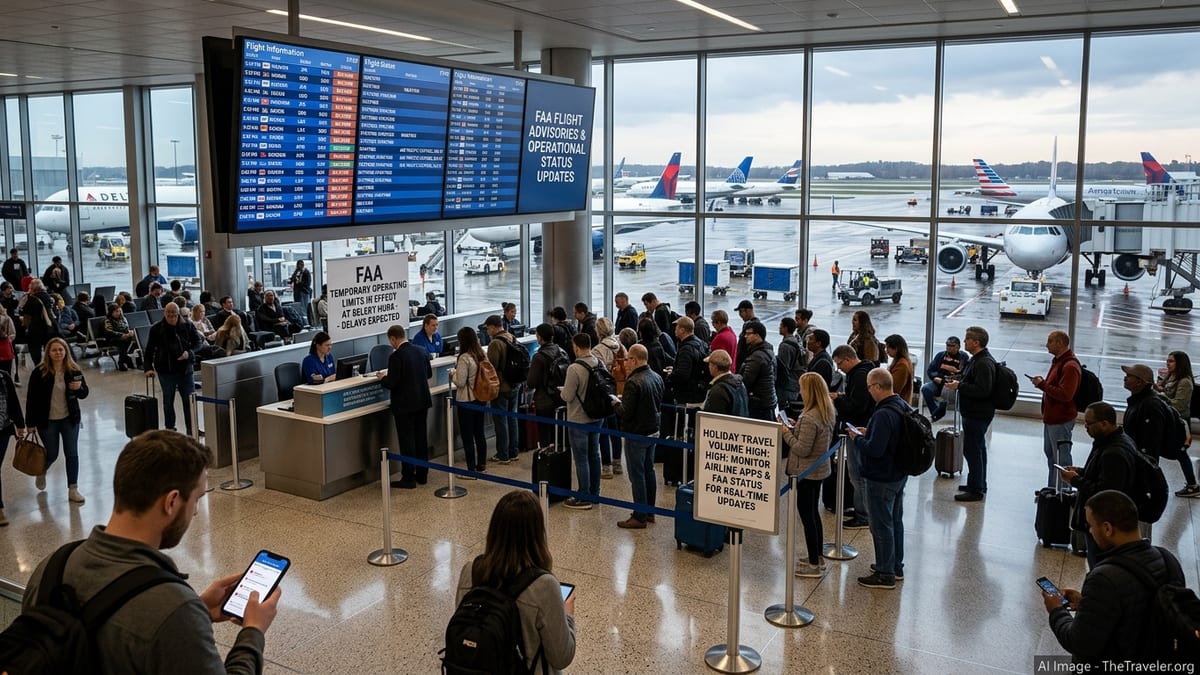
For passengers, the practical takeaway is that disruptions around November 24 and throughout the Thanksgiving period are most likely to arise from familiar sources: high demand, weather and the lingering effects of earlier outages, rather than a new nationwide rule silently scheduled to take effect. Travelers flying through busy hubs should anticipate crowded terminals, stretched security lines and a higher baseline probability of delays, especially on peak departure and return days identified by airlines and travel organizations. The risk is heightened where forecasts indicate storms, strong winds or low visibility, which can trigger restrictive operating configurations at major airports.
The most reliable way to monitor real disruption remains through official channels. Airline apps and websites will reflect both regulatory constraints and each carrier’s internal operating decisions, issuing real-time updates on departure times, gate changes and rebookings. For a broader system view, the FAA’s public status tools display current delay programs, ground stops and closure notices affecting specific airports, along with primary causes such as weather, volume or equipment outages. Checking these resources on the morning of travel can give passengers a clearer sense of whether they are facing routine congestion, localized weather impacts or a more serious system-wide issue.
Looking ahead, travelers should expect continued attention in Washington to the resilience of the national airspace system after the November 13 ground stop. The Department of Transportation has already signaled that it will press Congress for additional funding to accelerate replacement of aging communications infrastructure, and lawmakers have requested detailed briefings on contractor oversight, network architecture and modernization timelines. Any long-term regulatory or procedural changes arising from those reviews would move through established notice-and-comment processes, with proposed and final rules posted publicly well in advance. As of November 24, 2026, however, there is no confirmed new FAA rule set to activate on that date that would, by itself, ground or restrict flights nationwide. For now, passengers planning Thanksgiving trips should focus on booking flexibility, monitoring real-time updates and allowing extra time at the airport rather than rearranging plans in response to unverified social media claims.