


More news on this day
Dallas Fort Worth International Airport (DFW) expects about 3.1 million passengers to travel through the hub over the 2026 Thanksgiving period, as American Airlines and federal air traffic controllers work to keep operations stable following a recent nationwide Federal Aviation Administration network disruption that briefly halted flights across the United States earlier in November.
Get the latest news straight to your inbox!
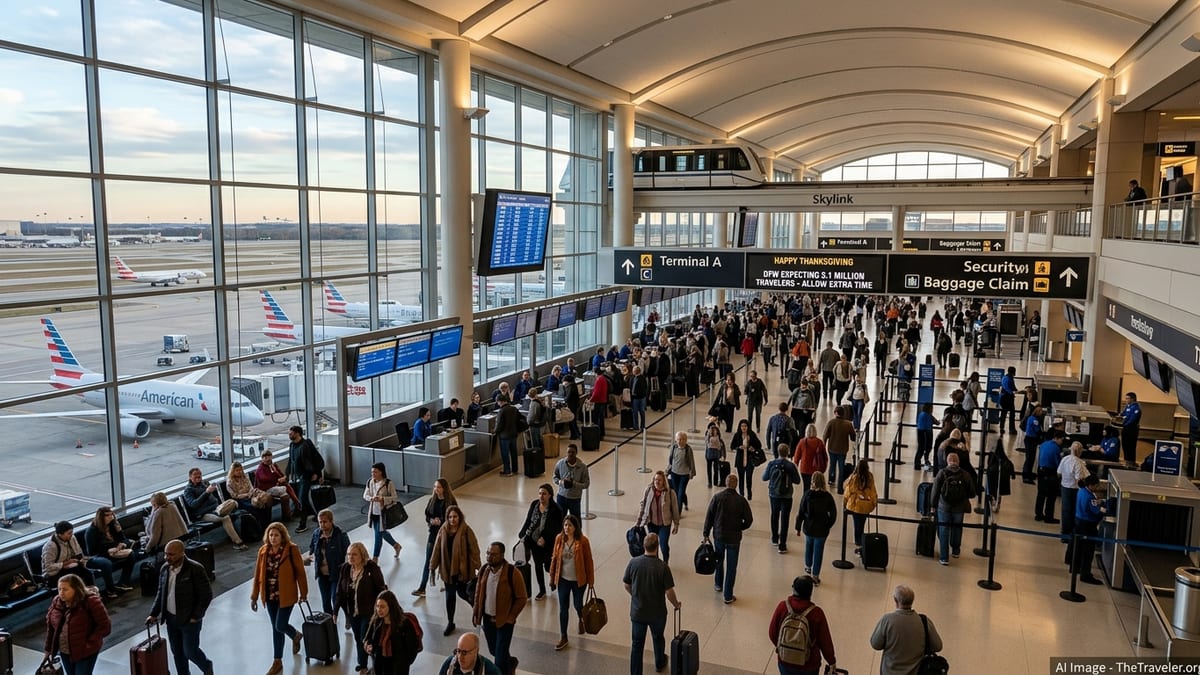
DFW forecasts 3.1 million travelers over 13-day Thanksgiving window
DFW Airport has projected that roughly 3.1 million passengers will travel to, from and through the airport during the core Thanksgiving travel period, which the airport defines as running from Thursday, November 19 to Tuesday, December 1. That forecast represents an increase of just under 5 percent compared with the same window last year, according to figures published by the airport in its latest holiday travel guidance and reiterated in local media briefings ahead of the rush.
The airport expects traffic to be spread across the full 13 days, but with clear spikes around the main holiday dates. Airport officials and local coverage have highlighted the Wednesday before Thanksgiving as well as the Saturday and Sunday following the holiday as the three single busiest days for passenger throughput, each with more than 120,000 passengers anticipated at DFW’s terminals. For context, federal screening data show that the airport handled about 509,000 departing passengers over the Thanksgiving period in 2025, and its total annual passenger volume now exceeds 80 million, placing it among the busiest airports in the United States.
The 3.1 million figure combines origin, destination and connecting passengers and reflects both domestic and international traffic. The estimate is based on scheduled airline capacity and recent booking trends at the airport’s 168 gates across five terminals. While forecasts can be revised closer to the peak dates if airlines adjust schedules, the current projection is being used by DFW’s operations teams, concessionaires, security partners and transportation providers as the planning baseline for staffing and resource allocation.
Recent FAA network issue still fresh as holiday travel ramps up
This year’s Thanksgiving rush at DFW is unfolding less than two weeks after a significant disruption to the Federal Aviation Administration’s air traffic control telecommunications network on November 13, which prompted a nationwide ground stop for several hours. The problem was traced to equipment at two FAA facilities and involved a malfunctioning router in a contractor-installed system that affected the flow of air traffic data. As a result, departures across the country, including from DFW and other major hubs, were temporarily halted while engineers isolated and resolved the issue.
The FAA has said that the November 13 incident did not stem from a cybersecurity attack and that the affected hardware has since been bypassed while a detailed technical investigation continues. Officials have indicated that additional monitoring and temporary redundancies are in place within the network as they work with the contractor to understand why the hardware behaved differently from similar devices deployed elsewhere in the system. While the disruption lasted only part of a day, it led to cancellations, rolling delays and missed connections for travelers across the domestic network in the week before Thanksgiving.
For passengers using DFW during the holiday period, the key implication is that air traffic control and airline operations are likely to remain under closer internal scrutiny in the short term, but regulators have not issued any specific new constraints on flight volumes at the airport as a result of the incident. The Thanksgiving schedules currently published by airlines and the airport are proceeding as planned, with no additional FAA capacity limits announced for the North Texas airspace beyond the usual weather or congestion-related flow management that can be imposed on a given day.
American Airlines leans on its largest hub during peak season
American Airlines, headquartered in Fort Worth and the dominant carrier at DFW, is preparing to carry the bulk of those 3.1 million Thanksgiving-period passengers through its hub-and-spoke network. DFW is the airline’s largest hub by daily departures and connecting traffic, and company data from recent years underline the scale: American has transported more than 8 million passengers across upward of 75,000 flights systemwide over the Thanksgiving travel window in previous seasons, with DFW and Charlotte serving as the two most critical connection points.
For the 2026 holiday, American’s schedule at DFW includes dense banks of departures in the early morning and late afternoon, designed to connect smaller domestic cities and regional destinations with long-haul and international flights. Industry schedule data show that the airline has slightly increased seat capacity on several core domestic routes from DFW compared with last Thanksgiving, particularly to Florida, the Mountain West and major Midwest cities, while keeping overall frequency growth relatively modest to avoid overstressing the operation during peak days.
Operationally, American has indicated through previous updates that it is relying on technology such as its “Smart Gating” system at DFW, which dynamically assigns arriving aircraft to gates to reduce taxi times and limit congestion on the ramp. The airline also continues to coordinate closely with the FAA’s traffic management units in the Dallas Fort Worth airspace, an arrangement that gained renewed attention after the November 13 FAA network outage. For travelers, this coordination is largely invisible but can determine whether connection times that appear tight on paper remain viable when minor delays begin to accumulate during busy bank periods.
What travelers can expect at DFW during the Thanksgiving rush
With 3.1 million people expected over less than two weeks, DFW is advising passengers to allow additional time at nearly every stage of the journey. Airport guidance calls for arriving at least two hours before scheduled departure for domestic flights and at least three hours in advance for international departures, especially on the heaviest travel days around Thanksgiving. These buffers are intended to absorb potential queues at parking facilities, shuttle stops, airline check-in counters and Transportation Security Administration checkpoints.
In recent holiday periods, around one quarter of U.S. flights have arrived at least 15 minutes late during November and December, according to federal on-time performance statistics. Although those figures cover the national network rather than DFW alone, the airport’s size and its role as a major connecting hub mean that disruptions in other regions can quickly ripple into North Texas. The recent FAA network issue underlined that delays do not always originate from local weather or airline staffing, and that constraints elsewhere in the system can affect even sunny-day operations at DFW.
On the ground, DFW has continued to expand its ground transportation and concessions offerings to handle peak holiday volumes, but some pressure points are predictable. Rental car centers, ride-hailing pickup zones and inter-terminal shuttles often see surges in demand in the late afternoon and evening, when many inbound and outbound flights overlap. Inside the terminals, food and beverage outlets and restroom facilities near the main security exits tend to be busiest during the first two hours of the morning departure window and again during late afternoon bank periods.
Planning ahead: key dates, verification points and what to watch next
The core Thanksgiving travel window defined by DFW for this year runs from Thursday, November 19 through Tuesday, December 1, with the single busiest days expected to fall on the Wednesday before Thanksgiving and the Saturday and Sunday after the holiday. Travelers who have flexibility and wish to avoid the highest crowds may find relatively lighter conditions at DFW on Thanksgiving Day itself, or on the Monday and Tuesday at either end of the period, although those days can still be significantly busier than a normal weekday.
Given the recent FAA network disruption and the potential for active late November weather in other parts of the country, passengers connecting through DFW are advised to verify their itineraries frequently in the 24 hours before departure. That includes checking airline apps or booking systems for any schedule adjustments, monitoring gate information for changes, and confirming minimum connection times for tight layovers, particularly when changing terminals. Those driving to the airport should also confirm real-time parking availability, as some on-site lots have reached capacity during past Thanksgiving weekends.
Looking beyond Thanksgiving, DFW and American Airlines will turn quickly to the December and New Year holiday travel periods, which bring another sustained wave of leisure travelers through North Texas. The FAA, for its part, will continue its technical investigation into the November 13 network issue, with any formal findings or recommended system changes likely to be published after the Thanksgiving peak. For travelers using DFW now, the most practical steps remain straightforward: build in extra time, monitor flight status closely and be prepared for occasional delays in a system that is running at near-peak capacity for much of the holiday period.