


For short hops across Europe, the choice between train and plane is rarely as simple as looking at the headline fare. Low cost airlines can advertise astonishingly cheap tickets, yet luggage fees, airport transfers and lost time at security can quietly erase any savings. High speed trains promise city center to city center convenience, but advance discounts can disappear and some flagship routes, such as London to Paris, are known for steep prices on popular dates. Understanding where the real costs and time sinks lie is the key to deciding which option suits a specific trip.
Get the latest updates straight to your inbox!
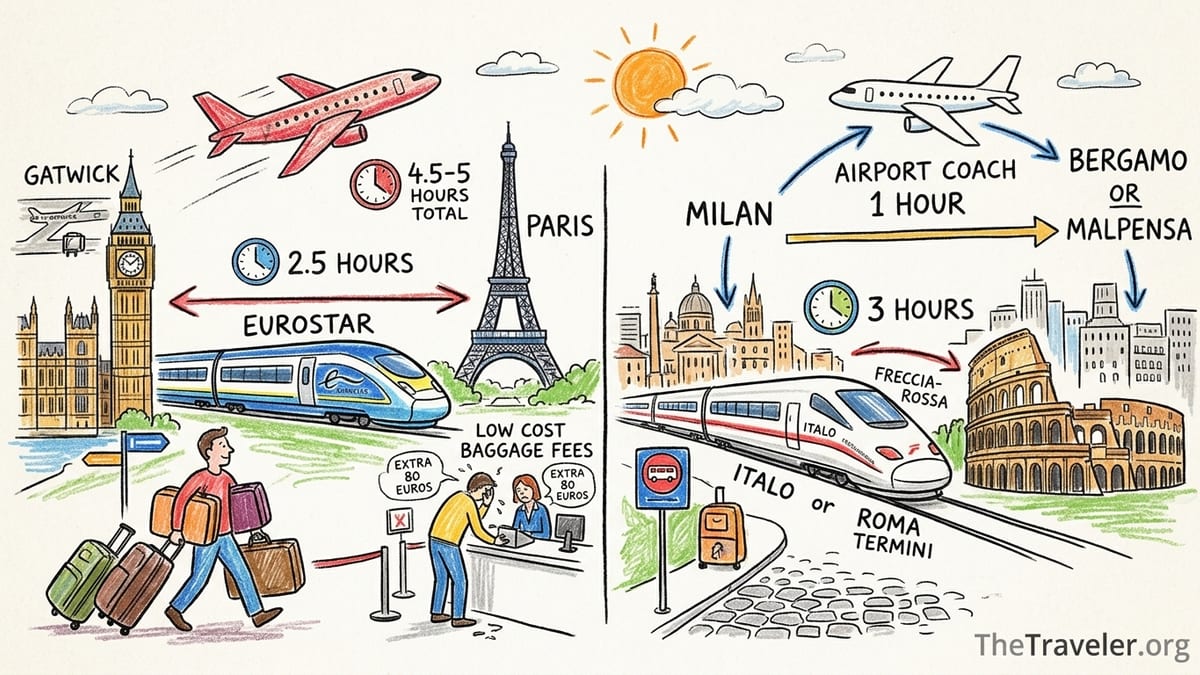
Door to door travel time: city center counts more than cruising speed
The most important factor for short European trips is not top speed in the air or on rails, but how long it takes to get from one city center to another. A high speed train from London St Pancras to Paris Gare du Nord takes about 2 hours 15 minutes on Eurostar. Many airlines schedule the London to Paris flight at around one hour in the air, which looks faster at first glance. Yet when you add a typical 45 to 60 minutes from central London to either Heathrow or Gatwick, 90 minutes at the airport for check in and security, and another 45 to 60 minutes from Charles de Gaulle or Orly into central Paris, the real door to door journey often reaches 4.5 to 5 hours even in good conditions.
Independent comparisons that model door to door times on European city pairs commonly assume about 25 minutes to reach a city airport by public transport, 90 minutes for check in and security, and another 25 minutes from the arrival airport into town for short haul flights. In practice, journeys to secondary airports used by low cost airlines can take longer. From Milan city center to Bergamo airport, for example, the coach transfer alone can take around an hour in traffic, while reaching Malpensa from central Milan often takes about 50 minutes on the express train. On the rail side, travelers leaving from Milano Centrale board direct high speed trains to Venice, Rome or Florence from the same urban hub where the metro, trams and airport buses converge, cutting out a separate airport leg entirely.
On shorter domestic routes within countries such as France, Spain, Italy and Germany, high speed rail is frequently as fast as flying door to door for journeys of roughly 2.5 to 5 hours by train. Paris to Lyon takes around 2 hours by TGV from central station to central station. A flight between the two cities takes only about 1 hour in the air but requires ground transfers at both ends plus airport time, so total travel time is often comparable. The same applies to Madrid to Barcelona, where fast AVE trains cover the route in roughly 2.5 to 3 hours between Atocha and Sants stations, set in the urban core of each city.
There are exceptions. When train routes are indirect or slow, flying can still deliver a clear time advantage even after accounting for airport formalities. For example, on some cross border routes in central and eastern Europe, such as Prague to Dubrovnik or Warsaw to Lisbon, rail itineraries can become overnight or multi day journeys, while budget airlines can still complete the trip in a few hours. The door to door time balance is therefore strongly route dependent and should be checked case by case rather than assumed.
Headline fares versus real costs: what tickets really add up to
Airline comparison sites often display extraordinarily low fares on short European flights, particularly from low cost carriers. It is not unusual to see promotional one way flights around 20 to 40 euros on routes like Barcelona to Rome or Berlin to Vienna outside peak holidays. Advocacy groups and travel analysts who compare flight and train prices across multiple routes have found that on many corridors the cheapest available ticket a month or more in advance is still a flight, sometimes by a large margin, especially where strong competition between low cost carriers exists.
However, a recent analysis of European airline pricing by consumer organizations and environmental groups highlighted that the apparent advantage of flying can reverse once all unavoidable extras are counted. On some routes departing Amsterdam, for instance, researchers documented cases where the total cost of flying, including unavoidable charges and luggage, reached more than five times the cost of an equivalent rail ticket bought on similar terms. On the other hand, they also found routes where long distance international trains, particularly on thinner cross border links, cost several times more than the cheapest budget airline fare. One example mentioned in public reports was Luxembourg to Milan, where at a given snapshot the typical train combination cost around ten times as much as a deeply discounted flight operated by a low cost carrier.
High speed rail fares vary widely between countries and operators. Eurostar services linking London with Paris, Brussels and Amsterdam are often cited as some of the more expensive trains on short routes, especially at busy times. Analysis of London to Paris tickets by consumer magazine Which? found that buying roughly six months ahead significantly reduced average one way prices compared with booking shortly before departure. As departure day approaches, Eurostar fares can rise into the triple digits in euros or pounds for standard class, allowing certain low cost flights plus airport transfers to undercut the train despite less convenient airports.
Elsewhere, national rail operators such as France’s SNCF, Italy’s Trenitalia, Austria’s ÖBB and Spain’s Renfe have introduced dynamic pricing that rewards early booking with lower fares. Independent rankings of European rail operators published in late 2024 noted that some brands, including Trenitalia and SNCF, offered a relatively strong balance between price and onboard quality. Promotional offers such as Italy’s “Super Economy” fares or Spain’s advance “Promo” tickets can bring one way high speed journeys onto popular routes like Rome to Florence or Madrid to Seville into the 25 to 50 euro range if booked well in advance, making them competitive with or cheaper than full cost airlines once extra fees are added.
Luggage rules: when bags quietly erase cheap airfares
The luggage policy is one of the biggest practical differences between trains and planes. On almost all European trains, including high speed services such as Eurostar, TGV, ICE and Frecciarossa, passengers can bring multiple suitcases and backpacks without explicit weight limits or additional fees, provided they can carry them on board and store them in the overhead racks or luggage bays. Space can be tight at peak times, but there is no check in queue or fee simply to bring a standard suitcase.
By contrast, several major European low cost carriers now restrict free hand luggage to a small under seat bag and charge extra for any larger cabin bag or checked suitcase. Ryanair, for instance, states in its current baggage policy that the basic fare includes one small personal item that must fit under the seat in front, with larger cabin bags and checked luggage charged as extras. EasyJet describes a similar approach in its fees and charges overview, specifying one small cabin bag included in the base fare with additional bags incurring fees. Independent fee comparison sites that collect data from official airline pages in 2026 report that at the bag drop desk, unbooked 20 kilogram checked bags on carriers such as Ryanair, easyJet and Wizz Air can easily cost between roughly 60 and 80 euros per flight segment.
Consumer research across more than one thousand low cost flights found that the very lowest advertised cabin bag charges were rarely available in practice, and that adding a standard roll aboard case could in some cases quadruple the total cost of a short flight compared with the bare ticket price seen in advertisements. A coalition of European consumer organizations has gone so far as to challenge some hand luggage fee practices as potentially breaching European law, arguing that what appears optional is sometimes unavoidable for ordinary travelers who cannot pack for a multi day city break into one small under seat bag.
For a concrete example, consider a traveler booking a spring weekend from Barcelona to Rome. A fare comparison site might display a basic one way ticket on a low cost airline for around 35 euros. Once the traveler adds a priority boarding option that allows a wheeled cabin suitcase and selects a 20 kilogram checked bag on the return leg, the total can easily climb to around 120 euros or more, depending on date and demand, not including seat selection. A competing high speed rail option on a route like Barcelona to Madrid, although not equivalent in destination, might list at 50 to 60 euros one way in standard class including multiple bags, showing how rail can become price competitive when realistic luggage needs are factored in.
City center access and transfer costs: planes often lose ground here
Access to and from the departure and arrival points can dramatically influence the true cost and convenience of a short trip. Major railway stations in European capitals and large cities are usually located in or near the historic center. Paris Gare de Lyon and Gare du Nord, Rome Termini, Berlin Hauptbahnhof, Madrid Atocha, Vienna Hauptbahnhof and Amsterdam Centraal all sit alongside dense urban public transport networks of metro, trams and buses. Walking distances to many hotels and attractions are often manageable, and local metro or tram rides usually cost only a few euros.
Airports, by design, are typically located outside the dense urban core. Low cost airlines frequently operate from secondary airports even further out, such as London Stansted and Luton, Milan Bergamo, Paris Beauvais, Frankfurt Hahn or Barcelona Girona for certain routes. Transfers into the city from these airports can cost 10 to 20 euros or more each way on dedicated coaches or regional trains. For example, the train or coach from London city center to Stansted can cost a noticeable fraction of the flight itself, especially when booked at the station rather than well in advance online.
When comparing door to door costs on a short break, it is therefore important to add up all local transport. A hypothetical trip from central London to central Brussels illustrates the point. Taking Eurostar from St Pancras to Brussels Midi involves a straightforward Underground or bus ride at the London end and a short metro or tram connection in Brussels, often costing less than 10 to 15 euros in total urban transport for a round trip. Opting to fly, especially with a low cost carrier from a secondary airport, might involve paying 25 to 30 euros each way for fast airport links like airport expresses or coaches, plus local metro tickets at the destination. When multiplied by two for a return trip, these transfers can erode much of the apparent saving of a cheaper flight ticket.
The time spent on these transfers also matters, particularly on weekend city breaks where every hour of sightseeing counts. Arriving at Roma Termini by train from Florence or Naples deposits you within walking distance or a short metro ride of the Colosseum and historic center. Landing at Rome Fiumicino or Ciampino, by contrast, makes an additional 30 to 60 minute train or bus journey unavoidable before you see your hotel room. The disparity can be even more pronounced late at night or early in the morning, when airport public transport may run less frequently and taxis or ride share services become an additional cost.
Booking patterns, flexibility and last minute prices
Both airlines and rail operators in Europe now use dynamic pricing, so booking strategy has a major impact on whether train or plane ends up cheaper. Budget airlines like Ryanair, easyJet and Wizz Air release a batch of low fares months in advance on many routes. Travelers who can commit early often secure one way tickets in the 20 to 50 euro range before fees. As planes fill up on popular days, those same routes can climb sharply in price, sometimes overtaking full service airlines or even high speed trains booked earlier.
On the rail side, advance discounts are equally crucial. In France, SNCF’s advance purchase “Prem’s” style fares, now bundled into the broader Ouigo and InOui offers, can provide significant savings on TGV routes when booked weeks ahead. Italy’s Trenitalia and Italo offer “Economy” and “Super Economy” fares that reward early planners with prices far below flexible base fares. Spain’s Renfe sells reduced price “Promo” and “Promo+” fares on AVE and Avlo services. These advance tickets are often non refundable or expensive to change, but they can make longish train journeys like Paris to Barcelona, Milan to Naples or Vienna to Budapest cheaper than or comparable to flying once baggage and transfers are included.
For spontaneous trips within a few days of departure, flying sometimes regains the upper hand on price. Last minute walk up tickets on flagship high speed routes in countries like France and the United Kingdom can be expensive, particularly at peak commuting or holiday times. In some of the Greenpeace price comparisons of European routes, late booked rail tickets on certain cross border journeys cost significantly more than remaining last minute airline seats, even after adding an estimate of baggage fees. This is especially common where there is limited rail competition or complex routings that require multiple reservations.
Flexibility also differs. Many low cost airline tickets are now changeable for a fee plus any difference in fare, but fully refundable options are rare. European rail operators increasingly offer a choice between cheaper, restricted advance fares and more expensive flexible tickets that allow changes up to a certain time before departure. For travelers whose schedule may change, a slightly pricier flexible rail ticket might avoid the risk of losing the entire value of a flight when plans shift, though each trip needs its own calculation based on the current fare rules.
Missed connections, delays and risk management
Short flights within Europe are susceptible to disruption from weather, air traffic control restrictions and congestion at busy hubs. While most journeys run on time, periods of strikes, storms or technical issues can quickly cascade across an airline’s network. For travelers planning a same day connection to another flight, a cruise departure or a time sensitive event, the risk of a missed connection is an important consideration.
Low cost airlines usually sell point to point tickets, so a delay on one leg does not obligate the carrier to protect your onward journey. If you book Copenhagen to London and London to Barcelona on separate tickets with a budget airline and the first flight is delayed, you may lose the second booking entirely and have to buy a new ticket on the day at a higher fare. Traditional network carriers operating through hubs such as Lufthansa in Frankfurt, Air France in Paris or KLM in Amsterdam are more likely to protect through tickets, but this often comes with higher base fares than the cheapest low cost options.
Trains in Europe, particularly on corridors with frequent service, can offer lower missed connection risk for regional hops. On routes like Berlin to Hamburg, Milan to Florence or Paris to Lille, trains run many times per day. If you miss one departure due to a late arriving local train or metro, you may be able to board the next service with your existing ticket, depending on fare conditions. Some flexible rail tickets are valid for any train on a given day, and even restrictive advance fares sometimes allow same day changes at a surcharge. National rail operators’ passenger rights rules usually provide some compensation or rebooking assistance when disruption is caused by the railway itself.
At the same time, international trains can also be affected by strikes, infrastructure works and unexpected technical problems. The temporary suspension of direct Eurostar services between London and Amsterdam around major station works is one prominent example of how rail capacity can be constrained. Travelers relying on a single daily or overnight train on certain cross border routes should therefore consider backup plans, just as they would with infrequent flights. Insurance that covers missed departures, along with conservative scheduling when connecting to time critical events, remains advisable regardless of mode.
Environmental and comfort considerations that indirectly affect value
Although the focus of this comparison is cost and time, comfort and environmental impact often influence which option feels better value to travelers. Studies that compare per passenger emissions of European short haul flights with electric rail consistently find that taking a high speed train generates a fraction of the greenhouse gases of flying on the same route. One recent analysis using British government emissions factors suggested that on city pairs like London to Paris, a train journey could emit roughly three to ten times less carbon dioxide equivalent per passenger than a flight, depending on the specific assumptions and energy mix.
Comfort on board is harder to quantify in euros but easy to feel. High speed trains typically offer more legroom, freedom to move around, and larger seats than short haul economy cabins. There are no liquid restrictions at security on most rail journeys within the Schengen Area and no need to remove laptops or belts, reducing stress for many passengers. Being able to bring food and drinks purchased in the station onto the train, work at a table with a laptop, or walk to a café car can make a three hour train ride feel more productive and less draining than a flight of similar door to door duration.
On the other hand, some low cost airlines have invested in newer, quieter aircraft and offer seat upgrades with extra legroom at reasonable surcharges. For travelers who strongly prefer a short time in the air to several hours on a train, particularly on routes without true high speed rail, the comfort trade off may tilt toward flying. Overnight sleeper trains, where available, introduce another dimension by combining travel with a night’s accommodation, as seen on routes like Vienna to Zurich or Paris to Berlin, although these services often command higher fares than day trains.
So when is the train or plane cheaper for short European trips?
Putting all these elements together reveals that there is no single universal rule, but some patterns are clear. For journeys where a fast, direct high speed rail connection exists between large city center stations, trains often match or beat planes on door to door time once airport formalities and transfers are included. When booked a few weeks or months in advance, especially outside peak holidays, rail can also compete well on price, particularly for travelers carrying more than a small under seat bag.
Flying tends to be cheapest in cash terms on routes where low cost carriers compete directly and rail options are slow, indirect or non existent. In those cases, a carefully chosen flight that includes at least one free cabin bag on a full service airline, or a bundled fare on a low cost carrier that transparently covers the luggage you need, may still undercut the train even after airport transfers. Travelers who book very late on busy rail corridors may also find that remaining train tickets are significantly more expensive than flights, leaving the plane as the more economical last minute choice.
As a practical rule for planning short European city breaks, start by comparing total door to door travel time and cost between the two modes on your specific dates. Include station or airport transfers, realistic baggage fees based on how you actually pack, and any costs of seat selection or priority boarding that you consider essential. For a London to Paris weekend, for instance, a mid priced Eurostar ticket booked well in advance, with generous luggage included and minimal transfer costs, may prove better value than a slightly cheaper low cost flight routed via a remote airport with expensive coaches and strict bag limits.
For longer or more complex itineraries, such as linking several cities over a week, consider mixing modes. You might travel by high speed train between nearby capitals like Paris, Brussels and Amsterdam, then fly a longer leap to reach a more distant region, such as from Amsterdam to Athens or from Rome to the Canary Islands. Evaluated trip by trip, with a clear eye on both visible and hidden costs, Europe’s growing web of high speed rail lines and dense network of regional flights together offer enough flexibility that most travelers can find a balance of price, time and comfort that fits their priorities.