


More news on this day
Chicago O’Hare International Airport experienced a brief Federal Aviation Administration ground stop on Tuesday, November 24, after an equipment outage, marking its second FAA‑ordered halt in as many days and adding fresh disruption just ahead of one of the busiest U.S. travel periods of the year.
Get the latest news straight to your inbox!
What Happened At O’Hare On November 24
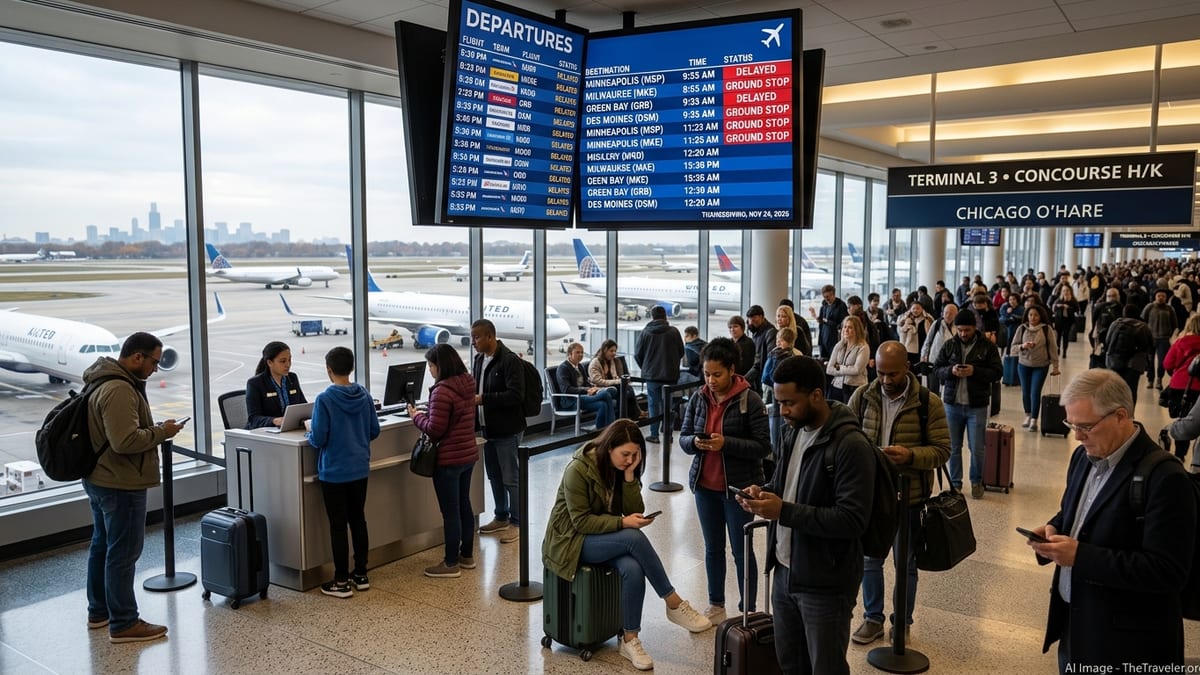
The Federal Aviation Administration (FAA) imposed a ground stop at Chicago O’Hare International Airport on Tuesday afternoon, November 24, after reporting an “equipment outage” affecting operations. Advisories posted on the agency’s National Airspace System status site show that flights bound for O’Hare were temporarily held at their departure airports while the issue was addressed.
According to multiple live-status trackers that log FAA advisories, the ground stop began around 3:22 p.m. CST and was lifted within approximately 40 to 60 minutes, once the affected equipment was stabilized and controllers confirmed they could safely manage arrivals and departures again. The FAA characterized the move as a precaution to maintain safe separation of aircraft while the outage was investigated.
Local media in Chicago reported that the disruption translated into delays rather than widespread cancellations. Data from flight-tracking services on Tuesday evening showed a few hundred delayed arrivals and departures combined at O’Hare and a small number of cancellations, but no prolonged shutdown of the airport. By late evening, the FAA was no longer listing any active ground stop or ground delay program for O’Hare, indicating that the operation had largely recovered.
Back‑to‑Back Halts In Chicago Ahead Of Thanksgiving
Tuesday’s incident followed another FAA-ordered ground stop involving O’Hare on Monday, November 23, this time attributed to staffing constraints in Chicago air traffic facilities. The FAA advisory cited insufficient staffing to handle normal traffic levels and required flights bound for the airport to be held at origin for about an hour until additional controllers were available.
Aggregated delay data show that Monday’s staffing-related halt was shorter than a typical O’Hare ground stop and was quickly replaced by a more limited ground delay program once traffic began moving again. Even so, the two consecutive days of FAA restrictions meant travelers flying into and out of one of the world’s busiest hubs encountered rolling knock-on delays at the very start of the Thanksgiving rush.
Chicago’s Department of Aviation has projected that about 1.6 million passengers will move through O’Hare’s terminals between Tuesday and Sunday of Thanksgiving week, with an additional several hundred thousand expected at nearby Chicago Midway International Airport. That concentrated volume means even short interruptions can ripple through the system, affecting connections and on-time performance at other U.S. airports that rely on O’Hare as a hub.
Context: This Month’s Nationwide Ground Stop And O’Hare’s Role
The back-to-back ground stops in Chicago come less than two weeks after a much larger disruption on Friday, November 13, when the FAA ordered a nationwide ground stop following a telecommunications failure that affected multiple air traffic control centers. In a question-and-answer summary published on November 15, the agency said instability in its telecommunications network, linked to legacy equipment exposed during a network change, forced it to halt all U.S. departures for safety while engineers diagnosed the problem.
Federal summaries and independent analyses indicate that the national halt lasted roughly four hours and 45 minutes and prompted approximately 12,000 flight cancellations, along with additional delays, across the United States. Officials have described it as the longest and most extensive U.S. aviation ground stop since the flight ban following the September 11, 2001 attacks, although they also stressed that the November 13 disruption was not related to a cyberattack or security incident.
That earlier outage had strong ties to the Chicago region. Documentation on the event notes that communications and radar feeds in and around Chicago were among the first to experience instability, and O’Hare’s status was one of the factors taken into account when the FAA moved from local traffic management measures to a nationwide ground stop. The repetition of issues affecting traffic flows through Chicago this month, albeit for different reasons, has underscored O’Hare’s importance within the national air traffic system.
How Big Is O’Hare And Who Is Affected?
Chicago O’Hare consistently ranks among the world’s busiest airports by aircraft movements. Airports Council International statistics for recent years have placed O’Hare at or near the top globally in annual takeoffs and landings, with operations approaching 860,000 movements a year. The airport is a major hub for both United Airlines and American Airlines and handles extensive domestic and international connecting traffic.
Because so many flights connect through O’Hare, a localized problem there can quickly spread delays across multiple regions. When a ground stop is in effect, flights that are scheduled to depart for the affected airport are held at their origin for the duration of the order. Once lifted, those flights are released in a controlled sequence, which can lead to short spikes in arrivals followed by ongoing minor delays as airlines reposition aircraft and crews.
On Tuesday, travelers flying nonstop into or out of Chicago were the most immediately affected by the equipment outage, experiencing gate holds, airborne holding patterns in some cases, and arrival delays. Passengers with tight connections via O’Hare, particularly those linking from smaller regional cities to long-haul domestic or international services, were more likely to miss onward flights and face rebooking, even though the ground stop itself was relatively brief. By late Tuesday night, however, routine operations had largely resumed, with residual delays tapering off into Wednesday.
Thanksgiving 2026 Travel Forecast And Potential Knock‑On Effects
The timing of O’Hare’s latest disruption has drawn attention because it coincides with one of the busiest travel weeks of the year. In its national Thanksgiving forecast released on November 16, AAA projected that 81.5 million Americans would travel at least 50 miles from home between Tuesday, November 24 and Monday, November 30, a slight decline from the 81.6 million estimated for 2025. Within that total, the organization expects just under 6 million people to travel by air, a modest 0.2 percent dip in domestic air passengers compared with last year.
Although the AAA forecast was prepared before the November 13 nationwide ground stop and the subsequent Chicago-specific issues, the group framed 2026 as a near-peak year for holiday movement, with volumes still very close to historic highs. Federal aviation planners, citing internal projections reported this week, have also indicated that scheduled Thanksgiving-period flights are expected to reach their highest level in more than a decade, despite the recent network disruption.
For travelers, the practical effect of Tuesday’s O’Hare ground stop is likely to be felt for a relatively short period compared with the earlier nationwide event. Because the equipment outage was contained and the hold order lasted under an hour, airline schedules for Wednesday, November 25 are expected to operate largely as planned, subject mainly to weather and normal congestion. However, passengers whose aircraft and crews were displaced on Tuesday afternoon and evening may still encounter localized delays and occasional missed connections as carriers continue to reposition resources.
What Travelers Should Do Next
At this stage, there is no indication from the FAA that the equipment problem that triggered Tuesday’s ground stop at O’Hare is ongoing. The agency’s public status dashboard on Wednesday does not list any active ground stop or special delay program for Chicago, and airlines are selling and operating their holiday schedules as planned. Investigations into both the nationwide telecommunications failure on November 13 and the more recent Chicago disruptions are ongoing, and the FAA has said it is working with contractors and technology providers to reduce the risk of similar outages.
Travelers booked through O’Hare over the Thanksgiving period should still plan for crowded terminals, longer security lines and heightened potential for delays due to weather or normal peak traffic. Airlines are encouraging passengers to monitor their flight status frequently through official apps or websites on the day of travel, pay attention to gate area announcements and build extra time into connections where possible, particularly for itineraries that combine regional flights with long-haul services.
For those who experienced a significant delay or missed connection linked to Tuesday’s events, options vary by carrier and fare type, but many airlines will allow same-day rebooking without additional change fees when disruptions are traced to operational or air traffic control issues. Travelers who believe their trip was affected should review their airline’s current travel alerts and policies, retain boarding passes and delay notifications, and contact their carrier directly for the most up-to-date information on rebooking and any available accommodations.