


More news on this day
Delta Air Lines says it has restored an automated system used to calculate aircraft weight and balance after a technical failure on Sunday, November 22, triggered widespread flight delays centered on the carrier’s Atlanta hub just days before the U.S. Thanksgiving travel peak.
Get the latest news straight to your inbox!
What happened to Delta’s system in Atlanta
According to Delta and multiple airport and aviation reports, the disruption began on the morning of Sunday, November 22, when an automated system that calculates weight and balance for departing flights malfunctioned. The tool is used before every takeoff to help determine safe loading and performance parameters, and the outage meant many flights could not be dispatched on time while manual workarounds were put in place.
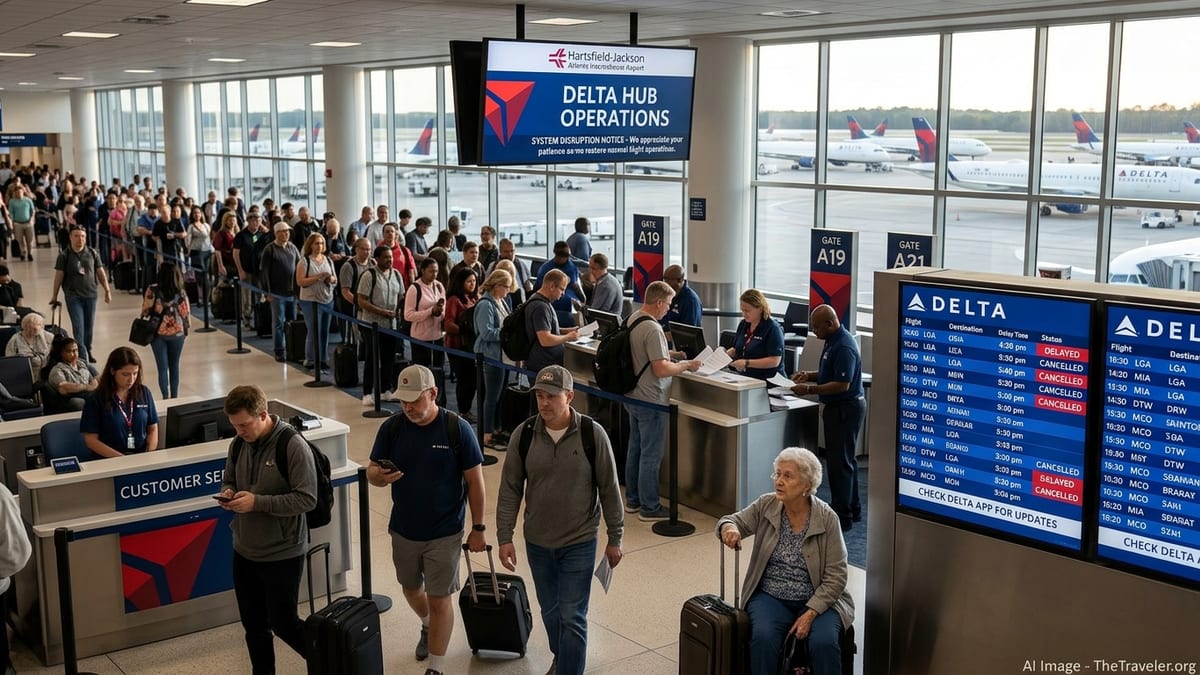
The impact was most visible at Hartsfield-Jackson Atlanta International Airport, Delta’s largest hub and the world’s busiest airport by passenger numbers. By early evening Sunday, flight-tracking services were showing roughly 1,100 to 1,250 delayed flights into and out of Atlanta, with the vast majority operated by Delta or its regional partners. Some reports citing airline and tracking data put the total number of affected Delta flights nationwide at more than 1,600 across the day, as the disruption in Atlanta cascaded across the network.
Because Atlanta sits at the center of Delta’s connecting-bank structure, delays there quickly propagated to aircraft and crews scheduled to operate onward legs. Travelers on social media and aviation forums reported departure times pushed back by several hours, missed connections and in some cases overnight disruptions, even at airports far from Georgia, as aircraft arrived late from Atlanta and other Delta hubs.
Ground stop, scope of delays and how long they lasted
The Federal Aviation Administration confirmed that on Sunday morning an air traffic management program was put in place that briefly halted some Delta-bound flights to Hartsfield-Jackson at their points of departure. Aviation advisories described it as a ground stop or similar traffic management measure requested because of the airline’s operational difficulties in Atlanta, rather than a problem with the airport itself or with the national air traffic control system.
That pause, which reports indicate lasted roughly an hour before being relaxed into a flow-control program, was intended to prevent additional aircraft from arriving at an already congested hub while gates and ramp operations were strained by late departures. Even after the formal halt was lifted, many inbound flights were assigned delayed departure slots so the airport could manage gate availability and ground handling for aircraft already on the ramp.
Delta has not released a precise, systemwide figure for cancellations linked to the incident, but flight-tracking data and contemporary reporting show that while the majority of affected flights were delayed, a smaller share were canceled outright as crews and aircraft fell out of position. The airline said in public statements that about 70 percent of the delays and cancellations reported by tracking services were directly attributable to the automation issue, while the remainder reflected pre-existing or concurrent weather constraints on parts of the network.
Delta’s response and restoration of the weight-and-balance system
By Sunday afternoon, Delta said it had identified and resolved the technology problem affecting the automated weight-and-balance calculations. The carrier has described the disruption as stemming from a problem with a “critical” automation system but has not detailed the exact cause beyond characterizing it as a technical failure rather than the result of a cyberattack or external security incident. The system’s restoration allowed new flight releases to proceed without the extra time and complexity involved in manual calculations and workarounds.
In statements after the outage, Delta said its operations teams were focused on completing the remainder of Sunday’s schedule and repositioning aircraft and crews to stabilize the network. The airline emphasized that safety procedures remained in place throughout the disruption, with flights departing only once all required performance checks had been completed, even if those checks took longer than usual while the automatic tools were unavailable.
Although the core system was brought back online on Sunday, the airline and airport authorities cautioned that residual delays would continue into Monday, November 23, as aircraft and crew rotations were reset. Local Atlanta coverage on Monday described another morning of elevated Delta delays and some cancellations, particularly on early bank departures, attributable to the aftereffects of the prior day’s outage rather than a fresh technical event.
Impact on Thanksgiving-week travel and what passengers experienced
The timing of the incident intensified its impact for travelers. U.S. airlines and airports are in the midst of one of the busiest travel periods of the year, with Atlanta expecting more than 4 million passengers over the extended Thanksgiving holiday window. The Delta outage followed closely on the heels of a rare nationwide Federal Aviation Administration ground stop earlier in November related to air traffic control communications equipment, as well as a separate technology outage that recently affected United Airlines departures. As a result, some passengers arrived at airports already on edge about potential disruptions.
Travelers at Atlanta and other airports described long lines at ticket counters and customer service desks on Sunday as they attempted to rebook missed connections or secure hotel and meal accommodations when onward flights could not be operated the same day. Posts on aviation forums referenced delays of several hours on some routes, with departure times repeatedly revised as new slots became available and aircraft were reassigned. In a number of accounts, passengers reported sitting onboard aircraft for extended periods before pushback while crews awaited clearance linked to the weight-and-balance checks or gate availability in Atlanta.
Despite the disruptions, there were no reports of safety incidents linked to the outage, and airport officials in Atlanta stressed that airport infrastructure and non-Delta operations remained functional. Other airlines at the airport continued flying their schedules, albeit with some knock-on effects from shared gate and taxiway congestion during the peak of the disruption. For most Delta customers, the primary consequences were delays, missed connections and schedule changes rather than outright trip cancellations, although a subset of travelers did report having to abandon or significantly reroute their plans.
What travelers should do next and how to plan around lingering effects
With Delta’s automated system now restored and the immediate outage resolved, the carrier’s schedule is expected to progressively normalize in the run-up to Thanksgiving Day, provided there are no further technology issues or major weather disruptions. However, network operations data and local reporting from Monday indicate that some routes, particularly those heavily dependent on Atlanta and other Delta hubs, are still experiencing elevated delay rates as aircraft and crews recover to their normal rotations.
Travelers booked on Delta during the Thanksgiving period should monitor their flight status closely through the airline’s website or mobile app and enable push notifications for any schedule changes. Given the potential for residual delays from the weekend outage to intersect with typical holiday-weather disruptions, passengers with tight connections, especially through Atlanta, may want to consider allowing extra time between flights or discussing alternative routings with the airline if their itinerary appears especially vulnerable.
Because Delta’s issue was confined to its own automation system and has now been fixed, there is no indication of a broader, ongoing problem with airport infrastructure in Atlanta or with the national air traffic control system related to this specific event. That said, November has already seen a separate FAA communications-related ground stop and a major outage at another large airline, underlining how sensitive peak travel periods can be to both weather and technology failures. For the rest of the Thanksgiving travel window, the most practical step for passengers is to stay informed, build in buffer time where possible, and check for any flexibility policies or travel waivers that Delta may issue if additional operational challenges arise.