


Few travel dreams feel as magnetic as standing under a sky exploding in green and purple light. If you are planning an aurora trip to the far north of Europe, you will quickly run into the same dilemma: Finland or Norway? Both sit directly under the auroral oval and both market themselves heavily as Northern Lights hotspots, yet the experience on the ground can feel very different. This guide compares the two in real, practical terms so you can choose the destination that matches your budget, comfort level, and travel style.
Get the latest updates straight to your inbox!
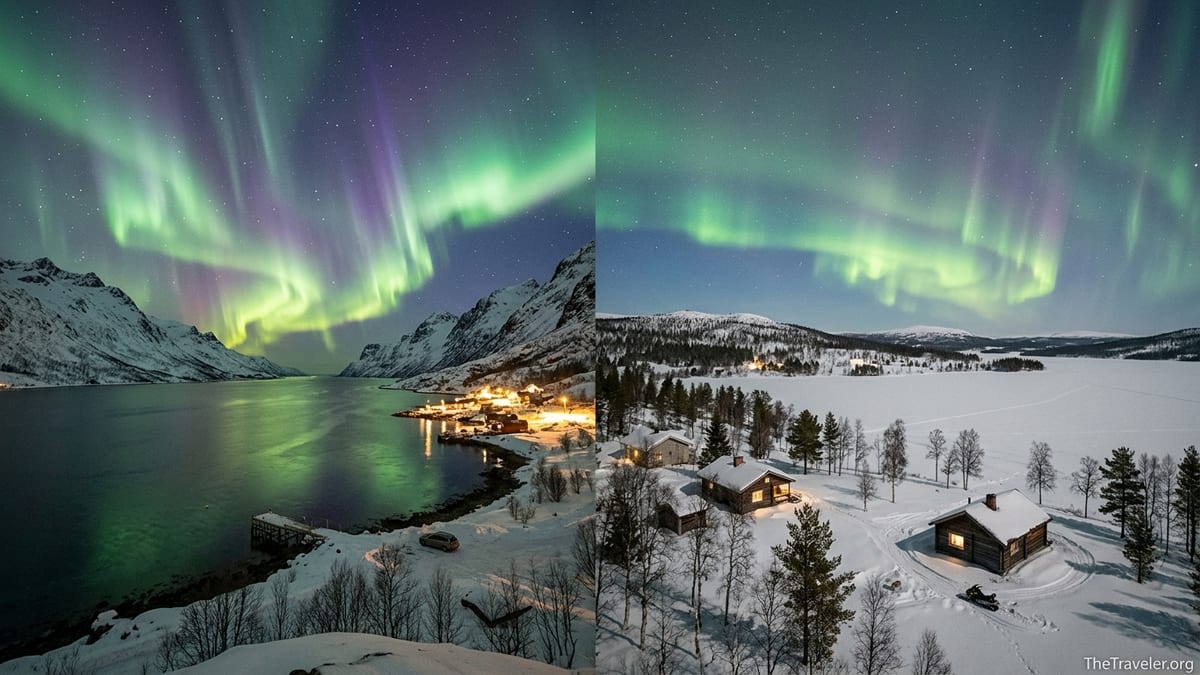
Where You Actually See the Lights: Key Regions in Finland and Norway
For most travelers, “Finland” and “Norway” really mean a handful of specific Northern Lights hubs. In Finland, that usually means Finnish Lapland: resorts and villages around Rovaniemi, Levi, Ylläs, Saariselkä, Inari and smaller wilderness lodges scattered along the road toward the Norwegian border. The city of Rovaniemi, just below the Arctic Circle, is easy to reach by flight or overnight train from Helsinki and offers quick access to darker skies within a 20–30 minute drive. Farther north around Levi and Saariselkä, light pollution drops dramatically and your chances of seeing aurora from your cabin doorstep increase.
In Norway, the classic base is Tromsø, a small Arctic city surrounded by fjords and mountains. It sits right in the auroral zone, with Northern Lights often visible even from the city waterfront on dark, clear nights. Beyond Tromsø, other strong contenders include Alta (often branded as the “city of the Northern Lights”), the Lofoten Islands, and the coastal ports and fjords that you can reach on multi-day coastal voyages. All of these lie far enough north that aurora activity, not latitude, becomes the main constraint.
In simple terms, Finland gives you primarily inland Lapland: forests, fells, frozen lakes and fairly stable, very cold interior weather. Norway gives you dramatic coastal landscapes: fjords, islands and mountains, but with cloudier, more changeable maritime conditions. Both can deliver unforgettable shows, but the backdrop and weather feel very different.
For a first-time traveler from North America or central Europe, it is common to fly into Helsinki and connect to Rovaniemi, Kittilä or Ivalo for Finland, or to connect via Oslo to Tromsø or Alta for Norway. In each case, you then book a mix of guided aurora chases and nights spent somewhere dark enough to simply step outside and look up.
Aurora Odds and Season: Does Either Country Really Win?
The biggest surprise for many travelers is that, in terms of raw aurora activity, Finland and Northern Norway are far more similar than different. Both sit under or very near the auroral oval, meaning that on geomagnetically active nights there is a good chance of some display as long as the skies are dark and clear. National tourism organizations in both countries commonly state that in the far north you can see the lights on roughly 100 to 200 nights per year, although what you see may range from faint green arcs low on the horizon to spectacular full-sky storms.
Seasonally, the patterns also match closely. In both Finnish Lapland and Northern Norway you need dark skies, so the season runs roughly from late August or early September through early April. Many local operators describe the “core” period as about mid-September to late March, with the deepest darkness, and therefore the longest nightly viewing window, from around November to February. During this midwinter period, it can be pitch dark even mid-afternoon in high-latitude locations such as Tromsø, Levi or Saariselkä, which means you can sometimes catch aurora in the late afternoon and again closer to midnight.
There are subtle differences. Inland Finnish Lapland often has more stable high-pressure weather in midwinter, which can mean more clear, cold nights, while the Norwegian coast is regularly affected by Atlantic low-pressure systems that bring clouds, snow and wind. On the other hand, Norwegian guides can often drive you along the coast or inland to “chase” clearer pockets of sky. Some Norwegian coastal cruise operators market multi-day voyages with “Northern Lights promises,” reflecting their confidence that, given several nights and mobility along the coast, odds become quite good.
If you plan a three to four night stay in either Tromsø or Finnish Lapland during the core season, many local guides suggest your chances of seeing at least some aurora are higher than fifty percent, often significantly higher in good years. Yet in both countries there is never a guarantee. The better question is not where the lights happen more often, but where you can more easily escape cloud and enjoy long, dark, comfortable viewing windows.
Weather, Darkness and Comfort: Inland Lapland vs Coastal Norway
Weather is where the experience can diverge sharply. Finnish Lapland’s interior climate is continental. Winter nights can plunge to minus 20 or minus 30 degrees Celsius, sometimes lower in the coldest spells. Skies can be strikingly clear, with dry, powdery snow and crisp stars overhead, but if you are standing on a frozen lake for several hours, you will feel the cold in your toes and fingers even with good gear. Many Finnish aurora accommodations respond with heated glass igloos, cozy cabins with private saunas, and short walks between your bed and open sky, so you can retreat indoors within minutes.
In Northern Norway, especially around Tromsø and the coastal islands, winter temperatures are often milder thanks to the Gulf Stream, commonly hovering around minus 5 to plus 2 degrees Celsius in midwinter. That can feel far more comfortable for a long evening outdoors. The tradeoff is frequent cloud, wind and changeable conditions. A day that begins in heavy snow can clear to brilliant stars by evening, or the reverse. Local Tromsø guides often drive 100 to 200 kilometers in a single night, crossing from coastal areas into inland valleys or toward the Finnish border to find breaks in the cloud.
Darkness also differs in character. In December and early January, both Finnish Lapland and Tromsø experience polar night, when the sun never fully rises. Around Rovaniemi and Levi you might see a few hours of deep blue twilight during midday, while up around Tromsø, Alta or Inari, the days can feel like an extended dawn and dusk. Some travelers find this mysterious and beautiful, with pink and blue skies framing snowy forests and fjords. Others find it disorienting and prefer the shoulder months of October, February and March, when you still have long dark evenings but brighter daytime for activities such as dog sledding and snowshoeing.
If you are cold-sensitive and worry about standing outside for hours at minus 25, coastal Norway’s milder temperatures can be attractive. If you crave very dry, clear, starry nights and are happy to dress for serious cold, inland Finnish Lapland might give you more evenings where you can simply step outside your cottage and see aurora arching overhead.
Typical Costs and How Far Your Money Goes
For many travelers, budget is the tie-breaker. On average, Finland tends to be slightly more affordable for accommodation and food than Norway, especially if you are willing to self-cater in an apartment or cabin. In Finnish Lapland, a midrange hotel room or cabin around Rovaniemi or Levi in peak winter might start from roughly mid three-figure amounts per night, with higher prices for premium glass igloos or boutique wilderness lodges. In contrast, similar-standard hotels in Tromsø in the core aurora season often price somewhat higher, reflecting Norway’s overall higher cost of living and the city’s intense winter demand.
Aurora tours show a similar pattern. In both countries, a small-group Northern Lights minibus chase with warm gear, hot drinks and a guide commonly falls into a mid hundreds of euros range per adult for an evening, with private tours costing substantially more. In Finnish Lapland, you will also see slightly cheaper options where aurora viewing is combined with a shorter snowmobile ride or reindeer visit on the outskirts of town. Norway’s coastal cruises that emphasize Northern Lights viewing, particularly multi-day voyages, quickly move into a higher price bracket, though they bundle transport, accommodation and meals.
Day-to-day costs add up. A simple dinner in Rovaniemi or Levi at a casual restaurant is likely to come in lower than an equivalent meal in Tromsø. Groceries for self-catering are also generally cheaper in Finland. Transport costs vary: Finland’s overnight trains from Helsinki to Rovaniemi or Kolari can be a relatively economical and atmospheric way to reach the north compared with adding an extra flight, while Norway’s internal flights to Tromsø, Alta or Kirkenes can fluctuate widely in price depending on season and how far ahead you book.
If you are traveling as a family or a group and plan four to seven nights in the Arctic, those small differences in hotel, food and tour pricing can easily translate to hundreds of euros in total savings in Finland. If your priority is dramatic scenery and you are prepared for higher costs, Norway’s fjords and islands may justify the difference.
Landscape, Activities and Overall Atmosphere
The landscapes beneath the lights feel quite different, and that can shape how memorable your trip is even on cloudy nights. Finnish Lapland is a land of gentle fells, birch and pine forests, and wide frozen lakes. Around Levi, Ylläs and Saariselkä you find classic ski-resort villages with low-rise chalets, pine-framed slopes and long cross-country trails threading through quiet forests. Rovaniemi, marketed heavily as the “official hometown of Santa Claus,” blends family-friendly attractions with easy access to nearby wilderness, including spots where you can walk a short path from your hotel to a riverside or hilltop aurora viewpoint.
In Norway, the scenery is more vertical. Tromsø is framed by steep, snow-covered mountains and narrow sounds. Many aurora chases drive over bridges and along fjords where reflections of green light shimmer on the water. The Lofoten Islands add jagged peaks rising straight from the sea and tiny fishing villages painted red and yellow. Alta combines coastal views with quicker access to inland plateaus. These landscapes can make even a modest aurora display feel dramatic, but they also mean more exposure to coastal winds.
Activities also differ in flavor. In both countries you can book dog sledding, reindeer sleigh rides, snowmobiling, ice fishing and snowshoeing. Finland leans into the sauna-and-silence culture: many cabins and hotels include private saunas, and it is common to warm up in the heat before stepping out barefoot into the snow to check whether aurora has appeared. Finland also offers a dense network of cross-country ski trails and family-focused winter parks.
Norway layers on more marine experiences. Besides classic aurora minibus chases, you can join small-boat cruises on the fjords, whale-watching trips that sometimes see faint aurora on the way back to harbor, or longer coastal voyages that emphasize life along the Norwegian coast as much as the sky. In Tromsø, your Northern Lights evening might begin in the city’s compact center, walking past cafes and bars, then continue out toward the islands where you set up on a beach facing north across the water.
Staying Under the Lights: Glass Igloos, Cabins and City Hotels
Accommodation style is one of the clearest practical contrasts between Finland and Norway. Finland has heavily invested in purpose-built aurora lodging. Glass igloos, dome cabins and panoramic-view suites dot the forests around Rovaniemi, Levi, Saariselkä and Inari. In these, you typically sleep in a warmed glass pod with one or more walls and roofs made of insulated glass, so you can watch for aurora without leaving your bed. Many of these properties add on-site restaurants, saunas and husky or reindeer farms, so you can build an entire trip around one or two locations.
Norway, by contrast, has traditionally focused more on conventional hotels, guesthouses and rental cabins in or near towns, especially in Tromsø and along the fjord coast. You can certainly book remote lodges and cabins with dark skies, but dedicated glass-igloo style resorts are less common and often more expensive. In Tromsø itself, many visitors choose a central hotel within walking distance of the harbor and restaurants, then rely on evening tours to get them into darker landscapes for actual aurora viewing.
For some travelers, this is decisive. If your dream image of the Northern Lights is lying in a glass-roofed suite watching green arcs drift overhead without ever starting a car, Finland is usually easier and cheaper to realize that fantasy. If, instead, you like the idea of spending the day in a lively small city and heading out on a different aurora chase route each night, Norway’s model works well.
One practical example: a couple might book three nights in a midrange glass igloo near Levi, combining one guided aurora chase on their first night with two nights of “wait and see” from their own bed. In Tromsø, the same couple might stay in a harborfront hotel and book two full-night minibus chases plus one quieter evening watching the sky from a viewpoint near the city. Both approaches can work; the right one depends on whether you value passive viewing comfort or variety and exploration.
Which Destination Suits Which Traveler?
Thinking in terms of “profiles” can help clarify your choice. Finland often suits travelers who want a slower, more self-contained stay in the snow: families with children who will enjoy daytime snow parks and Santa-themed activities, couples seeking privacy and comfort, and anyone who prioritizes cabins, saunas and the chance to see aurora without long night drives. If the idea of playing in knee-deep snow around your cabin by day and slipping into a glass igloo at night appeals to you, Finnish Lapland aligns naturally with that vision.
Norway tends to fit travelers who value dramatic landscapes and are comfortable with more movement. If you are okay with spending several evenings in a minibus or on a small boat chasing breaks in the cloud and you like the idea of combining aurora hunting with fjord scenery, coastal culture and a compact Arctic city, then Tromsø or the Norwegian coast may offer a richer overall experience. Photographers in particular often gravitate to Norway because fjords, peaks and islands give striking foregrounds for long-exposure shots.
Travel logistics might also nudge you one way or the other. If you already plan to spend time in Helsinki or elsewhere in Finland, extending north to Lapland is straightforward. The same is true if Norway’s fjords and cities like Bergen or Oslo are on your wish list; in that case, flying up to Tromsø for three or four nights becomes a natural add-on. Airline schedules, connection times and the cost of internal flights or trains will influence which seems simpler from your home airport.
Finally, think about your risk tolerance. If seeing the Northern Lights is a once-in-a-lifetime, “all or nothing” goal and you can afford to spend several nights, choosing a base where you can both chase clear skies and retreat to comfortable accommodation is essential. In that respect, both a well-planned Tromsø trip with flexible tours and a stay in a clear-weather pocket of Finnish Lapland can deliver, but the coastal variability in Norway and the deep cold in Finland are distinct forms of challenge to consider honestly.
The Takeaway
Finland and Norway are not rivals so much as two different frames for the same phenomenon. On the scientific level, the aurora dancing over Tromsø is the same aurora that might be flaring above Levi or Saariselkä. What changes is everything around it: the cold on your cheeks, the sound of waves or silence of a frozen forest, the ritual of a hot sauna or a midnight fjord crossing, the price tag of your hotel and the style of your nights.
If you imagine your perfect evening as stepping out of a glass igloo into minus 25 degree stillness, snow squeaking underfoot, and the Milky Way blazing over a line of pine trees, Finland is likely to give you the better experience. If you picture yourself on a beach beside a dark fjord, mountains cutting sharp silhouettes against a sky suddenly exploding in green and purple, with a small Arctic city buzzing behind you, then Norway will probably feel more magical.
In the end, both destinations can deliver unforgettable Northern Lights trips if you give yourself enough nights, stay flexible with weather and go in with realistic expectations. Rather than asking which country is objectively better, ask which landscape, pace and style of travel will make the waiting, the cold and the inevitable cloudy nights feel worthwhile. The aurora is only part of the story; the rest is everything you will remember long after the sky goes dark again.
FAQ
Q1. Is it easier to see the Northern Lights in Finland or Norway?
Both Finland and Northern Norway sit under the auroral oval, so the basic chances are similar. The real differences are weather and logistics. Inland Finnish Lapland often has colder, clearer nights, while coastal Norway has more cloud but lets guides drive or sail to clearer areas. Pick the one whose climate and style of trip you prefer.
Q2. When is the best time of year to visit for Northern Lights?
In both destinations, the practical season runs from about September to late March, when nights are long and dark. Midwinter brings the deepest darkness, but October, February and March can offer a good balance of aurora-friendly nights and brighter days for other activities.
Q3. Are glass igloos in Finland worth the price?
Glass igloos are expensive compared with standard cabins or hotels, but many travelers find the experience of watching for aurora from a warm bed unforgettable. They are most worthwhile if you value comfort and privacy and understand that the Northern Lights are never guaranteed, even with a glass roof.
Q4. Do I need to book guided Northern Lights tours, or can I go alone?
In both Finland and Norway you can see aurora on your own if you have a dark location and are comfortable driving or walking in winter conditions. Guided tours add local weather knowledge, safe transport, extra clothing and photography help. They are especially helpful in cloud-prone coastal Norway and for first-time visitors anywhere.
Q5. Which country is better for budget travelers?
Finland is generally a bit easier on the wallet, especially for longer stays or for travelers who are happy to self-cater. Accommodation, everyday meals and groceries often cost less than in Norway, and overnight trains can save on both transport and hotel nights. Norway rewards the extra cost with more dramatic fjord scenery and coastal experiences.
Q6. How cold does it actually get during Northern Lights season?
In inland Finnish Lapland, winter nights commonly drop well below minus 15 degrees Celsius, and cold snaps can be more severe. In coastal Northern Norway, typical winter temperatures are milder, often around minus 5 to plus 2 degrees. In both cases, proper layered clothing, insulated boots and gloves are essential for long nights outdoors.
Q7. Can I combine a city break with a Northern Lights trip?
Yes. Many travelers pair Helsinki with Rovaniemi or Levi in Finland, or Oslo with Tromsø in Norway. This lets you enjoy museums, restaurants and urban culture before or after heading north to chase the lights. Flight and train connections are well established on both routes.
Q8. Are the Northern Lights guaranteed if I stay several nights?
No destination can guarantee the Northern Lights. Staying three to four nights in the auroral zone during the main season greatly improves your odds, but clouds and low solar activity can still mean no visible display. Planning for other winter activities and choosing comfortable accommodation makes the trip rewarding even if the sky stays quiet.
Q9. Which country is better for families with children?
Both work well, but Finland’s family-friendly resorts, Santa-themed attractions around Rovaniemi and abundance of cabins with saunas and easy snow play areas often make it a smoother choice for younger children. Norway can be great for older kids and teens who will enjoy fjord cruises, city activities and more varied scenery.
Q10. What kind of camera gear do I need to photograph the Northern Lights?
A camera that allows manual settings, a wide-angle lens with a large aperture, a sturdy tripod and the ability to shoot at high ISO are usually enough. In both countries, many aurora tour operators can help with basic settings, and some even rent tripods, so you do not need professional gear to come home with good images.