


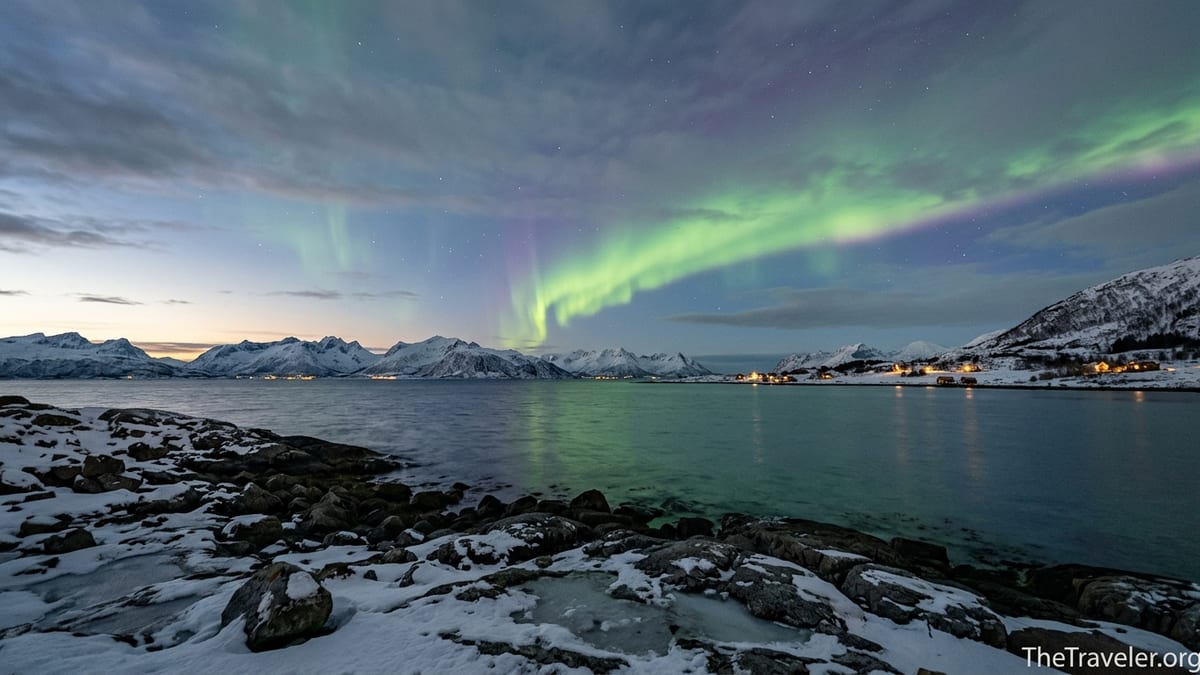
On a cold night near Tromsø in northern Norway, it often starts as a faint grey smudge, barely different from a passing cloud. Then the sky seems to wake up. A pale green ribbon sharpens over the fjord, curls into an arc, and suddenly unravels into curtains that ripple from horizon to horizon. Cameras on nearby tripods click frantically, but most people simply fall silent. This mix of science, spectacle and raw emotion is why, even in an age of livestreams and satellite imagery, the northern lights still rank among the most incredible natural wonders on Earth.
Get the latest updates straight to your inbox!
A Cosmic Light Show Written by the Sun
At its heart, the aurora borealis is a collaboration between the sun and Earth’s magnetic field. Charged particles from the sun stream outward in the solar wind and, during periods of heightened activity, ride powerful eruptions called coronal mass ejections toward our planet. When these particles are funnelled by Earth’s magnetic field toward the polar regions and collide with atoms high in the atmosphere, they excite oxygen and nitrogen, which then release light. The result is the familiar palette that travelers chase: soft greens from oxygen around 100 kilometers up, fleeting purples and pinks from nitrogen, and on rare nights, deep crimson arcs high above the main display.
Right now is an unusually good time to witness this process in person. We are in the active phase of Solar Cycle 25, an roughly 11 year rhythm in the sun’s behavior that reached its peak around late 2024. Scientists expect strong though gradually declining activity through at least 2026, which means more frequent geomagnetic storms and more chances for vivid auroras across the northern hemisphere. In May 2024, for example, powerful solar storms pushed the lights far beyond their usual Arctic haunts, lighting the skies over cities like Cleveland, Rome and Madrid and reminding millions of people just how dynamic our home star can be.
For travelers, the science does more than satisfy curiosity. It shapes practical decisions. Knowing that the so called “auroral oval” typically sits between about 60 and 75 degrees north helps explain why destinations like northern Norway, Iceland, Finnish Lapland, northern Sweden, Canada’s Northwest Territories and Alaska are such reliable vantage points. Understanding that the strongest shows tend to come a few days after a major solar flare helps serious aurora hunters follow space weather alerts with the same attention surfers give to swell reports.
Yet even when you know the physics, standing beneath a sky that appears to twist, fold and shimmer in real time feels strangely intimate. The same processes that generate these lights can disrupt GPS signals and satellites hundreds of kilometers overhead, but at ground level the experience is personal. In an age defined by screens, the northern lights reconnect people to forces that lie utterly beyond human control, and that sense of humility is part of their enduring power.
A Landscape-Sized Stage in the Far North
Unlike many natural spectacles that are confined to a single landmark, the aurora plays out across an enormous, ever changing stage. Each region along the auroral oval offers its own setting and mood, so a night under the lights in Iceland feels different from one in Canada or Finland, even when the sky itself behaves in similar ways.
In Norway, Tromsø has become almost synonymous with aurora tourism. The small city sits above 69 degrees north and is surrounded by islands, fjords and snowy mountains. On a typical winter evening, visitors might join a minibus tour that chases clear skies out of town, ending up on the beaches of Kvaløya island or in the Lyngen Alps, where curtains of green hang above black water and rugged peaks. Smaller communities like Alta, Senja and the Lofoten Islands offer quieter alternatives, where you might watch the lights reflect off fishing villages and sheltered bays with only a few other people around.
Iceland, perched directly under the auroral oval, delivers a different kind of drama. Here the lights often share the stage with geothermal steam and volcanic landscapes. One night might find you wrapped in a parka beside the black sands of Vík, watching green arcs stretch over Reynisdrangar’s sea stacks. Another might unfold near the famous Kirkjufell mountain on the Snæfellsnes Peninsula, where photographers line up to capture the peak’s perfect cone framed by swirling aurora. Some travelers base themselves near hotels that lean into the spectacle, such as a design focused property in southwest Iceland that built its bar with floor to ceiling windows pointed north for maximum sky views.
Across the Atlantic in Canada’s Northwest Territories, the lights feel wilder still. Around Yellowknife, purpose built aurora lodges sit a short drive from town on the shores of Great Slave Lake. Step outside at two in the morning and you may find a ribbon of green stretching from one end of the frozen lake to the other, the snow crunching under your boots as the temperature drops well below freezing. Local tour operators offer three day packages that typically include airport transfers, accommodation, warm winter clothing and nightly aurora outings, with prices often starting around the mid 400 dollar range per person and rising with added comfort, private cabins or extra activities like Indigenous cultural evenings.
Unpredictability That Keeps Us Chasing
One of the reasons the northern lights remain so compelling is that they refuse to be scheduled. Even in prime locations like Tromsø or Rovaniemi, even during a solar maximum, there are no guarantees. Forecasts can hint at activity, but clouds can spoil a promising night, or the solar wind can weaken just as darkness falls. This combination of high stakes and uncertainty creates a kind of travel suspense that few other experiences can match.
Travelers quickly learn to treat the aurora as a marathon, not a sprint. In Finnish Lapland, for example, glass roofed cabins near Levi or Saariselkä let guests watch the sky from bed, but locals will still advise staying at least three or four nights to improve your odds. Many accommodations operate “aurora alerts” that ring a bedside phone or send a text if the lights appear while you sleep. In Sweden’s Abisko National Park, operators emphasize the region’s unusually dry microclimate, which offers more cloud free nights than much of Scandinavia. Even there, guides joke that their best skill is convincing people to stay outside just a little longer, because the show can intensify dramatically in a matter of minutes.
This unpredictability shapes real world decisions about where and how to travel. Those on tight schedules often choose destinations with both strong aurora odds and plenty to do if the sky stays quiet. Reykjavik fits the bill with its blend of nightlife, museums, nearby hot springs and easy access to dark countryside within an hour’s drive. Around Tromsø, dog sledding, reindeer experiences with Sámi hosts, whale watching and snowshoeing fill the daylight hours. In Yellowknife, visitors might tour ice caves, snowmobile across frozen lakes or learn about Indigenous culture by day, then head to heated aurora domes at night.
Ironically, the risk of failure is part of what makes eventual success so satisfying. Travelers who have spent several cold nights outside often say that when the sky finally erupts, the experience feels earned. The long wait, the weather frustrations, the constant horizon checks they all dissolve the moment the first pillar of light shoots upward, turning a pretty sky into a memory that feels stitched to personal effort as much as cosmic chance.
Human Stories Under a Mythic Sky
The northern lights are not just a physical phenomenon. For thousands of years they have inspired stories, beliefs and art among the cultures that live under their glow, and modern tourism has only added new layers to this human tapestry. Hearing those stories in the places where they were born deepens the sense that you are watching something far older than any hotel or tour company.
In northern Scandinavia, Sámi traditions speak of the lights with respect and caution. Some stories describe them as the souls of the departed; others warn children to stay quiet and behave when the sky dances. On a clear winter evening outside Alta, you might sit around a fire in a traditional lavvu tent, sipping coffee while a Sámi host explains how their grandparents were taught never to wave or whistle at the aurora, lest it come closer. In Nunavut and the Northwest Territories, certain Inuit tales describe the lights as spirits playing games in the sky, sometimes with a ball made of a walrus skull. Hearing such stories, the streaks of light above begin to feel less like abstract science and more like living characters in local cosmologies.
Contemporary aurora tourism creates its own narratives. Couples fly to glass igloo resorts near Kakslauttanen in Finland to propose as the sky flickers green. Photographers gather each winter in Swedish Lapland and Iceland’s north to run workshops where beginners learn to balance ISO, aperture and shutter speed in subzero conditions. In Alaska, workers on remote oil fields share smartphone images of spectacular auroras on social media, turning isolated job sites into unexpected storytelling hubs.
For many travelers, one of the most powerful aspects of an aurora trip is the chance to disconnect from everyday noise. Remote lodges in places like Svalbard or Greenland often feature limited connectivity and long polar nights. Guests spend evenings talking, reading or soaking in outdoor hot tubs, glancing up every few minutes to check the horizon. When the lights arrive, the shared gasp that ripples through the group becomes as much a memory as the colors themselves. The experience of awe is communal, and that sense of collective wonder lingers long after suitcases are unpacked at home.
A Modern Adventure That Still Feels Wild
Despite its growing accessibility, aurora travel still carries a sense of frontier adventure. Getting to many of the prime viewing locations requires multiple flights, long drives or even snowmobile transfers. This is not a wildlife show watched from a highway pullout; it is a journey into the far north, where nature dominates the itinerary and winter conditions shape every decision.
Consider the logistics of a typical weeklong trip to Tromsø for a traveler from New York. After an overnight flight to Oslo and a connection north, they arrive in a city where winter days can offer only a few hours of pale blue “civil twilight” in December and January. They will need proper clothing thermal base layers, insulated boots, windproof outer shells and often hand warmers to stay comfortable on late night outings. Many tour operators include heavy duty suits and boots as part of the package, recognizing that a guest who is distracted by cold is unlikely to appreciate the sky overhead.
Costs reflect this complexity but are no longer reserved only for luxury travelers. In Yellowknife, three night aurora packages that bundle hotel stays, guided nightly excursions and local transport can often be found starting around several hundred dollars per person in basic accommodation, rising to higher four figure totals for private cabins, boutique hotels or add ons like ice road tours. In Finnish Lapland, a long weekend in a glass roofed cabin near Levi, with breakfast, one or two included activities and airport transfers, may run roughly the price of a similar length city break in Western Europe, though peak holiday weeks command premiums.
Importantly, the infrastructure that has grown around the northern lights has not completely tamed the experience. Weather can still close roads in Iceland, and in Greenland or northern Canada temperatures can plunge well below minus 20 Celsius, making even simple tasks like changing a camera battery feel challenging. For many, this mix of comfort and wildness is precisely the appeal. The lights may be increasingly photographed and shared, but they remain subject to the same Arctic whims that shaped Indigenous travel and survival for centuries.
An Accessible Wonder for a Changing Climate
In a warming world where many natural spectacles are threatened shrinking glaciers, coral bleaching, disappearing snowpack the northern lights occupy a peculiar position. The phenomenon itself is driven primarily by solar activity and Earth’s magnetic field, not by atmospheric temperature. The solar storms that created extraordinary auroras visible across mid latitudes in 2024 and 2025 were more closely linked to the sun’s magnetic contortions than to climate change. That relative independence from warming trends may be one reason the aurora feels like a stable wonder in an unstable era.
At the same time, the context around the lights is shifting. Warming winters are subtly reshaping travel seasons in some Arctic regions. In parts of northern Norway and Iceland, autumn now stays snow free longer than in past decades, which can make early season travel logistically easier while still offering long dark nights for viewing. On the other hand, changes in sea ice and precipitation can alter local weather patterns, affecting cloud cover and visibility. Communities that rely on aurora tourism increasingly face the challenge of balancing economic opportunity with environmental stewardship, from managing increased flights into fragile regions to reducing light pollution that can dull the sky.
On the positive side, growing awareness of dark sky protection is making the aurora more accessible in places far from the Arctic Circle. Several national parks and reserves in the northern United States, Scotland and southern Canada have earned dark sky designations, encouraging communities to shield or dim lights. During strong geomagnetic storms like those in May 2024, residents of these regions were able to witness vivid auroras that would likely have gone unnoticed under bright city glare a generation ago. For travelers willing to monitor space weather alerts, it is now entirely plausible to catch a rare aurora display without ever leaving their home country.
Ultimately, the northern lights exemplify the complex relationship between humans and their planet. They are a reminder that even in a highly engineered world, some of the most memorable experiences arrive unprompted from forces millions of kilometers away. To stand beneath a rippling sky is to feel simultaneously tiny and profoundly connected, an emotional combination that may matter more than ever as humanity grapples with its impact on Earth.
The Takeaway
There are many reasons the northern lights remain one of Earth’s most extraordinary natural wonders, but they all circle back to the same core experience: a human being looking up and feeling awe. The aurora is rooted in precise physics yet expresses itself in ways that feel almost magical. It plays out on landscape sized stages that are themselves worth the journey. It resists scheduling, demanding patience and humility. It carries deep cultural meanings for the peoples of the north while welcoming new stories from visitors who travel thousands of kilometers for a few minutes of sky born color.
In practical terms, the combination of an active solar cycle, improving infrastructure in Arctic regions, and rising interest in dark sky tourism makes the coming years an especially rich time for aurora travel. Whether you choose the fjords of northern Norway, the volcanic coasts of Iceland, glass igloos in Finnish Lapland or a lakeside lodge in Canada’s Northwest Territories, real world examples show that the experience can be tailored to a wide range of budgets and travel styles. Some will splurge on design hotels and private guides; others will rent a small car, watch forecasts and chase clear skies on their own.
Yet no matter how it is organized, an aurora trip hinges on one uncontrollable element: the sky’s cooperation. That uncertainty is not a flaw but a feature. A world full of on demand entertainment leaves little room for genuine surprise. The northern lights offer exactly that, a reminder that the universe still has its own rhythms and that sometimes the most meaningful journeys end not with a box checked, but with a feeling that defies easy description. If you are willing to travel north, stay up late and embrace the cold, you may find that a few minutes under a living sky are worth far more than any photograph suggests.
FAQ
Q1. When is the best time of year to see the northern lights?
The prime viewing season runs roughly from late September to late March in most aurora destinations, when nights are long and skies can turn fully dark.
Q2. Where are the most reliable places to see the northern lights?
Regions under the auroral oval, such as northern Norway around Tromsø, Iceland, Finnish and Swedish Lapland, Yellowknife in Canada and interior Alaska, offer some of the most consistent activity.
Q3. How many nights should I plan for an aurora trip?
Most guides recommend at least three or four nights in a good location to improve your chances, since clouds and solar activity vary from day to day.
Q4. Do I need special equipment to photograph the northern lights?
A tripod and camera that allows manual control of shutter speed, aperture and ISO are very helpful, but newer smartphones in night mode can also capture basic images.
Q5. How cold does it get on typical aurora outings?
Temperatures vary by region, but winter nights can drop well below freezing, especially in inland Canada, Alaska and parts of Lapland, so layered clothing and insulated boots are essential.
Q6. Are northern lights tours suitable for families with children?
Yes, many tours welcome families, but keep in mind that outings often run late into the night and involve standing outside in the cold, so realistic expectations and warm gear are important.
Q7. Can I see the northern lights from a city like Reykjavik or Tromsø?
It is possible during strong activity, but light pollution makes the display weaker; most operators drive 30 minutes to a few hours into darker areas for better viewing.
Q8. Are the northern lights dangerous to people on the ground?
No, the aurora occurs high in the atmosphere and poses no direct risk to people on the surface, though the solar storms that cause it can affect satellites and power grids.
Q9. Is it still worth going after the solar maximum of 2024?
Yes, auroras occur throughout the entire solar cycle; while the most frequent big storms cluster around solar maximum, strong displays can and do happen in the declining years.
Q10. How much does an aurora trip typically cost?
Prices vary widely, but a three night mid range package in places like Yellowknife or Finnish Lapland often starts in the mid hundreds of dollars per person and rises with added comfort, private guides and premium lodging.