


More news on this day
A new glass-roof night train in northern Norway is drawing global attention from travelers eager to watch the aurora borealis without braving sub-zero temperatures on a mountain plateau.
Get the latest news straight to your inbox!
A Viral Dream Train Meets a Real Arctic Route
In recent months, dramatic images of a sleek, glass-domed night train gliding beneath a sky filled with green aurora have spread rapidly across social media, fueling interest in what has been described as the ultimate Northern Lights ride. Travel features and blog coverage report that the concept has now taken physical shape in Norway as a panoramic night train experience focused squarely on aurora viewing in the Arctic night.
According to published coverage, the service is marketed as a dedicated Northern Lights train, operating in the far north of Norway around established hubs such as Narvik and Tromsø, regions known for clear winter skies and strong auroral activity. The train is promoted as a way to turn what is often a cold, outdoor stakeout into a warm, slow-motion journey through some of Scandinavia’s darkest and most easily accessible night skies.
The new offering arrives at a moment when rail-based Arctic tourism is booming. Existing services such as the Arctic Train excursions on the Ofoten Line from Narvik, as well as night trains that connect northern Sweden with Norway, have already demonstrated strong demand from winter visitors who want to combine low-impact transport with dramatic winter scenery and a chance of seeing the aurora.
Reports also note an important distinction between earlier marketing buzz and the current service. Earlier viral posts often combined real Norwegian scenery with digitally enhanced trains and skies, creating an impression of a fully glass-domed luxury express that did not yet exist. The newly promoted panoramic night train is presented as a response to that enthusiasm, with purpose-built viewing cars but not a fantasy-level rendering.
Glass Roof Carriages Designed for Aurora Viewing
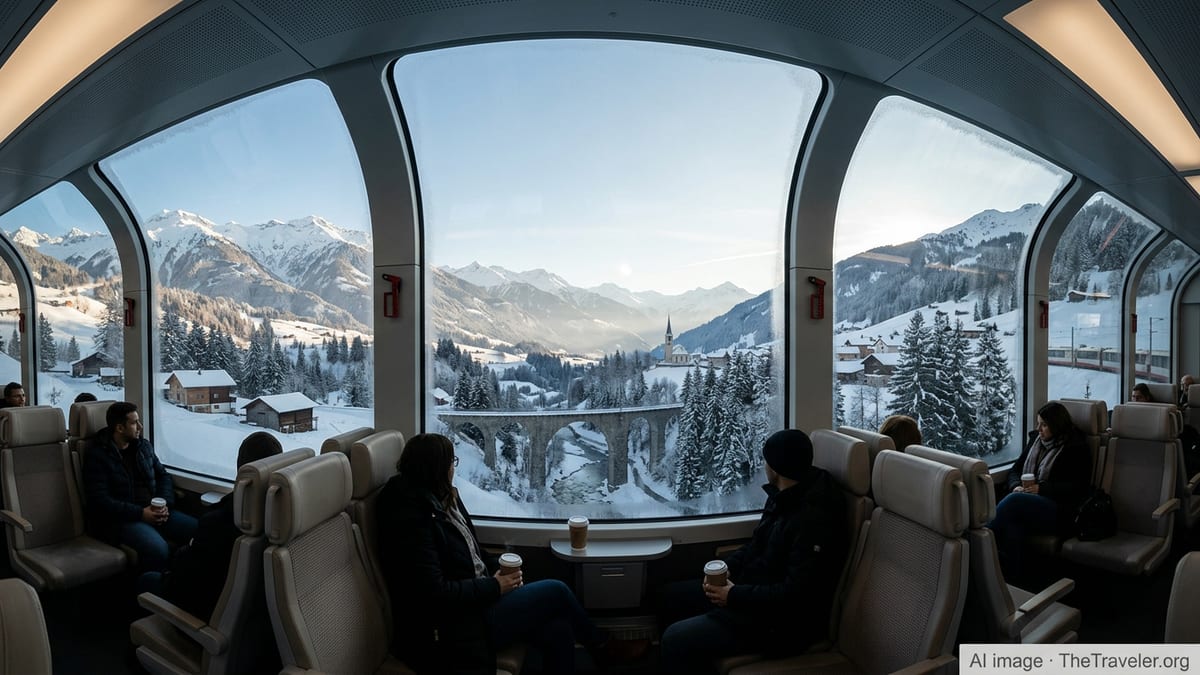
The main selling point of the new Norway Northern Lights train lies in its glass-rich architecture. Coverage describes carriages built with extended panoramic windows and a glass roof section that pushes well beyond the size of conventional train windows, allowing passengers to look up as much as out. The idea is to mimic elements of Arctic glass igloo hotels and observatories while retaining the constant forward motion of a long-distance train.
Interior images in travel reports show reclining seats oriented to maximize skyward views rather than standard forward-facing rows. Low, warm lighting and dark interior finishes are highlighted as design choices intended to reduce reflections on the glass and help passengers adjust to the night outside. Some reports describe paired seats and small lounge-style areas that allow travelers to move between sides of the train depending on where the aurora appears.
The service is presented as a night-focused product rather than a typical day-scenic train. Operating timetables and promotional material emphasize departures timed for peak darkness hours during the aurora season, generally from late autumn through early spring. The slow, measured pace of the train is described as deliberate, giving passengers time to settle in, watch the sky change, and move to better vantage points in the carriage when activity intensifies.
While not positioned as a five-star luxury train in the vein of historic European sleepers, the Norway Aurora service appears targeted at the upper midrange of the market. Reports point to extra-spacious seating, upgraded onboard service, and optional lie-flat or semi-reclining arrangements to justify premium pricing over conventional Nordic night trains that cross the Arctic Circle.
From Narvik and Tromsø to the Heart of Aurora Country
Geography is central to the appeal. Narvik and Tromsø sit well above the Arctic Circle in what scientists refer to as the auroral oval, a band around the geomagnetic pole where Northern Lights activity is most frequent. Tourism authorities in the region highlight long, dark winters, relatively mild coastal temperatures compared with inland Arctic areas, and frequent clear spells that make this part of Norway one of the most reliable places to chase the aurora.
Existing excursions already tap into this advantage. The Arctic Train, operating along the Ofoten Line from Narvik into the mountains toward the Swedish border, has been offering Northern Lights themed evening trips that bring passengers to remote, low-light locations before returning them to town. Travel information from Narvik-based tourism bodies also promotes dedicated Northern Lights trains as part of broader winter packages that include fjord views, campfires and storytelling stops in the high, snow-covered terrain.
What distinguishes the new glass-roof night train is its emphasis on a continuous overnight journey rather than an out-and-back excursion. Travel features describe itineraries that either connect multiple Arctic hubs or run extended loop-style routes timed around peak solar activity forecasts. For visitors flying into northern Norway, that turns an otherwise routine transfer into a marquee experience built around aurora viewing.
The train’s route concept also taps into an emerging trend in Scandinavian travel, where rail corridors that once served mainly as lifelines for remote communities are being repackaged as slow-travel attractions. Lines such as the Nordland Railway between Trondheim and Bodø and the Ofoten Line into Narvik are increasingly promoted for their views of fjords, peaks and winter skies. The glass-roof aurora train positions itself as the most immersive interpretation of that trend so far.
How the Night Train Experience Works in Practice
According to publicly available information, passengers book specific departures tied to the aurora season, with schedules clustered between roughly September and March when darkness is longest in the high north. Operators indicate that trips are subject to minimum daylight levels and clear-weather considerations, underscoring that while the aurora can appear any time during the season, visibility depends on cloud cover and solar activity that cannot be guaranteed.
On board, the experience is described as more akin to a rolling observatory than a typical sleeper train. Reports point to announcements or informational segments that explain aurora science, local folklore and safe viewing practices, often paired with dimming of interior lights when the lights appear. Passengers are encouraged to remain seated or move slowly near windows to avoid reflections, and to keep devices on lower brightness settings so that photos do not spoil others’ night vision.
Some travel writeups suggest that the train incorporates short stops at especially dark vantage points, allowing passengers to step outside with guides for a more traditional Northern Lights outing before returning to the warmth of the carriage. Hot drinks, simple snacks and local specialties feature prominently in descriptions of the service, adding to the atmosphere of an extended evening event rather than a mere point-to-point transfer.
Regardless of layout, the operator underlines that even near the Arctic Circle, aurora sightings depend on the whims of space weather. Marketing language tends to frame the experience as maximizing the odds rather than offering certainty. For many guests, the blend of mountains, fjords, snow and star-filled Arctic skies is presented as reason enough to make the trip, with the Northern Lights as the hoped-for centerpiece rather than a guaranteed show.
Booking Tips and the Reality Behind the Hype
For travelers inspired by viral videos, there are practical details to consider. Reports on Norway’s night rail network indicate that classic overnight services remain limited and can be subject to seasonal disruptions, especially on lines in northern Norway and northern Sweden. Prospective passengers are advised to pay close attention to published timetables and to distinguish between regular night trains with standard windows and the newer, niche panoramic services marketed specifically for aurora viewing.
Several travel analyses also caution that some of the most shared images of all-glass carriages under luminous skies stem from marketing visuals and digital artwork rather than real photographs. The actual panoramic train features extensive glass and strong sightlines, but within the constraints of operational safety, energy efficiency and winter conditions along Arctic tracks. Travelers seeking realism rather than fantasy are encouraged to look for recent photos, independent reviews and operator specifications that show how the interiors and roof sections are configured today.
Price and availability are another consideration. With interest in Northern Lights tourism at record levels, reports suggest that premium aurora-focused departures in Norway can sell out months in advance, particularly around school holidays and peak winter periods. Flexible travelers may improve their chances by targeting shoulder months within the aurora season, when nights are still long but demand is slightly lower.
For those who cannot secure a spot on the new glass-roof night train, conventional options remain. Standard night trains and regional services running north of the Arctic Circle still provide strong chances of incidental aurora sightings through regular windows on clear nights. In addition, established Northern Lights excursion operators in Narvik and other Arctic towns continue to offer dedicated evening outings by bus or standard train, sometimes combined with glass-cabin stays or mountaintop viewpoints that echo the panoramic ambition of the new rolling observatory.