


More news on this day
Austria’s Federal Railways are moving ahead with plans to double-track the busy St. Pölten–Herzogenburg line, positioning the regional corridor for higher capacity, more reliable timetables and better integration with long-distance services on the Western Railway.
Get the latest news straight to your inbox!
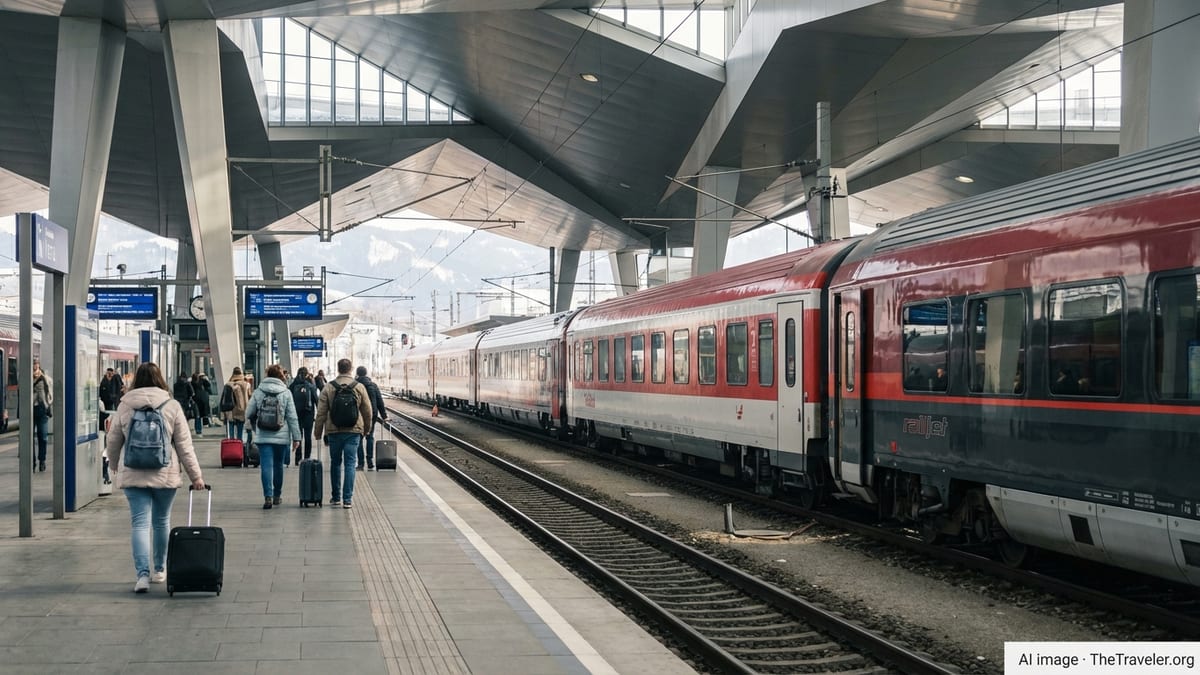
Strategic upgrade on a key Lower Austria corridor
The single-track section between St. Pölten and Herzogenburg is regarded in public planning documents as a capacity bottleneck on the northern approaches to St. Pölten, a major junction on Austria’s Western Railway. The corridor links the state capital with Herzogenburg and onwards toward Krems and the Kamptal, serving both daily commuters and regional traffic.
According to published infrastructure plans, a two-track expansion between St. Pölten and Herzogenburg has been added to ÖBB-Infrastruktur’s multi-year framework programme. The project appears alongside other priority schemes designed to remove pinch points, raise line speeds and support growth in both passenger and freight volumes on Austria’s core network.
References in recent federal and company reports indicate that the corridor is treated as part of a broader effort to modernise rail infrastructure in Lower Austria, in combination with electrification projects, signalling upgrades and the rollout of the European Train Control System on connecting lines.
By targeting the St. Pölten–Herzogenburg section for double-tracking, planners are aiming to align local and regional capacity with the high standards already achieved on the Western Railway main line, which has been progressively expanded, grade-separated and equipped for higher speeds.
Capacity, reliability and timetable benefits
Double-tracking the St. Pölten–Herzogenburg line is expected to deliver substantial operational benefits. With the existing single track, train crossings must be carefully scheduled, limiting the number of services and leaving little flexibility to recover from delays. A second track would allow more frequent regional services and create room for additional freight trains without compromising punctuality.
Publicly available material points to improved timetable robustness as a central goal. With two tracks, regional trains could be spaced more evenly and connections in St. Pölten toward Vienna, Linz and other destinations could be made more reliable. This is particularly important during peak periods, when regional and long-distance demand coincides and minor disruptions can cascade across the network.
The project is also anticipated to support future service concepts, including potential enhancements on the lines toward Krems and into the Kamptal. Observers of regional rail planning note that a double-tracked access route into St. Pölten would make it easier to extend through services, introduce clockface timetables at higher frequencies and accommodate special or seasonal trains without straining existing capacity.
In addition, a more resilient corridor north of St. Pölten is seen as helpful during diversions or planned works on the Western Railway. With greater flexibility to route regional and selected long-distance services, the network as a whole could become less vulnerable to localized disruptions.
Integration with wider Austrian rail investments
The St. Pölten–Herzogenburg upgrade is emerging in parallel with a series of national rail investments backed by Austria’s federal government, which has emphasized rail as a central pillar of climate and transport policy. Recent green financing and infrastructure reports highlight the role of capacity improvements and electrification projects in shifting more journeys from road to rail.
Within this context, double-tracking is framed as a relatively targeted but high-impact intervention. Compared with entirely new alignments, adding a second track along an existing railway can be delivered in phases and typically reuses established corridors, limiting land-take while still unlocking higher throughput.
The corridor also connects with routes earmarked for modern signalling and control technology. Official documentation for the rollout of the European Train Control System lists projects on lines converging at Herzogenburg and St. Pölten within this decade, suggesting that the civil works for double-tracking would likely be coordinated with digital upgrades to maximise efficiency and minimise disruption.
For passengers, the combination of additional track capacity and modern train control could translate into shorter travel times, more consistent journey planning and greater flexibility in choosing departure times throughout the day.
Local impacts and construction considerations
While detailed construction schedules and phasing have not yet been fully set out in public-facing documents, double-tracking typically requires works such as platform modifications, bridge widening and adjustments to level crossings or their replacement with grade-separated solutions. Communities along the route can therefore expect a period of intensified construction activity once the project moves from planning into delivery.
Available information on recent works in the region indicates that ÖBB has been carrying out stepwise upgrades on several Lower Austria lines, combining renewals with capacity improvements. Similar patterns are likely on the St. Pölten–Herzogenburg section, where track and signalling renewals may be timed alongside the addition of the second track to reduce overall closure periods.
Residents and rail users are likely to experience temporary timetable changes, bus replacement services and weekend closures during the construction phase, mirroring the approach seen on other Austrian corridors undergoing modernisation. However, the long-term expectation communicated through planning documents is that the upgraded line will offer more frequent and reliable services than are possible today.
Urban development strategies in and around St. Pölten also highlight the importance of high-quality public transport links to surrounding municipalities. Improved rail capacity toward Herzogenburg may support local efforts to concentrate growth around stations, reduce car dependency for commuting and attract businesses that value strong regional connectivity.
Positioning Lower Austria for future rail growth
The planned double-tracking of the St. Pölten–Herzogenburg line fits into a wider trend of strengthening secondary but strategically important corridors that feed into Austria’s mainline network. As long-distance routes receive high-speed upgrades and new rolling stock, regional access lines are increasingly being upgraded to ensure that smaller cities and rural areas can benefit from national rail investments.
For Lower Austria, securing a more robust connection between the state capital and towns along the Traisen and toward the Danube reinforces the role of rail in everyday mobility. Planners describe such projects as essential to achieving modal-shift targets, particularly in suburban and exurban belts where car use remains high but rail has the potential to offer competitive journey times.
Observers of Austrian rail policy note that framework-plan projects, once listed, tend to progress through successive design and permitting stages, even if final timelines can shift due to funding cycles and regulatory procedures. The appearance of the St. Pölten–Herzogenburg double-tracking in these documents is therefore seen as a clear signal that the corridor is on a path toward substantial enhancement.
As the project advances through planning and into implementation, the St. Pölten–Herzogenburg line is set to become a more capable and resilient element of the Austrian rail system, strengthening links within Lower Austria and supporting the continued expansion of climate-friendly mobility across the country.