


More news on this day
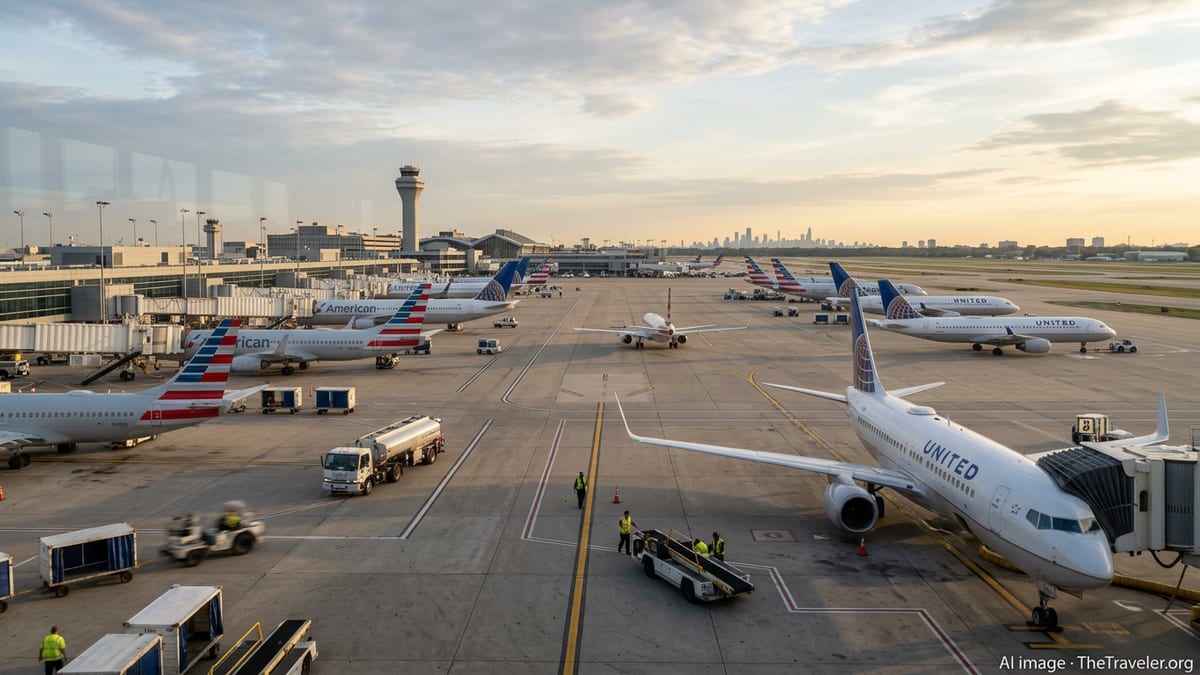
Hours of rolling delays and a cluster of cancellations at Chicago O'Hare International Airport have turned one of the United States' busiest hubs into a chokepoint for summer travelers, with publicly available data showing hundreds of disrupted flights and mounting knock-on effects for passengers on United Airlines, American Airlines, Emirates and their partners.
Get the latest news straight to your inbox!
Ground Delays Ripple Across a Key U.S. Hub
Real-time tracking boards and delay monitors on June 15 indicated heavy disruption across the U.S. network, with Chicago O'Hare among the most closely watched airports as thunderstorms and congestion slowed operations. Aggregate statistics from national trackers showed thousands of flights delayed nationwide and several hundred canceled, with O'Hare featuring prominently in the list of affected hubs.
Within that turbulence, 257 delays and 24 cancellations centered on O'Hare emerged as a snapshot of how quickly operations can deteriorate when weather, traffic management programs and crowded schedules converge at a major connecting airport. While those figures represent only a fraction of total daily movements at O'Hare, they illustrate how even a modest percentage of disrupted flights can translate into hours of waiting for passengers and strained resources for airlines.
Travel advisory tools and airport delay dashboards showed that most disruptions fell into the category of departure holds and extended arrival spacing rather than complete ground stops. Even so, longer taxi times, aircraft waiting for gates and rolling crew reassignments combined to produce the kind of cascading delays that can follow travelers throughout the day as missed connections stack up.
By midafternoon, O'Hare was still reporting general arrival and departure delays in the 15-minute range in federal air traffic summaries, but airline-level data pointed to a more uneven reality, with some departure banks experiencing significantly longer waits and scattered cancellations as schedules were reset.
United and American Bear the Brunt of Schedule Strain
United Airlines and American Airlines, which maintain large connecting complexes at O'Hare, were at the center of the disruption. Network analyses and schedule databases consistently show the two carriers accounting for the majority of movements at the airport, making them especially vulnerable when storms pass through northern Illinois or when traffic-control initiatives reduce the number of takeoffs and landings allowed per hour.
In recent months, United and American have already faced pressure over O'Hare performance. A federal draft order released in April called for a temporary cut in scheduled operations at the airport this summer after regulators warned that aggressive expansion plans by the two carriers risked driving chronic delays. The measure, aimed at reducing peak congestion, is designed to trim daily movements and improve on-time performance during the busiest travel months.
Travel forums and consumer-rights platforms have been documenting the impact of O'Hare disruptions on passengers throughout the spring and early summer, with numerous accounts of missed connections, overnight stays and long rebooking lines when afternoon storms collide with dense departure banks. Industry analyses of United and American statistics at O'Hare over the past several years suggest that while cancellation rates remain relatively low on most days, delay rates can spike sharply whenever the airport encounters convective weather or heavy-volume holidays.
The latest wave of 257 delays and 24 cancellations highlights how quickly those pressure points can reappear, even as airlines attempt to build more slack into schedules and regulators push for structural adjustments to capacity.
Emirates and Global Partners Feel Long-Haul Shockwaves
Emirates, which connects Chicago with its Dubai hub, has far fewer daily movements at O'Hare than United or American but faces outsized consequences when disruptions occur. A single delayed or canceled long-haul flight can affect onward journeys for passengers bound for Africa, Asia and the Middle East, particularly those relying on tight overnight connections in Dubai.
The carrier has been advising customers across its network to monitor email notifications and online flight-status tools closely for any schedule changes, and public guidance from the airline underscores the importance of checking flight status before traveling to the airport. When O'Hare experiences operational constraints, long-haul departures can be held in departure queues or retimed to align with crew-duty limits and slot availability.
On days when storms or capacity reductions strike Chicago, those Emirates departures and arrivals must be fitted into a complex pattern of domestic and international traffic dominated by United and American. Any delay on the Chicago segment can then propagate through connecting banks in Dubai, affecting flights to destinations well beyond the United States.
Interline and codeshare agreements can also complicate recovery. Passengers booked on itineraries that mix U.S. airlines and Emirates may find that a late arrival into O'Hare from a domestic feeder flight leaves too little time to board an onward international leg, forcing rebooking across multiple systems and sometimes pushing travel to the following day.
Weather, Construction and Capacity Cuts Form a Volatile Mix
Several overlapping trends have made O'Hare particularly sensitive to disruption in 2026. Seasonal thunderstorms in the Midwest regularly trigger ground delay programs, as air traffic controllers stretch out arrival spacing and meter departures to maintain safety. Even short-lived cells can cause ripple effects when they pass directly over Chicago or key en route corridors feeding into the region.
In parallel, ongoing airfield and terminal work around some of the United operations area has introduced additional bottlenecks. Travelers and aviation enthusiasts posting on public forums have pointed to construction constraints that limit available taxiways and gate access, sometimes contributing to extended taxi times on arrival or departure.
To address mounting concerns over congestion, a summer capacity reduction ordered for O'Hare is set to curb daily operations across the peak season. Publicly available summaries of that move indicate a reduction of roughly 12 percent in scheduled flights for the busy months, with regulators and airport planners arguing that the change will create more breathing room in departure and arrival banks.
Consumer advocates note that while capacity cuts may reduce the probability of large-scale meltdowns, individual travelers can still feel significant pain on bad-weather days, especially when demand remains high and unsold seats on alternative routes are limited. The latest disruptions, encapsulated in the 257 delays and 24 cancellations recorded for O'Hare, illustrate the continuing challenge of balancing growth with reliability at one of the nation’s most important hubs.
What Travelers Can Expect and How to Prepare
For passengers set to travel through Chicago in the coming weeks, the recent turbulence serves as a reminder that connecting through a major hub carries inherent risk during the summer storm season. Historical performance metrics show that O'Hare can operate smoothly for long stretches, but when weather and congestion align, delays can escalate quickly.
Industry guidance and airline advisories emphasize a few consistent themes for minimizing disruption: allowing longer connection windows, monitoring flight status frequently on day of travel and being prepared for gate or schedule changes. During periods when capacity cuts and severe weather advisories overlap, carriers often publish travel waivers that allow itinerary changes without additional fees, particularly for passengers scheduled to connect through high-risk hubs like O'Hare.
Passenger accounts from recent disruption days at O'Hare suggest that those who built in extra time, carried essential items in hand luggage and stayed flexible with rebooking options generally navigated the chaos more easily. On the other hand, tight 30- to 45-minute connections often proved difficult to maintain once departure banks began to slip.
With forecasts pointing to a typical pattern of summer thunderstorms across the Midwest, and with O'Hare entering the heart of peak leisure travel season, the possibility of more days resembling this latest 257-delay, 24-cancellation episode cannot be ruled out. Travelers routing through Chicago may want to weigh schedule convenience against the resilience of their itineraries as they plan upcoming trips.