


More news on this day
Thousands of travelers across the United States are facing long lines, missed connections and overnight disruptions as a wave of severe weather and air-traffic slowdowns delays 6,257 flights and cancels 639 more, with knock-on effects reaching airports from Illinois and Arizona to Houston, Chicago, Pittsburgh, Tampa and Norfolk.
Get the latest news straight to your inbox!
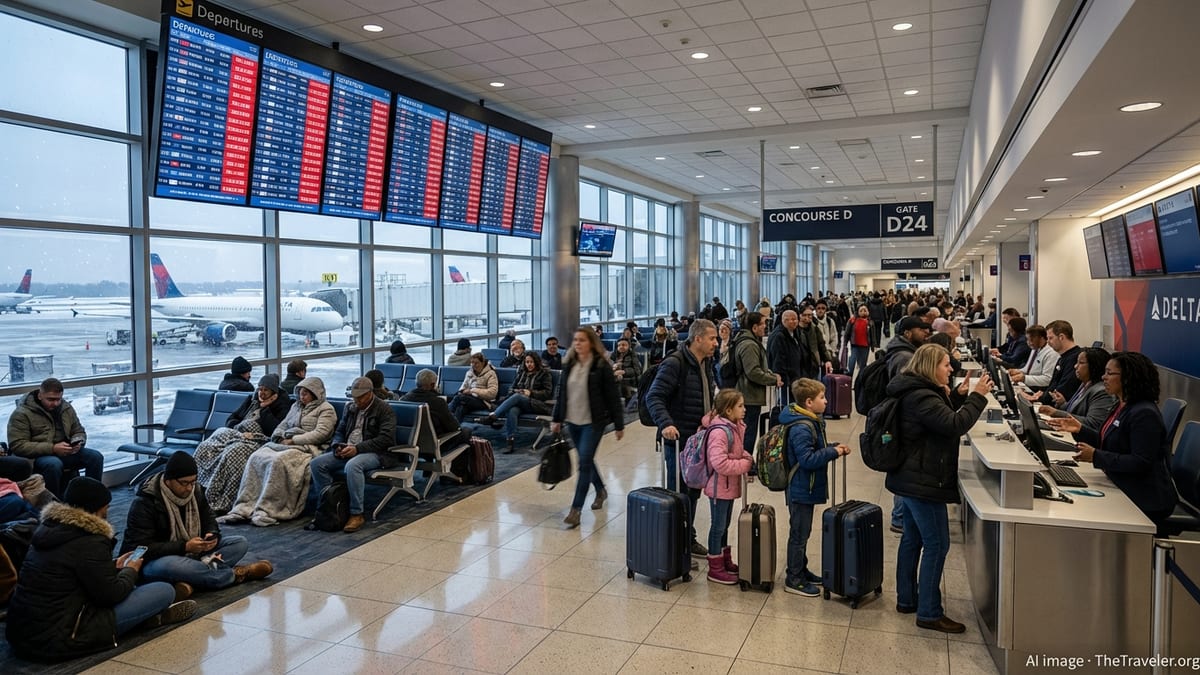
Storm Cells and Traffic Controls Ripple Through Major Hubs
Publicly available flight-tracking data on June 15 shows widespread disruption at U.S. airports as thunderstorms and unstable weather patterns pass through multiple regions. Ground delay programs and flow restrictions have been instituted at several hubs, slowing departures and arrivals and causing aircraft and crews to fall out of place across the network.
Travel industry coverage indicates that storm activity in the Northeast and Mid-Atlantic has intersected with unsettled conditions in Texas and the Southeast, a combination that tends to create cascading knock-on effects. Flights that depart late from one city often arrive late to the next, pushing back subsequent departures and compressing already tight turn times.
While individual airports may report only modest holding times at any given moment, the aggregate impact has been significant. Short ground stops, periodic ramp closures and congestion in busy airspace corridors have together produced thousands of delays within, into and out of the United States, with hundreds of flights removed from schedules entirely.
The numbers reflect the scale of the modern domestic system, where even localized weather can quickly magnify. When multiple regions see storms on the same day, carriers have fewer options for rerouting aircraft and crews, and delays that might otherwise be absorbed instead spread throughout the day and across the country.
Houston, Chicago, Pittsburgh, Tampa and Norfolk Among Hard-Hit Cities
Travelers in Texas have felt the strain early and often. Local broadcast reports from Houston describe a ground delay at George Bush Intercontinental Airport due to morning thunderstorms, with aircraft held from departure and some inbound flights reduced to slower arrival rates. Those types of traffic management initiatives typically lead to lines at security checkpoints, crowded gate areas and a wave of late-day scheduling adjustments.
In the Midwest, Chicago has again shown its vulnerability as a central hub. When operations slow at the region’s largest airports, connecting passengers throughout the country are affected. Flights bound for smaller markets in Illinois and neighboring states are particularly prone to rolling delays, as carriers prioritize long-haul and high-demand trunk routes during recovery.
Further east, disruptions have been noted in and out of Pittsburgh and Norfolk, both of which depend heavily on smooth flows through larger gateway airports. Delays at those hubs often translate into irregular operations on spoke routes, where there may be only a handful of daily frequencies and limited backup options for stranded passengers.
Florida’s summer storm pattern has also been in play, with Tampa among the airports seeing schedule adjustments. Short, intense downpours and lightning in the area can temporarily halt ramp activity, forcing ground crews to clear the tarmac and compounding departure queues. Even brief pauses can reverberate throughout the day when aircraft are already running behind.
Regional Carriers Endeavor, PSA and Piedmont Face Added Pressure
The current disruption has placed particular spotlight on regional airlines such as Endeavor Air, PSA Airlines and Piedmont Airlines, which operate many flights on behalf of major brands but often with tighter resources. These carriers run high-frequency schedules with small aircraft, feeding large hubs from dozens of secondary cities.
When storms or traffic programs slow the mainline operation, regional flights are frequently among the first to be retimed or canceled as airlines concentrate capacity on trunk routes. Historical performance data published by the U.S. Department of Transportation shows that regional operators typically experience higher cancellation percentages than their larger counterparts during weather-affected periods, reflecting their position at the edge of the network and their limited spare aircraft.
On days like June 15, this translates into disproportionate impacts for travelers starting or ending journeys in smaller communities served primarily by regional partners. A single cancellation can leave passengers with no same-day alternative, pushing them to overnight stays or lengthy ground transport to larger airports.
Industry guidance notes that these regional flights are also more sensitive to crew scheduling constraints. Pilots and flight attendants based at hub airports may quickly run up against duty-time limits when early rotations are delayed, forcing additional cancellations even after storms have cleared.
Major Brands United and Alaska Juggle Cancellations and Delays
Among the mainline carriers, United Airlines and Alaska Airlines are navigating a familiar balancing act: protecting safety and operational integrity while trying to limit the scale of schedule cuts. Past performance statistics compiled by transportation agencies indicate that both airlines normally maintain relatively low cancellation rates, but that sustained storms and airspace congestion can still drive meaningful spikes in scrubbed flights and late arrivals.
Public carrier data shows that United, with its heavy reliance on hub operations in Chicago, Houston and other weather-sensitive cities, can see widespread ripple effects on days dominated by thunderstorms. Aircraft and crews that arrive late into a hub are often unable to turn in time for onward flights, forcing dispatchers to consolidate or cancel departures and rebook passengers across the remaining network.
Alaska, which combines a large West Coast footprint with a growing transcontinental schedule, faces a different set of bottlenecks. When delays on one coast collide with congestion on the other, long-haul aircraft may miss their optimal departure windows, further tightening gate and runway capacity at already busy airports. Travelers on Alaska’s connecting flights through cities like Seattle, Portland and San Francisco can encounter holdovers that extend well beyond the original posted delay.
In the current wave of disruptions, both United and Alaska are managing operations alongside their regional partners, coordinating aircraft swaps, reroutes and re-crewing plans as the day progresses. For passengers, this often appears as a sequence of incremental schedule changes on airline apps rather than a single long posted delay.
What Travelers Can Expect as the System Recovers
Industry guidance suggests that recovery from a multi-region disruption rarely happens all at once. Even after storms move offshore and ground delay programs are lifted, residual effects typically persist into the late evening and sometimes into the next operating day, particularly for early-morning departures that rely on aircraft positioning flights the night before.
Passengers traveling through the affected cities can expect longer-than-usual lines at check-in and security, congested lounges and gate areas, and increased competition for rebooking options. Airlines may offer limited fee waivers or flexible change policies when delays are widespread, but these are applied within the constraints of remaining seat inventory.
Consumer information published by regulators emphasizes that U.S. rules around compensation for delays are more limited than in some other regions. While carriers are generally responsible for getting passengers to their destination when a flight is canceled, there is no broad federal requirement for meal vouchers or hotel rooms during weather-related disruptions, leaving individual airlines to set their own policies.
As thunderstorms remain a daily possibility in several regions through the summer season, travelers are likely to see further instances where large numbers of flights are delayed or canceled in a short window of time. The events surrounding the 6,257 delayed and 639 canceled flights serve as a reminder of how quickly the U.S. aviation system can feel the strain when weather, traffic management and tight schedules collide.