


More news on this day
Oman Air and SalamAir have announced a new phase of their reciprocal codeshare partnership, building on a July 2024 rollout to give travellers broader one-ticket connectivity through Muscat and support Oman’s longer term hub and tourism strategy.
Get the latest news straight to your inbox!
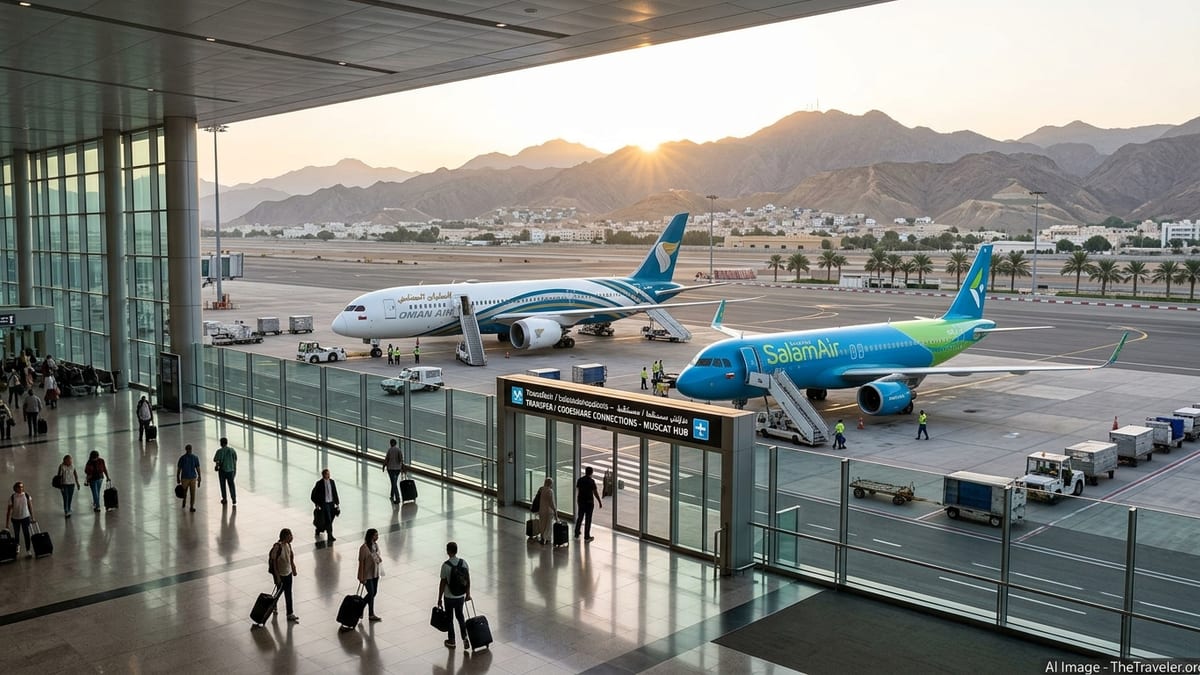
Expanded partnership builds on 2024 rollout
The latest joint announcement, dated 18 November 2026, confirms that Oman’s full service flag carrier Oman Air and low cost carrier SalamAir are extending and deepening their existing codeshare arrangement rather than creating a new structure. Under the agreement, each airline can continue to market and sell eligible flights operated by the other using its own code, WY for Oman Air and OV for SalamAir, with additional routes now brought under the shared umbrella.
The strengthened cooperation builds on a phase that took effect on 4 July 2024, when the airlines began offering selected reciprocal codeshare services and signalled that more routes would follow once operational systems, booking flows and connection handling had been tested. According to the latest statements, the partnership has now grown to cover several dozen destinations on each side, though the airlines do not publish a single exhaustive list and stress that coverage remains selective.
Both carriers frame the move as an operational and commercial deepening rather than a structural merger. Each airline keeps its own brand and business model, but aligns schedules and inventory on chosen routes in order to make Muscat International Airport work more effectively as a shared hub.
Using the codeshare to build Muscat’s hub role
At the core of the expanded deal is the aim to funnel more traffic through Muscat, already the main base for both airlines, and to position it more clearly as a regional gateway for travel between the Gulf, South Asia, East Africa, the Levant and Europe. The airlines highlight that they are coordinating flight times and minimum connection windows on key flows so that itineraries involving both carriers are easier to book and complete on a single ticket.
In practice, SalamAir’s short and medium haul network is being used to feed and distribute traffic for Oman Air’s longer haul and premium routes. Secondary and developing markets such as Duqm, Masirah and Salalah within Oman, as well as a range of points in India, Saudi Arabia, East Africa and the Levant that are primarily served by SalamAir, can now be more seamlessly connected to Oman Air’s services to Europe, Southeast Asia and parts of Africa through Muscat.
The airlines and regulators also link the cooperation to seasonal tourism peaks, notably the Khareef Dhofar season centred on Salalah, where additional capacity and better timed connections are part of a wider national plan to handle visitor growth. Authorities have separately outlined coordinated operations by both carriers on the Muscat–Salalah corridor during the 2026 Khareef period, using the combined network to support visitor access and internal connectivity.
What the expanded codeshare means for travellers
For passengers, the most immediate change is the wider range of through journeys that can be booked on a single ticket, even when one or both sectors are operated by the partner airline. This typically brings through-checking of baggage, coordinated minimum connection times in Muscat and a clearer pathway for recovering from disruptions compared with stitching together two separate tickets.
The airlines say that the expanded codeshare now links dozens of Oman Air destinations with a similar number of SalamAir points, although they stop short of publishing precise totals by city pair or guaranteeing daily or year round operation on each route. Travellers therefore need to check live schedules and booking engines for specific dates, especially on seasonal or lower frequency services used to connect to or from Oman Air’s long haul network.
On pricing, neither airline has disclosed specific promotional fares or average savings for itineraries using both carriers. The structure of a codeshare can open up more fare combinations and cabin options, and in some cases may lead to more competitive prices than buying separate tickets, but this will vary by route, date and booking channel. The current announcements do not promise across-the-board fare reductions.
Tourism strategy links and remaining unknowns
Oman’s aviation and tourism authorities have been explicit that better use of Muscat and Salalah as gateways is part of broader national plans under Oman Vision 2040 and the National Aviation Strategy 2040. The expanded Oman Air–SalamAir codeshare is presented as one of the tools to deliver that, by improving connectivity into and within the country while keeping both a full service and a low cost option active in the market.
Officials also highlight potential synergies with stopover and transit-to-tourism initiatives, including separate programmes that aim to convert connecting passengers into short stay visitors in Oman. While SalamAir and partners have promoted such stopover products, the airlines have not yet detailed any fully integrated joint tourism packages tied specifically to the new phase of the codeshare.
Several aspects of the cooperation remain open. The airlines have not listed all routes, frequencies or aircraft types covered, and have not announced any integration of loyalty programmes beyond what standard codeshare booking allows. They describe the relationship as an ongoing process, with further destinations and refinements possible in 2027, but without firm commitments on which city pairs or products will be added.
What travellers should watch next
Travellers planning to use Muscat or Salalah as a hub should monitor Oman Air’s and SalamAir’s booking engines and schedules for newly codeshared routes, particularly where SalamAir regional flights connect into Oman Air’s services to Europe, Southeast Asia or Africa. Because coverage is selective and subject to change, checking that both sectors sit on a single booking reference is important if you want the benefits of a through itinerary.
Over the next year, points to watch include any expansion of the codeshare into additional regional gateways, closer alignment of stopover or tour packages around Muscat and Salalah, and any new guidance from Oman’s Civil Aviation Authority that more explicitly links this cooperation to Vision 2040 targets. For now, the strengthened codeshare offers more ways to combine SalamAir’s short haul reach with Oman Air’s wider network, while leaving the long term shape of the partnership still evolving.