


More news on this day
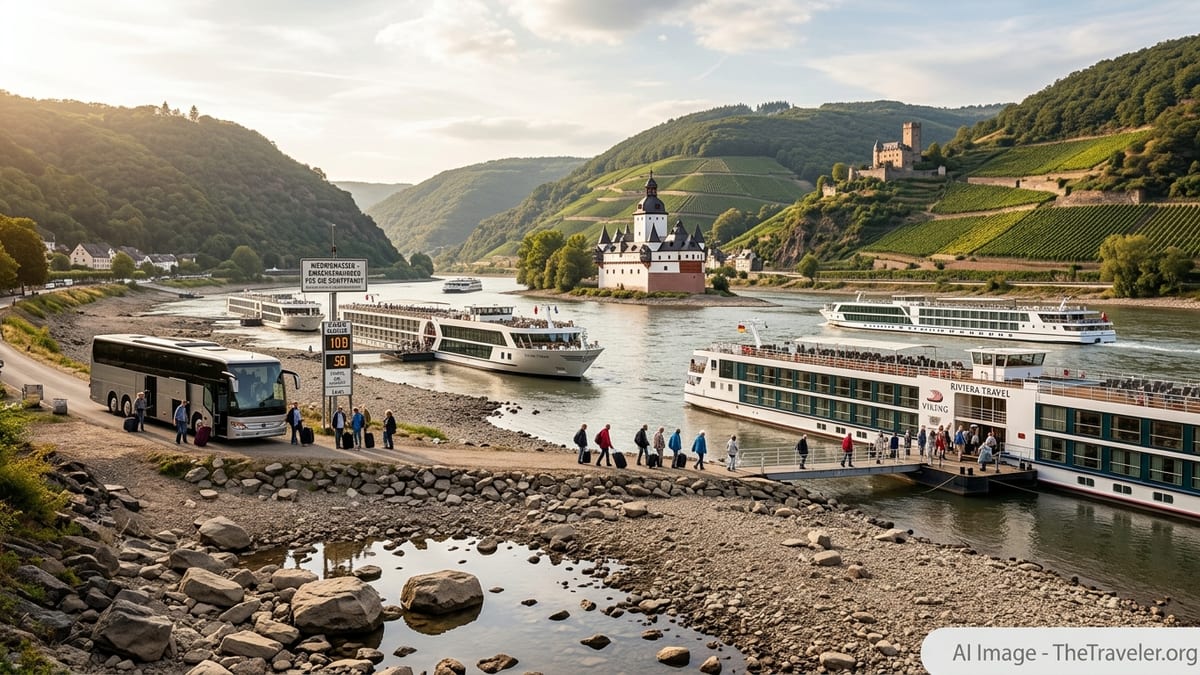
Germany’s Rhine is still feeling the effects of an “exceptional period of low water” declared by regulators in September 2026, leaving late‑season travelers on popular Christmas market river cruises facing rerouted itineraries, ship swaps and occasional cancellations rather than the classic sailings through the Middle Rhine’s shallowest reaches.
Get the latest news straight to your inbox!
Regulators Confirm One of the Toughest Low-Water Seasons on Record
On 10 September 2026, the Central Commission for the Navigation of the Rhine formally stated that the river was undergoing an “exceptional period of low water,” highlighting sustained pressure on Europe’s busiest inland waterway and its supply chains. That assessment covers the recent summer and autumn, particularly on the Middle Rhine corridor through Germany, where Kaub is the reference gauge for navigation decisions.
Hydrology data from Germany’s federal services and specialist trackers show that daily average levels at Kaub have stayed below the reference low-water mark, known as GlW, since late July, with readings in early autumn briefly approaching or even dipping below historic record territory before a modest recovery in November. Similar though slightly less extreme deficits have been logged further downstream toward the Dutch border, including around Lobith, reinforcing the Rhine-wide nature of the 2026 event while still leaving the narrow Middle Rhine as the most constrained section.
Authorities and technical analyses link the 2026 pattern to a combination of prolonged heat and rainfall deficits across the Rhine basin, consistent with a wider trend toward more frequent extreme low-water episodes, but they stop short of predicting that subsequent years will mirror this season’s severity. For now, regulators are focused on resilience measures, such as improving forecasting tools and adapting vessel and infrastructure standards, rather than signaling any long-term closure or collapse of Rhine navigation.
Patchwork Cruise Operations Replace Normal Rhine Gorge Sailings
Despite the difficult hydrological backdrop, major river cruise brands have kept most of their 2026 programs running, particularly as they move into the lucrative Christmas market period. Companies including Viking, AmaWaterways, Riviera and Emerald have shifted to a patchwork of operational workarounds, combining ship swaps, partial busing and redesigned routes to keep guests on the move while avoiding the shallowest Middle Rhine stretches.
Current travel-advisory pages from leading operators describe low water as an ongoing but localized constraint, with wording that stresses “below normal” water levels on sections of the Rhine and neighboring rivers but notes that many sailings are still operating largely as scheduled. The most substantial changes are concentrated on itineraries that would normally transit the Rhine Gorge between Cologne, Koblenz and Mainz, where draft limits are tightest and cargo traffic competes for usable depth.
In several documented cases, including recent guest communications from Viking, classic Amsterdam to Basel Christmas market sailings have been reworked into Germany-focused itineraries staying on deeper or more consistently navigable waters, such as the Main. Operators have also deployed sister ships on opposite sides of shallow stretches, moving passengers between them by coach while keeping the overall cruise dates and included excursions intact.
What Travelers Are Experiencing on Late-2026 Rhine Cruises
For travelers, the 2026 low-water season has translated less into outright trip cancellations and more into altered logistics and scenery. Guests booked on Middle Rhine-heavy itineraries face an elevated risk of waking up to revised day-by-day plans, including longer coach segments around bottlenecks, hotel nights replacing one or two onboard overnights, or a last-minute shift from a Rhine-focused voyage to a Germany-only route on the Main that still connects major Christmas market cities.
Industry reports and traveler accounts suggest that when operators cancel a sailing entirely or significantly change its character, they generally offer future-cruise credits or rebooking options rather than full refunds as a default. Levels of compensation vary by company and by contract, but partial credits in the roughly 40 to 60 percent range of the cruise fare are common in anecdotal cases, particularly where guests still receive transportation, accommodations and excursions in some form.
The impact is also uneven by geography. Dutch waterways and many stretches closer to the Rhine delta have seen fewer severe constraints, and some Danube and Main itineraries continue to operate comparatively normally, even as planners monitor their own local low-water hotspots. Travelers booked on these less affected routes may encounter few or no changes, underlining that the current difficulties are route-specific rather than a blanket shutdown of European river cruising.
How to Book and Prepare for Christmas Market Cruises Now
With Kaub and other critical Rhine gauges still hovering near or below low-water reference marks in mid-November, and six-week hydrological forecasts indicating only gradual improvement, travelers planning late-2026 or early-2027 river cruises should approach bookings with added flexibility. The most concrete step is to monitor cruise line travel-alert or “current sailings” pages closely in the weeks and days before departure, since operators tend to finalize workarounds only once short-range water-level forecasts are clearer.
Prospective guests should also review contract terms to understand how their operator classifies route changes. Many lines treat modifications such as switching embarkation ports, substituting a Main-centric “Germany Christmas” route for a Rhine Gorge itinerary, or inserting coach transfers as operational adjustments rather than cancellations, which can limit automatic refund rights while still triggering offers of credits or discounted rebookings.
Finally, travelers may want to favor flexible or changeable air tickets and consider travel insurance that explicitly covers transport disruption due to natural conditions, including low river levels. While no policy can eliminate the uncertainty created by an unusually dry Rhine season, these steps can reduce the financial impact if ships cannot safely navigate key stretches and a long-planned festive cruise turns into a more improvised holiday journey on Europe’s rivers.