


In the world of hotel loyalty programs and legacy names, it is easy to assume you know exactly what you are getting when you book a Sheraton, Hilton, or InterContinental. For years I treated those brands as interchangeable business-trip wallpaper. Then, on a late-arriving flight into Washington Dulles and a bleary check-in at the Sheraton Reston Hotel in Virginia, one small design detail in the lobby completely reframed how I think about legacy hotel brands and the quiet reinventions happening behind familiar logos.
Get the latest updates straight to your inbox!
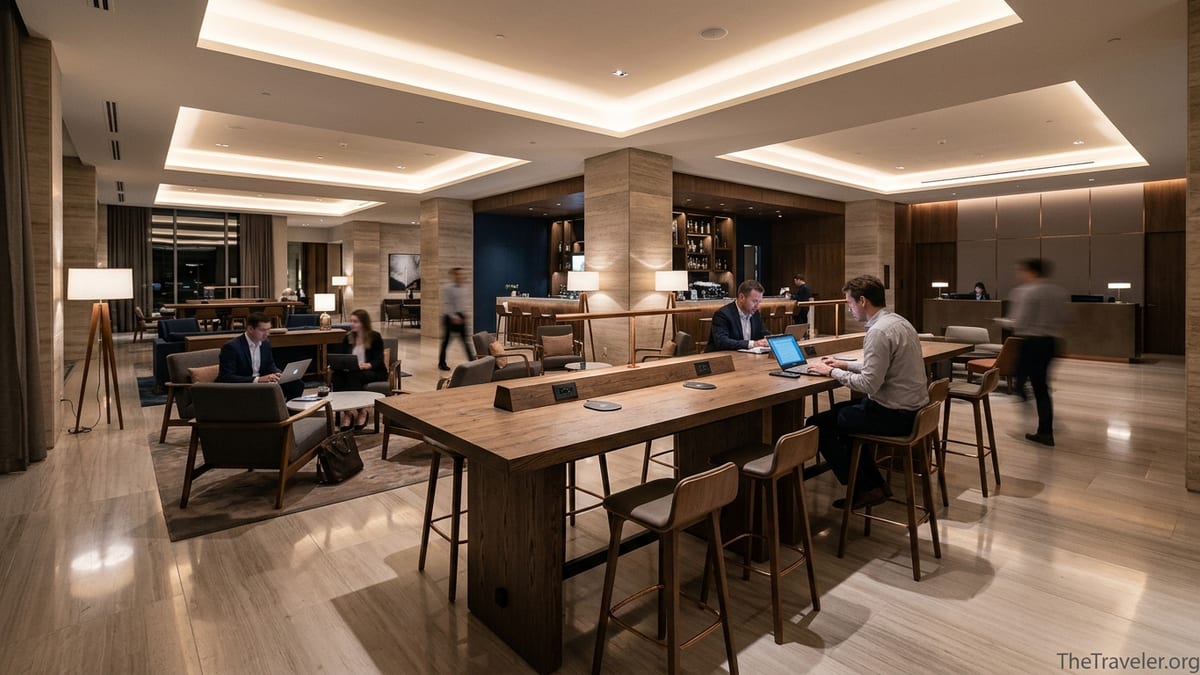
The Night a Lobby Detail Stopped Me in My Tracks
I arrived at the Sheraton Reston past 11 p.m., expecting the classic mix of beige carpets, heavy drapes and an anonymous front desk. Instead, as I walked into the lobby, what caught my eye was not some grand chandelier but a simple, shared worktable running almost the length of the space. It looked more like a co-working hub than a hotel lobby: integrated power outlets at every seat, a strip of wireless charging pads down the center, warm task lighting, and barista-style stools where solo travelers and small groups had quietly spread out laptops and takeout boxes.
At first glance it was just a big table. But the more I watched how people used it, the more it felt like a manifesto. A flight crew compared schedules at one end, a family sorted theme-park tickets at the other, and a pair of consultants held an impromptu debrief in the middle, coffees in hand. Instead of the lobby being a pass-through space, this one understated feature turned it into a gathering point, echoing Sheraton’s newer “Where the World Comes Together” positioning.
Later I learned that the Reston property was part of Marriott’s push to roll out a new Sheraton prototype, with open, active lobbies that blend bar, workspace and social areas. The shared table, plus tucked-away privacy booths and a small business center off to the side, were all intentional signals that this was no longer the Sheraton of closed-off lounges and formal front desks. It was a legacy brand quietly rewritten in furniture, power outlets and sightlines.
That one detail made me realize how much we underestimate the degree to which long-established hotel brands are changing not with fanfare but through hundreds of small, practical decisions that directly affect how travelers use a space.
From Stuffy Boardrooms to Community Hubs
Legacy full-service brands once built their reputations on grand ballrooms and hushed restaurants rather than everyday usability. Sheraton, founded in 1937, became one of the first truly global hotel chains and later a flagship name within Marriott’s portfolio of premium brands. For decades, the mental image of a Sheraton for many travelers was a conventional conference hotel with thick binders in the meeting rooms and a lobby designed more for passing through than staying in.
In recent years, however, Marriott has repositioned Sheraton to emphasize lobbies and public spaces as modern community hubs. The brand’s current tagline speaks of being the place where the world comes together, and properties from Bucharest to Zhuhai have been renovated with open-plan layouts, integrated bars and libraries, and club lounges that feel more like private co-working floors than closed-off perks for executives. At the Sheraton Grand Nashville Downtown, for example, a towering central light installation and adjacent Library Bar reframe the atrium as both a visual focal point and a casual mixing space for locals and guests.
The shift is as much cultural as it is visual. Instead of a front desk forming a physical and psychological barrier, many renovated Sheratons place seating, food and informal meeting zones at the heart of the lobby. Restaurant menus are increasingly designed to work for laptop lunches as much as for white-tablecloth dinners. You see it in details like plentiful two-top tables with accessible charging, or in the way a lobby bar stays open just late enough to catch delayed flights but keeps lighting and music at a level conducive to quiet conversation.
Legacy competitors are following related paths. Hilton has leaned into reliable, recognizable touchpoints such as DoubleTree’s warm cookie and Hilton’s executive lounges, while Hyatt and IHG are carving out clearer lifestyle and classic portfolios. Across brands, older properties are being refitted so that public areas support the way travelers actually behave in 2026: working from anywhere, blending business and leisure, and valuing casual, flexible social space over formal grandeur.
The Power of a Single Thoughtful Touch
Travelers tend to remember dramatic moments: an ocean view, a disastrous delay, an upgrade to a suite. Yet what often determines whether we go back to a brand is something smaller and more practical. That Sheraton lobby table, with its carefully spaced outlets and mix of bar-height and standard seating, did more to reset my expectations than any marketing campaign could have. It solved real problems: no more crouching under side tables to hunt for a plug, no more balancing laptops on armchairs that were built for show rather than function.
Once you start looking for these touches, you see them everywhere. In London, the Sheraton Park Lane, a landmark Art Deco property in Mayfair, installed custom illuminated ceiling panels in internal zones to mimic natural daylight. The technology is complex, but the effect for guests is simple: interior corridors feel less oppressive, meetings run in windowless rooms feel less draining, and the hotel’s historic character is preserved without sacrificing comfort.
In San Antonio, a renovation of the historic Sheraton Gunter included an interactive lighting installation that wraps around lobby columns and responds subtly to movement. The average guest may never know the name of the design firm behind it, but they feel the result: a lobby that feels alive, safer and more inviting late at night, and far removed from the static, dimly lit spaces many travelers still associate with aging city-center hotels.
Even invisible details count. Regular guests often talk about “signature scents” in brand lobbies, and Sheraton is no exception. A consistent, carefully tuned fragrance in public areas can make a dated property feel unexpectedly fresh, and it costs the guest nothing. These are all examples of how one thoughtfully executed detail can stand in for a much larger strategic shift, signaling to repeat travelers that a familiar brand is paying attention again.
Why Consistency Still Matters in a Sea of New Names
Part of what makes Sheraton’s incremental transformation interesting is the broader context. Major hotel groups now operate dozens of brands each, from lifestyle offshoots to soft brands that allow independent hotels to join a loyalty program without changing their name. Marriott alone runs everything from St. Regis at the luxury end to Courtyard and Fairfield in the select-service space, with Sheraton positioned as a classic premium brand competing with Hilton, Hyatt Regency and Crowne Plaza.
For travelers, this explosion of names can feel like noise. What most guests actually want is dependable consistency: a reasonable idea of what the room, lobby and service will be like before they arrive. Legacy names like Sheraton, Hilton and InterContinental carry decades of expectations, good and bad. They cannot reinvent themselves overnight without confusing loyal guests, so they do it gradually, one lobby refit and room refresh at a time.
This is where small details serve a dual role. They improve an individual stay while also signaling a brand’s direction of travel. When you see modernized Sheraton lobbies with open community tables, updated Sheraton Club lounges that function as day-long work and social spaces, or guest rooms equipped with multiple USB-C outlets and good task lighting, you are not just benefitting from isolated upgrades. You are reading the brand’s attempt to clarify what “Sheraton” means in an era when many travelers are as comfortable in an Aloft or Moxy as in a classic business hotel.
Other legacy brands are undergoing similar evolutions. Hilton has introduced newer concepts like Tempo and Motto while updating classic Hilton and DoubleTree properties to feel less formal, and Hyatt has reorganized its portfolio to make it clearer which brands lean toward lifestyle versus traditional full service. Yet even as these changes roll out, inconsistent renovations and franchise ownership structures mean that two hotels with the same logo can feel decades apart. That is why, when a legacy property gets details right, it stands out so sharply against the backdrop of hit-or-miss experiences.
How a Single Stay Can Reset Your Expectations
One of the most useful things a traveler can do is treat each stay as information rather than fate. That night at the Sheraton Reston, the lobby table primed me to notice other elements I might otherwise have ignored: a row of small privacy booths along one wall, ideal for short calls; a pre-function space that doubled as a spillover work zone between conferences; warm, indirect lighting that kept the space bright without glare. Collectively, these features told a story of a legacy hotel rebuilt around contemporary guest behavior.
On subsequent trips, I began to test this impression. In Nashville, I chose the Sheraton Grand Downtown over newer lifestyle options to see how far the redesign principles carried. The central atrium, with its dramatic light fixture and Library Bar, felt closer to a modern social hub than to a traditional convention hotel. In Bucharest, I toured the Sheraton’s updated meeting and lobby spaces and again found that public areas had been carefully planned to support both local communities and transient business travelers.
Not every Sheraton hits this mark yet, and that inconsistency can be jarring. Around many airports you can still find older properties under the same flag that feel trapped in another decade, with heavy drapes, limited outlets and underused lounges. But once you have experienced a renovated Sheraton that leans into its new community-driven concept, it becomes difficult to see the older versions as the default. Instead, they start to feel like outliers waiting their turn in the renovation cycle.
The practical outcome is that my booking behavior has shifted. I no longer write off all legacy full-service brands as interchangeable or automatically default to the newest lifestyle name. Instead, I actively seek signs of recent investment when choosing between, say, a Sheraton, a standard Marriott, or a Hilton. A single persuasive stay at an updated legacy property can earn a brand another serious look, even for travelers who have drifted toward newer concepts in recent years.
Reading the Small Signals When You Book
For travelers trying to decide whether a particular Sheraton or similar legacy property reflects this new thinking, the trick is to look for specific real-world clues instead of relying on the logo alone. Start with photos of the lobby rather than the rooms. Do you see a mix of seating types, such as communal tables, sofas and individual work pods, or just rows of identical armchairs along the walls. Are there visible power outlets built into tables, floor boxes near seating clusters, or lamps placed where people could realistically charge devices.
Next, scan recent guest photos and reviews. Travelers frequently mention practical details: whether the club lounge felt like a productive workspace, how easy it was to find a quiet corner to take a video call, or if the bar served reasonable food into the late evening for those arriving on delayed flights. Look for comments about renovated floors, updated bathrooms and improved lighting, which often indicate that a property is following the newer prototype more closely.
Price offers another clue. In many cities you will find an older Sheraton priced below a shiny lifestyle brand or a newly built select-service hotel from the same group. A modest price difference can be a fair trade for slightly dated bones if recent updates have addressed the details that matter most: a good mattress, blackout curtains that actually close, powerful showers and adequate work surfaces. On the other hand, if a legacy property charges a clear premium without visible signs of reinvestment, that is a sign to dig deeper.
Finally, pay attention to how staff talk about the hotel. Properties that have embraced a modernized brand vision tend to be proud of it. Front-desk teams will mention recent renovations, invite you to make use of co-working style areas, or point out upgrades in the Sheraton Club or bar. When employees are excited about new spaces and features, it often reflects genuine changes rather than cosmetic tweaks.
The Takeaway
That late-night encounter with a thoughtfully designed lobby table at a Sheraton near Washington Dulles did more than give me a convenient place to plug in my laptop. It reminded me that legacy hotel brands evolve in the details long before they overhaul their signage or marketing slogans. A shared worktable here, a reimagined club lounge there, a more generous use of natural-feeling light in an old Art Deco building: these touches collectively rewrite a brand’s story for the travelers who move through it every day.
For guests, the lesson is both practical and encouraging. Booking a legacy name like Sheraton no longer has to mean resigning yourself to beige predictability. By paying closer attention to the small but telling features of renovated properties, you can identify hotels that combine the scale, loyalty benefits and global reach of established brands with the functionality and warmth often associated with newer concepts.
The next time you wheel a suitcase into a familiar logo, pause for a moment before you head straight to your room. Look at the tables, the lighting, the power outlets, the way people are using the space. In those everyday details, you may find that a brand you thought you had already figured out is in the middle of an interesting second act.
FAQ
Q1. Are all Sheraton hotels now renovated to the new lobby and room design?
Not yet. Many flagship and high-visibility Sheraton properties have been renovated, but a significant number are still in transition, so experiences can vary widely by location.
Q2. How can I tell if a specific Sheraton reflects the newer brand vision before I book?
Check recent lobby and room photos, read guest reviews that mention renovations, and look for references to updated public spaces, modern work areas and refreshed club lounges.
Q3. Are renovated Sheratons usually more expensive than older ones in the same city?
Often they are priced slightly higher, reflecting recent investment, but not always. In some markets, competitive pressure keeps rates close, making renovated properties particularly good value.
Q4. How does Sheraton compare to other legacy brands like Hilton or Hyatt Regency?
Sheraton is positioned as a classic premium brand, similar in level to Hilton and Hyatt Regency, competing on full-service amenities, meeting space and increasingly modern public areas.
Q5. Do Sheraton Club lounges still offer a meaningful advantage for business travelers?
At renovated properties, Sheraton Club lounges can be strong differentiators, offering upgraded breakfast, evening snacks and flexible work or meeting space with good connectivity.
Q6. Is it worth staying at a legacy Sheraton instead of a newer lifestyle brand in the same group?
It can be, especially at properties that have embraced the new design standards. You may get more meeting space, better elite recognition and a quieter, more versatile lobby environment.
Q7. What small details should I look for on arrival to judge a Sheraton quickly?
Notice lobby seating variety, availability of power outlets, lighting quality, the condition of carpets and bathrooms, and whether staff point out co-working areas or renovated features.
Q8. Are airport Sheratons generally behind or ahead in terms of renovations?
Airport Sheratons are mixed. Some have been heavily updated to compete with newer options, while others lag behind. Reviews and recent photos are especially important for these locations.
Q9. Do legacy brands like Sheraton still appeal to younger travelers?
Yes, when they deliver practical, modern spaces. Younger travelers often respond well to co-working style lobbies, reliable Wi-Fi, good coffee and smart room layouts, regardless of a brand’s age.
Q10. Should I prioritize brand loyalty or individual property quality when choosing a Sheraton?
Ideally balance both. Loyalty benefits add value, but focusing on specific properties with recent renovations and strong reviews will usually result in a better overall stay.