


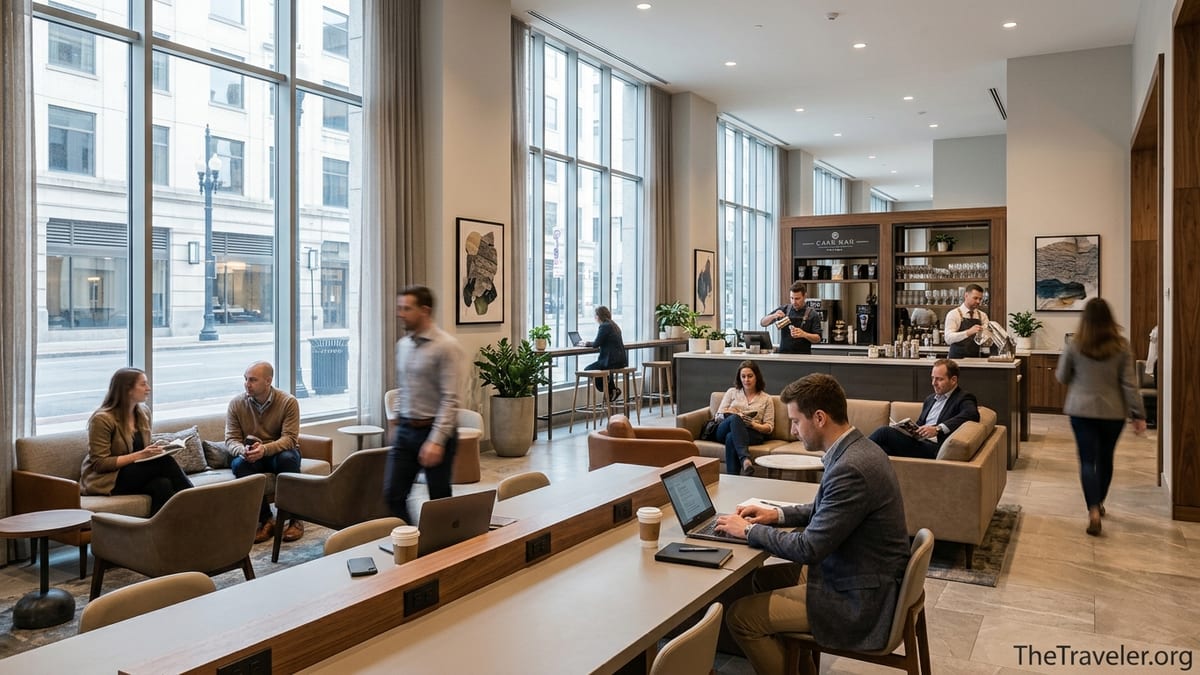
I checked into the Sheraton expecting beige. Beige hallways, beige ballrooms, a beige lobby full of rolling suitcases and exhausted business travelers. The brand, in my mind, belonged to the era of landline phones on the nightstand and crowded buffet breakfasts. What I walked into instead was a lobby buzzing with laptop-tapping locals, a café-bar hybrid that would not look out of place in a co-working space, and a guest room designed as much for remote work as for sleep. Somewhere along the way, Sheraton started to reinvent itself, and many travelers have not yet caught up.
Get the latest updates straight to your inbox!
How Sheraton Earned Its "Old Conference Hotel" Reputation
For decades, Sheraton was synonymous with big-box business hotels. Many properties were built in the 1970s through 1990s, and although they anchored convention districts and downtown skylines, renovation cycles often lagged behind newer competitors. Travelers swapping stories online still talk about Sheraton rooms with narrow bathtubs, heavy drapes and aging carpet that felt trapped in a different decade. In cities like Boston, for example, guests have described paying premium rates at legacy Sheraton properties only to find bathrooms and in-room technology that looked little changed from a decade earlier.
Part of the issue is scale. Sheraton is one of Marriott International’s most global brands, with more than 400 hotels across over 70 countries and territories. That reach made the brand instantly recognizable, but it also meant that quality and design could be inconsistent. In North America especially, frequent guests learned to approach Sheraton with caution: great locations and solid beds, but public spaces and guest rooms that sometimes felt like they had hosted one conference too many.
Against a backdrop of rising competition from lifestyle-focused brands and design-led independents, that reputation became a serious liability. Marriott’s own portfolio added sleeker options that made traditional Sheratons look tired by comparison. The brand needed more than a soft refresh; it needed a clear new identity that could appeal to a generation of travelers who expect their hotel lobby to double as a living room, office and neighborhood hangout.
What I did not realize before my stay is that Marriott has already been working on that problem for several years, quietly rolling out a transformation that is now starting to show up in a critical mass of properties around the world.
The New Sheraton Vision: Public Spaces as a "Community Square"
The surprise began the moment I walked through the doors. Instead of a traditional front desk flanked by silent seating, the lobby opened up into a kind of indoor plaza. At the Sheraton Phoenix Downtown, for example, the redesign centers the lobby around &More by Sheraton, a combined café, bar and grab-and-go market that functions from early morning espresso to late-night cocktails. Travelers answer emails at a long communal table, couples share flatbreads in lounge chairs, and local office workers drop in for a meeting over coffee.
This shift is not accidental. Marriott’s design teams have described the new Sheraton lobbies as “community squares,” where locals and guests share the same space. In practice, that means fewer tucked-away business centers and more open worktables with built-in power, screens that can be used for presentations or sports, and a mix of seating ranging from bar stools to deep sofas. At renovated properties like Sheraton Denver Downtown or Sheraton Centre Toronto, you can see this philosophy in action: the lobby feels closer to a well-designed co-working club than to the hushed, formal spaces Sheraton was once known for.
The hospitality concept follows the same logic. Rather than a single restaurant and a separate bar, the &More by Sheraton model centralizes food and beverage in the heart of the lobby. In Toronto, for example, the Sheraton Centre’s public spaces were reimagined with a market-style café and flexible lounge zones where you can grab a cappuccino at 8 a.m., plug in your laptop at 11 a.m., and order a glass of wine and small plates after work without ever moving more than a few steps.
That design focus on adaptability turns out to be a quiet game-changer. As a guest, you no longer have to choose between isolating yourself in your room or perching awkwardly at a bar table with your laptop. The lobby is designed for lingering, whether you are polishing a presentation, catching up with colleagues or simply people-watching between sessions at the convention center next door.
Inside the Rooms: From Tired Desks to Flexible Work-Life Layouts
The transformation is just as visible upstairs. One hallmark of older Sheraton rooms was the classic, bulky desk pushed against a wall under a mirror, paired with an office chair that seemed designed purely for late-night spreadsheet marathons. The new Sheraton guestroom flips that script. The brand’s updated rooms, which you will now find in properties from Jakarta’s airport hotel to new-builds in Japan, are built around flexible work surfaces, layered lighting and integrated power at nearly every perch.
In practical terms, that means a height-adjustable table that can serve as a desk, dining table or shared workspace, sometimes on casters so you can roll it closer to the window or the bed. Power outlets and USB ports appear where you actually need them: beside the sofa, next to the bed, embedded in the edge of the worktable. Wireless charging pads are increasingly common on bedside tables, eliminating the need to hunt for an adapter after a long flight.
The brand’s signature Sheraton Sleep Experience bed remains, but it is now framed by cleaner lines, softer headboard upholstery and lighting you can control in zones, from reading lights to ambient glow. In renovated rooms at hotels like Sheraton Phoenix Downtown, finishes tend toward neutral woods, stone-inspired surfaces and textured fabrics that feel contemporary without trying too hard to be trendy. Bathrooms, while varying by property, are gradually moving away from shower-tub combos toward walk-in showers with glass enclosures, larger mirrors and better task lighting, especially at flagship and fully renovated locations.
For remote workers and business travelers, these details matter. Being able to jump between a video call at the worktable, a quick email session from the sofa, and a late-night review in bed without juggling chargers or fighting bad lighting is the difference between a room that simply provides a bed and a room that actually supports how people live and work in 2026.
Real-World Examples: Phoenix, Denver, Toronto and Fort Worth
Some of the clearest examples of the new Sheraton identity can be found in cities that might not usually top leisure travelers’ wish lists. In Phoenix, the massive downtown Sheraton underwent a head-to-toe redesign that shifted it from a convention workhorse to a showroom for the brand’s new look. The lobby’s central bar-café, sculptural lighting and desert-inspired artwork immediately signal that this is not yesterday’s Sheraton. Walk a few steps from the front door and you will find locals using the space as a casual meeting spot long after the day’s sessions at the nearby convention center have ended.
In Denver, the Sheraton Denver Downtown completed a comprehensive renovation of its public areas, turning what had been a fairly standard meeting hotel into an attractive base on the city’s 16th Street Mall. The porte cochère, lobby, club lounge and signature bar were all reimagined. Guests now arrive into a space that feels more like a design-forward urban hotel than an anonymous convention property, with mountain-inspired textures, warm woods and large windows that connect the lobby to the city outside.
North of the border, the Sheraton Centre Toronto undertook a multi-year, multi-million-dollar makeover that finished in the early 2020s. Designers leaned into the idea of “globally local,” weaving Toronto references into artwork and materials. The lobby was opened up into a series of zones organized around reception, lounge seating and an &More café-bar, with a sculptural installation that nods to the city’s urban fabric. The result is a hotel that still serves conference crowds but also appeals to downtown professionals who use the lobby as an extension of their office.
Even secondary markets are seeing the shift. In Texas, the Sheraton Fort Worth Downtown reopened in 2024 after a roughly 50 million dollar renovation that refreshed guest rooms and public spaces in an “abstract Western” style. The investment effectively created what local tourism officials described as the equivalent of a brand-new hotel, giving Fort Worth’s convention district a more modern flagship and further proof that the Sheraton brand overhaul is not limited to a few showcase properties.
What This Means for Prices, Value and Expectations
With all this investment, it is fair to ask whether Sheraton’s rates have climbed beyond reach. In many cities, newly renovated Sheratons now sit comfortably in the upper-upscale bracket, often pricing slightly below luxury names but above select-service brands. In practice, that might mean seeing nightly rates that are competitive with full-service Marriott or Hyatt Regency hotels in the same market, especially during busy convention periods.
The value equation, however, can be surprisingly strong. Because Sheraton’s legacy reputation has not fully caught up with its new reality, some travelers still overlook the brand when comparing options. In downtown Phoenix, for instance, you can sometimes find the redesigned Sheraton priced similarly to or just below lifestyle competitors, while offering larger rooms, full meeting facilities and an expansive lobby that functions as a co-working hub. In Toronto or Denver, renovated Sheratons can come in slightly under luxury-branded neighbors while delivering a guest experience that feels far more current than the Sheraton name might suggest.
For loyalty members, the calculus is even more appealing. As part of Marriott Bonvoy, Sheraton participates fully in the points and elite-benefits ecosystem. That can translate into room upgrades, club lounge access where available, late checkout and points-earning at a brand that still sometimes prices like a workhorse but increasingly delivers a lifestyle feel. On a recent North American trip, frequent guests reported back-to-back suite upgrades at Sheraton properties in cities like Calgary, underscoring the brand’s continued positioning as a good value for elites compared with some of Marriott’s more in-demand luxury flags.
The key is to go in with calibrated expectations. Not every Sheraton has completed its renovation, and some older properties remain firmly rooted in their previous era. But when you identify one of the transformed hotels, you are often getting a level of design, comfort and amenity that would have seemed improbable at Sheraton a decade ago, often at a price that still reflects lingering skepticism.
How to Tell if a Sheraton Has Been Transformed
Because the brand-wide refresh is rolling out over time, you cannot assume that every Sheraton has adopted the new look and feel. Fortunately, a bit of research before booking can usually reveal whether a property is part of the transformation wave. Start by looking at recent photos of the lobby and guest rooms. If you see an airy lobby with a central café-bar, long communal tables, and a variety of modern seating zones, you are likely looking at a redesigned hotel. If the lobby photos show a traditional front desk flanked by rows of identical armchairs and heavy drapery, it may not yet have been updated.
Pay attention to renovation announcements or press references in the hotel description. Properties like Sheraton Phoenix Downtown, Sheraton Denver Downtown, Sheraton Centre Toronto, Sheraton Fort Worth Downtown or Sheraton Grand Nashville Downtown publicly highlight their renovations and often mention alignment with the new global Sheraton vision. In contrast, long-time Sheraton hotels that quietly changed flags or left the brand entirely in recent years, such as certain downtown properties in smaller U.S. cities, can be a hint that not every building fits the new strategy.
Guest reviews over the past 12 to 24 months can also be revealing. Travelers who have stayed at both old and new Sheratons are usually quick to note when a property “does not feel like a Sheraton anymore” in the best possible sense, praising brighter lobbies, better food options and thoughtfully updated rooms, while still pointing out the occasional legacy Sheraton where the lobby is the only modern touch. Look for consistent comments about contemporary design, comfortable workspaces and improved dining rather than a single glowing or critical review.
Finally, if you are booking as part of a conference or group, consider reaching out directly to ask when the last major renovation was completed. A hotel that has invested heavily in updating its lobby and rooms will usually be happy to say so, and a simple question can help you decide whether to stay on-site or consider a nearby alternative if design and comfort are priorities for your trip.
The Takeaway
I arrived at Sheraton expecting nostalgia. I left with the sense that the brand is quietly becoming one of the more interesting options in Marriott’s mainstream portfolio. The beige ballrooms and identical armchairs are not gone everywhere, but at an increasing number of properties they have been replaced by lively lobbies, flexible workspaces and guest rooms that feel tuned to how people travel now.
For travelers who wrote Sheraton off years ago, it may be time to take another look. In cities from Phoenix to Toronto and Fort Worth, the new Sheraton identity is already on display: open, social, built for laptops as much as luggage. You still need to be selective, because not every property has turned the corner, but when you land on one of the transformed hotels, the experience can be far better than the logo on the building might suggest.
If you are planning a trip where a central location, strong loyalty program benefits and all-day usable spaces matter, adding a renovated Sheraton to your shortlist is a smart move. You may still spot a few echoes of the past, but you are just as likely to find yourself, as I did, sipping a perfectly pulled espresso at a sleek lobby bar and wondering when Sheraton stopped feeling like yesterday’s hotel and started feeling surprisingly current.
FAQ
Q1. Are all Sheraton hotels now renovated to the new design standard?
Not yet. Many flagship and high-profile city properties have been transformed, but others are still operating with older designs while renovations roll out over time.
Q2. How can I quickly tell if a specific Sheraton has been updated?
Check recent lobby and room photos, look for mentions of a renovation in the description, and read reviews from the past year that highlight modern design and an active lobby bar-café concept.
Q3. Do renovated Sheratons cost significantly more than older ones?
Rates vary by city and season, but renovated Sheratons often price competitively with other full-service hotels. Sometimes they are only slightly higher than unrenovated properties in the same market.
Q4. Is Sheraton considered a luxury brand within Marriott Bonvoy?
No. Sheraton is generally positioned in the upper-upscale tier rather than luxury, sitting alongside brands like Marriott and Hyatt Regency competitors, with select properties designated as Sheraton Grand.
Q5. Are club lounges still common at Sheraton hotels?
Many larger Sheratons still operate club lounges, though offerings and opening hours vary. Some redesigned properties integrate more of the lounge-style experience into the main lobby and bar area.
Q6. What type of traveler is Sheraton now trying to attract?
The refreshed brand targets business and conference travelers, remote workers and leisure guests who value flexible workspaces, social lobbies and reliable full-service amenities.
Q7. Are renovated Sheratons good options for families on vacation?
Yes, especially in city centers and resort areas. Larger rooms, on-site dining, pools at many locations and lively lobbies can work well for families who want convenience and space.
Q8. How does the &More by Sheraton concept improve the guest experience?
It brings a café, bar and grab-and-go market into the lobby, so guests can easily get coffee, light meals or drinks throughout the day without hunting for separate outlets.
Q9. Do Sheraton rooms now have better in-room technology?
At renovated hotels you can usually expect more charging points, improved Wi-Fi, larger TVs and, increasingly, features like streaming capability or wireless charging pads.
Q10. If I had a disappointing Sheraton stay years ago, is it worth trying the brand again?
Yes, especially at properties that have recently completed renovations. The difference between older and updated Sheratons can be dramatic, so it is worth revisiting with careful property selection.