


Visiting Teide can be confusing because there are actually three different experiences that often get mixed together. First, you can visit Teide National Park by road, stopping at viewpoints and short trails without taking the cable car. Second, you can ride the Teide cable car from the base station on the TF 21 road up to La Rambleta at 3,555 metres, where there are short signposted paths to viewpoints. Third, and separate from both, is the final summit trail to the crater via the Telesforo Bravo path, which is strictly regulated and requires a special permit or, in some cases, a stay at the Altavista refuge. Understanding how these three levels work together is the key to planning a realistic, low‑stress visit.
Get the latest updates straight to your inbox!
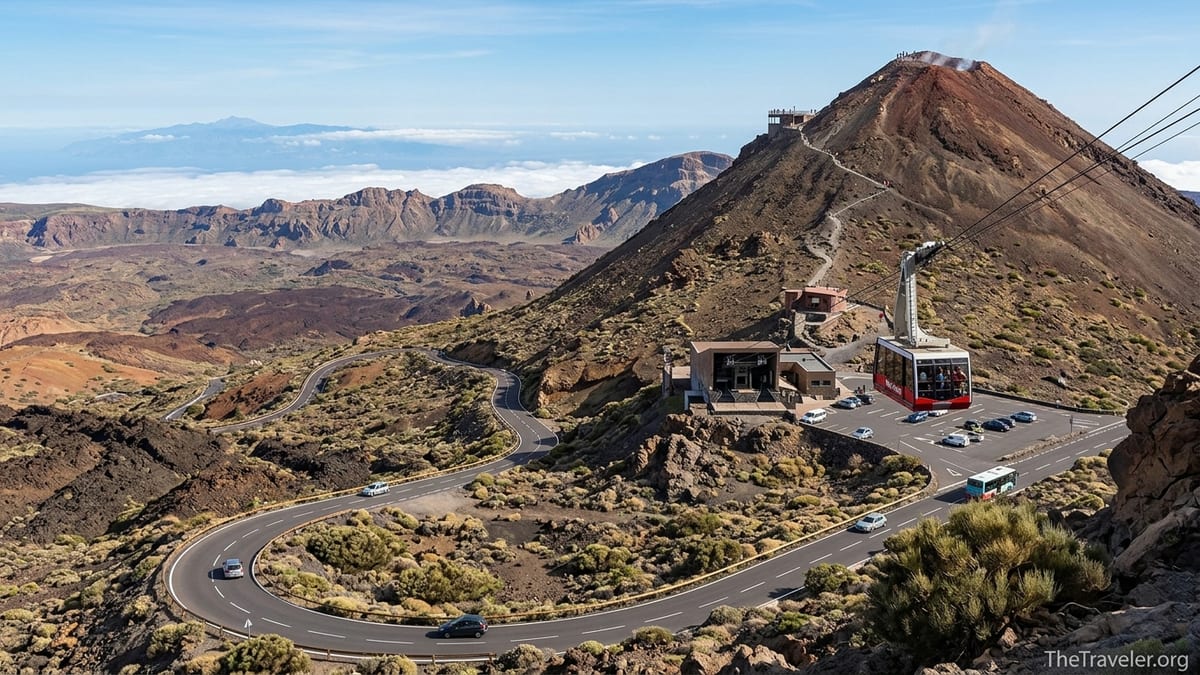
Park by Road, Cable Car and Summit: How the Pieces Fit Together
Teide National Park covers a large high plateau that you can visit free of charge by car or bus. The main TF 21 road crosses the park between La Orotava and Vilaflor, with multiple mirador viewpoints, short walks across lava fields and the Parador hotel area. You do not need any ticket or permit simply to drive through the park, use the public viewpoints or walk the shortest low‑level trails, although from early 2026 a small visitor fee, sometimes called an ecotax, has begun to apply to some regulated routes and parking areas. The fee structure is still evolving, so visitors should always check current rules shortly before travel.
Separate from general park access is the Teide cable car. It runs from a base station beside the TF 21 at about 2,356 metres to the upper station at La Rambleta around 3,555 metres, roughly 163 metres below the true summit. The ride takes about eight minutes inside large cabins carrying several dozen people, and it is the quickest way for most visitors to experience very high altitude in the park without a long hike.
The last component is the final summit cone. Access to the Telesforo Bravo trail from La Rambleta to the true peak of Teide is tightly regulated. A free but limited summit permit is required during daytime hours, and the number of people allowed up each day is capped. Since 2026, very early morning access is generally reserved for overnight guests at the refurbished Refugio de Altavista. You can ride the cable car and enjoy views from La Rambleta without this permit, but you cannot legally step onto the summit trail itself unless you appear on the day’s permit list or have a qualifying refuge booking.
This three‑tier structure explains why so much online advice seems contradictory. Someone who has driven through the park without problems may never have dealt with cable car tickets. Another visitor who rode the cable car may assume that automatically grants access to the summit, which is not the case. Treat park access, the cable car and the summit permit as three linked but separate decisions and you will avoid most surprises.
Cable Car Only Visit: Route, Timetable and What To Expect
The Teide cable car base station sits directly off the TF 21 road between La Orotava and Vilaflor, with its own car park, ticket office and basic services. Official descriptions put the base at around 2,356 metres. From here, cabins ascend in one span to the upper station at La Rambleta, about 3,555 metres above sea level. The ascent is fast, around eight minutes, and you will feel the change in altitude and temperature almost immediately as the cabin doors open at the top.
The upper station is compact and functional rather than a leisure complex. Expect indoor platforms, exits to the outside terraces and signposted paths, along with basic services rather than full restaurant facilities. From La Rambleta there is no direct, automatic access to the summit; instead you will find three main routes: two short, signed paths to viewpoints over the surrounding caldera and Pico Viejo crater, and the gated start of the Telesforo Bravo summit trail, where rangers check permits.
According to operator information checked in November 2026, the cable car normally operates daily from 9:00, with last lifts in the mid to late afternoon depending on season. Standard tickets are sold with a fixed outbound time slot, and adults can choose between return and one‑way options. As of autumn 2026, the published fare for a non‑resident adult return ticket is a little over forty euros, with lower prices for residents, children and one‑way travel, but fares are periodically revised and should be re‑checked before booking.
Operations are highly sensitive to weather. Strong winds, electrical storms, heavy snow or technical issues can stop the cable car on short notice at any time of year. In such cases, the line may either fail to open at all that day, or close during operating hours. If you are already at La Rambleta when an unexpected shutdown occurs, protocols usually aim to bring passengers down safely by cabin once conditions permit. However, in rare cases authorities can require fit, properly equipped hikers to descend on foot on marked trails if the line cannot operate for an extended period and conditions on the ground are safe enough. Travellers should treat the cable car as high‑mountain transport, not an urban elevator, and always build in a margin for weather‑related disruption.
Tickets and Booking: How and When To Reserve
In the current system, advance booking is strongly recommended and, for most days, functionally essential. The official sales channels emphasise online purchase with a chosen starting time. In busy holiday periods many morning and late morning slots sell out days or even weeks ahead, especially when combined with organised excursions. Afternoon slots can be easier to secure, but you should not assume that any particular time will remain available close to the date.
For 2026 the operator’s help materials highlight online booking as the primary method, with an electronic voucher or QR code scanned on arrival. You select a specific outbound time, and your boarding is tied to that slot rather than being an open ticket for any cabin. In practice, travellers are advised to arrive at the base station at least 20 to 30 minutes before their scheduled departure to allow for parking, walking to the building, potential queues and the identity or voucher checks required.
Same‑day ticket availability at the base station has become increasingly limited. Current guidance from Teide‑focused visitor information sites indicates that in high season the official channels either sell out in advance or restrict sales to online purchases only, with no traditional walk‑up ticket counter for unsold seats. During quieter shoulder periods some same‑day places may appear online early in the morning, and a minority of visitors still report buying tickets on the day, but this cannot be relied on. The realistic assumption for 2026 is that if you turn up without a prebooked slot, especially in mid‑morning, you may not be able to ride at the time you want or at all.
On boarding, staff generally scan your QR code or printed voucher and may request matching identification, especially for discounted resident tickets. The whole check‑in process is straightforward but can feel rushed in busy periods. It is worth having your documents ready and understanding that your time at the top is not unlimited; many ticket conditions mention a recommended maximum stay around one hour at La Rambleta, both to manage crowding and because of altitude. While staff are not usually timing individuals with a stopwatch, you should plan your visit with this indicative window in mind.
Summit Permit Explained: Telesforo Bravo Rules and Enforcement
The Telesforo Bravo trail, officially numbered PNT 10, is the only legal route from La Rambleta to the true summit of Teide. Because this section is short but very sensitive, access is strictly controlled. Under the regulations checked in late 2026, visitors must hold a specific summit permit for a defined two‑hour window, carry identification that matches the permit and respect time limits. Permits are obtained through the official reservation system operated under the authority of the park managers and regional environment ministry.
The latest written rules describe four daytime access windows, typically 9:00 to 11:00, 11:00 to 13:00, 13:00 to 15:00 and 15:00 to 17:00, although exact clock times can vary slightly with season and operational constraints. Only a limited number of people are allowed per window, and permits are free but heavily booked, especially in popular months. Regulations explicitly state that you must not hold overlapping permits for the same person in multiple time slots. Some earlier documents also prohibited holding more than one permit in a week for the same individual; this wording appears in older English translations, but more recent Spanish‑language resolutions focus on preventing duplicate bookings for the same day. Because the official texts are being updated alongside wider reforms to Teide management, travellers should always verify the current cap on how many permits one person can hold.
Crucially, rangers enforce the permit system at a checkpoint very close to the start of the Telesforo Bravo path above La Rambleta. Even if the gate is visible and the trail looks quiet, you will not be allowed to pass without your name appearing on the permit list for that particular time slot and with matching identification. A cable car ticket alone does not grant summit access. Rangers can and do turn back visitors without the correct paperwork, and fines are possible for breaching protected‑area rules.
There has historically been a second category of access covering very early morning summit ascents outside cable car hours, usually from 6:00 to 9:00, associated with mountaineering activity or overnight stays at the Altavista refuge. As of November 2026, public statements from the Cabildo of Tenerife and the refuge operator indicate that early‑morning summit access is now effectively reserved for registered refuge guests as part of a combined system intended to reduce uncontrolled night traffic on the mountain. The precise legal language is still being harmonised in official regulations, so the safest approach for would‑be sunrise visitors is to consult the current refuge conditions and park rules rather than rely on older online anecdotes.
Altavista Refuge and Alternative High‑Altitude Experiences
The Refugio de Altavista, at around 3,260 metres on the slopes of Teide, is the only staffed mountain refuge in the national park. After several years of closure for refurbishment, it reopened in July 2026 with upgraded facilities and a renewed role in managing summit access. The refuge is reached on foot, typically via the Montaña Blanca trail, and offers basic overnight accommodation for trekkers comfortable at high altitude.
According to reopening statements in mid‑2026 and current booking information, an overnight stay at Altavista now usually includes the authorisation needed to complete the final ascent to the summit via Telesforo Bravo very early the next morning, within a defined time window before regular daytime permits begin. In practice, this means refuge guests who are properly booked and registered can hike up from Montaña Blanca in the afternoon or evening, rest for a few hours at the refuge, and then continue to the summit for sunrise under controlled conditions, descending either on foot or later by cable car once it opens. The exact mechanics of how the refuge booking integrates with the permit system, including whether a separate application is still required, depend on the latest park management agreements and should be verified at the time of planning.
For visitors who either cannot or do not wish to secure a summit permit, the cable car upper station still provides a rewarding high‑altitude experience. From La Rambleta, two short signposted paths lead to viewpoints that do not require the summit permit in normal conditions. One path heads towards the Pico Viejo viewpoint, where on clear days you can see the vast multi‑coloured crater and, beyond, the south and west coasts of Tenerife and neighbouring islands. Another route leads to the La Fortaleza viewpoint, with panoramas towards the northern slopes and Las Cañadas plateau. These walks are relatively short but feel demanding because of the altitude and uneven volcanic terrain.
Access to these side paths can occasionally be restricted because of ice, snow, maintenance or elevated volcanic gas levels, particularly in winter or after storms. As of November 2026, there is no standing ban on walking to the Pico Viejo and La Fortaleza lookouts, but intermittent closures continue to be reported. Visitors should therefore treat the ability to reach specific viewpoints as weather dependent and confirm local conditions at the top station on arrival.
Practical Tips, Weather and Safety at High Altitude
La Rambleta sits at around 3,555 metres, and even the cable car base station is at over 2,300 metres. At these elevations the air is significantly thinner, temperatures are lower and ultraviolet exposure is stronger than at sea level. Many visitors notice mild shortness of breath, faster heartbeat or lightheadedness when they first arrive at the upper station, especially during the short walks to the viewpoints. These symptoms are usually temporary but can feel unsettling if you have never experienced altitude before.
To stay comfortable, plan your cable car trip much as you would a short high‑mountain excursion rather than a city attraction. Dress in layers with a warm top, windproof outer layer and long trousers, even on sunny days. Sturdy closed shoes with good grip are preferable to sandals, as the paths are rocky and sometimes dusty or icy. Pack drinking water and a snack; while there are basic services at the base and occasionally at the upper station, you should not rely on them as your only supply. Sunglasses, a hat and high‑factor sunscreen are highly recommended because reflection from pale lava and, in winter, snow can be intense.
The cable car operator and park authorities suspend operations in severe or even moderate adverse conditions, including high winds, storms and heavy snowfall. Autumn and winter 2026, for example, have already seen temporary closures during Atlantic storms that brought snow to the caldera. These decisions are safety driven and can be taken with little notice. Anyone planning a Teide visit that depends on the cable car should check for closure notices on the morning of travel through official channels or reliable local news outlets and be ready to switch to a road‑only visit or alternative day if necessary.
Visitors with pre‑existing heart or respiratory conditions, pregnant women and the parents of very young children should pay particular attention to the health warnings associated with rapid ascent to high altitude. In current safety advice, the cable car operator discourages or restricts access for people with serious cardiovascular or respiratory illnesses, pregnant women and children under three years old, as well as for some categories of reduced mobility, because of the combination of height, steep terrain and potential evacuation scenarios. If in doubt, seek medical guidance before booking.
Accessibility and Mobility Considerations
From an engineering perspective the Teide cable car is relatively accessible: the base and upper stations are equipped with lifts and level platforms to allow people with limited mobility to board the cabins. However, information from the operator and practical reports from recent seasons make clear that the overall experience is only partly accessible, and conditions at the upper station and surrounding paths can be challenging.
At the base station, designated parking spaces and ramp access are generally available, and staff can assist with boarding. The cabins are large enough to accommodate some mobility aids, though bulky electric wheelchairs may need special arrangements or may not be accepted, depending on current policies. The ride itself is smooth but includes one relatively quick vertical gain, which can affect anyone sensitive to pressure or altitude changes.
The main limitation comes once you arrive at La Rambleta. The immediate station area includes viewing terraces that may be reachable with careful assistance, but the signposted paths to Pico Viejo and La Fortaleza viewpoints are on uneven, often narrow volcanic trails with significant gradients. They are not suitable for standard wheelchairs or for people who cannot manage steep, rocky surfaces on foot. Current official descriptions say that people with reduced mobility can enjoy the views from the upper station terraces but may not be able to access the viewpoints beyond.
Because policies can change as facilities are upgraded, travellers with specific needs should check the latest accessibility details directly with the cable car operator before purchase, including whether a companion ticket policy applies and what happens in case of weather‑related stoppages. It is important to balance the desire for the high‑altitude experience against the practical realities of moving around safely at over 3,500 metres on exposed terrain.
If Your Trip Is Cancelled or the Weather Turns
Weather‑related closures are an unavoidable part of Teide’s cable car operations. Updated guidance in 2026 from official and semi‑official channels explains that if the cable car does not operate at all on the date and time of your ticket because of adverse conditions or technical problems, you are typically entitled to choose between a refund and rebooking, according to the terms stated at the time of purchase. If only part of the day is cancelled, policies can be more nuanced, for example allowing rebooking for passengers whose time slots were directly affected.
Because the exact wording of refund and change conditions can vary between the official operator and third‑party resellers, and may be updated without wide publicity, travellers should read the conditions attached to their specific ticket at purchase time and keep a copy. Booking directly with the operator usually offers the clearest route for resolving any disruption. If you bought as part of a tour, the tour company’s own terms on cancellations and substitutions will also apply.
Situations where the cable car closes unexpectedly while you are already at the upper station are less common but deserve serious thought. In most cases, staff suspend boarding temporarily and resume service once winds ease or technical checks are complete, prioritising a safe, orderly descent. Only in more exceptional scenarios where the line cannot run for an extended period and weather on the ground remains manageable might authorities instruct suitably equipped visitors to descend on foot via established trails under ranger supervision. The practical risk of being forced into a long emergency hike is low but not zero, and it is another reason why sturdy footwear, warm clothing and basic fitness are advisable even for a “simple” cable‑car visit.
In all cases, do not attempt to circumvent closures or ignore ranger instructions. Teide is a high mountain with rapidly changing weather and fragile volcanic terrain. Respect for signage and staff guidance keeps both individual visitors and the environment safer. If your prebooked visit is disrupted, consider it part of the reality of travelling in an alpine environment and, if possible, build an extra day or two into your Tenerife itinerary to give yourself flexibility.
Which Teide Experience Suits You: A Simple Decision Guide
Most visitors to Tenerife will fall into one of three broad categories when planning Teide. The first group want scenic views and a sense of the volcanic landscape without altitude extremes. For them, a park‑by‑road visit is ideal. Driving or taking a bus along TF 21 and nearby routes, stopping at miradors, the Roques de García and the Parador area, already offers striking views of the volcano and the surrounding caldera. This option works well in questionable weather because roads may remain open even when the cable car has to close.
The second group are comfortable with high altitude but do not feel the need to stand on the absolute summit. For these travellers, a park visit plus cable car ride to La Rambleta is the best balance. It delivers the drama of 3,500 metres, wide views to other islands and short, memorable walks to Pico Viejo or La Fortaleza viewpoints without the permit logistics and stricter time windows of the summit trail. This choice suits families with older children, reasonably fit adults and photographers who value dramatic horizons more than the last 163 vertical metres.
The third group dream specifically of reaching Spain’s highest point. For them, the park plus cable car plus summit hike combination, or a full ascent that includes an overnight at Altavista, is worth the extra planning. These travellers need to be flexible, prepared to book summit permits or refuge beds months in advance when possible, and ready with backup dates in case of weather. They should also be comfortable walking steep paths at high altitude and strictly respecting park rules.
Whichever category you fit, start by deciding how important the summit itself is compared with simply experiencing Teide’s landscapes. Then check the current cable car timetable, ticket availability and summit access rules as close as possible to your travel dates. With realistic expectations and an understanding of the separate systems for park access, cable car operations and summit permits, Teide can be one of the most rewarding and memorable days of a Tenerife trip.