


Even if you have never been to the French Riviera, you have probably seen the Palais des Festivals in Cannes. The broad flight of red-carpeted steps, camera flashes, and evening gowns have become global shorthand for movie-star glamour. Yet for many travelers, this massive waterfront building is still a mystery. Is it a museum, a theater, or just a backdrop for the Cannes Film Festival? In reality, the Palais is all of those things and more, and it plays a crucial role in the cultural and business life of Cannes all year long.
Get the latest updates straight to your inbox!
What Exactly Is the Palais des Festivals in Cannes?
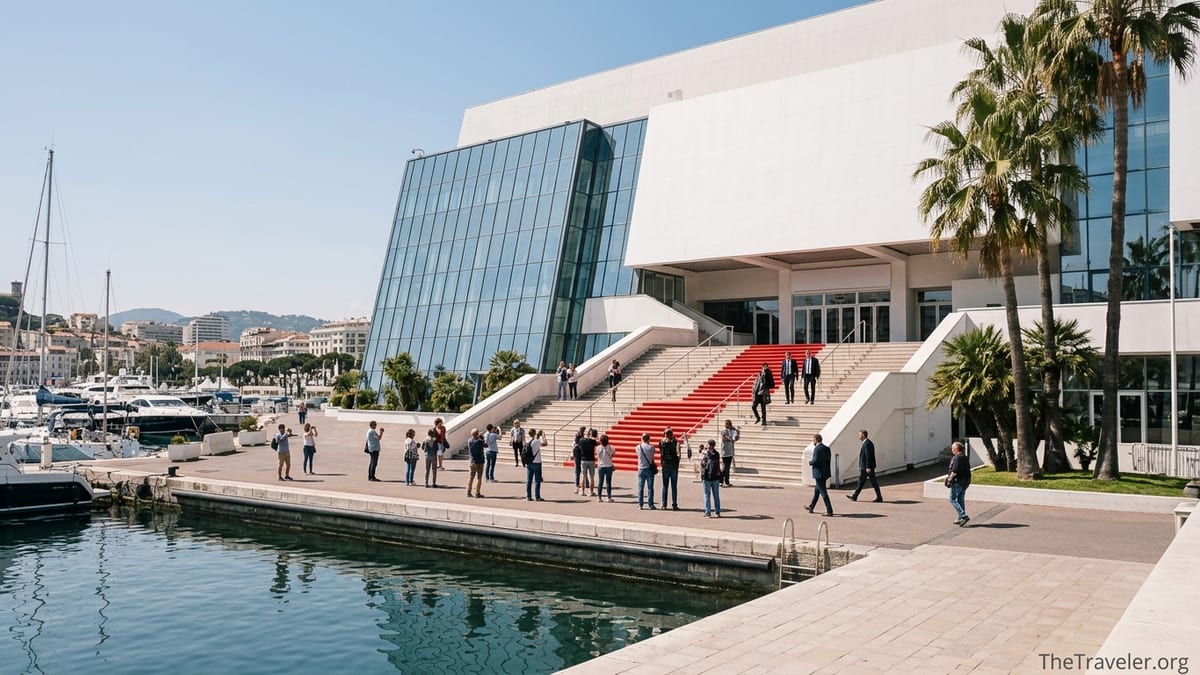
The Palais des Festivals et des Congrès is a large convention and events center that sits at one end of the seafront boulevard La Croisette in Cannes. It is the main venue of the Cannes Film Festival, and its Grand Auditorium Louis Lumière is where the festival’s biggest premieres and closing ceremony take place. From the outside, the building is a low, angular structure in glass and white concrete, with its most recognizable feature being the broad staircase where the red carpet is rolled out during major events.
Inside, the Palais is closer to a compact campus than a single hall. It contains several auditoriums of different sizes, exhibition spaces, press rooms, meeting rooms, and rooftop terraces looking over the Old Port and the Bay of Cannes. During the film festival, badge holders weave through these corridors between screenings, industry meetings, and press conferences. At other times of the year, the same spaces host trade shows, music events, gaming festivals, and business congresses.
For the city of Cannes, the Palais is the engine that powers its position as a year-round destination, not just a resort that sleeps through the winter. On a random March weekday, you might walk past real-estate executives attending MIPIM, one of the world’s biggest property fairs, or advertising professionals in town for Cannes Lions in June. The building is managed on behalf of the city and is considered the largest public facility in the Alpes-Maritimes region, designed to attract international events that keep hotels, restaurants, and local services busy beyond the summer high season.
Travelers often discover that the Palais is much more accessible than its glamorous TV image suggests. Outside the dates of the biggest events, anyone can walk right up the steps, peek into the main lobby, and explore the esplanade around it. Local families use the seafront promenade beside the Palais as a place for evening walks, teenagers skateboard on the smooth paving nearby, and cruise-ship passengers snap photos on what might be the most photographed staircase in modern cinema history.
A Brief History: From Seaside Casino to Global Icon
The story of the Palais begins with the creation of the Cannes Film Festival itself. The festival’s first official edition was held in 1946, when screenings took place in the city’s former municipal casino on the Croisette. As the festival’s reputation grew over the following years, Cannes needed a permanent home that could cope with guests, screenings, and the emerging film market. In 1949, the first Palais des Festivals was built on the site where a major seafront hotel now stands, and it served as the festival’s base for several decades.
By the 1960s and 1970s, Cannes had started to attract other major professional events, including early television and music markets. The existing building could not keep up with the demand. In 1979 the city decided to construct a much larger, dedicated complex at the western end of the Croisette, beside the old harbor. The new Palais, designed by architects François Druet and Sir Hubert Bennett, opened in the early 1980s and has hosted the Cannes Film Festival since 1983. Its stark, blocky look earned it the nickname "the Bunker" among early festival-goers, but it was a practical solution for a rapidly expanding event.
Over the years, the Palais has been continually updated to keep pace with technology and expectations. Its flagship Grand Auditorium Louis Lumière, which seats roughly 2,300 people, has been equipped with high-end projection and immersive sound systems that meet the standards demanded by filmmakers premiering their work. For example, the hall has been upgraded to advanced surround formats so that world premieres play with sound quality comparable to or better than top-tier cinemas in major cities. For directors unveiling a film they spent years making, this technical reliability is one of the reasons Cannes remains such a prestigious launchpad.
The building has also been reworked to be brighter and more environmentally efficient, with a reorganized glass roof and redesigned interiors. These renovations were not just cosmetic. They helped Cannes compete with other global convention destinations by offering daylight-filled foyers, flexible halls, and energy performance that appeals to companies under pressure to reduce the footprint of their events.
Why the Palais Became World Famous
The main reason the Palais des Festivals is known worldwide is simple: it is the physical stage of the Cannes Film Festival. Every May, images of celebrities climbing its 24 steps on a long red carpet are broadcast across news channels and entertainment programs. When photographers shout for stars to turn and pose, they are doing it right at the top of this staircase. From a distance, the Palais is often just a background blur behind gowns and tuxedos, but it is the host that makes the festival logistically possible.
During the festival, the Palais turns into a hive of activity that goes far beyond the famous premieres. Inside, the Marché du Film, one of the world’s most important film markets, takes over multiple levels. Buyers from streaming platforms and distributors hold meetings in temporary offices and booths. Posters of upcoming films line the walls, from art-house dramas to genre pictures hoping to find international partners. A small indie producer might sit at a modest stand, pitching a project set in rural India, while across the hall a major studio team negotiates release strategies for its next tentpole. All of this happens inside the Palais, while the red carpet drama plays out just a few meters away.
The venue is also where the festival’s most significant prizes are handed out, including the Palme d’Or for best film. This trophy, crafted by a luxury jewelry house and often described in media reports for its golden palm leaf design, has become one of cinema’s most coveted honors. When a director like Bong Joon-ho or Julia Ducournau has walked on stage to accept the Palme d’Or in recent years, they have done so in the Grand Auditorium of the Palais, under its distinctive ceiling lights and in front of a densely packed audience of filmmakers and journalists.
Outside of festival weeks, the Palais still appears in headlines because of the events it hosts. For example, in March the MIPIM real-estate fair brings tens of thousands of property professionals to Cannes, filling the exhibition halls with scale models of new office towers and waterfront developments. In June, Cannes Lions draws global advertising agencies and big brands to celebrate creativity in marketing, with talks and awards in the same auditoriums where art-house masterpieces compete in May. Music and television industry markets such as MIDEM or MIPTV have also used the Palais as their base, reinforcing its image as a crossroads for global media and business.
Inside the Building: Spaces, Technology, and Design
For visitors lucky enough to step inside during an event, the Palais can feel like a maze. The Grand Auditorium Louis Lumière is the heart of the building, with steeply raked seating and a screen large enough to make even wide-format films feel immersive from the back rows. On a festival night, guests in tuxedos and evening dresses enter through the main foyer, climb a set of interior stairs, and queue at security checkpoints before finding their allocated seats. Ushers in formal attire guide people to their row, while television crews set up at the back to capture the moment a director walks in.
Other major spaces include the Debussy Theatre, used for certain festival sections and many conferences, and large exhibition halls known as Riviera and Rotonde, where stands and pavilions are assembled during trade fairs. A tech start-up exhibiting at a content market might rent a small stand in one of these halls, install demo screens and banners, and hold back-to-back meetings from breakfast until late afternoon. The building’s layout allows organizers to separate closed-door meetings, big keynote sessions, and press areas while still keeping them within walking distance.
Recent press information from the Cannes convention bureau highlights upgrades aimed at sustainability and comfort: LED lighting, refined air-conditioning systems, and waste-reduction programs during large-scale events. For instance, organizers of a medical conference might opt for eco-certified catering supplied through the Palais, while exhibitors at a tourism fair are encouraged to use reusable stand components rather than single-use structures. These behind-the-scenes details do not show up in glamorous photographs, but they matter to corporate clients choosing between Cannes and rival destinations.
Architecture enthusiasts sometimes criticize the Palais for lacking the Belle Époque charm of the grand hotels that line the Croisette. Yet many visitors come away impressed by its position and functionality. Standing on one of the terraces during a break, you can look one way toward the old quarter of Le Suquet, with its church and fortified tower, and the other way down the palm-lined curve of the Croisette, flanked by luxury boutiques and beach clubs. For photographers, sunset from the Palais terraces offers a chance to capture the harbor’s yachts and the Lérins Islands beyond, even when no one famous is in sight.
How Travelers Can Experience the Palais Today
One of the most common questions first-time visitors have is whether they can go inside the Palais. The answer depends on timing. During the Cannes Film Festival or large-scale trade fairs, access to the interior is restricted to accredited guests, exhibitors, and staff. Security checkpoints and badge controls are in place at every entrance. However, throughout most of the year, parts of the building and the outdoor spaces around it are open to the public, often free of charge.
On a regular day outside major events, you can walk right up the famous staircase, which usually has simple stone steps when the red carpet is not in place. Many tourists use this as an impromptu photo studio, re-creating film posters or pretending to talk to invisible photographers. Inside the main lobby, you may find temporary exhibitions related to cinema or local culture, such as displays honoring well-known directors or installations created for a short-term "pop-up" museum of film. Information counters in the lobby can provide schedules of upcoming public events, including concerts, theater performances, or game festivals that sell tickets to the general public.
Prices for public shows at the Palais vary widely. A contemporary dance performance in one of the smaller theaters might cost around 30 to 50 euros, which is similar to a mid-range night out at a Paris theater. Tickets for a classical music concert during a local festival could be slightly higher for prime seats, especially if a well-known orchestra is playing. For trade fairs and congresses, registration fees are much steeper, usually ranging from several hundred to over a thousand euros for multi-day professional access, which is why those events are primarily aimed at industry participants rather than casual tourists.
If you visit Cannes in winter or early spring, check the city’s cultural program to see if the Palais is hosting any public performances. It is increasingly used for regional events, from comedy festivals to e-sports competitions. A young traveler might find themselves watching a European video-game tournament on the same stage where Palme d’Or winners are announced in May. This dual life as both a local cultural venue and a global showcase is part of what makes the Palais unique.
Red Carpet Culture: Dress Codes, Security, and Atmosphere
The red carpet at the Palais is not just a photo backdrop. It is a carefully managed ritual that sets the tone of the Cannes Film Festival. Screening invitations specify dress codes that are enforced at the door, especially in the evening. For gala premieres in the Grand Auditorium, guests are typically required to wear formal attire such as tuxedos or dark suits for men and evening dresses for women. Over the years, there have been public debates about how strictly these rules are applied, particularly around shoe styles, with some reports of guests being turned away for wearing flats instead of high heels during previous festivals.
Security at the Palais during major events is tight, especially since the mid-2010s. Bag checks, metal detectors, and multiple accreditation controls are the norm. Visitors with market accreditation, for example, often go through scanners every time they enter from the seaside esplanade or the street-level entrance. The visible police presence around the building increases sharply during the festival, and entire lanes of traffic on the adjacent streets can be shut or diverted to protect crowds gathering outside the steps.
For travelers, this can make Cannes feel like a small city temporarily taken over by its most famous building. Hotel lobbies turn into informal meeting spots for producers, local cafés near the Palais fill with people wearing lanyards, and even fast-food outlets across the street see long lines of festival-goers grabbing a quick meal between screenings. Many first-time attendees are surprised to discover that they barely see the rest of the Riviera during the festival because their days are locked between the Palais, nearby cinemas, and late-night conversations at bars favored by industry regulars.
Outside festival weeks, the atmosphere is much more relaxed. Couples stroll hand in hand past the Palais at sunset, street performers play guitar or juggle near the harbor, and cruise passengers disembark from tenders just in front of the building. Even then, some of the red carpet mystique lingers. Children run up and down the steps, imitating stars, while parents take pictures and imagine what it must feel like when the lights of the world’s media are focused on this same spot.
Planning Your Visit: Practical Tips Around the Palais
The Palais sits at a practical crossroads for Cannes visitors. On one side is the Old Port, with ferries to the Lérins Islands and moorings for everything from small sailboats to superyachts. On the other is the start of La Croisette, lined with luxury hotels, designer boutiques, and private beach clubs. Directly inland are the main shopping streets and the train station, putting the Palais at the center of most walking routes through town.
Accommodation prices in Cannes swing dramatically depending on whether a major event is taking place at the Palais. During the film festival in May, hotel rates can multiply several times compared with a normal week in March or November. A room in a three-star hotel that might cost around 120 euros in the low season could climb to several hundred euros per night once red carpet season begins, and many properties require multi-night minimum bookings. Apartments listed on rental platforms often follow the same pattern. Travelers who are not attending the festival but simply want to see Cannes are wise to avoid those peak dates and aim for shoulder seasons instead.
Food options near the Palais range from quick-service chains to smart brasseries with harbor views. Some festival veterans jokingly refer to the fast-food restaurant opposite the building as an unofficial canteen for badge holders who do not have time for a sit-down lunch between screenings. If you are visiting outside major events, you will find it easier to linger at outdoor tables on the Quai Saint-Pierre, sampling seafood platters or a simple salade niçoise while looking up at the façade of the Palais and watching the stream of people along the promenade.
For a quieter perspective, walk behind the Palais toward the Esplanade Pantiero, a wide open space between the building and the harbor. From here, you can photograph the Palais without the usual crowds of the front steps, especially early in the morning. Then, continue up into the historic Le Suquet district for a hilltop view of the entire bay. Looking down from the old town, the Palais appears as a bright, angular block that anchors the waterfront, making its role in the city’s landscape as obvious as its role in its economy.
The Takeaway
The Palais des Festivals in Cannes is much more than a building with a red carpet. It is a working convention center, a cultural venue, and the beating heart of one of the world’s most influential film festivals. Its history is closely tied to the rise of Cannes from a seaside resort to a global meeting place for cinema, music, television, advertising, and high-end business events.
For travelers, the Palais offers several layers of experience. From the outside, you can climb the steps, pose for a photo, and soak up the view without spending a cent. With a bit of planning, you might attend a concert, a performance, or even a smaller festival inside its halls and see the building functioning beyond its most famous ten days in May. And if you happen to be in Cannes during a major event, simply walking the streets around the Palais will give you a sense of how powerfully one venue can shape the rhythm and identity of an entire city.
FAQ
Q1. What is the Palais des Festivals best known for?
The Palais des Festivals is best known as the main venue of the Cannes Film Festival, where red carpet premieres and the Palme d’Or ceremony take place each May.
Q2. Can anyone walk up the famous red-carpet steps?
Outside major events, the steps are generally open to the public and often uncovered, so visitors can freely walk up and take photos. During festivals and big congresses, access may be restricted or partially closed for security.
Q3. Is it possible to visit the inside of the Palais des Festivals without accreditation?
Access to the interior is usually limited to ticket holders or accredited participants when events are running. However, at quieter times or during public cultural programs, parts of the building such as the main lobby and theaters may be open to anyone who has bought a ticket for a show.
Q4. Are there guided tours of the Palais des Festivals?
Guided tours are occasionally organized in partnership with the local tourism office, especially outside peak festival periods, but they are not guaranteed every day. It is best to check current information with Cannes tourism services or at the Palais reception desk once in town.
Q5. How much does it cost to attend an event at the Palais?
Prices vary widely. Public performances like concerts or plays can start at around a few dozen euros per ticket, while professional congresses or trade fairs typically charge several hundred euros or more for multi-day passes aimed at industry participants.
Q6. Is the Palais des Festivals used only for film events?
No. Although it is most famous for the Cannes Film Festival, the Palais also hosts real-estate fairs, music and television markets, advertising and creativity festivals, board-game and entertainment events, and a wide range of corporate congresses and local cultural shows.
Q7. What is the best time of year to see the Palais without crowds?
Outside the big international events in spring and early summer, the atmosphere around the Palais is calmer. Visiting in late autumn, winter, or early spring usually means fewer crowds and easier access to the steps and seafront promenade.
Q8. How do I get to the Palais des Festivals from the Cannes train station?
The Palais is within easy walking distance of Cannes train station. The walk takes roughly five to ten minutes, mostly along flat streets, and brings you directly to the front of the building and the harbor.
Q9. Can you see celebrities at the Palais outside the Cannes Film Festival?
Occasionally, yes. High-profile congresses, music events, or award shows sometimes bring well-known business figures, artists, or performers to the Palais. However, the intense celebrity presence is mainly concentrated around the film festival in May.
Q10. Is the Palais des Festivals accessible for visitors with reduced mobility?
The building is equipped with ramps, elevators, and reserved seating areas designed for visitors with reduced mobility. During major events, staff are usually available to assist with access to auditoriums and to help guests navigate security checkpoints.