


At first glance, the Palais des Festivals et des Congrès in Cannes can feel almost unreal. Its sharp, modernist lines rise above the palm trees and superyachts, fronted by that famous red-carpet staircase where, every May, the world’s most photographed people pause beneath a wall of flashbulbs. Yet behind this glamorous facade is a surprisingly turbulent story of cancelled editions, temporary venues, political protests and architectural reinvention. For travelers, understanding how this building came to embody the Cannes Film Festival adds an extra layer of magic to any stroll along the Croisette.
Get the latest updates straight to your inbox!
From Riviera Resort to World Cinema Capital
Long before the Palais des Festivals existed, Cannes was a quiet Riviera town best known for wintering European aristocrats. Its transformation into a global film capital began in the late 1930s, when French officials, frustrated that the Venice Film Festival had drifted into fascist propaganda, proposed an alternative event dedicated to cinematic freedom and artistic exchange. Plans were drawn up for an international film festival in Cannes, with a new palace to host it, and a first edition was set for September 1939. History intervened: Germany invaded Poland and the Second World War broke out just days after the opening night’s symbolic festivities, and the festival was abruptly abandoned.
It was only in 1946, in the fragile optimism of the postwar years, that the first full Cannes Film Festival finally took place, initially using makeshift spaces along the waterfront rather than a permanent palace. The success was immediate. Filmmakers and stars flocked to the Croisette, and Cannes quickly gained a reputation as a “world showcase” for cinema, playing a similar role to what fashion weeks do for haute couture. For travelers today, that early improvisation is easy to forget when they see the imposing current building; nothing about those early festivals suggested the town would one day need a convention complex large enough to host tens of thousands of accredited professionals every spring.
The first dedicated Palais des Festivals opened in 1949 on the site of the former Cercle Nautique, near today’s beachfront hotels. Contemporary accounts describe it as elegant but modest by today’s standards, with a main auditorium, terrace and a small number of screening and reception rooms. It was nicknamed Palais Croisette after the boulevard that runs past it, and for almost four decades it was the physical heart of the festival, anchoring the glamour of evening premieres and daytime market screenings in a single seafront building.
As global filmmaking expanded in the 1950s and 1960s, however, the Palais Croisette began to feel cramped. Each year more producers arrived to sell films in what would become the Marché du Film, the professional market that now turns the festival into a crucial business hub. By the late 1970s, festival organizers and the city council were confronting a simple reality: if Cannes wanted to remain the premier global film showcase, it needed a new, much larger palace.
From Palais Croisette to the Modern “Bunker”
The decision to build a new Palais des Festivals on the site of the old municipal casino marked a turning point both for the festival and for Cannes itself. Following an international architectural competition, work began in 1977 on a stark, contemporary complex designed by Hubert Bennett and François Druet. The new building, which opened with the 1983 festival, offered substantially more space: a vast main theater, multiple screening rooms, meeting halls and exhibition levels to accommodate the exploding Marché du Film and the growing number of side events.
Compared with the Belle Époque hotels lining the Croisette, the new structure was unapologetically modern, all sharp angles and white stone. Locals quickly nicknamed it “le bunker” for its blocky profile. Some cinephiles still wax nostalgic about the more intimate Palais Croisette, which was demolished in 1988, but for the festival’s operations there was no going back. Where the older building had struggled with queues and outdated equipment, the new Palais brought large foyers, better sound and projection, and a layout intended to serve both glamorous premieres and serious business meetings.
For visitors today, that architectural choice has practical consequences. The main Grand Auditorium Louis Lumière, which anchors the complex, seats more than 2,000 people and is the stage for the festival’s evening red-carpet premieres and award ceremonies. When you see televised images of stars climbing the iconic staircase in tuxedos and gowns, they are heading into this room. During the rest of the year, the same auditorium might host a corporate keynote during the Cannes Lions International Festival of Creativity, a major TV drama premiere during Canneseries, or a concert or ballet performance during local cultural seasons.
The surrounding interior spaces underscore how the building was designed to function as a year-round convention hub rather than a single-purpose cinema. Travelers attending non-film events such as MIPCOM, a television content market, or Tax Free World Exhibition, a duty-free and travel retail trade show, will find the same maze of escalators, terrace levels and exhibition halls that producers and distributors navigate during the Marché du Film in May. The Palais’ ability to switch from a red-carpet gala to a tech trade fair in a matter of days is a direct legacy of that 1970s planning.
Inside the Palais: Spaces, Screens and Star Entrances
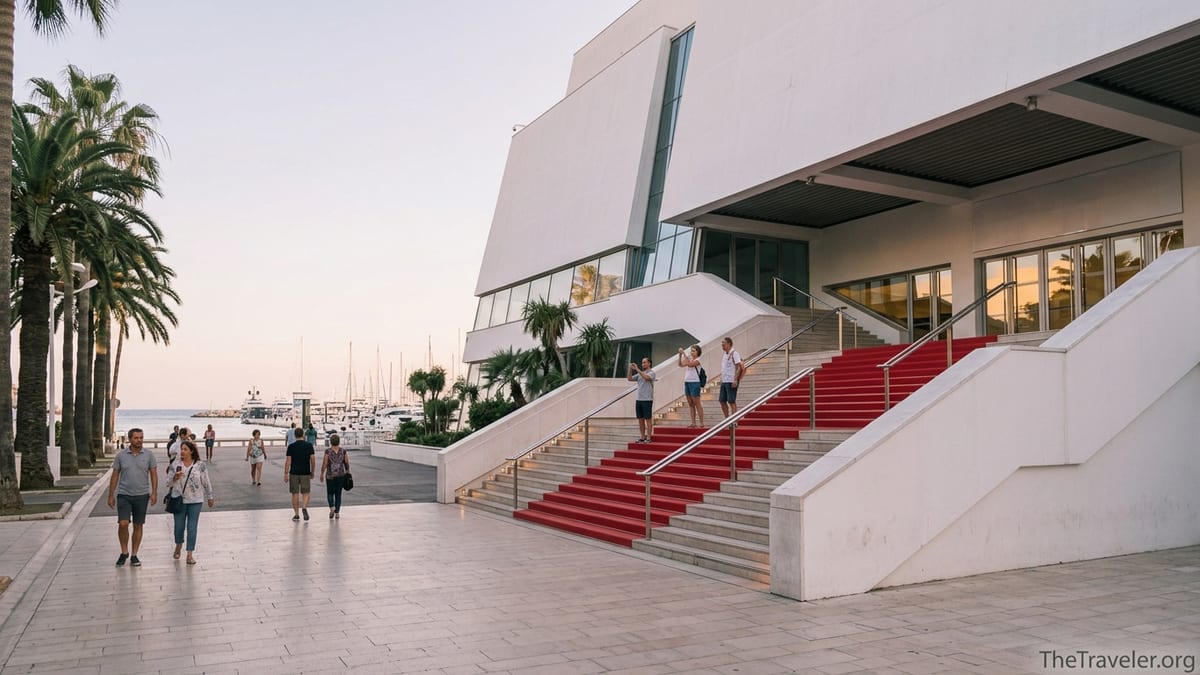
To understand how the Palais des Festivals supports the festival’s complex ecosystem, it helps to visualize its key spaces. The most recognizable feature is the exterior staircase facing the Croisette, draped in a red carpet that is replaced several times a day during the festival to ensure it looks pristine for each evening premiere. Travelers passing by in the off-season often see crews pressure-washing the steps or technicians testing lighting rigs where photographers will later compete for the perfect angle on arriving stars.
Inside, the Grand Auditorium Louis Lumière is the crown jewel, but it is only one of several major rooms. The Debussy Theatre, a smaller but still sizable auditorium, hosts press screenings, certain competition titles and parallel program events. Upstairs and in the Riviera wing, which extends toward the harbor, are medium and small screening rooms, market booths and meeting areas used heavily by industry professionals during the Marché du Film. A traveler with market accreditation might spend a morning in back-to-back screenings in 200-seat rooms tucked behind anonymous doors, then emerge into bright sunlight on a balcony overlooking the Bay of Cannes.
Beneath the glamour, the building is full of very functional details. There are badge checkpoints, security scanners, press conference rooms, translation booths and dedicated interview spaces where actors sit under harsh white lights discussing films that the public outside has not yet seen. During the festival, temporary offices mushroom in every available corner, from international sales company suites near the main atrium to national pavilions on the seaside Pantiero extension. Outside, along the harbor opposite the Palais, dozens of countries set up pavilions in white tents, effectively expanding the building’s professional footprint across the waterfront.
For non-accredited visitors, the most tangible experience is often the red carpet itself. During festival nights, locals and tourists can gather behind barriers on either side of the staircase to watch arrivals. It is not unusual to hear a mix of languages as people compare notes on which stars they have spotted or to feel the atmosphere spike when a major filmmaker like Pedro Almodóvar or a cast led by Hollywood names steps out of a black car. At other times of year, the steps become a selfie magnet; it is common to see cruise passengers recreating their own “Cannes premiere” moments for family photos, formal wear optional.
Moments That Forged the Festival’s Reputation
The story of the Palais des Festivals is inseparable from the controversies and triumphs that played out inside its walls. In May 1968, before the current building existed, directors such as Louis Malle and Jean-Luc Godard occupied the Palais Croisette’s main hall, interrupting screenings in solidarity with nationwide student and worker protests. The festival was cut short without awarding prizes, a vivid example of how politics and cinema have always intertwined in Cannes. That legacy shapes the mood inside the current Palais whenever a politically charged film premieres or a jury speech comments on the state of the world.
Over the decades, the Palais has seen the debuts of films that changed careers and even influenced global cinema. In the 1980s, Wim Wenders’ “Paris, Texas” and Akira Kurosawa’s “Kagemusha” both received the Palme d’Or, cementing the festival’s reputation as a place where art-house films could get global attention. More recently, titles such as Bong Joon-ho’s “Parasite,” which first took the Palme d’Or before winning the Academy Award for Best Picture, demonstrated how a rapturous reception inside the Grand Auditorium can echo across the global box office.
There have also been less glamorous but equally telling moments. When the current Palais opened in 1983, the first screening reportedly suffered technical problems: sound issues, too much light in the auditorium, a stubborn curtain. The film, Martin Scorsese’s “The King of Comedy,” eventually played, but that rocky start is a reminder that even the most prestigious venues are, at heart, complex machines that require constant fine-tuning. Today, visitors to the festival sometimes experience their own version of that imperfection: a delayed premiere because of “technical difficulties,” a last-minute venue change from the Lumière to the Debussy, or a late-running press screening that keeps journalists penned inside well past midnight.
For travelers who follow film culture, being in the Palais during a major premiere can feel like stepping into history in real time. Imagine attending a festival screening of a buzzy competition title: you enter through the main hall, clutching a ticket obtained through the festival’s online system or an industry contact, pass security, then climb into the darkened auditorium as the lights dip. Before the film begins, the festival’s emblem flickers across the screen and the room erupts in applause. Hours later, if the audience has loved what they saw, a standing ovation might stretch to several minutes, with the filmmakers on stage struggling to hold back tears. That ritual, repeated year after year inside the same walls, is a major part of the festival’s enduring mystique.
A Living Landmark Beyond Festival Season
Although the Cannes Film Festival defines its global image, the Palais des Festivals is busy in almost every month of the year. The city and regional authorities have invested heavily in turning it into a convention and events engine, using its central location and existing prestige to draw diverse industries. For visitors, that means the atmosphere around the building varies dramatically depending on when you come.
In March, for example, TV professionals descend for MIPTV, while October brings MIPCOM, both large-scale trade markets where the space beneath the Palais’ glass atrium is transformed into a grid of stands. Designers roll in modular booths, LED displays and sound systems, overlaying the same floors where producers once hawked arthouse cinema with promos for drama series and streaming platforms. In June, the Cannes Lions International Festival of Creativity fills the Palais with global advertising executives, brand representatives and agency creatives, many of whom network on the terraces overlooking the bay between seminars in the main auditorium and breakout sessions in smaller rooms.
More recently, Cannes has developed Canneseries, a festival dedicated to television and streaming series that runs alongside MIPTV in spring. While smaller than its film counterpart, it uses many of the same spaces, including pink carpets on the Palais steps and red-carpet-style premieres in the Lumière and Debussy theaters. Travelers visiting at this time will find a different but related energy: fans cheering for stars of popular series, poster installations across the forecourt and branded photo walls along the main entrance.
Even outside major events, the Palais hosts concerts, dance performances, local festivals and corporate gatherings. On a random autumn weekend, a traveler might wander into a public exhibition in one of the halls or catch a symphony orchestra performance in the main auditorium. The city has emphasized sustainability and modernization, with ongoing investment in LED lighting, more efficient air conditioning, and digital signage to guide delegates through its many levels. For Cannes residents, the building is not just a cinematic symbol but a practical, year-round facility that supports local jobs in hospitality, transport and event management.
Experiencing the Palais as a Traveler Today
Most travelers will never walk the Palais steps in a couture gown, but there are many accessible ways to connect with its film legacy. During the Cannes Film Festival, which usually runs for twelve days in May, the easiest option is to join the crowds outside in the early evening, when premieres begin. You can position yourself behind the barriers across from the staircase or along the Croisette and watch as limousines pull up, photographers shout for attention and stars ascend the red carpet. The best vantage points often require some patience; many fans arrive an hour or more in advance, especially when a major Hollywood title or beloved auteur is premiering.
Opportunities to get inside the building during the festival are more limited but not entirely out of reach. While the main badge accreditations are reserved for industry professionals, journalists and students in film-related programs, the festival has in recent years expanded initiatives that give members of the general public a chance at tickets to selected screenings, including some held in the Palais. These offers change over time, but they typically involve online registration through local cultural institutions or the city of Cannes. Outside festival season, visitors can sometimes attend public performances, concerts or regional events in the Palais’ main halls, offering a more relaxed way to experience the interior architecture.
Budget-conscious travelers should be aware that the area immediately around the Palais can be expensive during major events. Hotel rates across Cannes often rise several times above their off-season levels during the film festival or Cannes Lions, and even simple meals near the Croisette may come with a premium. Some festival-goers, including film students and young journalists, cope by staying in neighboring towns such as Antibes or Nice and commuting by regional train, grabbing quick, inexpensive meals at chain restaurants opposite the Palais or in side streets away from the seafront. If you visit outside those peak windows, by contrast, you might find mid-range hotel rooms within walking distance of the Palais at prices closer to what you would expect in other French coastal towns.
Regardless of your budget, one simple, free way to engage with the building’s legacy is to explore its immediate surroundings. On the pavement in front of the Palais and along the Esplanade Pompidou you will find the “Chemin des Étoiles,” a series of handprints and signatures inlaid into the ground, echoing the Hollywood Walk of Fame. You might stumble across the prints of actors like Jean-Paul Belmondo or directors who have left their mark on festival history. For many visitors, tracing these names with their fingertips while looking up at the palace where those careers were celebrated can be as meaningful as any red-carpet sighting.
How the Palais Shapes Cannes’ Identity and Future
For Cannes, the Palais des Festivals is both a practical resource and a powerful symbol. Economically, it anchors a convention industry that brings hundreds of thousands of visitors through its doors each year, supporting jobs in hotels, restaurants, transportation and event services. Culturally, it projects an image of modernity and ambition that complements the town’s historic villas, luxury boutiques and old harbor. When news outlets like Reuters or the Associated Press broadcast images from Cannes, the Palais’ staircase and distinctive facade almost always appear in the background, effectively acting as the town’s global logo.
This dual role has driven a series of modernization efforts. Over the past decade, local authorities have invested heavily in refurbishing interiors, updating seating and projection systems, and improving energy efficiency. The aim is not only to keep the building attractive for the world’s top film professionals but also to ensure it remains competitive against other European convention centers. Discussions about future upgrades often revolve around making circulation smoother for large crowds, integrating more digital technology and enhancing the experience for delegates who may spend an entire week inside its walls during a major trade show.
At the same time, the Palais is at the heart of debates about how Cannes should evolve. Some residents worry about over-dependence on short, intense bursts of high-end tourism, while others see opportunities to diversify the town’s cultural calendar and appeal to a broader range of visitors. Newer events like Canneseries, along with music festivals and e-sports or tech gatherings, reflect a recognition that the building’s prestige can be leveraged beyond traditional film and advertising markets. For travelers, this means the odds of stumbling across an interesting event at the Palais during an off-peak visit are steadily increasing.
Looking ahead, the building will continue to frame how future generations experience the festival. As streaming platforms, virtual markets and digital premieres grow, there is ongoing discussion about what a physical venue like the Palais means for an art form that is increasingly consumed online. For now, the answer seems clear every May: tens of thousands of professionals and film lovers still converge on this particular set of steps, screens and foyers because the shared, in-person experience of cinema remains irreplaceable. The Palais functions as both a real-world meeting point and a symbol that reminds people why films matter enough to watch together.
FAQ
Q1. What exactly is the Palais des Festivals in Cannes?
The Palais des Festivals et des Congrès is Cannes’ main convention and cultural center, best known as the headquarters of the Cannes Film Festival and its red-carpet premieres.
Q2. When was the current Palais des Festivals built?
Construction of the current Palais began in the late 1970s on the site of the former municipal casino, and it opened for the Cannes Film Festival in 1983.
Q3. Is the Palais des Festivals the same as the original festival building?
No. The early postwar festivals took place in other venues, and from 1949 the event used the Palais Croisette. That older palace was later demolished and replaced by the current, larger complex.
Q4. Can tourists visit the inside of the Palais during the Cannes Film Festival?
Access is mostly limited to accredited guests and ticket holders, but some public programs and occasional ticket initiatives allow members of the general public into selected screenings or events.
Q5. What happens inside the Palais when the film festival is not on?
Outside May, the Palais hosts conventions, trade shows, television and advertising festivals, concerts, local cultural events and corporate meetings throughout the year.
Q6. Where can I see the famous handprints near the Palais?
The “Chemin des Étoiles,” a series of celebrity handprints set into the pavement, runs in front of the Palais and along the nearby seafront esplanade.
Q7. Why do some people call the building “the bunker”?
The nickname “the bunker” comes from the Palais’ angular, modernist architecture, which contrasts sharply with the ornate Belle Époque hotels and older buildings along the Croisette.
Q8. Do I need a special dress code to walk on the red carpet?
For official evening premieres inside the Palais, strict formal dress codes apply. However, outside festival times, anyone can walk the steps in everyday clothes and take photos.
Q9. Is it worth visiting Cannes if I am not attending the festival?
Yes. Even without accreditation, you can enjoy the atmosphere around the Palais, explore the Croisette, visit beaches and old-town Le Suquet, and attend other events hosted in the palace.
Q10. How early should I arrive to watch the red carpet as a spectator?
For major premieres during the festival, it is wise to arrive at the barriers at least an hour in advance, or even earlier, to secure a good viewing spot.