


Walk along Cannes’ palm-lined Croisette during festival season and the Palais des Festivals et des Congrès is impossible to miss. Its angular white facade and famous red steps spill down toward the Mediterranean, drawing filmmakers, executives, critics and star‑struck visitors from every continent. For travelers who care about movies, this building is far more than a backdrop for paparazzi shots. The Palais is a working engine of global cinema culture, and it still matters profoundly to how films are financed, discovered, debated and ultimately watched around the world.
Get the latest updates straight to your inbox!
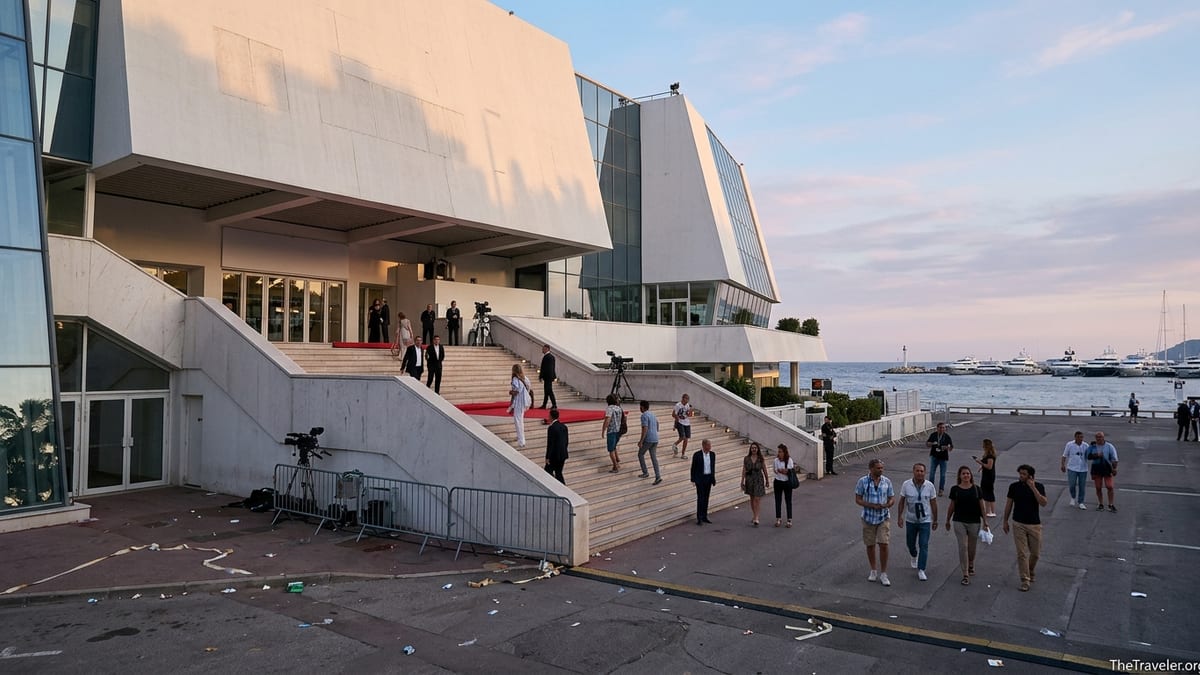
The Beating Heart of the Cannes Film Festival
The Palais des Festivals is the operational core of the Cannes Film Festival, the world’s most closely watched showcase for auteur cinema. Each May, the Grand Théâtre Lumière inside the Palais hosts the Competition premieres that determine who takes home the Palme d’Or, while parallel sections like Un Certain Regard and Out of Competition unspool in adjacent auditoriums. In 2026, for example, Cristian Mungiu’s political drama “Fjord” won the Palme d’Or after its premiere here, underlining how a single screening inside this building can shift the global conversation about cinema for an entire year.
For travelers with industry badges, days at the Palais are a blur of security checks, escalators and packed queues snaking along the carpeted foyers. Journalists rush between press screenings and conferences, while programming teams from Toronto, Busan or San Sebastián quietly scout titles that will define their own lineups. Even if you are just a cinephile visitor holding a ticket to a single public screening, taking your seat in the Grand Théâtre Lumière connects you directly to a chain of historic first showings, from “Pulp Fiction” to “Parasite.”
The festival’s official ceremonies also unfold within the Palais. The opening night gala, where past honorees have included Meryl Streep and John Travolta receiving honorary Palme d’Or tributes, turns the main stage into a global broadcast platform. Acceptance speeches ripple outward via news outlets and social media, shaping discourse about representation, politics and artistic risk. The building is therefore not just a venue but a megaphone through which the festival speaks to the world.
From a traveler’s perspective, that means the Palais is where you feel Cannes at its most intense. Stepping onto the terrace after a late‑night screening and seeing the spotlight beams sweep across the bay is a reminder that, for a couple of weeks every year, this single structure becomes the symbolic capital of world cinema.
Where the Global Film Market Makes Its Deals
Beyond the red carpet, the Palais matters because it houses the Marché du Film, a vast film market running alongside the festival. Inside its exhibition halls and temporary stands, producers from countries as varied as South Korea, Nigeria, Mexico and Iceland present projects and completed films to buyers and sales agents. Research using data from Cinando, the Cannes Film Market’s platform, has shown how this circuit shapes which national cinemas gain visibility, highlighting the Palais as a crucial gateway for international representation.
Walk through the market floors and the atmosphere is closer to a global trade fair than a glamorous premiere. Stands for national film bodies such as UniFrance or the British Film Institute sit next to independent sales companies. A producer from a small Baltic nation might screen a rough cut in one of the Palais’ market rooms, hoping to sell distribution rights to an American streaming platform or a German arthouse distributor. If that deal closes, audiences months later in New York, Mumbai or Sydney will experience a movie that was effectively launched within these walls.
For filmmakers, meeting tables in the Palais can be the difference between a project remaining a script and becoming a finished feature. A director might leave a 30‑minute pitch session with a commitment for gap financing from a European fund, or secure festival invitations that will build a film’s profile. Even as virtual markets have become more common, the concentration of decision‑makers who physically converge under the Palais roof each year means face‑to‑face encounters still carry extraordinary weight.
Travelers with industry access get a tangible sense of how the business of cinema works here. You might line up for a market screening at 9:00 a.m., then weave through corridors plastered with posters and one‑sheet artwork, overhearing conversations in French, English, Mandarin and Arabic as teams negotiate minimum guarantees and territory splits. It is in these quietly lit meeting rooms, rather than on the red carpet, that much of global cinema’s future is brokered.
A Year‑Round Hub for Festivals, TV and Creativity
Although the Cannes Film Festival is the most famous tenant, the Palais des Festivals operates all year as a multi‑event convention center that affects what ends up on our screens. Television and content markets such as MIPTV and MIPCOM bring together thousands of buyers from over 100 countries annually, using the same auditoriums and exhibition spaces to trade series, documentaries and formats. A telenovela that later airs in Latin America or an innovative Nordic crime series might first be pitched and sold across a table inside the Palais.
The Cannes Lions International Festival of Creativity, held every June at the Palais, has become the leading global event for advertising and marketing professionals. Over five days, agencies, brands and tech firms gather to present campaigns and compete for coveted Lions awards in categories like Film, Titanium and Glass. Sessions in the Palais’ conference rooms dissect how storytelling, data and new platforms shape the commercials and branded films we encounter worldwide, from Super Bowl spots to short digital documentaries.
Recent years have also seen the Palais host events that speak to emerging trends affecting cinema, such as the World AI Cannes Festival, which explores how artificial intelligence intersects with creative industries. Press material from the venue emphasizes its ambition to position Cannes as a model of creativity and sustainable development, with a 12‑month calendar that now includes gaming fairs, dance festivals and live performance markets alongside audiovisual events.
For visitors outside the traditional film crowd, this means you can experience the Palais in many contexts. A traveler attending a board‑games convention at the Festival International des Jeux in February might stay in the same hotels and walk the same Croisette promenade that movie stars do in May, yet discover a completely different creative community inside the building. The continuity of the Palais as a gathering point for ideas reinforces its role in global culture, not just cinema in the narrow sense.
An Architectural Symbol on the Croisette
Architecturally, the Palais des Festivals is neither the most ornate nor the most charming structure on the Côte d’Azur. Its boxy, angular silhouette contrasts with the belle époque elegance of nearby hotels like the Carlton and the Majestic. Yet that very contrast has become part of its symbolic power. The building is designed for function: vast auditoriums, flexible exhibition halls, thick layers of security and backstage infrastructure able to handle thousands of attendees per day.
For travelers, approaching the Palais from the Croisette is experiencing a series of cinematic frames. In the morning, you might see crews rolling out fresh red carpet and testing spotlights, with the Mediterranean glittering behind them. By late afternoon during the festival, crowds of fans gather behind barriers below the central staircase, hoping to catch a glimpse of actors arriving for a 7:00 p.m. premiere. At night, the facade becomes a canvas for projected festival logos and sponsor imagery, so the building itself turns into part of the media spectacle.
The city and the venue operator have invested in ongoing renovations and digital upgrades, with press dossiers referring to improvements in circulation areas and plans for more immersive visitor journeys. For example, foyers now integrate more interactive screens and signage, helping first‑time attendees navigate a complex layout that includes multiple screening rooms, press areas and market zones stacked over several levels.
Despite its pragmatic design, the Palais has become an instantly recognizable icon. For cinephile travelers, standing on the steps for a daytime photo, even when the red carpet is rolled up, feels like an initiation rite. The texture of the concrete underfoot, the sea breeze and the echo of distant sound checks all contribute to a sense that cinema history passes constantly through this threshold.
How the Palais Shapes Film Careers and Trends
The importance of the Palais des Festivals goes beyond prestige. Decisions made in its screening rooms and jury deliberation spaces directly influence which films and filmmakers gain global momentum. When a title wins the Palme d’Or or another major prize on the stage of the Grand Théâtre Lumière, international distributors often respond within hours by adjusting release plans, buying additional territories or increasing marketing budgets.
Consider how Cannes launches have affected recent careers. Directors like Bong Joon‑ho, whose “Parasite” won the Palme d’Or before sweeping the Oscars, or Justine Triet, who followed “Anatomy of a Fall” with heightened global attention, both benefited from prize announcements delivered inside the Palais. After awards nights, posters in cities from Los Angeles to Tokyo proudly reference “Cannes winner” or “Prize of the Jury,” shorthand that signals a certain level of artistic ambition to audiences.
Research into festival circuits shows that selection at a top‑tier festival such as Cannes can dramatically alter a film’s trajectory, especially for works from smaller or less wealthy countries. A debut filmmaker from North Africa or Southeast Asia might go from relative anonymity to international touring after a strong premiere in one of the Palais screening rooms. Festival programmers from around the globe sit in those same darkened auditoriums, taking notes on titles that will later anchor retrospectives or themed seasons elsewhere.
The Palais also exerts influence through the industry programs it hosts during the festival, including workshops for emerging producers and script labs for early‑stage projects. Participants often leave with mentors, co‑production partners or invitations to other residencies. For a traveler accepted into one of these initiatives, days spent moving between small meeting rooms and seaside terraces become a pivotal chapter in a professional journey.
Experiencing the Palais as a Traveler
Many visitors assume the Palais is off‑limits unless you are a celebrity, but in practice there are several ways travelers can experience it. During the Cannes Film Festival, local initiatives like Cinéma de la Plage host free outdoor screenings on the beach, often tied to the festival’s program. While these take place just outside the main building, audiences watch with the illuminated Palais as their backdrop, sharing the atmosphere without needing an industry badge.
Outside festival dates, the Palais operates more like a conventional convention center, and access is usually much easier. If you visit Cannes in autumn or winter, when hotel rates drop significantly compared to May, you may be able to step inside during a public trade show or cultural event. Day passes for niche festivals or expos can cost less than a mid‑range restaurant meal, giving you a chance to walk the foyers, ride the escalators and peek into the main auditorium even if the screen is showing product demos rather than art‑house premieres.
Practical details matter here. During major events, security is tight and bag checks are routine, so plan extra time to enter. Dress codes vary widely: a morning TV content market session might be filled with jeans and sneakers, while evening film premieres still often require formal attire, with invitations specifying black tie. Staying in a small hotel or apartment a few blocks inland rather than on the Croisette itself can keep costs manageable while keeping you within a 10‑minute walk of the Palais.
For many cinephile travelers, the most rewarding approach is to accept that you may never set foot in the Grand Théâtre Lumière during a star‑studded premiere, yet the building can still anchor your visit. Sitting at a café opposite the steps, you can watch crew members, publicists and journalists stream in and out, catching fragments of conversations about last night’s screening. That sense of proximity to the living machinery of cinema is precisely what makes the Palais compelling.
The Takeaway
The Palais des Festivals in Cannes remains central to global cinema culture because it operates simultaneously as a symbol and as a working machine. Its red‑carpeted steps supply the images that define popular perceptions of film glamour, while its interior screening rooms and market halls quietly shape which stories reach cinemas, festivals and streaming platforms worldwide. Decisions made under its roof influence careers, national film industries and even the direction of related fields like television and advertising.
For travelers, the Palais is not only a landmark to photograph but a living crossroads worth experiencing in some form, whether by attending a niche winter convention, watching an open‑air beach screening during the festival, or simply lingering along the Croisette as guests spill in and out of its glass doors. As long as filmmakers, producers and storytellers continue to converge there each year to share work, argue about art and negotiate the future of moving images, the Palais des Festivals will keep mattering far beyond the shoreline of Cannes.
FAQ
Q1. Can visitors enter the Palais des Festivals during the Cannes Film Festival?
Access is tightly controlled during the festival, but accredited professionals, invited guests and holders of certain public tickets can enter specific areas and screenings.
Q2. Is it possible to tour the inside of the Palais outside festival dates?
At quieter times of year, entry is often possible when public fairs, concerts or trade shows are running, sometimes with inexpensive day passes at the door.
Q3. Do you need to be in the film industry to attend events at the Palais?
No. Many year‑round events, from gaming conventions to dance festivals, welcome general visitors, though professional markets usually require registration in advance.
Q4. Can travelers walk on the famous red carpet steps?
Yes, outside major events the steps are generally open to the public, and the red carpet is often removed, but during the festival access is restricted and heavily supervised.
Q5. How early should I book accommodation near the Palais during the Cannes Film Festival?
For May festival dates, booking several months in advance is wise, since major hotels on the Croisette can sell out quickly or impose long minimum stays.
Q6. Are screenings at the Cannes Film Festival ever open to the general public?
Yes. Certain sections and late‑night screenings offer public access, though tickets must be requested or collected through specific channels set by the festival.
Q7. What is the difference between the Cannes Film Festival and Cannes Lions at the Palais?
The film festival focuses on cinema and auteurs in May, while Cannes Lions in June celebrates advertising and creative communications, attracting brands and agencies.
Q8. Is there a dress code for events inside the Palais?
Evening film premieres often request formal wear, but daytime markets and conferences typically accept smart‑casual attire, with comfort important due to long days.
Q9. How close is the Palais des Festivals to public transport in Cannes?
The building sits opposite Cannes train station and near multiple bus stops, so travelers arriving from Nice or Antibes can walk to the Palais in just a few minutes.
Q10. Can I visit the Palais on a budget trip to the French Riviera?
Yes. By avoiding peak May and June events, staying a few streets inland and choosing low‑cost cafés, you can still experience the Palais area without overspending.