


Travelers come to Pisa for the Leaning Tower, but it is Pisa Cathedral that truly explains why this Tuscan city once rivaled the great maritime republics of Venice and Genoa. Rising from a carpet of green lawn on the Piazza dei Miracoli, the Cathedral of Santa Maria Assunta is one of the finest Romanesque churches in Europe, a building that shaped the architecture of Tuscany and advertised Pisa’s power to the medieval world. Understanding what this cathedral is, how it was built, and how it influenced other cities turns a quick photo stop into one of Italy’s most rewarding architectural encounters.
Get the latest updates straight to your inbox!
What Pisa Cathedral Is and Where You’ll Find It
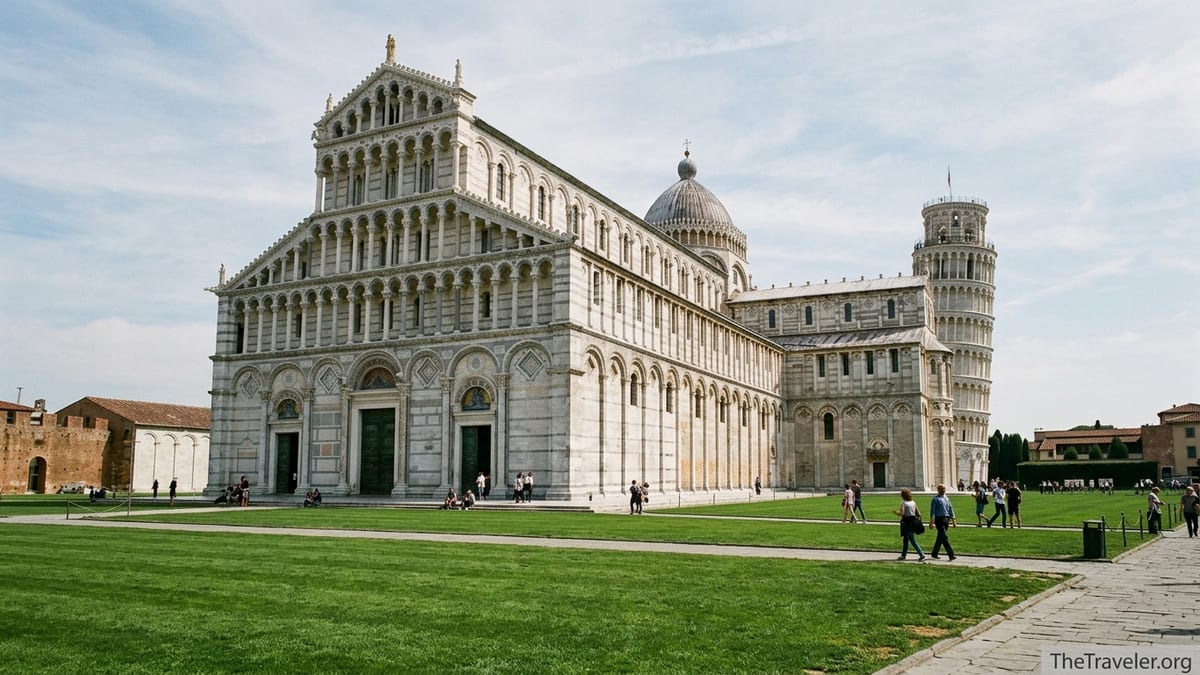
Pisa Cathedral, or Duomo di Santa Maria Assunta, is the monumental medieval church that forms the heart of the Piazza del Duomo, better known as Piazza dei Miracoli, on the northern edge of Pisa’s historic center. Construction began in 1064, when Pisa was a rising maritime republic trading across the Mediterranean, and the cathedral was consecrated in 1118. Today it stands within a UNESCO World Heritage Site that also includes the Leaning Tower, the baptistery and the monumental cemetery, all grouped within a walled green precinct that feels like a stone island floating in a sea of modern city streets.
For visitors, the cathedral is usually the second or third monument you enter after seeing the Leaning Tower. The main entrance faces west across the lawn, so most travelers walk straight from Via Santa Maria through the old city walls, see the tower tilting to their right, and then realize that the long, low, arcaded church in front of them is the original centerpiece of the square. Entry to the cathedral is managed through timed tickets that are sold together with access to other monuments of the Piazza; in practice, many people buy a combined ticket that includes the tower or baptistery and then reserve a specific time slot for the Duomo interior later in the same day.
Once inside, you are not simply standing in a parish church but in what was once the symbol of an entire city-state. The cathedral served as Pisa’s main place of worship, as the stage-set for state ceremonies, and as a treasury for art and relics brought back from Pisa’s campaigns and trade expeditions. It is this mix of religious function, civic pride and artistic ambition that makes Pisa Cathedral a key to understanding medieval Tuscany.
How Pisa Cathedral Defined the “Pisan Romanesque” Style
Architecturally, Pisa Cathedral is the prototype of what is now called the Pisan Romanesque style. At a time when many European churches were still quite compact, Pisan builders created a vast basilica with a five‑aisle nave, a projecting transept and a large elliptical dome over the crossing. From the outside, the defining feature is the façade: a rhythmic stack of blind arches and open galleries, clad in alternating bands of white and grey marble, studded with columns and inlaid decoration. This layered arcade motif became a visual signature across northern Tuscany, echoed in churches in Lucca, Pistoia and smaller towns that looked to Pisa as a cultural model.
Stand on the lawn facing the façade and you can see why other cities copied it. Sunlight catches the pale marble and the hundreds of small columns that march across the front, while darker stone inlays trace geometric patterns that recall Islamic and Byzantine ornament. Many columns are made from re‑used Roman marble, a deliberate statement that Pisa, like ancient Rome, was a power of the Mediterranean. Travelers familiar with Florence’s San Miniato al Monte or Lucca’s San Michele in Foro immediately notice the family resemblance: arcaded fronts, striped stone, sculpted capitals and rich portals, all of which trace their lineage back to Pisa Cathedral’s design.
The building also reflects Pisa’s trading links. Pointed arches and gold ground mosaics inside the cathedral show a strong Byzantine influence, probably drawn from Constantinople and other eastern ports where Pisan merchants operated. At the same time, rounded Romanesque arches, thick walls and sturdy arcades root the church firmly in western medieval tradition. The cathedral is, in effect, a stone summary of the cultures that met in Pisa’s harbor at the height of its power.
Inside the Duomo: Mosaics, Marble and a Legendary Chandelier
The interior of Pisa Cathedral feels surprisingly tall and airy compared with its rather low external profile. Step through the bronze doors and your eye is immediately drawn along a forest of grey marble columns towards the glittering apse mosaic of Christ in Majesty. Black and white marble bands run across the walls and arches like stripes, creating a bold graphic contrast that is very different from the soft frescoes of many Tuscan churches. Overhead, a richly gilded coffered ceiling, rebuilt after a fire in 1595, gleams in the light that filters down from clerestory windows.
At the eastern end, the apse mosaic provides one of the cathedral’s most important art works. The composition shows Christ enthroned, flanked by the Virgin Mary and Saint John the Evangelist. The face of Saint John was painted around 1302 by the Florentine master Cimabue and, remarkably, survived the 16th‑century fire that damaged much of the interior. For visitors who know Florence’s Santa Croce or Assisi’s Basilica of Saint Francis, seeing Cimabue’s work here in Pisa provides a direct link between Tuscan cities at the moment when medieval art was starting to move toward the Renaissance.
Look up in the nave and you will notice an enormous bronze chandelier hanging from the ceiling. Local tradition connects this lamp with Galileo Galilei, who was born in Pisa in 1564. According to accounts preserved by later writers, a young Galileo watched the slow swing of the lamp during Mass and realized that the time needed for each oscillation was almost constant, an observation that helped him formulate the principle of isochronism and, later, influenced the development of pendulum clocks. Whether or not the story is exactly true, modern visitors often find themselves repeating Galileo’s experiment, timing the lamp with a wristwatch or smartphone as it moves gently in the drafts of the nave.
Giovanni Pisano’s Pulpit and the Sculpture of a City
Among the cathedral’s treasures, the stone pulpit carved by Giovanni Pisano between about 1302 and 1310 is one of the most celebrated sculptures of the Italian Middle Ages. Standing near the nave, it is a raised, polygonal structure supported on marble columns, some resting on crouching lions. Around its sides, densely carved relief panels show scenes from the life of Christ, framed by twisting columns and populated with muscular figures that appear to strain and twist in real three‑dimensional space. Art historians often point out how Giovanni pushes beyond the more classical calm of his father Nicola’s earlier pulpits in the Pisa Baptistery and Siena Cathedral, anticipating the energy of later Renaissance carving.
For travelers, the pulpit offers an unusually close encounter with medieval sculpture. The area around it is routinely roped off, but you can stand only a few steps away, close enough to see chisel marks, delicate curls of hair and even the tension in tiny hands and faces. Many guided tours of the cathedral pause here for several minutes, as local guides use the pulpit to explain how Pisan sculpture influenced artists from Florence to northern Europe. If you have time later in the day, you can visit the nearby Museo dell’Opera del Duomo, where fragments of original medieval sculpture, including the famous bronze Pisa Griffin that once stood on the cathedral roof, are preserved away from the weather.
The pulpit also demonstrates why Pisa Cathedral is more than a backdrop to the Leaning Tower. In the same way that the tower’s tilt unintentionally created an icon of Italian tourism, Giovanni Pisano’s pulpit was intended as a focal point of preaching and storytelling in stone. Today, standing in front of it, you can still imagine the sound of sermons rolling through the nave as townspeople, sailors and pilgrims listened from the marble floor below.
From Maritime Republic to UNESCO World Heritage
Pisa’s decision to build such a large and richly decorated cathedral in the 11th century was directly tied to its status as a maritime republic. In this period, Pisan fleets carried pilgrims to the Holy Land, traded with Islamic ports in North Africa and the Levant, and took part in military campaigns that brought home both wealth and prestige. The cathedral’s size, multiple aisles and elaborate artworks were a civic statement: this was the church of a city that considered itself a major Mediterranean power.
Over the centuries, the Piazza del Duomo evolved. The separate baptistery, begun shortly after the cathedral, and the free‑standing bell tower, started in 1173 on the same unstable ground that caused its famous lean, completed the core ensemble. To the north, the walled Camposanto cemetery later enclosed a long cloister around sacred earth said to have been brought back from Golgotha. In the 19th century, the architect Alessandro Gherardesca ordered the demolition of later houses and ecclesiastical buildings that had encroached on the space, opening the square into the broad, lawn‑covered expanse that modern visitors know as the “Field of Miracles.”
In 1987, UNESCO recognized the entire Piazza del Duomo as a World Heritage Site for its outstanding example of medieval Christian architecture and its influence on sacred building across Europe. That inscription emphasizes that the cathedral, baptistery, bell tower and cemetery form a single artistic and spiritual ensemble. For travelers, this means that spending time inside the cathedral helps make sense of the tower and vice versa: the same Pisan ambition, engineering skill and artistic experimentation is visible in all four monuments.
Visiting Pisa Cathedral Today: Practical Tips and Realistic Expectations
Pisa Cathedral is open to visitors throughout the year, with seasonal variations in opening hours that typically run from morning to late afternoon or early evening. Access is organized through the Opera della Primaziale Pisana, the body that manages the monuments of the square. At the time of writing, entry to the cathedral itself is often included with a combination ticket for the Piazza dei Miracoli, while a small booking fee or timed reservation helps control crowding inside. In high season, particularly between May and September, it is wise to book tickets at least a few days ahead, especially if you also plan to climb the Leaning Tower.
Most travelers experience the cathedral as part of a half‑day visit from Florence, Lucca or the Tuscan coast. Direct regional trains from Florence’s Santa Maria Novella station to Pisa Centrale take roughly one hour, and from there it is a 20 to 25 minute walk through the historic center to the Piazza dei Miracoli. Alternatively, city buses and taxis connect the station with the square in around ten minutes. Organized day tours from Florence or Livorno cruise port typically bundle round‑trip transport, timed tower tickets and guided cathedral visits into a five to eight hour excursion, giving a structured way to see the main sights without managing individual reservations.
Inside the cathedral, photography without flash is generally allowed, so visitors often bring a camera or smartphone with a wide‑angle lens to capture the repeating arcades and gilded ceiling. Tripods are not permitted. Shoulders and knees are expected to be covered, in line with most Italian churches; in summer, visitors sometimes buy inexpensive shawls from street vendors near the square to comply with the dress code. Because the marble floor can be slippery and the interior cool even on hot days, comfortable shoes and a light extra layer are useful.
Why Pisa Cathedral Matters for Understanding Tuscan Romanesque
Seen in isolation, Pisa Cathedral is an impressive large church with a famous neighbor. Seen in context, it is one of the most important stepping stones between early medieval architecture and the Gothic and Renaissance buildings that later shaped Italy. Its wide, arcaded façade and rhythmic use of striped marble established a Tuscan visual language that inspired churches from Lucca’s San Martino to Pistoia’s San Zeno and, in different ways, even parts of Florence’s cathedral complex. For travelers tracing the evolution of European architecture, starting in Pisa and then visiting these other cities provides a concrete itinerary through Romanesque and early Gothic Tuscany.
The cathedral also matters because it shows how ideas moved around the Mediterranean. The combination of Byzantine mosaic, Islamic‑influenced geometric inlay and Roman architectural fragments speaks of a city whose ships sailed to Constantinople, North Africa and the Levant. When you compare the apse mosaic here with those in Venice’s Basilica of San Marco or Monreale Cathedral in Sicily, you see a shared golden visual language that tied together distant ports. Pisa Cathedral is part of that network, and visiting it gives a more complete picture of how medieval Italy engaged with the wider world.
Finally, Pisa Cathedral is important as a lived space of worship. Daily services, special Masses and religious festivals still take place here, and visitors are sometimes asked to pause sightseeing during liturgy. For many travelers, slipping into a pew for a few quiet minutes between tour groups can be the most memorable part of the visit, offering a rare sense of continuity with the Pisans who have prayed under these arches for nearly a thousand years.
The Takeaway
When you step onto the grass of Pisa’s Piazza dei Miracoli, it is tempting to head straight for the Leaning Tower and treat the cathedral as scenery. Yet it is the Duomo of Santa Maria Assunta that made the tower possible in the first place: a vast, confident Romanesque basilica that proclaimed Pisa’s arrival as a Mediterranean power and set a template for Tuscan church design. Inside, glittering mosaics, a golden ceiling, Giovanni Pisano’s restless sculpture and even the legend of Galileo’s swinging lamp turn abstract art‑history terms into tangible experiences.
For travelers willing to look beyond the famous tilt, Pisa Cathedral offers one of the clearest and most accessible introductions to medieval architecture in Europe. It explains why the city’s builders chose this language of stripes and arches, shows how ideas from East and West mixed in a single space, and anchors the wider story of Tuscan Romanesque from Lucca to Siena. Whether you visit on a quick rail trip from Florence or as part of a longer Tuscan journey, allowing at least an unhurried hour inside the cathedral transforms Pisa from a postcard stop into a place whose history you can feel under your feet.
FAQ
Q1. What exactly is Pisa Cathedral?
Pisa Cathedral is the main medieval church of Pisa, dedicated to Santa Maria Assunta, built from 1064 on the Piazza dei Miracoli and renowned as a masterpiece of Romanesque architecture.
Q2. Why is Pisa Cathedral considered one of Tuscany’s greatest Romanesque landmarks?
It set the model for the Pisan Romanesque style with its arcaded marble façade, striped stone, and grand five‑aisle interior, influencing churches across Tuscany and beyond.
Q3. How is Pisa Cathedral related to the Leaning Tower?
The Leaning Tower is the cathedral’s freestanding bell tower. Both were built as part of the same complex, and together with the baptistery and cemetery they form a single monumental ensemble.
Q4. Do I need a ticket to visit Pisa Cathedral?
Yes. Access is managed through timed tickets sold by the Opera della Primaziale Pisana, often bundled with entry to the Leaning Tower, baptistery or other monuments in the square.
Q5. How much time should I plan inside the cathedral?
Most visitors spend 30 to 45 minutes, but architecture and art enthusiasts often allow at least an hour to study the apse mosaic, pulpit, ceiling and sculpted details.
Q6. What are the must‑see artworks inside Pisa Cathedral?
Highlights include the apse mosaic with figures partly by Cimabue, Giovanni Pisano’s sculpted pulpit, the gilded coffered ceiling, and the legendary bronze chandelier linked to Galileo.
Q7. Is there a dress code for visiting Pisa Cathedral?
Yes. As in most Italian churches, visitors are expected to cover shoulders and roughly knee‑length or longer; light shawls and modest clothing are recommended, especially in summer.
Q8. Can I take photos inside Pisa Cathedral?
Photography without flash is generally allowed for personal use, but tripods and professional lighting are not permitted and visitors should avoid disrupting services or other guests.
Q9. How does Pisa Cathedral compare with churches in Florence or Lucca?
Compared with Florence’s Gothic cathedral, Pisa’s Duomo is earlier, more Romanesque and more clearly tied to maritime influences; Lucca’s churches, like San Martino, closely echo Pisa’s arcaded façades.
Q10. Is Pisa Cathedral still used for religious services?
Yes. The cathedral remains an active place of worship with regular Masses and special liturgies, and sightseeing may pause or be limited during major religious celebrations.