


For many travelers, Pisa is a quick detour: hop off the train, snap a comic photo “holding up” the Leaning Tower, grab a gelato and move on to Florence or Cinque Terre. But that rushed checklist often skips the building that made the tower possible in the first place: Pisa Cathedral, or the Duomo di Santa Maria Assunta. The question is whether it deserves precious time from a tight Italy itinerary, especially if you are already seeing showpiece churches in Florence, Siena or Rome. The answer, for most visitors, is yes. The cathedral is not only the artistic and spiritual heart of Pisa, it also offers a surprisingly rich visit that costs little, or nothing at all, when planned well.
Get the latest updates straight to your inbox!
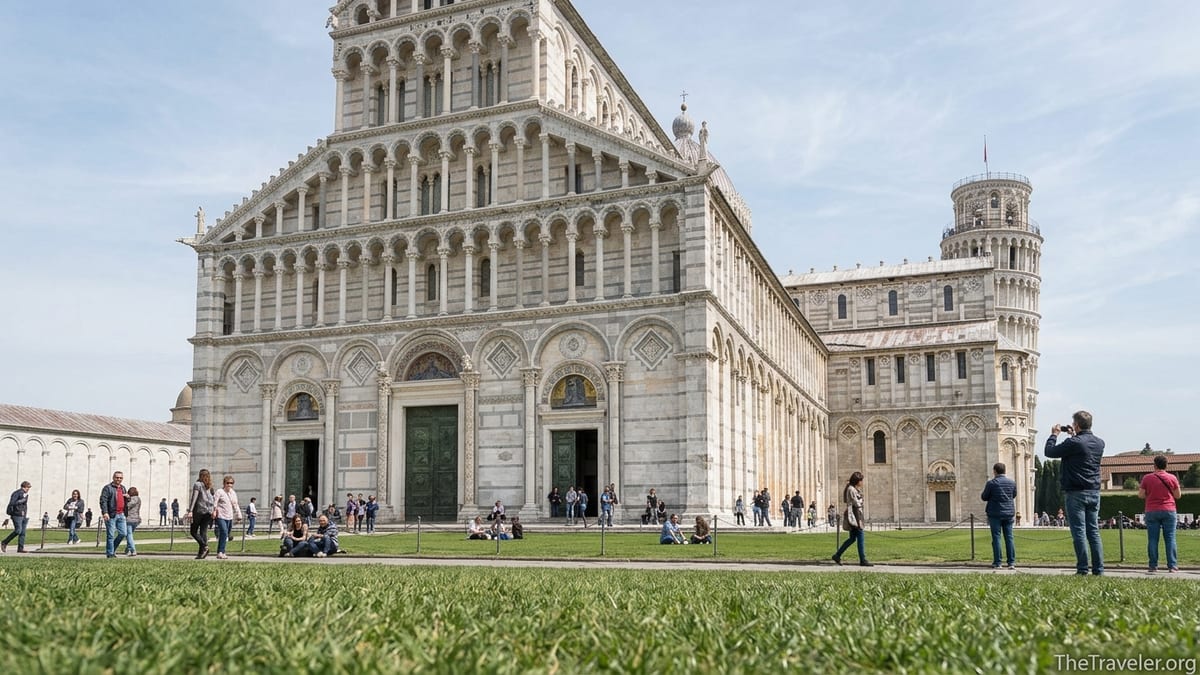
Pisa Cathedral in Context: More Than a Backdrop to the Leaning Tower
It is easy to forget that the Leaning Tower is actually just the bell tower of Pisa Cathedral. The Duomo itself predates the tower by decades and effectively created the Romanesque style that would influence churches across Tuscany and parts of the Mediterranean. When you stand in Piazza dei Miracoli today, that long marble basilica with striped arcades and bronze doors is the real centerpiece, with the tower, baptistery and monumental cemetery all orbiting it.
The cathedral is officially known as the Primatial Metropolitan Cathedral of Santa Maria Assunta. Construction began in the 11th century, at a time when Pisa was a powerful maritime republic trading with North Africa, the Byzantine Empire and the Middle East. You see those connections in the details: Islamic-style arches, Byzantine mosaics, and classical columns that seem borrowed from ancient Roman temples. Compared with the compact vertical drama of the tower, the Duomo’s horizontal sweep and layered decoration reward slow, close looking.
In practical travel terms, the cathedral is also the most accessible major monument in the piazza. Entry is free, provided you hold a timed ticket, which is automatically included with any paid monument ticket such as a Leaning Tower climb or a multi‑site combo pass. If you are balancing budget and time, this can make the Duomo one of the best-value high‑profile interiors anywhere in Italy.
That combination of architectural importance, distinctive style and low cost means the cathedral often ends up being a quiet highlight for travelers who originally came only for the tower. Many people leave Pisa with more photos and memories of the shimmering apse mosaic and marble colonnades than of their 30 minutes on the tower staircase.
What Makes the Interior Special: Art, Light and Acoustics
Stepping into Pisa Cathedral is a shift in atmosphere from the bright, lawn‑ringed piazza outside. The interior is vast but not overwhelming, a forest of gray‑and‑white marble columns under a coffered wooden ceiling, with an apse that glows gold in the right light. Even travelers who have already visited St. Peter’s in Rome or the Duomo in Florence often comment on how distinctive Pisa feels, more like a fusion between a Roman basilica and an Eastern church than a typical Gothic cathedral.
One of the star pieces is Giovanni Pisano’s pulpit, carved in the early 14th century and later painstakingly reassembled in its current position. The structure is supported by columns that rest on lions and figures, with reliefs showing scenes from the life of Christ. If you stand close, you can pick out minute chisel work in the drapery folds and faces. Many guided tours pause here for several minutes, and a good guide will point out how Pisano’s more emotional, dynamic figures helped pave the way toward Renaissance sculpture.
At the far end of the nave, the apse mosaic of Christ in Majesty, begun in the 13th century and associated with the painter Cimabue, dominates the space. Viewed from mid‑nave, it appears as a burst of gold framed by rounded arches and columns. In late afternoon on a clear day, the mosaic reflects soft light back into the nave and can make the whole eastern end of the cathedral appear to shimmer. Travelers who time their visit between roughly 3 pm and 5 pm in spring or autumn often find the interior particularly atmospheric, with angled light and slightly thinner crowds.
The cathedral’s acoustics are also part of the experience. While the famous sound demonstration happens next door in the Baptistery, the Duomo’s long nave and high vault create a gentle echo that lends even low conversation a hushed tone. If you happen to visit during a short organ practice or a choir rehearsal, which occasionally occur in the late afternoon, the mix of music and fading daylight can feel unexpectedly moving, even for visitors who are not religious.
Practicalities: Tickets, Opening Hours and How to Avoid the Crowds
As of 2026, Pisa Cathedral remains officially free to visit, but you must hold a valid ticket. Any paid ticket for another monument in Piazza dei Miracoli, such as the Leaning Tower or a combo pass that includes the Baptistery, Camposanto or museums, automatically includes cathedral access. If you are not purchasing any other tickets, you can still obtain a free, timed‑entry pass from the official ticket offices on the edge of the square, subject to availability on the day.
In high season, particularly July and August, the free cathedral slots can run out by early afternoon. Travelers arriving on regional trains from Florence around midday sometimes find only late‑day times left. If your heart is set on entering, it is wise to buy at least a basic monument ticket online in advance, which secures cathedral access by default. Typical combo tickets for multiple monuments in 2026 are commonly in the range of 27 to a little over 30 euros for adults, depending on how many sites are included and whether you are climbing the tower.
The cathedral usually opens at 10 am and closes in the late afternoon or early evening, with exact hours varying by season and religious events. Morning is quieter, especially in the first hour, but light can be softer later in the day. If you have a tower climb reserved, a common strategy is to schedule the tower for late morning, then visit the cathedral after lunch when tower queues are less of a concern. Travelers arriving on day trips from Florence or Lucca often aim for a cathedral visit between 2 pm and 4 pm, piggybacking on their tower ticket for entry.
To minimize waiting, check the time printed on your ticket and arrive at the cathedral entrance a few minutes before your slot. Security is fairly straightforward compared with major basilicas in Rome, but there may be checks on bags. Large luggage is not allowed inside, and there are dedicated luggage storage options near Pisa Centrale station that many travelers use before heading to the piazza. Dress codes are enforced in a general way: shoulders and knees should be covered, though in practice a light scarf or travel shawl is usually sufficient for visitors in summer clothing.
Comparing Value: Pisa Cathedral vs Other Italian Duomos
Travelers often wonder if Pisa Cathedral is worth carving out time when they are already planning to see the Duomo and Baptistery in Florence, St. Mark’s Basilica in Venice, or the cathedrals in Siena and Orvieto. Each of these monuments has a different character and cost structure, and thinking of Pisa’s Duomo in that broader context can clarify priorities.
In Florence, for instance, entry to the main cathedral nave is free but involves a long, slow queue that can easily reach an hour or more. Access to the dome, bell tower, baptistery, crypt and museum requires a paid pass. In Venice, St. Mark’s Basilica now charges for both basic entry and add‑ons like the museum and loggia. Compared with those, Pisa Cathedral remains unusually budget‑friendly. You either pay specifically for the Leaning Tower and get the cathedral effectively as a free extra, or you pick up a basic monuments ticket that costs roughly the same as a simple museum entry in a major European capital but unlocks several sites.
In terms of visual impact, Pisa’s interior is less covered in frescoes than Siena’s soaring striped Gothic cathedral, and it does not have a vast dome like Florence. Instead, it offers a distinctive blend of white and gray stripes, gilded ceiling panels, a glowing mosaic apse and sculptural details. For many visitors, it feels more balanced and less overwhelming than some of Italy’s most ornate churches. Travelers who appreciate Romanesque and early Gothic architecture often rank Pisa’s Duomo alongside Modena or Parma as a key stop, rather than treating it as an afterthought to the Leaning Tower.
Time‑pressed itineraries sometimes force trade‑offs. A common scenario is a half‑day stop in Pisa on the way from Cinque Terre to Florence. In that case, many travelers prioritize the tower climb and at least a quick loop through the cathedral. Even 20 to 30 minutes inside the Duomo can provide a sense of the city’s medieval power and artistic taste that no exterior photo can convey.
Planning a Short Visit: What Not to Miss Inside
If you only have half an hour inside Pisa Cathedral, it helps to focus on a few key elements rather than trying to inspect every side chapel. Once you pass the entrance, pause mid‑nave and look along the full length of the interior. The alternating gray and white marble banding on the columns, the gilded ceiling panels overhead, and the deep gold of the apse mosaic at the far end together create the cathedral’s signature view. This long axis is the perspective most often used in professional photography and is worth taking in before you start zooming in on details.
Next, make your way to Giovanni Pisano’s pulpit, usually on the right‑hand side of the nave as you move forward. Walk slowly around it if space allows. You will see scenes like the Nativity and Crucifixion carved in high relief, with swirling robes and expressive faces. Travelers with a background in art history often compare the pulpit favorably to more famous works in Siena and Pistoia, noting its movement and emotional intensity.
At the high altar end, stand back a little to appreciate the apse mosaic as a whole, then move closer to notice how the gold tesserae catch the light. Somewhere along the nave, many guides also point out the “Galileo lamp,” a bronze lamp associated in local tradition with Galileo Galilei’s early observations on pendulum motion. Whether or not the story is strictly accurate, the lamp serves as a tangible reminder that this building has witnessed scientific as well as religious history.
If you have extra minutes, glance up at the coffered wooden ceiling, decorated with gilding and medallions, and step briefly into one of the side aisles to appreciate how the colonnades frame long perspectives of alternating shadow and light. Even on a crowded day, these quieter angles can give you a more contemplative view than the central aisle alone.
Beyond the Cathedral: How It Fits With the Baptistery, Camposanto and Tower
One of the strongest arguments for visiting Pisa Cathedral is how naturally it fits into a broader visit to Piazza dei Miracoli. The Leaning Tower, Baptistery, Camposanto Monumentale and museums all relate directly to the Duomo; understanding one helps you appreciate the others. When you know that the tower was built as the cathedral’s campanile, the square stops feeling like a collection of disconnected monuments and more like a planned sacred complex.
Many travelers choose a ticket that includes the Baptistery and Camposanto alongside the cathedral. The Baptistery’s interior offers a powerful acoustic demonstration every half hour, when staff sing or strike notes to show off the echoing interior. The Camposanto, a monumental cemetery housed in a cloistered quadrangle, contains frescoes and sarcophagi that echo themes seen inside the Duomo. Spending an hour or two rotating among these sites builds a rounded picture of medieval Pisa’s spiritual life and artistic priorities.
Practically, the order of visits matters. A common and efficient sequence for a half‑day visit is: collect tickets, visit the Baptistery first if an acoustics demonstration is about to begin, then climb the Leaning Tower at your reserved time, and finish with the cathedral and Camposanto. Ending inside the cathedral works well, because the interior can be appreciated even if the weather has turned windy or rainy, and it allows you to sit for a few minutes after climbing the tower’s spiral staircase.
For travelers who have more time, the Museo dell’Opera del Duomo, just off the main square, displays original sculptures and architectural fragments from the cathedral and tower. Even a brief stop there can deepen your appreciation of the copies and reconstructions you saw in situ. If you are particularly interested in sculpture or conservation, combining the museum with a careful look at the cathedral’s exterior facades can be especially rewarding.
The Takeaway
So, is Pisa Cathedral worth visiting beyond the Leaning Tower? For most travelers, the answer is a clear yes. The Duomo is the architectural and historical anchor of Piazza dei Miracoli, and its interior offers a blend of sculpture, mosaic, light and space that you simply cannot capture from the lawn outside. Because the visit is either free or bundled into tickets many people already buy for the tower or other monuments, the cost-to-reward ratio is unusually high compared with other famous Italian churches.
Even if you have only 20 or 30 minutes, a focused circuit that takes in the nave view, Giovanni Pisano’s pulpit, the apse mosaic and a few moments of quiet sitting can transform a rushed photo stop into a more meaningful encounter with the city. Travelers who dig a little deeper, adding the Baptistery, Camposanto and museum, often come away saying that Pisa was far more than just a leaning tower after all. If your itinerary brings you anywhere near the city, it is worth planning your day so that the cathedral is not just a backdrop in your pictures, but a place you truly enter and experience.
FAQ
Q1. Is Pisa Cathedral free to visit, or do I need to buy a ticket?
The cathedral is free, but you must hold a ticket. Any paid monument ticket for the Leaning Tower, Baptistery or Camposanto automatically includes cathedral entry. If you are not buying other tickets, you can request a free, timed‑entry pass at the official ticket office, subject to availability on the day.
Q2. How much time should I plan inside Pisa Cathedral?
Most visitors are satisfied with 20 to 40 minutes inside. If you are interested in art and architecture and want to study the pulpit, mosaic and chapels in detail, you might comfortably spend up to an hour, especially in quieter seasons.
Q3. What are the usual opening hours for Pisa Cathedral?
Opening times vary slightly by season and religious events, but the cathedral typically opens around 10 am and closes in the late afternoon or early evening. Hours can be reduced on major religious holidays or during special services, so it is wise to check the same week you visit.
Q4. When is the best time of day to visit to avoid crowds?
Early morning just after opening and mid- to late afternoon outside peak summer tend to be calmer. In July and August, the middle of the day can be crowded with tour groups. If you can, aim for a weekday visit and avoid the 11 am to 2 pm window when most day‑trippers arrive.
Q5. Is Pisa Cathedral suitable for children and families?
Yes. The visit is relatively short, there are no steep climbs inside the cathedral itself, and the space is visually engaging. Families often pair a brief cathedral visit with time on the lawns outside, plus a Baptistery visit where the echo demonstration captures children’s attention.
Q6. Is there a dress code for Pisa Cathedral?
Yes, a standard Italian church dress code applies. Visitors are expected to cover shoulders and roughly to the knee. In practice, a light scarf or travel shawl over sleeveless tops is usually acceptable, and longer shorts or skirts are preferred. Very beach‑style outfits may be turned away on busy days.
Q7. Can I visit the cathedral without climbing the Leaning Tower?
Absolutely. You can enter the cathedral with a free timed ticket from the ticket office, even if you do not climb the tower or visit other monuments. This is a good option for travelers with mobility issues, vertigo, or anyone watching their budget but still wanting to see the main interior.
Q8. Are photos allowed inside Pisa Cathedral?
Non‑flash photography for personal use is generally allowed, but tripods, large camera rigs and flash are not. As in most churches, visitors are asked to be discreet, avoid blocking pathways or altars, and respect any temporary restrictions during services.
Q9. Is Pisa Cathedral accessible for visitors with limited mobility?
The cathedral floor is on a relatively even level, and entrances are designed to accommodate most visitors. However, some areas may have small steps or uneven stone. If you use a wheelchair or have reduced mobility, it is helpful to travel with a companion and allow a little extra time for entry checks and movement inside.
Q10. Is it worth visiting the cathedral if I have already seen big churches in Florence and Rome?
Many travelers who have visited Florence’s Duomo and major Roman basilicas still find Pisa Cathedral worthwhile. Its blend of Romanesque architecture, Eastern influences, distinctive pulpit and glowing apse mosaic offers a different atmosphere and story. Since the visit is either free or low‑cost with existing tickets, it usually represents excellent value for anyone interested in Italy’s cultural and religious history.