


Most travelers arrive in Pisa for the Leaning Tower, snap a quick photo, and move on. Yet the building that made the tower possible, and that still anchors one of Italy’s most important religious spaces, is the one many visitors barely step inside: Pisa Cathedral. This vast Romanesque basilica is not just a backdrop for the famous tilt next door. It is a place where medieval faith, Mediterranean trade, early science, and the first stirrings of the Renaissance all meet under a gilded ceiling. To understand why Pisa Cathedral still matters in Italy’s religious and artistic history, you have to walk through its bronze doors, crane your neck to the apse, and let almost a thousand years of stories sink in.
Get the latest updates straight to your inbox!
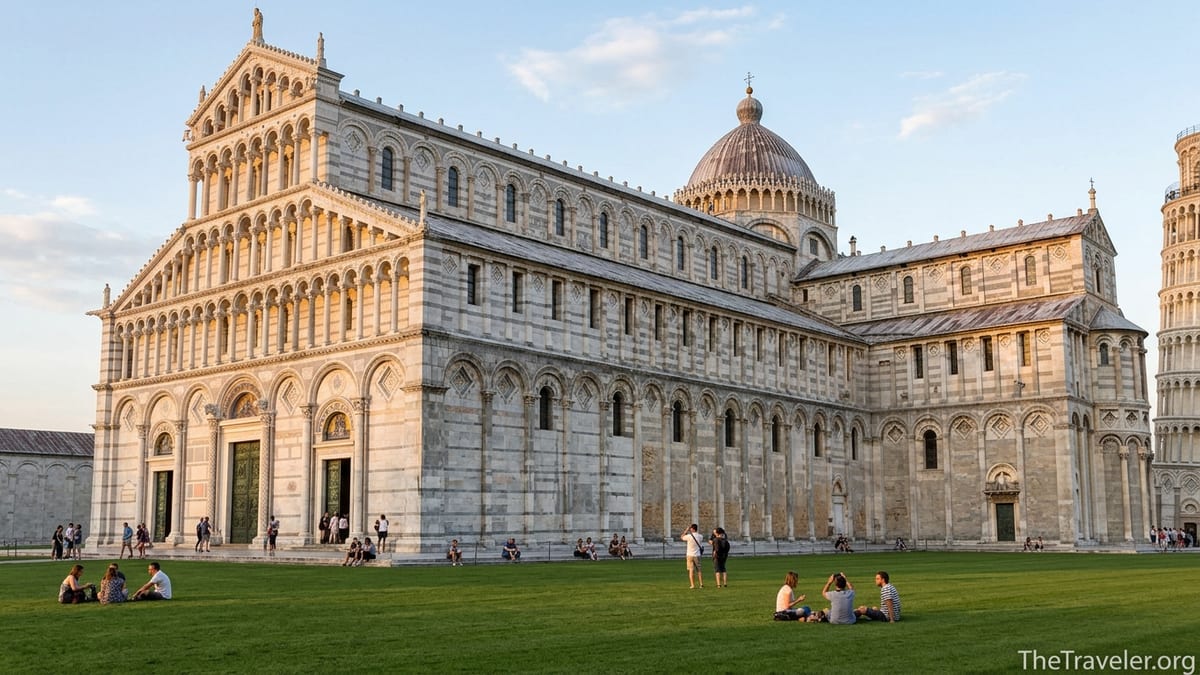
A Cathedral Born From Faith, Wealth, and the Sea
Pisa Cathedral, officially dedicated to Santa Maria Assunta, was begun in 1063 when Pisa was a rising maritime power in the Mediterranean. Its sheer size, at the time among the largest churches in Europe, was a statement of both devotion to the Virgin Mary and the city’s new political clout. The decision to build such a monumental church on what is now Piazza dei Miracoli linked religious identity with civic pride, turning the cathedral into a symbol of Pisa’s destiny as a Christian port city.
Travelers today see the same striped marble walls that medieval pilgrims saw when they arrived from North Africa, the Holy Land, or inland Tuscany. The façade’s tiers of blind arcades and columns would have been a first glimpse of Latin Christendom for sailors returning from Islamic ports or Byzantine harbors. The cathedral still functions as the seat of the Archbishop of Pisa, and the rhythm of daily Mass and major feasts, especially the Assumption of Mary on 15 August, reminds visitors that this is not a museum but a living center of Catholic worship.
That mix of old spiritual purpose and ongoing religious life is easy to witness in practice. On a typical summer weekday, you might join a timed entrance supplied with a free cathedral ticket bundled into a Leaning Tower or Baptistery pass sold through local ticket offices. Step inside during the late afternoon, and you will see tourists photographing Cimabue’s mosaic while local parishioners slip quietly into side chapels to light candles or attend confession. The coexistence of global tourism and local devotion keeps the cathedral at the heart of religious life in Pisa.
The wider complex reinforces that role. The baptistery, monumental cemetery, and campanile were all built to support the cathedral’s liturgical needs, from baptizing new Christians to burying the city’s elite. Recognized together as a UNESCO World Heritage Site, these buildings form one of Europe’s most complete medieval Christian ensembles. Yet it is the cathedral that gives the square its meaning: a place where birth, worship, and death are framed by the story of salvation told in stone, bronze, and mosaic.
Inventing “Pisan Romanesque”: An Architectural Turning Point
Architecturally, Pisa Cathedral is crucial because it helped define a distinct regional style now known as Pisan Romanesque. When construction began, Italian churches drew on a loose mix of early Christian basilicas and Lombard traditions. In Pisa, those habits merged with influences brought home by merchants and crusaders who traded with the Islamic world and the Byzantine Empire. The result is a building that borrowed widely yet turned those references into something new, especially visible in the striped marble, rounded arcades, and faintly Eastern rhythms of its elevations.
Walk around the exterior and the Pisan Romanesque vocabulary becomes easy to recognize. You will see alternating bands of white Carrara marble and darker stone, blind arcades running along the side walls, and tiers of open galleries stacked across the façade. Look closer and you notice carved capitals with animals and foliage that recall both classical Roman carving and early medieval fantasy. For architectural historians, this hybrid language marks a decisive step between the heavy, compact Romanesque of northern Europe and the more open, light-filled spaces that would eventually characterize Italian Gothic and Renaissance churches.
For a traveler, this design matters because it repeats across central Italy. When you later visit Lucca, Pistoia, or even parts of Florence, you will see façades and bell towers that echo Pisa’s striped masonry and arcade bands. In Lucca’s San Martino or Pistoia’s San Giovanni Fuorcivitas, the spirit of Pisa Cathedral is clearly present in the stone. The building did not just shape one city’s skyline; it set a model that other Tuscan communities adopted when expressing their own Christian identity in stone.
The interior reveals other innovations. The Latin-cross plan with its wide central nave and four side aisles created a generous processional space well suited to medieval liturgy, which relied heavily on movement and visual spectacle. The alternating black and white marble columns and horseshoe arches, influenced by Islamic and Byzantine architecture, created a rhythmic, almost hypnotic space that guided worshippers’ eyes toward the apse. That blend of practicality, symbolism, and visual drama would inspire later cathedrals across Italy, making Pisa a quiet but important laboratory for church architecture.
Cimabue’s Mosaic and the Birth of a New Artistic Language
Pisa Cathedral also matters for art history because it preserves one of the key works that mark Italy’s transition from Byzantine to early Renaissance painting: the great apse mosaic of Christ in Majesty with the Virgin and Saint John. The mosaic was begun around 1301, and the figure of Saint John is attributed to Cimabue, the Florentine master often described as a forerunner of Giotto. His contribution survived a devastating fire in 1595 that destroyed much of the medieval interior, making the mosaic a rare, near-contemporary witness to his style.
Stand beneath the crossing and look up at the apse, ideally in the late morning when sunlight filters through the clerestory windows and ignites the gold tesserae. The towering Christ, flanked by Mary and John the Evangelist, feels both distant and startlingly present. Christ’s robe is modeled with subtle shifts of hue, and Saint John’s face shows the first hints of emotional realism that would later define Renaissance painting. Compared with the more rigid, mask-like figures in earlier Byzantine mosaics in Ravenna or Monreale, Cimabue’s work in Pisa points toward a world in which sacred figures could display human feeling.
For visitors who have already seen Giotto’s frescoes in Padua or Florence, the Pisa mosaic offers a chance to trace that evolution backward. Many art lovers plan itineraries that link Pisa’s cathedral with Florence’s Uffizi Gallery, where Cimabue’s painted Maestà hangs alongside Giotto’s. In practice, that might mean an early-morning high-speed train from Florence to Pisa, a mid-morning visit to the cathedral’s interior to study the mosaic up close, and an afternoon return to Florence for a timed Uffizi entry. Experiencing Cimabue’s mosaic in situ, still presiding over a functioning liturgical space, is very different from seeing his panel paintings in a museum.
The mosaic also demonstrates how Italian churches used large-scale visual programs to teach complex theology to largely illiterate congregations. Medieval worshippers in Pisa would have looked up at Christ in Majesty during Mass and understood it as a preview of the Last Judgment and the glory of heaven. Today, information panels within the cathedral, and explanations by local guides, help modern travelers reconnect those images to their original religious meaning. In this way the cathedral continues to educate, bridging the gap between devotional art and art history.
Giovanni Pisano’s Pulpit and the Power of Sculpted Sermons
If the apse mosaic signals a new direction in painting, Giovanni Pisano’s pulpit inside the nave does the same for sculpture. Carved between about 1302 and 1310, this multi-sided marble structure bristles with narrative reliefs depicting scenes from the life of Christ, framed by twisting columns, personifications of virtues, and lion supports at the base. Many historians see it as one of the masterpieces of Gothic sculpture in Italy, an artwork that combines classical energy with Christian storytelling.
Approach the pulpit from the side aisles to appreciate how high it stands above the floor and how its staircase curls upward. In the reliefs, crowds press around Christ in densely layered scenes such as the Nativity, the Crucifixion, and the Last Judgment. Figures twist, lean, gesticulate, and sometimes spill out of their architectural frames. Compared with the more orderly, static reliefs of Nicola Pisano’s earlier pulpit in the nearby baptistery, Giovanni’s work feels almost cinematic, as if the Gospel narrative were unfolding in real time.
For centuries, preachers would climb this pulpit to deliver Lenten sermons and feast-day homilies to packed congregations. The images carved around them served as a permanent visual commentary on their words, making complex theological themes more immediate. Today, most travelers encounter the pulpit during short guided visits included in combined ticket packages for the square’s monuments. A good guide will often encourage you to walk slowly around the pulpit and compare individual figures, pointing out, for instance, the way sorrow is etched into the faces beneath the Crucifixion or the way angels seem to swirl above the Last Judgment.
The pulpit’s influence extends beyond Pisa. Giovanni Pisano later worked in Siena and Pistoia, and his dramatic style helped shape the emotional language of Italian Gothic sculpture. When you see sculpted pulpits and façade reliefs elsewhere in Tuscany, you are often looking at echoes of the experiments he undertook here. Pisa Cathedral thus functions as an open textbook for travelers interested in how three-dimensional religious art evolved, scene by scene, from static symbolism toward vivid human drama.
From Fire and Baroque Splendor to Modern Conservation
The cathedral’s interior tells another story that matters for Italy’s artistic history: the tension between preserving the medieval fabric and updating the building for new tastes and needs. The great fire of 1595 destroyed the roof and much of the original decoration, forcing a massive restoration in the late 16th and early 17th centuries. Out of that disaster came the richly gilded coffered ceiling over the nave and transept, new marble revetments, and large canvases by late Renaissance and Baroque painters depicting saints and episodes from the life of the Virgin.
Visitors walking down the main nave today see a layered space. Above are painted and gilded coffers that reflect the wealth and aesthetic preferences of post-Tridentine Catholicism, when the Church emphasized splendor and drama in its interiors. Along the walls, marble altars and canvases speak to ongoing devotions, each sponsored by powerful local families or religious orders. Yet above the high altar, the medieval mosaic still glows, an older voice that somehow survived the flames. The juxtaposition reminds travelers that Italian churches are not frozen in one stylistic moment but rather palimpsests written and rewritten over centuries.
In recent decades, conservation campaigns have focused on stabilizing stone surfaces, cleaning mosaics, and monitoring the cathedral’s structural health in a tourist-heavy environment. The façade’s bronze doors, for example, are modern works from the circle of Giambologna, installed after the fire to replace earlier medieval doors. Today, conservation labs in the nearby Museo dell’Opera del Duomo study such metalwork and marble fragments under controlled conditions, and some original sculptures have been moved indoors while replicas stand outside. When you compare the crisp detail of a capital inside the museum with the weather-softened version on the façade, you witness how the care of sacred art has itself become a specialized, ongoing practice.
For travelers, these efforts translate into practical measures such as controlled visitor numbers, clearly marked circulation routes inside the cathedral, and periodic closure of certain chapels during restoration. You might discover that one transept altar is curtained off behind scaffolding, with multilingual panels explaining the cleaning of a 17th-century canvas or the consolidation of a marble cornice. Far from being an inconvenience, these visible interventions highlight how seriously Pisa takes the stewardship of its religious heritage in the 21st century.
Galileo, Science, and the Cathedral as a Laboratory of Ideas
Pisa Cathedral’s importance is not limited to religion and the arts. It also occupies a special place in the history of science thanks to the figure of Galileo Galilei. According to long-standing tradition, the young Galileo observed the sway of a bronze lamp hanging from the nave and began timing its oscillations, a simple experiment that eventually contributed to his understanding of pendulum motion. Whether every detail of the story is literally accurate or somewhat embellished, the link between Galileo and the cathedral has been strong enough that UNESCO explicitly cites it in assessing the square’s historical value.
For visitors, this connection offers a powerful symbol. Within a building devoted to divine mysteries, an inquisitive mind noticed a small physical phenomenon and started asking new questions about how the world works. When you stand beneath the crossing and look up at the current chandeliers, it becomes easy to imagine a teenager counting heartbeats to measure how a pendulum’s swing remains regular regardless of amplitude. The cathedral thus becomes not only a house of prayer but also a place where observation and curiosity were quietly encouraged.
Modern Pisa embraces this dual legacy. The city’s university, one of the oldest in Europe, is a few minutes’ walk away, and students often cross the square on their way to and from lectures. On a typical weekday, you might see a group of physics undergraduates photographing the cathedral ceiling after attending a class on Galileo, or overhear guides explaining to school groups how medieval architecture, religious ritual, and early modern science intersect here. The building’s continued use as a teaching tool for both faith and reason keeps it relevant far beyond its immediate parish boundaries.
This scientific thread adds another layer to the traveler’s experience. If your Italy itinerary already includes stops like Florence’s Museo Galileo or Padua’s university anatomy theatre, adding Pisa Cathedral creates a coherent narrative about how Italian thinkers moved from theological speculation to empirical science. It reminds you that in the Italian tradition, art, faith, and science often developed in conversation rather than in isolation.
Experiencing Pisa Cathedral Today: A Living Sacred Space
All of this history would matter less if Pisa Cathedral were simply a monument frozen in time, but it remains a functioning church with an active calendar of liturgies and local events. On Sundays and major feasts, regular parishioners share pews with visitors from around the world. During Holy Week, the nave fills for processions that weave through side aisles lined with candles and statues. On important Marian feasts, the cathedral hosts special Masses and vespers where centuries-old chants echo beneath the mosaic of Christ.
Travelers can tap into that living dimension in simple ways. Instead of visiting only in the midday rush, consider entering early in the morning when the doors first open. The interior is cooler and quieter, and shafts of low light cut across the striped columns. A modest dress code applies, as in most Italian churches: shoulders covered, shorts at least knee-length. Small signs at the entrance remind visitors to remove hats and keep voices low near the high altar and chapels where people may be praying.
Tickets to the cathedral itself are often free but tied to a time slot when purchased alongside access to the Leaning Tower, baptistery, or cemetery through local ticket counters or official kiosks in the square. In practice, many visitors choose a combined pass, spend the morning climbing the tower and exploring the baptistery, then enter the cathedral in the early afternoon once group tours thin out slightly. Audio guides and locally run guided tours are widely available in several languages and can deepen your understanding of how each artwork fits into broader patterns of Italian religious culture.
Outside, the lawns of Piazza dei Miracoli offer one more reminder of the cathedral’s central role. Families picnic while facing its façade, local school groups sketch the columns, and wedding parties sometimes pose under the arcades after ceremonies. The square’s nickname, “Square of Miracles,” coined in the early 20th century, captures what many travelers still feel when they step out of the bus or off the train and see the ensemble for the first time: an improbable concentration of sacred architecture, anchored by a cathedral that has quietly shaped Italian religious and artistic life for almost a millennium.
The Takeaway
Pisa Cathedral matters because it brings together strands of Italian history that are often treated separately: medieval piety, maritime ambition, the invention of regional architectural styles, the birth of more lifelike religious art, the theatricality of the Baroque, and the beginnings of modern science. Within its walls you can trace a continuous line from the Romanesque experiments of the 11th century to the conservation challenges of the 21st, from Cimabue’s shimmering mosaic to the scientific curiosity of Galileo.
For travelers, taking the time to truly visit the cathedral rather than treating it as background for a tower selfie transforms Pisa from a quick stop into a meaningful encounter. Standing beneath the coffered ceiling, circling Giovanni Pisano’s pulpit, and watching worshippers pause before the high altar make clear that this building is not just a chapter in an art history book. It is a living space where faith, beauty, and human curiosity have long met and continue to do so. In the wider story of Italy’s religious and artistic heritage, Pisa Cathedral remains one of the country’s most eloquent and enduring voices.
FAQ
Q1. Is Pisa Cathedral worth visiting if I have already seen the Leaning Tower? Yes. The cathedral is the original centerpiece of the square, with major artworks like Cimabue’s apse mosaic and Giovanni Pisano’s pulpit that you will not experience from the outside.
Q2. How much time should I plan inside Pisa Cathedral? Most visitors spend 30 to 45 minutes, but art and architecture lovers often stay an hour or more to study the mosaic, pulpit, and ceiling in detail.
Q3. Do I need a ticket to enter Pisa Cathedral? Entry is often free but managed with timed access; many travelers obtain a free cathedral entry when purchasing paid tickets for the tower or other monuments in the square.
Q4. What is the best time of day to see the interior? Late morning and late afternoon are ideal, when natural light enhances the gold of the apse mosaic and the stripes of the marble columns while crowds are slightly thinner than midday.
Q5. Is there a dress code for Pisa Cathedral? Yes. As in most Italian churches, visitors are expected to dress modestly with shoulders covered and shorts or skirts at least knee-length, and to remove hats inside.
Q6. Can I attend Mass at Pisa Cathedral as a visitor? Visitors are welcome at public liturgies; you can quietly join locals for Sunday or feast-day Mass, taking care to arrive a bit early and avoid moving around during the service.
Q7. What are the must-see artworks inside the cathedral? Do not miss the apse mosaic of Christ in Majesty, Giovanni Pisano’s sculpted pulpit, the gilded coffered ceiling, and the marble altars and paintings along the nave and transepts.
Q8. How does Pisa Cathedral compare to Florence or Siena’s cathedrals? Pisa is earlier and more strongly Romanesque, with clear Byzantine and Mediterranean influences, while Florence and Siena show later Gothic and early Renaissance developments that in many ways grew from models established in Pisa.
Q9. Is Pisa Cathedral accessible for travelers with limited mobility? Access is generally level at the main entrance, and staff can assist; it is advisable for travelers with mobility concerns to check current arrangements at the ticket office on arrival.
Q10. Can I take photos inside Pisa Cathedral? Non-flash photography is typically allowed for personal use, but tripods and disruptive equipment are restricted, and visitors are asked to avoid photographing during liturgical celebrations.