


Most visitors arrive in Pisa with one goal in mind: to see the Leaning Tower. Yet the tower was never meant to be the star. It is only the bell tower of a far more important building that quietly dominates the Piazza dei Miracoli: Pisa Cathedral, or the Duomo di Santa Maria Assunta. Understanding the story behind this cathedral, from its 11th‑century foundations to its distinctive “Pisan Romanesque” style, transforms a quick photo stop into one of the most rewarding architectural visits in Italy.
Get the latest updates straight to your inbox!
A Cathedral Born From Maritime Power and Ambition
Pisa Cathedral rose in an era when Pisa was not a sleepy Tuscan town, but a formidable maritime republic rivaling Genoa, Venice, and Amalfi. Construction began around 1063–1064, shortly after a major Pisan victory in Palermo in Sicily. Contemporary sources and later city tradition present the Duomo as a kind of stone trophy, funded and built to proclaim the city’s strength and piety. For travelers today, it helps to imagine the cathedral as medieval Pisa’s equivalent of a flagship: a public statement that could not be missed by anyone entering the city.
In a bold gesture, the city chose to build its new cathedral outside the early medieval walls, on what was then an open field at the edge of town. The message was clear: Pisa felt no need to hide its greatest treasure behind fortifications. This field, now the UNESCO‑listed Piazza dei Miracoli, would later gain the Baptistery, the monumental cemetery, and the now‑famous leaning campanile. When you step off the modern shuttle bus or walk in from the train station, you are essentially entering through what used to be the outskirts, where the Duomo once stood alone against the horizon.
The first master architect was Buscheto, probably of Mediterranean background, who started a building that already broke many local conventions. After his death, another architect, Rainaldo, extended the nave and completed the remarkable facade. Together they created not just a cathedral, but a new architectural language that would spread across Tuscany and islands once controlled by Pisa.
Understanding the Pisan Romanesque Style
Pisa Cathedral is the textbook example of what art historians call “Pisan Romanesque,” a regional variant of the broader Romanesque style that flourished across Europe from the 11th to early 13th centuries. Romanesque churches usually feature thick walls, rounded arches, and relatively small windows. In Pisa, these elements were reimagined with Mediterranean lightness and strong references to classical and Byzantine architecture. The result, as you will see walking around the exterior, is a building that feels both solid and unexpectedly airy.
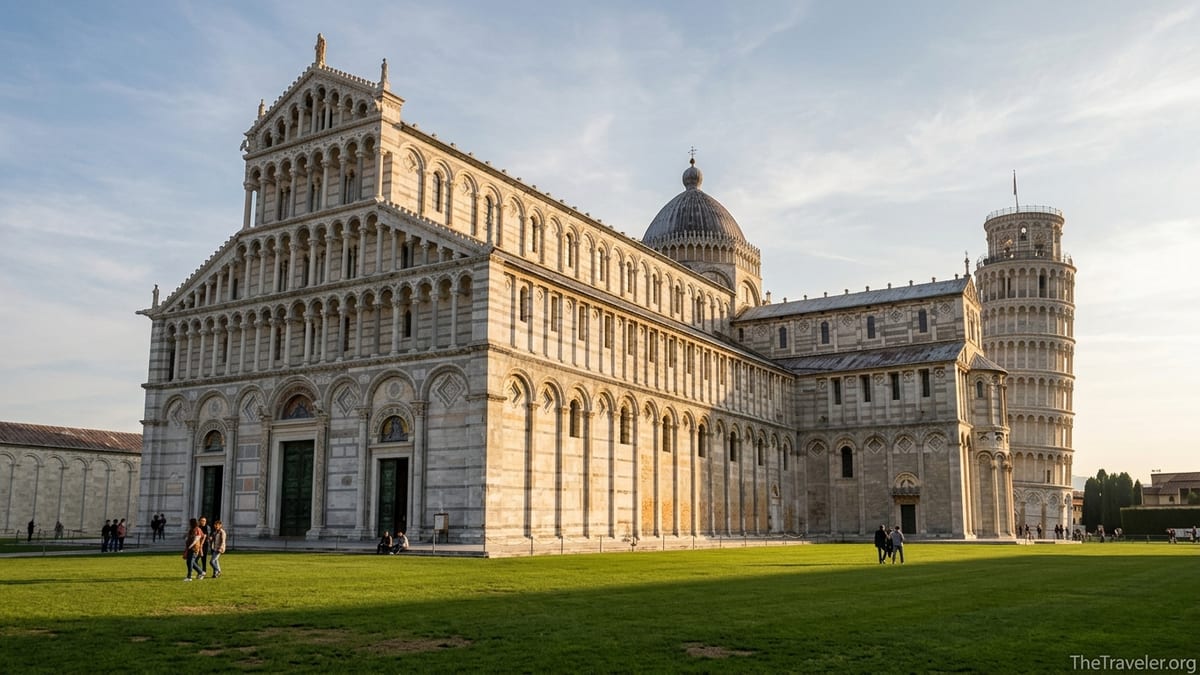
Look at the facade from the grass in front of the cathedral. You will notice four tiers of open arcades stacked above a solid lower level. These arcades are not just decorative; they break up the mass of the wall into delicate rhythms of columns and arches, giving the front a lace‑like quality when the afternoon sun strikes. The use of alternating colored marble, mostly white Carrara with darker stone accents, creates horizontal stripes that echo early Christian basilicas in Rome but feel distinctly Tuscan.
A hallmark of Pisan Romanesque is the playful reuse of classical fragments. As you walk along the flanks of the Duomo, look closely at the bases and capitals of some columns and at the carved panels set into the walls. Many are spolia: pieces taken from ancient Roman buildings or from monuments in conquered Mediterranean cities. For a visitor in 2026, a guided tour costing roughly 15 to 20 euros per person often points these out, linking them to Pisa’s trading and military routes to Sardinia, Corsica, and North Africa.
The cathedral’s plan also reveals the Romanesque character of the building. From above, it forms a Latin cross, with a long nave, shorter transepts, and a projecting apse. Yet even this conventional outline is enriched with local twists, such as the unusual elliptical dome over the crossing. When you step inside and look up at this dome painted with a glittering sky of frescoes, it is easy to see how Pisa’s architects blended Western structural forms with ideas drawn from Byzantine and Islamic domed spaces around the Mediterranean.
Reading the Façade: Marble, Bronze, and Spoils of the Sea
Most visitors first encounter the Duomo via its facade, a layered composition of marble, sculpture, and bronze. To appreciate it, stand back near the central lawn, ideally in the late afternoon when the low sun accentuates every carving. The bottom level consists of tall blind arcades and three great portals. Behind you, crowds cluster around the Leaning Tower; in front of you is the building that gave the tower its reason to exist.
The current bronze doors on the main portal are 17th‑century works created after a devastating fire in 1595 destroyed earlier doors. They depict scenes from the life of the Virgin and Christ. At the right end of the facade, however, the so‑called San Ranieri door, usually accessed from the south transept, preserves an earlier set of bronze panels cast by Bonanno Pisano in the late 12th century. Many modern visitors enter the cathedral through this side, often after queuing next to the Leaning Tower. When you pass through, take a moment to look at the small narrative scenes: they compress complex Gospel stories into a sequence of vivid medieval images.
Higher up, the facade is punctuated by rows of slender columns, many in colored marble or granite. Some of these shafts are thought to be reworked from earlier Roman structures, shipped to Pisa as political trophies or purchased as valuable building material. At the very top sits a statue of the Virgin and Child, a reminder that the cathedral is dedicated to Santa Maria Assunta, the Assumption of Mary. If you book a timed ticket that includes the Baptistery and Camposanto, priced in 2026 at roughly 10 to 15 euros depending on the combination, you can spend an hour just circling the Duomo and spotting details on the facade that repeat, in different variations, across the whole square.
Travelers interested in comparative architecture may notice that the facade of Pisa Cathedral feels more cohesive than many Italian churches where the front is clearly a later addition. Here, horizontal string courses and arcades visually knit the facade into the body of the building behind it. This integration became a model for later churches across the region. If your itinerary includes Lucca or Pistoia, you will recognize the Pisan influence in churches like San Michele in Foro or the cathedral of Pistoia, both of which echo the multi‑tiered arcaded fronts pioneered here in Pisa.
Inside the Duomo: Light, Space, and the Glitter of Mosaics
Stepping into Pisa Cathedral after waiting at the ticket office on the north side of the square, visitors are often surprised that admission is technically free. In practice, you still need to obtain a timed free pass or hold a combo ticket to enter. Once inside, the bustle of the piazza gives way to a cool, striped interior of light and shadow. The nave walls are faced with alternating bands of black and white marble, an effect that will feel familiar if you have seen the interiors of Siena or Florence’s cathedrals, though Pisa’s is stylistically earlier.
The nave is divided by rows of massive granite columns, many quarried on the island of Elba and some said to have been captured during campaigns in Sicily. Each column is a single monolithic shaft, which was a major technical and financial feat in the 11th century. When a guide points out that each of these columns had to be shipped by sea and hauled overland, the space suddenly reads not only as a place of worship but also as a celebration of Pisa’s maritime logistics.
Look up and you will see a richly gilded coffered ceiling added in the 17th century after the fire of 1595. In the center is the Medici coat of arms, evidence of the later political control of Pisa by Florence. Although the ceiling is post‑medieval, it harmonizes with the older structure and reflects light down into the nave, especially on sunny mid‑day visits. If you stand just behind the crossing and let your eyes adjust, a subtle glow from the apse will draw your attention further east.
There, in the half‑dome of the apse, is one of the cathedral’s greatest treasures: a monumental mosaic of Christ in Majesty, or Christ Pantocrator, flanked by the Virgin and Saint John the Evangelist. Completed in the late 13th century and substantially the work of the painter Cimabue, it survived the 1595 fire that destroyed so much else. Many organized tours that cost around 30 to 40 euros per person, including the tower, make a point of pausing here. Even independent travelers should give themselves several minutes to take in the mosaic’s gold background and expressive faces, which bridge the transition from Byzantine to early Italian Renaissance art.
The 1595 Fire and What Was Lost and Rebuilt
The interior appearance you see today is partly the result of disaster. On a June day in 1595, a fire triggered during roof repairs swept through the cathedral’s wooden trusses and coffered ceilings. Flames destroyed much of the medieval timber roof, several bronze doors, and numerous paintings and furnishings. For architecture enthusiasts, this event marks a dividing line between the original Romanesque interior and the later Baroque and post‑Baroque interventions.
In the decades that followed, the cathedral chapter and Tuscan rulers embarked on an extensive restoration and redecoration campaign. New bronze doors were commissioned for the main portals, the wooden roof was replaced, and frescoes and paintings were installed along the nave and transepts. The richly gilded ceiling you see today is a product of this phase. When you visit, you are looking at a carefully staged interior that seeks to respect the Romanesque skeleton while overlaying a 16th‑ and 17th‑century visual language of splendor.
One of the most famous casualties of the post‑fire reorganization was the great pulpit by Giovanni Pisano, carved between 1302 and 1310. To facilitate roof reconstruction, the pulpit was dismantled around 1600, its elements stored or reused. It was not reassembled in the cathedral until the 1920s, and even then not in its original location. When you find it today along the right side of the nave, you are seeing a puzzle that modern scholars pieced back together, with some original components missing.
For visitors interested in how historic buildings evolve, the story of the fire is a reminder that what you see in 2026 is only the latest chapter. If you have time, consider visiting the nearby Opera del Duomo Museum, where several original sculptures and fragments from the cathedral are preserved indoors, protected from weather and later alterations. Entry to the museum is usually included in higher‑priced combination tickets and can be a quieter complement to the crowded main monuments.
Giovanni Pisano’s Pulpit and Sculpted Storytelling
Among the many artworks inside Pisa Cathedral, Giovanni Pisano’s marble pulpit stands out as a masterpiece that rewards close, unhurried viewing. Carved in the early 14th century, it is supported by a cluster of columns and figures, including personifications of virtues and crouching animals. Above, a hexagonal parapet is covered with densely packed reliefs narrating scenes from the life of Christ: the Nativity, the Adoration of the Magi, the Crucifixion, and others.
Unlike the more static figures of earlier Romanesque sculpture, Giovanni’s characters twist, lean, and gesture in ways that anticipate the emotional realism of the Renaissance. If you are visiting during a relatively quiet time of day, such as early morning slots before the Leaning Tower crowds peak, you can walk around the pulpit slowly and notice details like the expressive faces of grieving figures at the Deposition or the tightly bunched bodies around the manger scene.
The pulpit also illustrates how Pisa Cathedral functioned as a stage for preaching and public ritual. In the Middle Ages, a cleric would climb a staircase (now reconstructed differently from the original) and address the congregation from this elevated platform, using the carved scenes as visual reinforcement of his message. For modern travelers, accustomed to audio guides and projection screens, the pulpit is a reminder of how architecture and sculpture once worked together as teaching tools for largely illiterate audiences.
Giovanni’s work in Pisa would influence pulpits and sculptural programs in other Tuscan churches. If your itinerary takes you to Siena Cathedral, for example, you can see an earlier but related pulpit by his father Nicola Pisano. Comparing the two gives a tangible sense of how sculptural style evolved across generations, and how Pisa’s cathedral acted as both a laboratory and an export hub for new artistic ideas.
How the Cathedral Relates to the Leaning Tower and the Piazza dei Miracoli
No visit to Pisa Cathedral is complete without understanding its relationship to the other monuments in the Piazza dei Miracoli. The Duomo stands at the center of a carefully planned sacred complex that includes the Baptistery to the west, the campanile (Leaning Tower) at the south‑west corner, and the Camposanto Monumentale to the north. All four share similar materials, such as white marble with darker stone accents, and many design motifs, including arcaded galleries and sculpted capitals.
The Leaning Tower, begun in the 12th century, was conceived simply as the cathedral’s bell tower. Its signature tilt, caused by unstable soil, turned what was meant to be a functional adjunct into a world‑famous attraction. In practice, many travelers today book a climbing slot for the tower first, then time their cathedral entry around it. Combination tickets in 2026 that include the tower plus the Duomo and other monuments often range between 25 and 35 euros for adults, with discounted rates for children and seniors.
From an architectural perspective, the tower echoes elements of the Duomo: ring after ring of open arcades with slender columns, a circular variation on the horizontal tiers of the cathedral’s facade. Standing in the Camposanto’s cloister, you can frame both the tower and the Duomo in a single view and see how their rhythms align. The Baptistery similarly combines a Romanesque lower zone with a later Gothic crown, but its striped marble and arcades clearly reference the cathedral that inspired it.
For visitors, this means that time spent studying the Duomo pays dividends when you look at the other buildings. The black‑and‑white striping inside the cathedral echoes in the Baptistery’s stone; the reuse of classical fragments on the Duomo’s walls continues in the Camposanto’s sarcophagi. Allowing at least half a day for the entire complex, rather than rushing through in an hour, makes the architectural dialogue between the four monuments much easier to appreciate.
Planning Your Visit: Practical Tips to See the Architecture at Its Best
Pisa Cathedral remains an active place of worship, so access and opening times can vary slightly with the liturgical calendar. In 2026, the standard pattern is that the square opens in the morning, with the cathedral operating on timed entry slots that begin mid‑morning and run through late afternoon, except during Mass. It is wise to check times in advance via the local tourist board or at the ticket office near the Baptistery, especially if you are visiting on a Sunday or major feast day.
Tickets for the Duomo itself are officially free, but you must hold either a dated free pass or a paid ticket to another monument. Many travelers who arrive on day trips from Florence or La Spezia (including cruise excursions) opt for a package that includes the Leaning Tower, Duomo, and at least one additional site. Because tower climbs are strictly timed and limited in number, it can be worth reserving those online ahead of time, then planning your cathedral visit for earlier or later in the day when group tours are fewer.
From a purely architectural perspective, the best times to see the Duomo are early morning or late afternoon. In the morning, the interior is generally quieter, which makes it easier to linger by the pulpit, mosaic apse, and side chapels. Late afternoon light, on the other hand, is ideal for photographing the facade as the sun warms the marble and shadows deepen the arcades. Tripods are usually not allowed in the interior, but a standard smartphone or a small mirrorless camera with a wide‑angle lens will capture most of the key views without issue.
Dress codes are enforced intermittently but can be stricter in high season, similar to other Italian churches. Shoulders and knees should be covered, and hats removed. Security screening at the entrance is fairly quick but can create bottlenecks during the busiest summer weeks, so arriving 15 to 30 minutes before your timed slot is prudent. Lockers and left‑luggage facilities are available near the ticket office for items not allowed in the tower climb, which can also be convenient if you are carrying a larger backpack and want to move more freely inside the cathedral.
The Takeaway
Pisa Cathedral is far more than the backdrop to a famous leaning bell tower. It is the building that crystallized Pisa’s golden age into stone, inaugurated a distinct Romanesque style, and set a pattern that neighboring cities would emulate for generations. Standing beneath its striped arches, or gazing up at Cimabue’s mosaic in the apse, you step into a space that compresses centuries of Mediterranean exchange: Roman columns and Sicilian spoils, Byzantine mosaics and Tuscan marble, medieval ambition and post‑Renaissance restoration.
For travelers willing to look beyond the obvious snapshot of a tilting tower, the Duomo offers one of Italy’s most layered architectural experiences. Give it time. Circle the exterior to read the facade, pause by Giovanni Pisano’s pulpit to see how stone can tell stories, and let your eyes adjust to the glow of the apse mosaic. In doing so, you will not only understand Pisa’s remarkable cathedral more deeply, but also see the entire Piazza dei Miracoli and, indeed, Romanesque architecture across Europe, with a sharper, more informed eye.
FAQ
Q1. When was Pisa Cathedral built?
The earliest construction phase began around 1063–1064, and major work continued through the 12th century, with additions and restorations in later centuries.
Q2. What architectural style is Pisa Cathedral?
Pisa Cathedral is a prime example of Pisan Romanesque, a regional form of Romanesque architecture characterized by arcaded facades, striped marble, and classical influences.
Q3. Is it free to enter Pisa Cathedral?
Yes, entry to the cathedral is officially free, but you must obtain a timed free pass or hold a paid ticket to another monument in the Piazza dei Miracoli.
Q4. How much time should I plan for a visit?
Plan at least 45 to 60 minutes inside the cathedral, and two to four hours if you want to visit the Duomo along with the Leaning Tower, Baptistery, and Camposanto.
Q5. What are the must‑see highlights inside the cathedral?
Key highlights include the apse mosaic of Christ in Majesty, Giovanni Pisano’s marble pulpit, the striped marble nave, and the gilded coffered ceiling.
Q6. Can I take photos inside Pisa Cathedral?
Photography without flash is generally allowed for personal use, but tripods and professional equipment are typically restricted, so check local rules on arrival.
Q7. Do I need to book tickets in advance?
You usually do not need to prebook for the cathedral alone, but advance reservations are strongly recommended for Leaning Tower climbs and combination tickets.
Q8. What is the best time of day to visit for fewer crowds?
Early morning and late afternoon tend to be quieter inside the cathedral, especially outside peak summer months and major public holidays.
Q9. Is Pisa Cathedral accessible for visitors with limited mobility?
The main floor of the cathedral is largely accessible, though some areas have small steps or uneven surfaces; staff can advise on the easiest entrance and pathways.
Q10. How does Pisa Cathedral relate to the Leaning Tower?
The Leaning Tower is the cathedral’s freestanding bell tower, designed to serve the Duomo; both share similar materials and arcaded forms within the same sacred complex.