


Adolfo Suarez Madrid Barajas Airport is the main gateway to Spain and one of Europe’s busiest hubs. Whether you are changing planes on your way to Latin America, starting a city break in Madrid or facing a long overnight layover, a little advance planning will make your time at Barajas far easier. This guide walks you through how the airport is laid out, how much time you realistically need for connections, what it costs to get into the city and where you can rest, work or sleep if you are in transit.
Get the latest updates straight to your inbox!
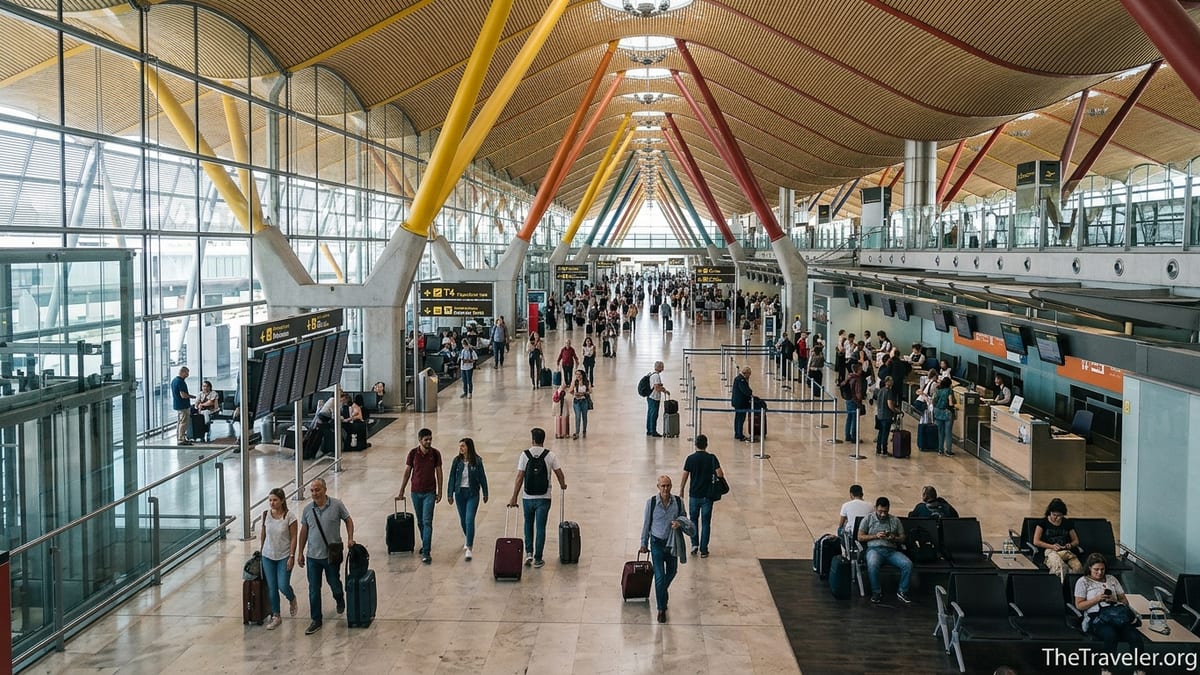
Understanding Madrid Barajas: Layout, Terminals and Airlines
Madrid Barajas sits about 12 to 15 kilometers northeast of the city center and has four main passenger terminals: T1, T2, T3 and the newer T4, plus the satellite building T4S. The terminals are in two main zones. T1, T2 and T3 form one large complex, while T4 and T4S are in a separate area a few minutes away by airport shuttle. Knowing which terminal you will use is the first step in planning your time, especially if you have a connection.
Most long haul and many European flights on Iberia and its oneworld partners such as American Airlines and British Airways operate from T4 and T4S. A typical itinerary from New York to Madrid on Iberia lands at T4S, with a short automated train ride to T4 for arrivals and connections. Many low cost and non alliance carriers use the older terminals. For example, Ryanair typically uses T1 while several Star Alliance airlines and regional European carriers use T2. If your inbound and outbound flights are on different airlines or alliances, check carefully whether you will need to change terminal zones.
Transfers between T1, T2, T3 and T4 are handled by a free green airport shuttle bus that runs 24 hours a day. In normal daytime traffic it takes about 10 minutes between T1 and T4, but you should allow at least 25 to 30 minutes from stepping off the plane to reaching another terminal gate area, and more if you need to collect bags and check in again. The key message: build in extra time if your flights use different terminals or if you need to recheck luggage with another airline.
For most point to point trips, you will only see one terminal. If, for example, you are flying Chicago to Madrid on American and then continuing to Seville on Iberia, your entire journey will be in T4 and T4S. Your bags are usually checked through, and you follow the signs for connecting flights without exiting to the public area. This is the smoothest type of connection and usually the least stressful.
How Much Time Do You Really Need for a Connection?
Official minimum connection times at Barajas can be as low as around 45 to 60 minutes on a single ticket, but those figures assume everything runs perfectly. In practice, most frequent flyers aim for at least 90 minutes for a domestic or Schengen connection and around two hours when changing between non Schengen and Schengen flights, especially if you need to clear passport control. This buffer protects you from queues at security or delays in disembarkation and transport between gates or terminals.
Consider an example: you land in Madrid from Miami at 07:30 in T4S and need to connect to a 09:00 Schengen flight to Rome from T4. You must walk from your arrival gate to passport control, clear the check, take the automated train to T4, pass through security again and then walk to your departure gate. If passport control is quiet this can take around 45 minutes, but in peak morning banks it can stretch closer to an hour. With a 90 minute connection, you still have time for a quick coffee at a café like Rodilla or Mahou Bar near the gate. With a 60 minute connection, any small delay can make the experience stressful.
Connections that involve a terminal change need more padding. If you arrive on a low cost carrier like Ryanair into T1 and depart on Iberia from T4, you will usually need to collect your checked luggage, exit arrivals, take the green shuttle bus to T4, check in again and clear security. On busy days this whole process can easily take 2 to 2.5 hours. Many travelers in this situation book at least a 3 hour gap and treat the time as a chance to have a proper breakfast or browse shops once they are airside again.
If you are buying separate tickets, be even more conservative. For example, if you fly into Madrid with an intercontinental carrier that arrives at T4S and then continue on a separately booked low cost flight from T1, a 4 hour window is often a sensible minimum. That allows for a late inbound flight, longer queues at passport control and the transfer between terminals, as well as time to resolve any baggage issues without panicking.
Arrivals: Immigration, Baggage and Getting Your Bearings
On arrival from a non Schengen country like the United States or the United Kingdom, you will pass through passport control before reaching baggage claim. The experience can vary. Arriving at 6 in the morning, many travelers report being through in 15 to 20 minutes. Landing with a wave of long haul flights around mid morning or late afternoon, the queue can be significantly longer. Automated passport gates, where available for eligible travelers, usually speed things up, but staff occasionally funnel everyone through manual checks when traffic is heavy.
Once past immigration, you will enter the baggage claim hall specific to your terminal. Carousels are clearly numbered, and digital screens show expected delivery times. At busy times it can still take 20 to 30 minutes for bags from a large wide body aircraft to arrive. If your bag does not appear, most airlines at Barajas now support starting a property irregularity report online via their apps or websites, which can save you from queuing at the baggage service desk along with other affected passengers.
After collecting bags, you exit into the arrivals hall, where you will find ATMs from major Spanish banks, car rental desks and information counters. Currency exchange counters are available but typically use less favorable rates than withdrawing from an ATM, so many travelers use their bank card instead. Public transport ticket machines for the metro and some bus services are located in or near the arrivals and transport connections area, which is helpful if you plan to go straight into the city by metro or bus.
If you feel disoriented, look for the large overhead signs color coded by function and terminal area, a design feature that has made T4 in particular easier to navigate than many older European airports. Staff at the official information desks speak Spanish and generally good English, and they can confirm the latest details on shuttle buses, metro services or where to find specific airline check in counters.
From Airport to City: Metro, Train, Bus and Taxi
Madrid Barajas is relatively close to the city center, and travelers have several practical options at different price points. The metro runs directly from the airport into the city on Line 8. There are two airport metro stations: one serving T1, T2 and T3, and another serving T4. A typical journey from T4 to the central hub of Nuevos Ministerios takes around 20 minutes, with onward connections to the rest of the metro network. You must buy or reload a rechargeable transport card at the vending machines and pay a small airport supplement on top of the regular metro fare, but the total cost remains modest compared with many other European hubs.
Another popular option is the Cercanias commuter train, which connects T4 with stations such as Chamartin and Atocha. The trip from T4 to Chamartin often takes around 10 to 12 minutes and about 25 to 30 minutes to Atocha, depending on the service. This can be particularly useful if your hotel is near one of these stations or if you are connecting to long distance trains elsewhere in Spain. Ticket prices are usually similar to regular city train fares, making this a cost effective route for solo travelers or couples.
For those who prefer a direct road link, the yellow Airport Express bus, often labeled as Line 203, runs between the airport and central Madrid with stops at places like O’Donnell, Cibeles and Atocha. The service is designed for travelers with luggage, with underfloor storage and space for suitcases, and typically costs a bit more than a standard city bus but less than a taxi. Journey times vary with traffic but usually range from 30 to 40 minutes to reach central points.
Taxis are straightforward and popular, especially for late night arrivals or families with children and multiple bags. Madrid operates a fixed fare from the airport to most addresses in the central city area, so you know in advance approximately what you will pay for the whole car rather than per person. At busy times you may queue briefly at the official taxi ranks outside each terminal, but cars usually move quickly. Ride hailing services also operate from designated pick up points, with prices that can sometimes be slightly lower or higher than the fixed taxi rate depending on demand. For a group of three or four sharing, door to door taxi or ride hailing often works out only slightly more expensive than four separate public transport tickets.
Leaving Madrid: Check In, Security and What to Expect Airside
On departure from Madrid Barajas, timing is again important. For flights within Spain or the Schengen area, airlines commonly recommend arriving at least two hours before departure. For intercontinental flights to North America or Latin America, three hours is a safer bet, especially at peak travel times such as summer weekends and major holidays. This allows for check in or bag drop, security, any passport control checks and the walk to your gate.
Security checkpoints in T4 are usually spacious, but queues can build quickly in the morning rush between roughly 6:30 and 9:00. Independent monitoring sites and traveler reports consistently describe wait times that can range from under 15 minutes at quiet times to 30 minutes or more when several waves of departing flights overlap. Liquids in small containers must be placed in a clear plastic bag, and electronics such as laptops are often requested to be removed from carry on bags, similar to most other European airports.
Airside, the range of services varies by terminal. T4 and T4S have the broadest choice of restaurants, cafés and shops, including Spanish chains like 100 Montaditos for quick sandwiches, Mahou or Estrella branded bars for a last local beer, and branches of global coffee brands. Pricing is higher than in the city, but a basic coffee and pastry can still be found for only slightly more than downtown cafés. The older terminals also offer duty free shops and food options, though with somewhat fewer choices and a more traditional layout.
Lounges are available in all major terminals, including airline operated lounges for oneworld carriers in T4 and several independent lounges that accept pay per use access or membership cards in T1, T2 and T4. For example, a traveler with a Priority Pass membership can often access lounges in both Schengen and non Schengen areas, subject to space and time restrictions, which is useful if your flight is delayed and you need a quiet place to work or rest.
Long Layovers, Sleeping and Luggage Storage
If you have a long layover, Madrid Barajas offers multiple options ranging from simple airport benches to full hotel rooms. Many travelers with overnight layovers choose to stay landside in T4, which is spacious and stays open all night, with a noticeable number of people “camping” on benches or quiet corners. Security does not generally move sleepers on as long as they remain in designated public areas. However, the lighting remains on, and cleaning and announcements can make it a noisy environment.
For more comfort, there is an airside hotel in T4 that sells rooms by the hour or overnight, aimed at travelers who do not want to leave the secure zone. A few minutes’ walk from the gates, it offers basic but comfortable rooms with beds, showers, Wi Fi and soundproofing, useful for those with early morning departures. In addition, capsule style resting pods have been introduced in parts of the airport. These small private units come with a bed, power outlets and storage for hand luggage, and can usually be rented for a block of hours, making them a mid range step between a bench and a hotel room.
Outside the terminals, several traditional hotels cluster around Barajas town and along the main access roads, many of which provide free shuttle buses to and from all terminals. For example, a mid range chain hotel in Barajas might offer a night’s stay with shuttle included for a price that is often comparable to or slightly above the cost of several rest pod sessions for a couple. For a 15 to 20 hour layover, many travelers choose a real bed and shower in one of these hotels and perhaps a dinner in the nearby neighborhood before returning to the airport.
Luggage storage is available inside the airport with staffed left luggage facilities in some terminals that charge per item per 24 hour period, often with discounts for longer storage. This can be useful if you are returning through Madrid a few days later and want to leave a large suitcase behind while you travel light elsewhere in Spain. In the city itself, third party services connect travelers with hotels and shops willing to store bags for a fee, sometimes at lower prices than the airport options. These city based services can be practical if you plan to spend all day in Madrid between flights and do not want to keep returning to the airport.
Making the Most of a Few Hours in Madrid
One of the advantages of Barajas is its proximity to central Madrid. If your layover is longer than about six to seven hours and your luggage situation is simple, leaving the airport for a quick taste of the city can be realistic. For example, if you land at 09:00 and your onward flight departs at 19:00, you might clear immigration and be on a metro or train to the center by 10:30, allowing four or five relaxed hours in town before heading back around 15:30 or 16:00.
Popular short stop ideas include a walk around the Plaza Mayor and Puerta del Sol area, coffee at a traditional café near Gran Via, or a stroll in Retiro Park if the weather is pleasant. Art lovers might choose to focus on a single museum such as the Prado or Reina Sofia rather than trying to see everything. Whatever you plan, remember to leave generous time for the return trip and airport formalities. For an intercontinental departure, aim to be back at the appropriate terminal three hours before scheduled takeoff, and factor in possible delays on public transport at rush hour.
If you prefer to stay closer to the airport, the nearby district of Barajas offers local restaurants and cafés within a short taxi or bus ride from the terminals. Spending an afternoon there can be more relaxing than remaining inside the airport while still keeping you only a few minutes from check in. This works especially well for families who want outdoor space for children to run around in a local park before a long onward flight.
When considering whether to leave the airport, think about visas and entry rules. If you are not an EU or Schengen national, ensure that you are eligible to enter Spain on your passport and that you do not risk any complications by crossing the border for just a few hours. If your bags are checked through and you have a boarding pass for the next leg, re entering the secure area is usually straightforward, but the decision ultimately depends on your comfort with timing and procedures.
The Takeaway
Madrid Barajas is a large but generally well organized airport. Understanding its terminal layout, planning adequate connection times and choosing the right transport into the city are the three decisions that most strongly shape your experience. A traveler connecting inside T4 on a single ticket with a two hour buffer will usually find the process smooth, while someone changing from a low cost carrier in T1 to a long haul flight in T4 on separate tickets with only 90 minutes can face avoidable stress.
For arrivals and departures, prepare in the same way you would for any major European hub. Have your documents to hand for passport control, expect variable queues at security, and use the time airside to eat, hydrate and charge devices rather than browsing aimlessly. If you know you will often pass through Madrid, consider loyalty programmes or lounge access that give you a more predictable environment on busy travel days.
On longer layovers, weigh the appeal of a quick visit to central Madrid against the value of rest. A capsule, day room or nearby hotel can transform a long wait into a chance to recover from jet lag. With a bit of homework before you fly, Barajas can feel less like an obstacle on your journey and more like a manageable, even pleasant, stopover that connects you efficiently to Spain, Europe and Latin America.
FAQ
Q1. How early should I arrive at Madrid Barajas before my flight? For flights within Spain or the Schengen area, arriving about two hours before departure is usually sufficient. For long haul flights, especially to North America or Latin America, aim for three hours to allow for check in, security, passport control and walking time to distant gates.
Q2. Is one hour enough for a connection at Madrid Barajas? One hour can work for tight, same terminal connections on a single ticket, but it leaves very little margin for delays. Most travelers feel more comfortable with at least 90 minutes for Schengen to Schengen connections and around two hours when changing between non Schengen and Schengen flights or changing terminals.
Q3. Which terminal does Iberia use at Madrid Barajas? Iberia and most of its oneworld partners use Terminal 4 and the satellite building T4S. Long haul flights often arrive and depart from T4S, with a short automated train ride connecting it to the main T4 building for arrivals, departures and transfers.
Q4. What is the easiest way to get from the airport to central Madrid? For many visitors, the metro or the Cercanias commuter train from T4 are the most economical and predictable options, taking around 20 to 30 minutes to reach central stations. The yellow Airport Express bus is a good alternative if you have more luggage, while taxis and ride hailing services offer fixed or near fixed prices and door to door convenience.
Q5. Are there hotels inside Madrid Barajas Airport? Yes. There is a hotel inside Terminal 4 that offers rooms by the hour or overnight for passengers who prefer not to leave the secure area, and there are also capsule style sleeping pods in parts of the airport. In addition, multiple traditional hotels around the airport and in the nearby Barajas district offer free shuttle buses to the terminals.
Q6. Can I sleep in the airport if I have an overnight layover? Sleeping informally in the public areas of Madrid Barajas, particularly in Terminal 4, is common and generally tolerated. Many travelers use benches or quiet corners overnight. However, light, noise and cleaning operations can make this uncomfortable, so some passengers prefer a rest pod or nearby hotel for better sleep.
Q7. Is there luggage storage at Madrid Barajas? Yes. The airport offers staffed left luggage facilities in certain terminals where you can store bags for a daily fee, often with discounts for multi day storage. In central Madrid, several private services work with hotels and shops to provide alternative bag storage, which can be useful if you plan to spend your layover in the city.
Q8. How much does a taxi from Madrid Barajas to the city center cost? Madrid uses a fixed fare system for trips between the airport and defined central zones of the city, which keeps costs predictable. The total price for the car is typically comparable to or slightly higher than what three or four people would pay in total for public transport tickets, making taxis good value for small groups or families.
Q9. What should I do on a 6 to 8 hour layover in Madrid? With a layover of 6 to 8 hours, you can often leave the airport for a brief visit to central Madrid if immigration and security conditions allow. Many travelers opt for a walk around Puerta del Sol and Plaza Mayor, a meal near Gran Via or a relaxed stroll in Retiro Park, returning to the airport at least three hours before an intercontinental departure.
Q10. Is Madrid Barajas difficult to navigate for first time visitors? Although Barajas is large, it is generally well signposted, especially in Terminal 4, where color coded columns and clear overhead signage make orientation easier. First time visitors who know their terminal in advance, follow the signs and allow adequate time for walking, security and passport formalities usually find the airport manageable.