


Plovdiv is often marketed as an easy day trip from Sofia, but treating Bulgaria’s second city as a quick tick-box does it a disservice. With a remarkably intact Roman theatre and stadium, layered ruins from ancient Philippopolis, a cobbled Old Town of nineteenth century mansions, a lively creative quarter and green hills that glow at sunset, Plovdiv rewards at least two full days. Add in straightforward rail and bus links from Sofia and you have one of Eastern Europe’s most appealing city breaks.
Get the latest updates straight to your inbox!
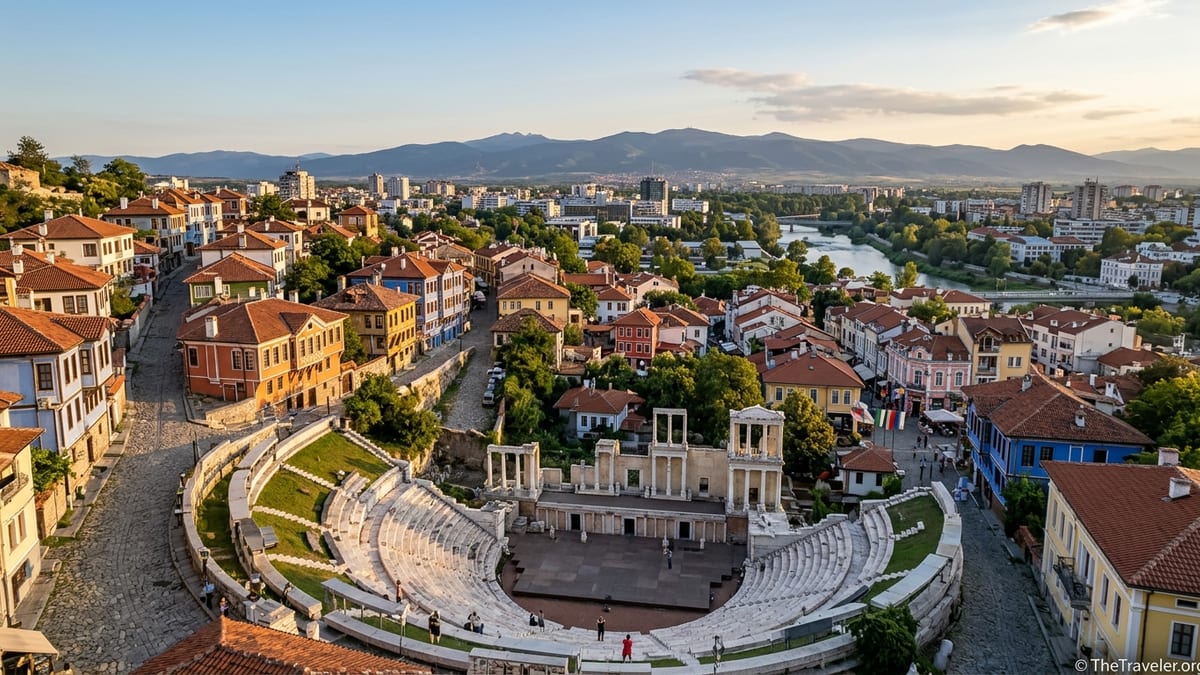
Why Plovdiv Deserves More Than a Sofia Day Trip
Plovdiv’s compact size tempts many visitors to squeeze it into a rushed one-day loop from Sofia. On paper this looks feasible: the journey between the capitals takes roughly 2 hours 30 minutes by train and about 2 hours by direct bus, so tour operators can advertise a whistle-stop itinerary. In reality, travel delays, summer heat and the city’s hilly terrain all eat into your time on the ground. You can easily spend half your “day trip” in transit, leaving only a few hurried hours for its main sites.
What truly argues for a longer stay is the depth of Plovdiv’s heritage. You are not dealing with a single headline monument but with an ensemble of Roman, medieval and Revival era landmarks spread across several hills and districts. The Ancient Theatre, Roman Stadium, Forum and Bishop’s Basilica each merit at least an hour, more if you enjoy interpreting mosaics and architectural details. Add in two or three historic merchant houses in the Old Town plus time to meander the lanes and photograph views and one day quickly feels inadequate.
Evenings are when Plovdiv comes into its own. Locals stroll the central pedestrian streets, cafés spill onto the cobbles of Kapana and the city’s hills turn into open-air viewpoints for sunset over the Maritsa River. Late day light transforms the Roman stones and pastel mansions in a way that a mid-afternoon dash from Sofia cannot capture. Staying overnight lets you see both the quieter early mornings in the Old Town and the after-dark buzz in Kapana.
There is also a practical case for slowing down. Summer temperatures in central Bulgaria can rise above 30 degrees Celsius, sometimes significantly higher, which makes climbing the steep Old Town streets or the trails to Bunardzhik and Sahat Tepe tiring. By spreading your sightseeing over two days you can schedule hill walks and exposed ruins for early morning or late afternoon, retreating to museums and cafés at midday. For travellers who enjoy both history and a relaxed café culture, two days in Plovdiv, plus a third for day trips, is a far more satisfying plan than a single rushed visit.
Getting from Sofia to Plovdiv: Train and Bus Compared
Bulgarian State Railways, known as BDZ, run multiple daily trains between Sofia and Plovdiv. The majority depart from Sofia Central Station, next to the city’s main bus terminal, with some services also calling at suburban stops such as Iskarsko Shose on the way out of the capital. According to recent official rail information, the Sofia to Plovdiv rail journey typically takes around 2 hours 30 to 2 hours 45 on faster services. Slower stopping trains can take over three hours, so it is worth checking the timetable and choosing “fast” or “express” categories where possible.
Fares on this route remain one of the bargains of Bulgarian travel. Public information from Bulgarian authorities in late 2024 indicated a standard one-way second class ticket around 12 Bulgarian lev for Sofia to Plovdiv, which is roughly 6 euros at current exchange rates. While the exact figure can change with new tariffs, it gives a reliable order of magnitude. First class supplements are modest, often only a few euros more, and many travellers are content with second class, which offers simple but functional carriages. Seat reservations are usually not compulsory on ordinary fast trains, but can be a good idea in high season or on Friday and Sunday evenings.
Intercity buses provide an alternative that is both frequent and fast. Direct services run from Sofia Central Bus Station to Plovdiv’s bus terminals with several operators. Current timetables for 2026 on the official Central Bus Station system show multiple departures through the day with journey times around 2 hours to 2 hours 20 minutes. For example, a morning bus operated by a major company such as Karat-S or Union Ivkoni is scheduled to leave Sofia Central Bus Station around 08:10 and arrive in Plovdiv about 10:30. Recent price listings for these services show one-way fares generally in the range of 9 to 11 euros, depending on the operator and exact route.
The choice between train and bus comes down to priorities. Trains offer a more spacious, scenic ride and are less affected by highway traffic, but BDZ rolling stock can be older and air conditioning is not always guaranteed to be strong on very hot days. Buses tend to be modern coaches with effective climate control and onboard Wi-Fi on some services, and they run more frequently in the middle of the day and later into the evening. However they are dependent on motorway traffic around Sofia and can face delays at peak times or during roadworks. For most visitors, the marginally higher price of the bus compared with the train is offset by the slightly shorter journey and the ease of booking at the Central Bus Station ticket counters or online in advance.
Arriving in Plovdiv: From Station to Historic Center
Plovdiv Railway Station sits on the south side of the city, about 1.5 kilometres from the central pedestrian streets and roughly 2 kilometres from the heart of the Old Town. Plovdiv’s main bus terminals, including the “Yug” and “Rodopi” stations, are clustered nearby, making this area an intercity transport hub. From here, reaching the historic centre is straightforward and travellers can choose between walking, public buses and taxis depending on luggage and mobility.
The walk from the railway station to Plovdiv’s main pedestrian area typically takes 15 to 20 minutes on level pavements. One common route is to head north along Ivan Vazov Street, which leads directly towards the central underpass by the Roman Stadium. From there you can climb into the Old Town or turn into the Kapana district. This option costs nothing and offers an early look at modern Plovdiv, but it may feel tiring if you are carrying heavy bags or arriving in the heat of the day.
City buses serve the station area, and municipal information shows that a single ticket for local buses within Plovdiv costs around 1 lev, purchased either from kiosks or directly from the driver. Several lines run between the station and the city centre, usually taking around 10 minutes. However, working out exact routes and stops can be confusing for short-term visitors, as stop names and timetables are often only in Bulgarian. For this reason, many first-time travellers find that the minor savings over a taxi are not worth the extra complexity, especially after a long train or bus ride.
Taxis are widely considered the easiest link into town. Official city taxi fares in Plovdiv are regulated and are generally low by Western European standards. Recent local transport guides suggest that a metered ride from Plovdiv Railway Station to the Old Town or Kapana usually costs in the range of 5 to 8 lev, which is about 2.50 to 4 euros, depending on traffic and your exact drop-off point. Look for licensed taxis displaying company names and a visible tariff sticker in the window, and insist on the meter being used. For many visitors, especially those arriving with luggage or in hot weather, this short taxi hop offers the best value for time and comfort.
Roman Plovdiv and Old Town Highlights: Tickets and Practicalities
Plovdiv’s signature attraction is the Ancient Theatre, a dramatically sited Roman theatre cut into the slope of Taksim Tepe in the Old Town. It still hosts concerts and performances, but outside event times it functions as a regular archaeological site with set opening hours. Municipal ticket information for 2026 indicates that individual admission to the Ancient Theatre is around 10 lev for adults, with concessions for students and seniors. Opening hours vary slightly by season but typically cover daylight hours from morning until late afternoon or early evening. During major performances, tourist access can be restricted, so visitors who particularly want daytime photos of the empty seats should check locally for event schedules.
Running beneath Plovdiv’s main pedestrian street is the Roman Stadium, a long chariot-racing track whose northern end has been excavated at Dzhumaya Square. Much of the stadium remains buried under modern buildings, but the open section is free to view from the square, and a small underground interpretation area offers displays and audiovisual material. Entry to this underground section requires a ticket, which is modestly priced, but budget-conscious travellers can still appreciate the scale of the stadium from the street-level viewpoints at no cost.
South of the present-day centre lie the remains of the Roman Forum, the civic heart of ancient Philippopolis. Sections of colonnades, paving and foundations are visible in open-air spaces adjacent to modern roads. At the time of writing, these forum ruins are freely accessible to walk around, effectively functioning as a public archaeological park. This makes them an excellent stop for travellers watching their budget, and a reminder that substantial parts of ancient Plovdiv are integrated into the living city rather than fenced off behind ticket booths.
The Bishop’s Basilica of Philippopolis, which opened to the public in 2021 after an extensive conservation project, showcases some of the finest early Christian mosaics in the Balkans. The two-level museum space uses raised walkways and lighting to reveal intricate bird and geometric designs. Official municipal and museum information in 2025 and 2026 shows adult tickets priced around 18 lev, with discounted rates for students and free or reduced entry for young children. Nearby, the Small Early Christian Basilica also preserves impressive floor mosaics and can be visited separately or as part of a combined ticket with other sites in the Old Plovdiv network.
Historic Merchant Houses, Combination Tickets and Free Views
Plovdiv’s Old Town spreads across several hills, most notably Nebet Tepe and the slopes of Dzhambaz and Taksim Tepe, and is known for its richly decorated nineteenth century merchant houses. Several of these mansions operate as museums under the Municipal Institute Old Plovdiv. Examples include the Balabanov House with its wood-carved ceilings, the Hindliyan House with painted interior fountains and the Kuyumdzhioglu House, which houses the Regional Ethnographic Museum. Each offers a glimpse into the lifestyle of wealthy Bulgarian merchants during the National Revival period.
To simplify admissions, Old Plovdiv operates combined ticket schemes. Official ticket information for the Old Town confirms that visitors can purchase a combined ticket that covers a set number of house museums at a reduced total price compared with buying individual entries. Although exact combinations and prices are periodically updated, recent data suggest that a combined ticket for several house museums and selected historic buildings costs in the region of 20 lev for adults. Another type of combined ticket focuses on late antique and early Christian sites, including the Small Basilica, the Bishop’s Basilica and related buildings. Travellers who plan to visit at least two or three of these attractions generally save money by opting for a combination ticket, provided they check current details at the first site they enter.
Nebet Tepe, the highest point of the Old Town, offers one of Plovdiv’s most atmospheric viewpoints. Here you can walk among low stone walls and foundations from Thracian, Hellenistic and Roman fortifications, with panoramic views over the city and the Maritsa River plain. As of late 2026, there is no standard admission charge to access the main open-air ruins on Nebet Tepe, though there may be occasional fenced excavation areas. The lack of a ticket barrier makes this hilltop an ideal place for budget travellers to experience Plovdiv’s deep history and sunset views without extra expense, though the uneven rocky surfaces require good footwear.
Not all historic houses or church interiors in the Old Town require payment. Some smaller churches and galleries invite voluntary donations or have very small entry fees, and simply walking the cobbled lanes offers constant architectural rewards: projecting upper stories, ornate woodwork and bright facades in ochre, blue and terracotta. The trade-off is that the steep gradients and irregular cobblestones can be demanding, particularly for visitors with limited mobility. Planning frequent café stops and allocating a generous half day to the Old Town reduces the feeling of rushing between paid sights and allows you to enjoy the streets as an attraction in their own right.
Kapana and the Seven Hills: Atmosphere, Walks and Accessibility
Kapana, just west of the Roman Stadium and below the Old Town, has transformed in recent years from a fading craftsmen’s quarter into a creative district of cafés, bars, small galleries and design shops. Low-rise nineteenth and early twentieth century buildings house independent businesses selling artisan chocolate, craft beer, ceramics, local fashion and graphic design. In the evenings, outdoor tables spill into narrow pedestrian lanes strung with colourful flags, and the area becomes one of Plovdiv’s liveliest social hubs. For example, you might have a morning espresso in a minimalist coffee bar, browse a shop selling Bulgarian-made cosmetics and stationery, then return at night for dinner at a bistro and live music at a small bar.
Compared with the Old Town, Kapana’s streets are mostly flat or gently sloping, with smoother paving that is kinder on knees and luggage wheels. The atmosphere is more contemporary and urban, with street art, creative studios and co-working spaces mixing with restaurants. Noise levels can rise sharply at weekends and during festivals, when music and conversation continue until late. Travellers who want to experience Plovdiv’s nightlife and café culture up close often prefer to stay here, while those seeking quieter evenings may opt for accommodation just outside the densest cluster of bars or further into the Old Town.
Plovdiv is also known as the city of seven hills, although quarrying reduced the height of some over time. Two of the most accessible and rewarding for visitors are Bunardzhik and Sahat Tepe. Bunardzhik Hill, crowned by a towering monument and parkland, lies west of the centre. A typical walk from the main pedestrian street to the top takes around 30 to 40 minutes, with a mix of paved paths and stairs and a steady but manageable gradient. From the summit you can enjoy 360-degree views that include the Old Town hills and the distant Rhodope Mountains. Many locals and visitors time their climb for the golden hour before sunset, when temperatures are lower and the city lights begin to glow.
Sahat Tepe, also known as the Clock Tower Hill, rises just north of the Old Town and is a little shorter but still offers fine views towards Kapana and the modern city. The ascent from the surrounding streets usually takes 15 to 20 minutes on paved paths, with fewer stairs than Bunardzhik. For visitors with mobility limitations, neither hill is fully accessible by vehicle right to the summit, but taxis can drop you at higher starting points on the slopes, shortening the walk. Alternatively, some travellers choose to experience elevated views from easier vantage points in the Old Town, such as terraces near the Ancient Theatre or the open areas of Nebet Tepe, which, while uneven underfoot, require less sustained climbing than the larger hills.
Two and Three Day Itineraries: City Sights and Day Trips
A practical two-day plan groups Plovdiv’s sights by geography to minimise backtracking and steep climbs at the hottest times. On Day One, focus on Roman and early Christian sites plus Kapana. Start in the morning at the Bishop’s Basilica of Philippopolis, when it is cooler and less crowded, spending at least an hour exploring the mosaics. Walk north to the Roman Forum ruins, then continue towards the central pedestrian street for lunch in or around Kapana. In the afternoon, visit the Roman Stadium, including the free views at Dzhumaya Square and, if you wish, the small underground exhibition. Linger in Kapana’s cafés and shops before dinner, then finish the day with an evening drink on an outdoor terrace.
Day Two can concentrate on the Old Town and hilltop views. Begin with the Ancient Theatre before the tour groups and strong midday sun. From there, wander deeper into the Old Town to visit two or three house museums covered by a combination ticket, such as the Balabanov House and the Ethnographic Museum. Allocate time for a slow lunch at a restaurant with a courtyard or terrace, then make your way up to Nebet Tepe in the late afternoon for panoramic views, staying through sunset if the weather is clear. If you still have energy, an evening stroll back down into Kapana or along the main pedestrian street gives a final taste of contemporary Plovdiv.
With an optional third day, you can either explore additional museums and galleries in Plovdiv or take a day trip into the nearby Rhodope foothills. Two classic excursions are Bachkovo Monastery and Asen’s Fortress. Buses from Plovdiv’s “Rodopi” bus station run to Bachkovo village, stopping near the monastery, with journeys of under an hour and modest fares stated in recent timetables. From Bachkovo, you can continue a short distance by bus or taxi towards Asenovgrad and then Asen’s Fortress, though coordinating public transport schedules for both sites in a single day requires some planning. Some travellers choose to focus on just Bachkovo by bus and leave Asen’s Fortress for another visit.
For a more relaxed and flexible day trip that combines both Bachkovo Monastery and Asen’s Fortress, a rental car or private driver is often the most convenient option. Driving times from Plovdiv are roughly 30 minutes to Asenovgrad and then a short additional climb to the fortress, followed by another 15 to 20 minutes to Bachkovo. A private transfer or organised tour can collect you from your hotel and manage parking and timing, which is particularly helpful if you are travelling in a small group or in the hotter months. Independent budget travellers with time and patience can manage with local buses, while those prioritising convenience and comfort may prefer to factor the cost of a car or driver into their plans for the third day.
Where to Stay and What It Costs in Late 2026
Plovdiv’s accommodation choices cluster in four main areas: Kapana, the Old Town, the central pedestrian zone and the broader area around the railway station. Each offers a different balance of atmosphere, noise, terrain and price. In Kapana, you will find stylish boutique hotels, serviced apartments and guesthouses above cafés and bars. Rooms here often command mid-range prices, reflecting the district’s popularity and central location. The upside is being able to step directly into the nightlife and dining scene. The downside is potential late-night noise, especially on weekends and during events, so light sleepers should check guest reviews carefully and request rooms facing inner courtyards where possible.
In the Old Town, accommodation ranges from small heritage hotels in renovated merchant houses to simple guest rooms in traditional buildings. The ambiance is romantic, with cobbled lanes, period architecture and quieter evenings once day-trippers leave. However, the steep streets and uneven surfaces mean that rolling heavy suitcases can be challenging, and taxis may not be able to drop you directly at the door of some properties. Prices are often comparable to or slightly higher than similar-quality options in the modern centre, reflecting the unique setting. Couples and history enthusiasts who do not mind daily climbs often find this area the most rewarding place to stay.
The central pedestrian area between the Roman Stadium and the main underpass offers a practical middle ground. Here you will find contemporary hotels, business-style properties and apartments just off the main shopping streets. Noise is moderate rather than extreme, with some traffic and nightlife but less intense than Kapana’s busiest corners. Walking access to both the Old Town and Kapana is excellent and largely flat, which is advantageous for travellers with joint issues or heavy luggage. Room rates span from budget to upper mid-range depending on standard and brand, and this area usually provides the best choice for families or visitors who value convenience over historic architecture.
Near the railway and bus stations, accommodation skews towards budget and functional options. These hotels and guesthouses are handy for early departures or late arrivals and can sometimes be a little cheaper than equivalents in the centre. The trade-offs include a less atmospheric urban environment and the need to walk or take a short taxi ride to reach the main sights. For a typical two-night stay in Plovdiv in late 2026, international booking data show that mid-range double rooms in central areas often fall in the rough range of 55 to 90 euros per night, while simple guesthouses and budget hotels can be found for around 35 to 50 euros per night if booked in advance outside the busiest festival dates.
Budgeting, Practical Tips and Who Will Love Plovdiv
Building a realistic budget helps set expectations. As of November 2026, Bulgaria uses the lev as its currency, with an exchange rate close to 1 euro for just under 2 lev. For a mid-range traveller, a reasonable daily budget in Plovdiv might include 60 to 70 euros for a central double room, 10 to 15 euros per person for casual lunches and café stops, 15 to 25 euros per person for dinner with drinks, and around 10 to 20 euros per person for admissions to museums and archaeological sites, depending on how many combination tickets you buy. Local public transport within Plovdiv is inexpensive, with single bus tickets around 1 lev, and a few short taxi rides per day may add another 5 to 10 euros to your costs. Intercity travel between Sofia and Plovdiv by train or bus will typically add roughly 10 to 15 euros each way per person to your overall trip budget.
Climate and terrain shape the on-the-ground experience. Summers can be intensely hot, particularly in July and August, when stone pavements and ruins radiate heat. Visiting in late spring or early autumn brings milder temperatures and softer light, but if summer is your only option, aim for early starts, long midday breaks and plenty of water. Footwear is crucial: the Old Town’s cobbles, Nebet Tepe’s rocky surfaces and the paths up Bunardzhik and Sahat Tepe all call for sturdy, closed shoes rather than sandals with smooth soles. Travellers with mobility challenges should anticipate that some parts of the Old Town and hilltop viewpoints will be difficult or impossible to access and may prefer to focus on flatter areas such as the central pedestrian streets, Kapana and the Bishop’s Basilica, which is housed in a modern, accessible building.
History enthusiasts will find Plovdiv particularly rewarding. Few cities allow you to stand in a Roman theatre still used for concerts, walk along the footprint of a stadium beneath a modern shopping street, explore early Christian mosaics and then climb through layers of medieval and Revival era architecture in such a small radius. Couples often appreciate the combination of romantic hilltop sunsets, atmospheric restaurants in the Old Town and lively evenings in Kapana, while budget travellers benefit from reasonably priced food, low-cost public transport and free access to several major viewpoints and open-air ruins.
For visitors combining Plovdiv with Sofia, the two cities complement rather than duplicate each other. Sofia offers a national museum network, large parks and a broader range of international dining, while Plovdiv feels more intimate, walkable and rooted in its ancient topography. Many travellers choose to spend three or four nights in Sofia and at least two in Plovdiv, travelling between them by bus or train as described earlier. Approached this way, Plovdiv becomes not a hurried add-on but a highlight in its own right, a place where the deep past and present-day creative energy coexist on the same sunlit hills.