


More news on this day
Poland is moving to introduce a nationwide cadenced, or clockface, train timetable, a structural shift in how rail services are planned and operated that is expected to simplify travel, boost passenger numbers and align the country more closely with leading European rail markets.
Get the latest news straight to your inbox!
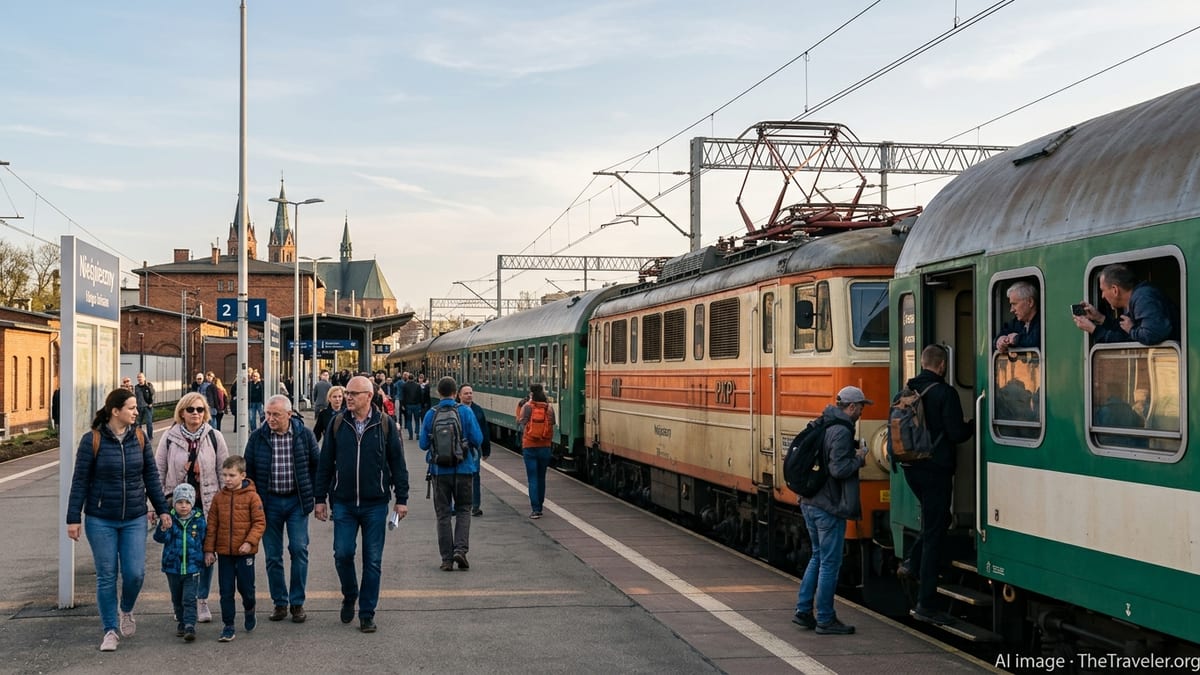
From Fragmented Schedules to a Fixed Rhythm
For years, Poland’s rail network has expanded rapidly in terms of routes and modern rolling stock, but timetables often remained irregular, with long distance and regional trains departing at varying minutes past the hour and limited coordination between operators. Publicly available information now indicates that this patchwork approach is giving way to a cadenced system in which trains on key routes are planned to depart at the same minutes every hour, or every two hours, throughout the day.
The shift is framed around the concept of a nationwide “Horizontal Timetable,” designed jointly by Centralny Port Komunikacyjny, the Ministry of Infrastructure and infrastructure manager PKP Polskie Linie Kolejowe. Descriptions of the project emphasize a regular-interval pattern for long distance and interregional trains, designed to create a web of predictable connections across hubs such as Warsaw, Łódź, Poznań, Wrocław and Kraków.
In practice, a cadenced timetable means that if a fast train from Warsaw to Kraków leaves at, for example, 10 minutes past the hour, the next services are scheduled at the same minute each subsequent hour. Regional networks in Warsaw and other metropolitan areas already use this logic on many lines, and national planners are now extending the principle to the broader long distance network.
The move brings Poland in line with countries such as Switzerland and the Netherlands, where regular interval schedules are considered a backbone of rail planning. Analysts note that while Poland’s infrastructure has been upgraded significantly, the timetable reform is what can turn hardware investment into a coherent, user friendly system.
Horizontal Timetable and the High Speed “Y” Corridor
The new cadenced approach is closely linked with upcoming high speed corridors, particularly the so called “Y” line connecting Warsaw, Łódź, Poznań and Wrocław. Planning documents and expert commentary suggest that this axis will operate on a tight, repeating pattern of express and semi fast trains, forming the spine of the nationwide timetable.
On the core sections between Warsaw and Łódź, and further west toward Poznań and Wrocław, planners are working with assumptions of multiple trains per hour in each direction, slotted into regular paths. This makes it easier to align feeder services from regional centers, increasing the number of convenient, short transfer times at interchange stations.
The Horizontal Timetable concept is also intended to open the market for more international and long distance operators, including cross border connections to Germany, the Czech Republic and beyond. A predictable, published pattern of train paths can lower barriers to entry for new services, as operators can see where their trains would fit in the national plan.
According to published coverage, the cadenced framework is being prepared alongside the 2025 to 2026 annual train timetable, with successive cycles of temporary adjustments for engineering works layered on top. The long term objective is a robust baseline pattern that survives seasonal changes and construction phases.
What Cadenced Service Means for Passengers
For travelers, the most immediate change is expected to be simplicity. Instead of checking detailed departure boards for every journey, passengers will be able to rely on easy to remember patterns, such as departures at the same minutes past each hour for major routes. Tourism platforms already highlight Poland’s improving rail offer, and a clockface timetable is likely to become a key selling point for visitors planning multi city trips.
A cadenced network also improves the chances of fast, reliable transfers. When regional trains are scheduled to arrive a few minutes before long distance services at fixed times each hour, missed connections become less common and alternative options are easier to understand. This is particularly important at new or expanded hubs linked to the planned central airport project, where air rail integration is being designed around rail punctuality and frequency.
Public information from operators shows that elements of such regularity are already present in metropolitan areas. In Warsaw, for example, suburban and urban rail services often run every 30 or 60 minutes on consistent minutes past the hour, while some lines reach frequencies of 15 minutes at peak times. Extending this logic nationwide aims to give passengers similar predictability whether they are commuting into a city or traveling several hundred kilometers across the country.
Travel industry observers note that a clearer structure can also encourage advance ticket purchases and help rail compete more directly with domestic aviation, especially on routes under four hours. As infrastructure upgrades shorten journey times, the combination of speed and regularity is seen as critical to shifting more trips from road and air to rail.
Operational and Infrastructure Challenges
Implementing a nationwide cadenced timetable is complex. Polish rail infrastructure remains a mix of modernized high speed sections and older, capacity constrained lines undergoing renovation. Infrastructure managers must fit a repeating pattern of passenger trains around freight services and long term engineering works, while keeping room for seasonal and occasional trains.
Network statements for the 2025 to 2026 timetable period outline a detailed calendar of construction phases and temporary traffic arrangements, which must be reconciled with the new regular interval structure. Planners need to ensure that even when tracks are partially closed, the perceived rhythm for passengers survives, possibly through rerouting or replacement services that honor the same departure minutes where feasible.
The cadenced model also places demands on rolling stock and crew deployment. Regular intervals at higher frequencies require more trains ready to depart at precise times, with tight turnaround at terminal stations. Passenger oriented timetable design needs to be balanced against constraints such as maintenance windows and depot locations.
Experts point out that some areas of the network may initially see partial implementation, with a hybrid of cadenced and non cadenced services, especially on regional lines with lower demand. Over time, as infrastructure upgrades progress and demand grows, more routes are expected to be brought into the fixed rhythm structure.
Positioning Poland in the European Rail Landscape
By embracing cadenced scheduling, Poland is positioning itself closer to the European rail systems often cited as models of integration and reliability. The reform aligns with European Union policy objectives that encourage rail to absorb more passenger demand as part of climate and mobility strategies.
For neighboring countries, a more predictable Polish timetable may facilitate better cross border planning. Operators in Germany, the Czech Republic, Slovakia and the Baltic region can synchronize their own services with Polish nodes when departure and arrival minutes are stable over the day and across the year.
For domestic travelers, the change could mark a cultural shift in how rail is perceived. Instead of consulting detailed timetables or ticketing platforms for each trip, many journeys could be planned with rules of thumb such as “there is a fast train every half hour” or “the regional connection leaves on the hour.” This is the hallmark of matured cadenced systems in Western Europe, and Polish planners are now working to replicate that experience.
As the 2025 to 2026 timetable period approaches, further details of specific lines and frequencies are expected to be reflected in the annual schedules of operators across the country. For visitors and residents alike, the arrival of a fixed rhythm on Polish rails is set to be one of the most visible changes in how the country moves.