


More news on this day
Poland’s largest regional rail operator, Polregio, carried nearly 51 million passengers in the first six months of 2026, according to industry reports, underscoring the strength of the country’s fast‑growing everyday rail market.
Get the latest news straight to your inbox!
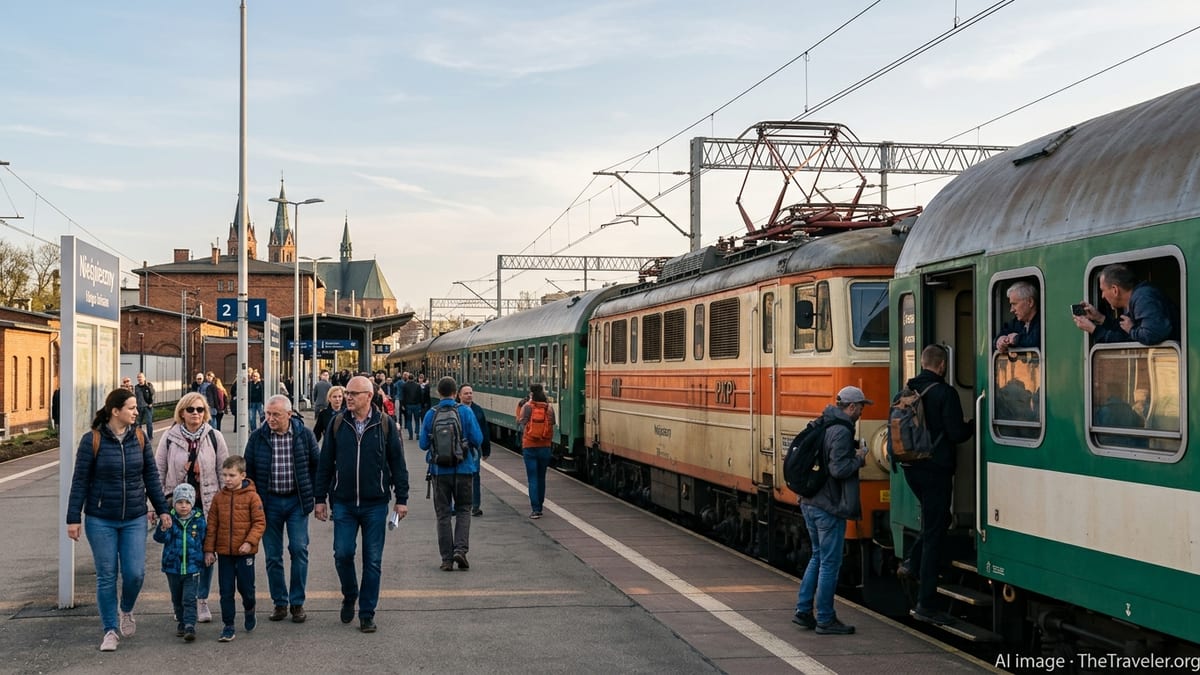
Half‑year milestone for Poland’s biggest regional carrier
Specialist rail coverage in Poland indicates that Polregio trains were used by almost 51 million passengers between January and June 2026. The figure marks one of the strongest half‑year results in the operator’s history and places it among the leading regional carriers in Europe by volume.
Polregio, which operates local and interregional services under contracts with 15 of Poland’s 16 provincial governments, has been a central player in shifting everyday travel from road to rail. Publicly available data from previous years shows that the company carried more than 100 million passengers in 2025, giving it a market share of more than one fifth of all rail journeys nationwide.
The latest half‑year result suggests that Polregio is broadly on track to match or modestly exceed last year’s full‑year total if demand holds through the busy summer and autumn timetable periods. Rail analysts in the Polish press note that regional operators now account for the majority of rail journeys in the country, ahead of long‑distance brands.
Industry commentary frames the Polregio milestone as part of a wider pattern in Central and Eastern Europe, where investment in rolling stock and infrastructure is translating into rapid growth for public transport on densely populated regional corridors.
Regional contracts and dense service patterns drive growth
Polregio’s half‑year passenger total is closely linked to the way regional rail is organised in Poland. Since the liberalisation of the sector, provincial authorities have been responsible for planning local services and contracting operators, a model that has led to dense, timetable‑based regional networks focused on commuting and short‑distance travel.
The operator runs hundreds of trains each day across most of Poland’s voivodeships, serving both major regional capitals and smaller towns that lack strong intercity links. Reports highlight particularly high volumes on routes in the Pomeranian region, where frequent services connect coastal destinations and commuter belts with Gdansk and Gdynia, especially during the summer season.
Under public service contracts, Polregio receives budget support from regional authorities in exchange for maintaining agreed levels of frequency, capacity and ticket integration with local transport systems. This framework has supported a steady build‑up of services and has helped maintain ridership even on routes where commercial operation alone would be challenging.
Observers of the Polish market point out that the regional model has also encouraged competition and specialisation, with several voivodeships creating their own branded rail companies while still relying on Polregio for large parts of the network.
Passenger boom reshapes Poland’s rail landscape
The near‑51‑million result for Polregio comes against the backdrop of record rail usage across Poland. Public statistics for recent years show that national rail ridership has climbed to its highest levels since the mid‑1990s, driven by a combination of improved timetables, new trains and rising fuel and road‑use costs for private motorists.
While long‑distance carrier PKP Intercity has reported its own record half‑year totals, regional and agglomeration services still account for the clear majority of journeys. Regional operators such as Koleje Mazowieckie, Koleje Dolnośląskie and other voivodeship‑owned companies have all reported strong year‑on‑year gains, reinforcing the role of rail as a daily transport mode rather than an occasional option.
For Polregio, serving a wide geographic footprint means that growth in one part of the country can offset softer demand elsewhere. Industry analysis notes that suburban expansion around major cities, tourism to coastal and mountain regions, and renewed services on previously underused lines are all contributing to higher passenger numbers.
The shift has implications for capacity planning, with regional trains now heavily used not only during weekday peaks but also on weekends and holidays. This pattern has required operators to adjust rolling stock deployment and, in some cases, lengthen trains or add extra departures.
Investment in rolling stock and regional infrastructure
Reports on the Polish rail market emphasise that rising demand is being supported by significant investment in trains and infrastructure. Polregio has been renewing and modernising its fleet, introducing electric multiple units with better acceleration, air conditioning and accessibility features compared with older rolling stock.
Parallel to fleet upgrades, national and regional programmes are funding track renewals, station refurbishments and signalling improvements. These projects aim to remove long‑standing speed restrictions, shorten journey times and make smaller stations more attractive through better platforms, lighting and passenger information systems.
In several regions, previously dormant or freight‑only lines have been reactivated for passenger use, expanding Polregio’s potential catchment. Such reopenings often begin with modest service levels but can see rapid growth once reliable, clock‑face timetables are in place and integrated ticketing makes transfers straightforward.
Analysts caution that infrastructure works also bring temporary disruption, as line closures and diversions affect punctuality and capacity. However, the general assessment in specialist coverage is that the upgrades are a prerequisite for sustaining the higher ridership levels now being recorded by regional operators.
Future prospects and challenges for regional rail
Looking ahead, industry observers expect Polregio’s passenger numbers to remain high, but point to several challenges that could influence growth in the coming years. Chief among them are funding stability for regional contracts, the rising cost of energy and labour, and the need to align timetables with new or upgraded main lines.
Competition from other modes is also evolving. Intercity coach operators and new open‑access rail entrants have increased options for longer‑distance travel, while private car use remains strong, especially in areas where road upgrades have outpaced rail modernisation. Regional rail will need to maintain a clear advantage in reliability and total journey time to continue attracting new passengers.
At the same time, climate and energy policies at both national and European level are pushing governments to prioritise rail over road transport. Observers suggest that this political and financial backing, combined with the proven appetite for train travel in Poland, creates a favourable environment for further expansion of regional services.
For now, the near‑51‑million passengers recorded by Polregio in just six months highlight how far Poland’s regional rail has come from a period of decline to become a backbone of everyday mobility, and a reference point for other countries seeking to rebuild local rail networks.