


More news on this day
Arriving flights into Austin–Bergstrom International Airport are facing new delays after the Federal Aviation Administration put a ground delay program in place, citing ongoing runway and taxiway construction that is temporarily constraining the airport’s capacity.
Get the latest news straight to your inbox!
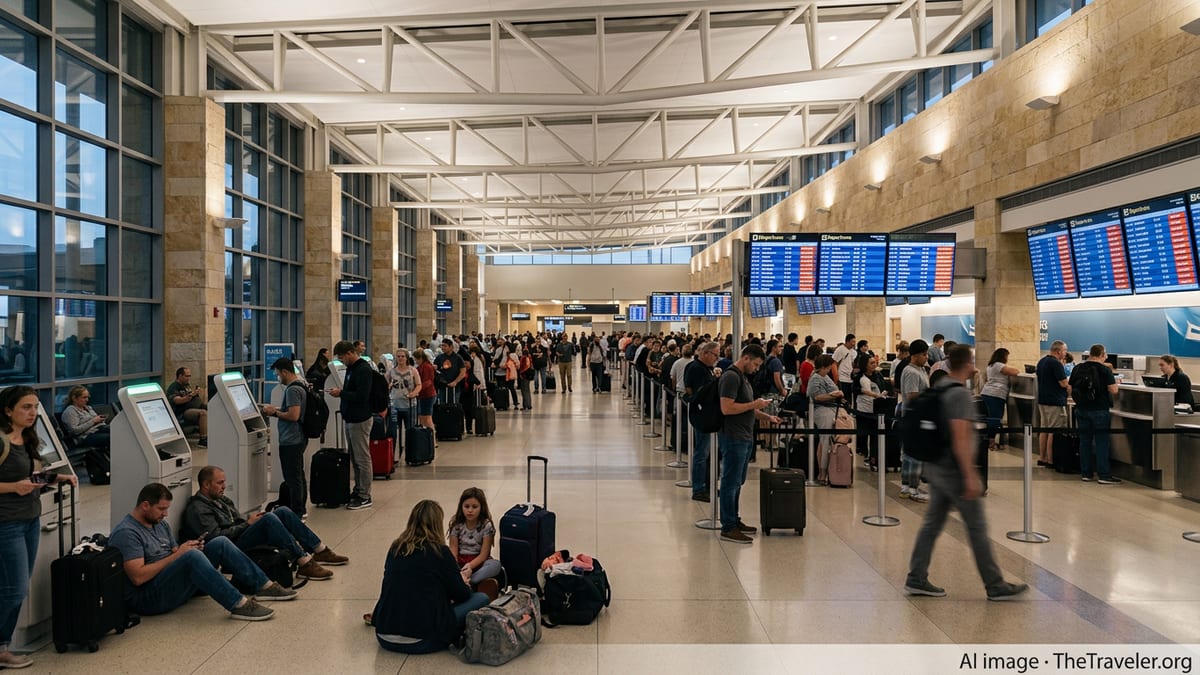
Runway Work Triggers Arrival Metering at AUS
Publicly available FAA air traffic management data shows that a ground delay program is in effect for Austin–Bergstrom International Airport, requiring many departing flights bound for Austin to hold at their origin until assigned arrival slots become available. The program is being used to manage traffic flows while active construction limits how many aircraft can land and taxi safely at one time.
Ground delay programs are a standard tool used by the national air traffic system when an airport’s capacity is temporarily reduced by factors such as runway and taxiway closures, weather, or equipment limitations. In Austin’s case, construction related to airfield improvements is reducing the number of available arrival paths and the flexibility controllers normally have to sequence aircraft.
FAA documentation on construction-related risks notes that runway and taxiway projects can increase the potential for congestion on the ground, especially where there are already limited parallel taxi routes or where work zones reduce usable pavement. Under these conditions, metering inbound flights through a ground delay program is one of the preferred methods to prevent gridlock and maintain safe spacing between aircraft.
Real-time status information on the FAA’s public dashboard indicates that delays at Austin currently average in the tens of minutes for some arrivals, with impacts varying by airline and route as the program assigns specific departure times from origin airports.
Capacity Constraints at a Fast-Growing Airport
Austin–Bergstrom has been operating under sustained growth pressure, with passenger volumes and flight schedules expanding faster than the airfield and terminal footprint were originally designed to handle. City and airport documents describe an ongoing multi-year expansion initiative aimed at adding gates, new taxiways, and a midfield concourse to accommodate future demand.
As part of that broader “Journey With AUS” program, airport construction updates detail a series of overlapping projects on and around the airfield, including new taxiways and related infrastructure designed to improve how aircraft move between runways and gates. While these upgrades are intended to increase long-term capacity, they can temporarily reduce the number of available routes aircraft can use to enter and exit the runway system.
FAA construction planning materials emphasize that when portions of key taxiways are closed or narrowed, airports often experience a measurable reduction in throughput, even if primary runways remain open. With Austin’s two-runway layout and a developing network of taxiways, any closure or restriction on critical pavement can quickly translate into longer taxi times, runway occupancy, and constrained arrival rates.
Recent federal infrastructure funding announcements also highlight Austin among the airports pursuing significant capital projects. These initiatives include work on airfield safety areas, new taxiways, and related improvements that require careful coordination between airport operators and the national airspace system to manage day-to-day traffic impacts.
How the Ground Delay Program Works for Passengers
Under a ground delay program, flights headed for the affected airport are assigned controlled departure times from their origin locations, based on calculated landing slots at the destination. This approach is intended to keep aircraft on the ground at the departure airport rather than holding in airborne queues near Austin, which conserves fuel and reduces congestion in the skies around the city.
Published FAA guidance explains that these programs rely on a dynamic assessment of how many arrivals an airport can safely handle per hour under the current constraints. For Austin, runway and taxiway construction reduces that number relative to normal operations, so the system spaces out flights accordingly. If conditions improve or work phases shift during the day, the parameters of the program can be adjusted.
For travelers, the most visible effect is that flights to Austin may depart later than originally scheduled, even when weather appears clear at both ends of the trip. Airlines typically reflect these changes in their departure boards and mobile apps as traffic management or air traffic control delays. Once airborne, flights subject to a ground delay program generally proceed directly to Austin without additional lengthy holding patterns.
While average delays reported for Austin at present are modest by national standards, the cumulative effect can still ripple through tightly timed connections and evening bank schedules. Travelers connecting through Austin or departing from the airport later in the day may encounter knock-on delays as aircraft and crews arrive behind their original timetable.
Construction Phasing and Safety Considerations
According to FAA runway construction guidance, major airfield projects are typically divided into multiple phases in order to keep at least one primary runway and associated taxi routes open whenever possible. Each phase is associated with a set of Notices to Air Missions (NOTAMs) and updated airport diagrams so pilots and dispatchers can plan for closed intersections, altered taxi paths, and temporary markings.
For Austin, federal documents related to its expansion and development program reference a combination of taxiway additions and pavement rehabilitation designed to strengthen safety margins and reduce the likelihood of future bottlenecks. The construction now underway forms part of a broader strategy to modernize the airfield after several years in which growth outpaced infrastructure.
National safety reports also point to previous high-profile runway and taxiway incidents at Austin as a factor in the urgency surrounding these improvements. Investigators have highlighted the importance of clear surface markings, modern surveillance technology, and straightforward taxi routing in reducing the risk of runway incursions, particularly during low-visibility or peak-traffic periods.
In that context, the current ground delay measures can be understood as a short-term tradeoff in favor of a more resilient, higher-capacity airfield over the longer term. Keeping arrival flows safely within the reduced capacity limits while construction crews work on or near the movement areas is consistent with standard FAA risk-mitigation practices.
What Travelers Through Austin Should Expect Next
Public forecasts in FAA airport construction outlook documents indicate that airfield work at Austin is structured to continue across multiple construction seasons, with recurring impacts on select taxiways and pavement areas as projects progress. That pattern suggests that episodes of traffic management, including occasional ground delay programs, may recur when particular phases most heavily constrain the airfield.
Airport construction updates advise passengers to allow extra time for parking, check-in, and security during active work periods, noting that roadway and curbside projects can compound the effects of airfield constraints. While today’s ground delay program primarily affects arriving flights, gate availability and aircraft positioning can also have knock-on effects on departures from Austin.
Travelers planning trips into or out of Austin in the coming weeks are encouraged by publicly available guidance to monitor flight status closely with their airlines and to pay attention to any advisories highlighting air traffic control or construction-related delays. The FAA’s delay information pages and the airport’s own construction bulletins provide additional context about the scale and timing of ongoing work.
As construction phases advance and new taxiways and safety improvements come online, capacity at Austin is expected to gradually increase. For now, however, the combination of intensive airfield work and strong travel demand means periodic arrival metering and modest delays are likely to remain part of the travel experience at Central Texas’s primary airport.