


More news on this day
Air travel across Asia faced another turbulent day as real time aviation dashboards and industry monitoring sites reported 4,804 delayed flights and 206 cancellations across major airports, underscoring how quickly congestion and weather patterns can ripple through one of the world’s busiest air corridors.
Get the latest news straight to your inbox!
Data Snapshot Shows Elevated Disruption Across the Region
Aggregated performance tables compiled from live disruption maps and aviation analytics indicate that a cluster of large Asian hubs spent much of the latest reporting period operating with elevated delay shares and pockets of cancellations. Airport disruption indices used by tracking platforms combine the number of delayed flights, the average delay per departure and the volume of cancellations into a composite score, with several Asian airports moving into bands associated with minor to moderate operational problems at different points in the day.
Published coverage drawing on these datasets points to a combined total of 4,804 delays and 206 cancellations recorded across a group of major Asian airports in a single 24 hour snapshot, placing the region firmly among the global hotspots for schedule disruption this month. The figures align with a recent pattern in which Asia Pacific airports have repeatedly contributed a significant share of worldwide delays and cancellations, particularly on peak travel days in late August and early September.
Real time disruption maps for Asia show that performance has not been uniform. Some airports maintained near normal operations with modest delay shares, while others tipped into higher disruption ranges as weather, congestion and airspace constraints combined. As conditions at a handful of big hubs worsened, connecting banks were affected and knock on delays spread to secondary airports around the region.
Jakarta, Delhi, Tokyo and Gulf Hubs Among Key Pressure Points
Recent regional reports highlight Jakarta, New Delhi and Tokyo among the airports most frequently appearing in higher disruption bands. Earlier snapshots this month showed Jakarta’s Soekarno Hatta International Airport contributing more than 200 delays and over 50 cancellations on a single day, the highest cancellation total attributed to a single airport in one dataset. Other monitoring has flagged New Delhi’s Indira Gandhi International Airport as a recurrent pressure point when monsoon storms or low visibility conditions move through northern India, occasionally pushing regional totals above 6,500 delays and hundreds of cancellations in late August.
Tokyo’s Haneda Airport has also featured prominently in recent delay statistics, with compressed departure banks and tight runway sequencing amplifying the impact of even short weather disruptions. Analytics cited in regional travel coverage show that Haneda’s on time performance can degrade quickly when a combination of strong winds, low ceilings or congested airspace limits arrival and departure slots, producing waves of rolling delays that propagate across domestic and international networks.
Gulf and Southeast Asian hubs feeding traffic into and out of Asia have periodically added to the strain. Coverage of recent disruptions notes that weather and air traffic management restrictions around Dubai and Abu Dhabi, as well as storms affecting routes over the Bay of Bengal and South China Sea, have occasionally required rerouting and extended flight times. These changes increase aircraft and crew utilization, reducing the buffer available to absorb unexpected delays elsewhere in the system.
Weather, Congestion and Network Complexity Drive the Numbers
Publicly available information on recent disruption waves points to a familiar mix of drivers behind the 4,804 delays and 206 cancellations. Seasonal weather remains one of the most visible triggers. Monsoon conditions around the Indian subcontinent, thunderstorms over Southeast Asia and typhoon season activity in parts of East Asia all reduce runway capacity and force temporary ground stops or flow restrictions, particularly at tightly scheduled hubs.
At the same time, congestion and infrastructure constraints continue to play a role. Aviation analysts quoted in earlier reporting on Asia Pacific operations have emphasized that traffic growth in several markets has outpaced the expansion of runways, taxiways, stands and air traffic control resources. As a result, many airports operate near capacity for large portions of the day, meaning even modest disruptions can cascade into substantial queues, missed connections and missed slot times.
Network complexity also magnifies the impact of local issues. Major Asian hubs function as connective tissue between Europe, the Middle East, Oceania and North America, so delays on a single bank of flights can reverberate across multiple time zones. Passenger rights organizations and disruption tracking services have noted that tight aircraft rotations and high load factors leave airlines with fewer spare aircraft and crew to recover schedules quickly when weather or airspace constraints intervene.
Impact on Travelers and Emerging Advice for Managing Disruptions
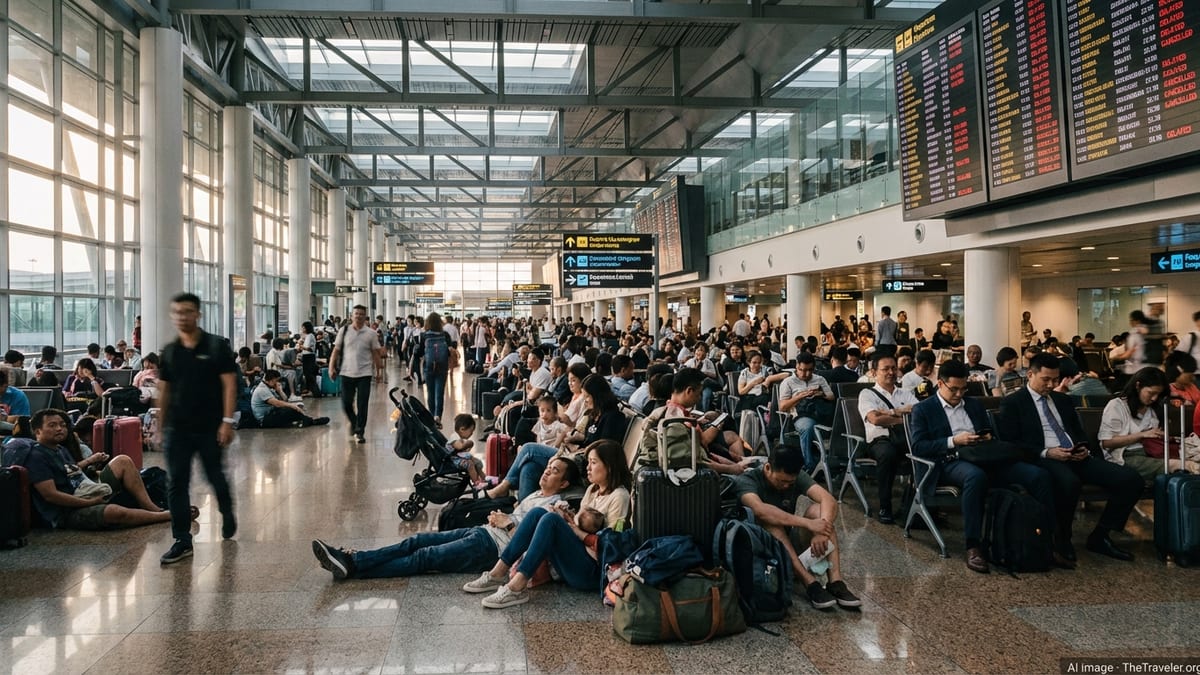
The operational picture translated into a challenging experience for travelers across the region, particularly those relying on tight connections or flying through known bottlenecks during peak hours. Industry coverage describes crowded departure halls, longer queues at transfer and rebooking desks, and increased pressure on call centers and digital customer service channels as passengers sought alternative routings after missed connections.
Recent guidance from travel advisories and passenger advocates focuses on practical steps to reduce exposure to disruption risk on days when delay indicators begin to climb. Recommendations include monitoring flight status repeatedly in the 24 hours before departure, enabling airline app notifications, and building longer connection windows through known congestion points such as Jakarta, New Delhi or key Japanese and Gulf hubs. Some advisories also encourage travelers to consider early morning departures, which tend to be less affected by accumulated delays than evening flights.
Airlines and airports, for their part, have been using data from real time tracking tools and historical performance reports to refine schedules and staffing plans. Industry analyses suggest that more dynamic use of runway configurations, additional contingency staffing in air traffic control and ground handling, and clearer communication protocols with passengers can all help moderate the impact when disruption indices start to rise. While such measures cannot eliminate the effects of severe weather or airspace closures, they can reduce the number of flights that tip from delay into cancellation and shorten overall recovery time.
Asia’s Role in the Global Disruption Picture
The latest figures on 4,804 delays and 206 cancellations sit within a broader pattern in which Asia frequently ranks near the top of global disruption tables on busy travel days. Worldwide airport disruption maps show that the region often contributes a disproportionate share of delayed and canceled flights relative to its already large share of global traffic, particularly when multiple monsoon or storm systems are active.
Comparisons with previous recent events underline both the scale and the recurrence of these episodes. In late August, aggregated statistics cited by travel industry outlets showed more than 3,600 delays and roughly 470 cancellations across 39 Asian airports during one 24 hour period, while other analyses documented disruption days with well over 6,500 delays and more than 450 cancellations when severe weather at a single major hub affected itineraries across the region. Against that backdrop, the current tally of 4,804 delays and 206 cancellations represents another significant, though not unprecedented, spike in operational stress.
Looking ahead to the remainder of the monsoon and typhoon seasons, analytics providers and travel commentators expect Asia’s disruption profile to remain elevated, even as airlines and airports apply lessons from recent episodes. For travelers, the data continues to reinforce a consistent message: flexibility, preparation and close monitoring of flight information are increasingly essential when planning itineraries through the region’s busiest hubs.
Flightradar24 Asia airport disruption map
TheTraveler.org analysis of Asia disruption trends